The Mission 300 Africa initiative has reached a major milestone, providing electricity access to more than 50 million people across 40 African countries. Led by the World Bank Group and the African Development Bank Group (AfDB), the program aims to connect 300 million Africans to electricity by 2030 through a combination of policy reforms, infrastructure investments, renewable energy deployment, and private sector participation.
Key Overview
- More than 50 million Africans have gained access to electricity under Mission 300
- The initiative spans 40 African countries
- Mission 300 aims to connect 300 million people to electricity by 2030
- The World Bank and AfDB have committed nearly US$15 billion in financing
- Approximately US$4.5 billion in co-financing has been mobilized
- Additional development partners have pledged over US$7 billion
- Tanzania and Ethiopia have recorded significant gains in electricity access
- Private sector participation is helping accelerate energy expansion
Mission 300 Brings Electricity to 50 Million Africans
More than 50 million people across Africa have gained access to electricity through the Mission 300 initiative, marking a major step toward addressing one of the continent’s most significant development challenges.
The milestone was announced by the World Bank Group and the African Development Bank Group (AfDB), which jointly lead the initiative. Mission 300 aims to connect an additional 300 million Africans to electricity by 2030 through coordinated investments, policy reforms, infrastructure development, and private sector engagement.
The achievement reflects a significant acceleration in electrification efforts across the continent and demonstrates the impact of collaboration between governments, development finance institutions, investors, and international partners.
Accelerating Electricity Access Across Africa
Despite progress in recent years, Africa remains the world’s largest electricity access deficit region. Limited access to power continues to constrain industrial development, healthcare delivery, education, agricultural productivity, and digital transformation across many countries.
According to the World Bank and AfDB, Mission 300 is now delivering electricity access at nearly twice the pace recorded when the initiative was launched in 2024.
The accelerated progress highlights the effectiveness of aligning financing, policy reforms, and infrastructure investments around country-specific energy priorities.
Tanzania and Ethiopia Lead Progress
Several countries have recorded notable gains under the initiative.
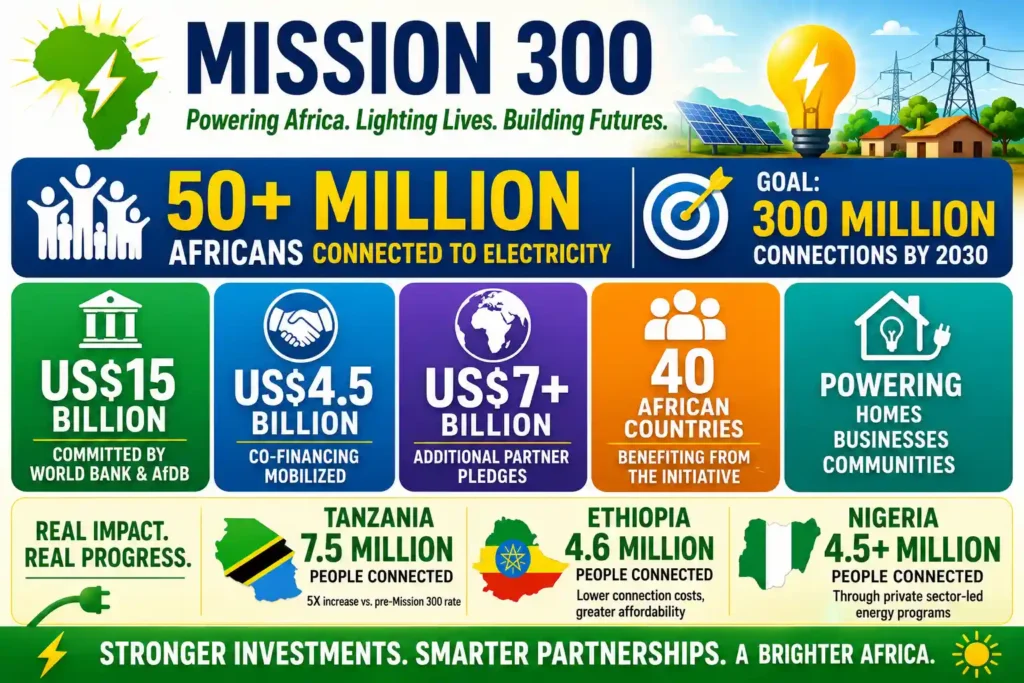
Tanzania has connected approximately 7.5 million people to electricity through Mission 300-supported programs. This represents a five-fold increase compared to the country’s average annual electrification rate prior to the initiative.
Ethiopia has connected around 4.6 million people after implementing reforms designed to lower connection costs and improve affordability for households and businesses.
These examples demonstrate how targeted policy reforms combined with investment can rapidly expand electricity access.
Context is everything. Stay ahead of shifting trends with today’s market updates, and uncover emerging opportunities using the Serrari Group Market Index and Marketplace. Then, take control of your own financial future by exploring our Money & Life Reset Transformation Blueprint ™ to build stronger habits, create better systems, and design a path toward lasting wealth.
Financing Drives Expansion
A key factor behind the initiative’s success has been the mobilization of large-scale financing.
To date, the World Bank Group and the African Development Bank Group have committed nearly $15 billion to Mission 300-related projects.
The initiative has also attracted about $4.5 billion in co-financing from development partners and investors.
In addition, international partners have pledged more than $7 billion to support energy sector development across Africa.
This financing supports investments in power generation, transmission networks, distribution systems, and last-mile connections that bring electricity directly to homes and businesses.
Private Sector Participation Expands
Mission 300 places strong emphasis on private sector participation as a driver of long-term energy access.
The initiative combines public financing tools such as grants, concessional loans, and guarantees with policy reforms that reduce investment risks and encourage private companies to serve previously underserved communities.
Nigeria provides a notable example of this approach.
More than 4.5 million Nigerians have gained access to electricity through private sector-led initiatives supported by public financing and development partner programs.
Officials say this model is helping create commercially sustainable electricity markets while expanding access to reliable power.
National Energy Compacts Gain Momentum
An important component of Mission 300 is the development of National Energy Compacts.
These country-led plans are designed to strengthen energy systems, increase affordable electricity generation, expand renewable energy deployment, promote regional energy integration, and encourage private investment.
So far, 30 African countries have launched National Energy Compacts under the initiative.
Additional compacts are expected from Burkina Faso, the Central African Republic, Djibouti, Gabon, Rwanda, and Uganda.
The compacts help align national priorities with financing and investment opportunities while creating clear roadmaps for expanding electricity access.
Outlook
The achievement of connecting more than 50 million people to electricity demonstrates the growing momentum behind Mission 300 and its goal of delivering power access to 300 million Africans by 2030. With billions of dollars already committed and additional financing continuing to flow into the sector, the initiative is helping accelerate energy infrastructure development across the continent.
As governments, development partners, and private investors continue working together, Mission 300 could become one of Africa’s most transformative energy programs, improving livelihoods, supporting economic growth, expanding renewable energy access, and strengthening long-term energy security for millions of people.
FAQs
Q1: What is Mission 300?
Mission 300 is a joint initiative led by the World Bank Group and the African Development Bank Group (AfDB) that aims to connect 300 million Africans to electricity by 2030 through investments, policy reforms, and private sector participation.
Q2: How many people have gained electricity access through Mission 300?
More than 50 million people across 40 African countries have gained access to electricity under Mission 300, marking a significant milestone in Africa’s electrification efforts.
Q3: How is Mission 300 being financed?
The World Bank Group and AfDB have committed nearly US$15 billion to Mission 300 projects, mobilized about US$4.5 billion in co-financing, and attracted over US$7 billion in additional funding from development partners.
Q4: Which countries have seen major benefits from Mission 300?
Several countries have recorded significant progress, including Tanzania, where 7.5 million people gained electricity access, Ethiopia, which connected 4.6 million people, and Nigeria, where more than 4.5 million people were connected through private sector-led energy programs.
Sources: Africa Sustainability Matters, Ecofin Agency, Africa Business Communities, World Bank Group, fundsforNGOs
Your financial future isn’t something you wait for—it’s something you build.
The real question is: when do you begin?
Move beyond simply staying informed.
Navigate the markets with clarity—track trends through the Serrari Group Market Index, uncover opportunities in the Serrari Marketplace, and build practical knowledge with our Curated Wealth Builder Platform.
Stay connected to what truly matters.
Get daily insights on macro trends and financial movements across Kenya, Africa, and global markets—delivered through the Serrari Newsletter.
Growth opens doors.
Advance your career through professional programs including ACCA, HESI A2, ATI TEAS 7 , HESI EXIT , NCLEX – RN and NCLEX – PN, Financial Literacy!🌟—designed to move you forward with confidence.
See where money is flowing—clearly and in real time.
Track Money Market Funds, Treasury Bills, Treasury Bonds, Green Bonds, and Fixed Deposits, alongside global and African indexes, key economic indicators, and the evolving Crypto and stablecoin landscape—all within Serrari’s Market Index.