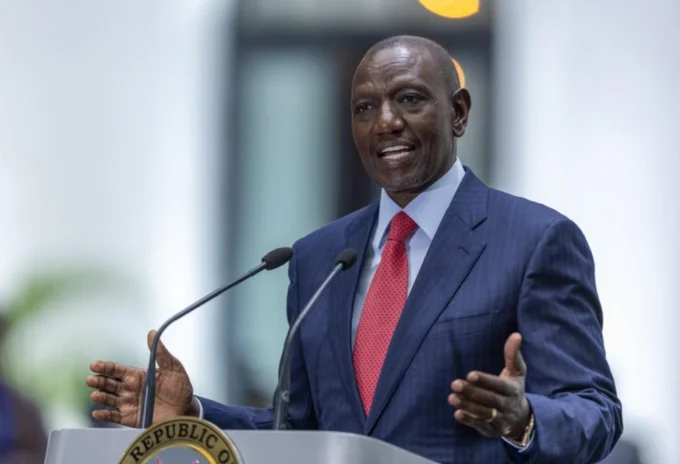
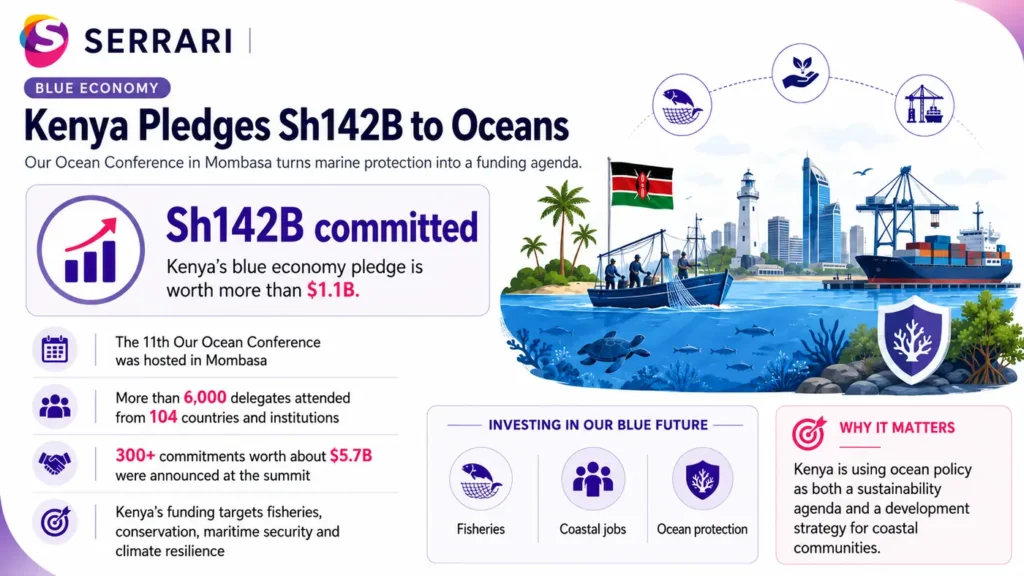
Kenya has committed more than $1.1 billion, equivalent to about Sh142 billion, to advance its blue economy agenda following the close of the 11th Our Ocean Conference in Mombasa. President William Ruto said the pledge will support fisheries, conservation, maritime security and climate resilience as Kenya seeks to turn ocean protection into practical economic opportunity for coastal and fishing communities.
The conference, held under the theme “Our Ocean, Our Heritage, Our Future”, brought together governments, institutions, businesses and civil society groups to move global ocean commitments from dialogue to implementation. Kenya became the first African country to host the forum, giving the continent a stronger platform in debates on marine protection, sustainable fisheries and ocean finance.
Key Overview
- Kenya committed more than $1.1 billion, or about Sh142 billion, to its blue economy agenda.
- The 11th Our Ocean Conference was hosted in Mombasa from 16 to 18 June 2026.
- President Ruto said the summit attracted more than 6,000 delegates from 104 countries and institutions.
- The conference generated more than 300 commitments valued at about $5.7 billion, according to Ruto’s closing remarks.
- Independent conference reporting also counted 320 new commitments worth $6.4 billion, showing a wider final tally.
- Kenya’s priorities include fisheries, aquaculture, ports, fish landing sites, maritime security and climate resilience.
- The summit also advanced action on illegal fishing, ocean governance, marine pollution and high-seas protection.
Kenya moves from ocean pledges to investment
President Ruto used the closing session to argue that ocean summits should be judged by delivery, not announcements. In his public statement on the conference close, he said Kenya had committed over $1.1 billion to the development of the blue economy ecosystem.
The commitment fits into Kenya’s broader effort to raise the blue economy’s contribution to growth. Kenya’s investment agency describes the sector as an emerging driver of sustainable development, with opportunities in fisheries, aquaculture, maritime transport and marine biotechnology. Its blue economy snapshot places the sector’s current GDP contribution at about 1%, while projecting a stronger economic role as marine investment expands.
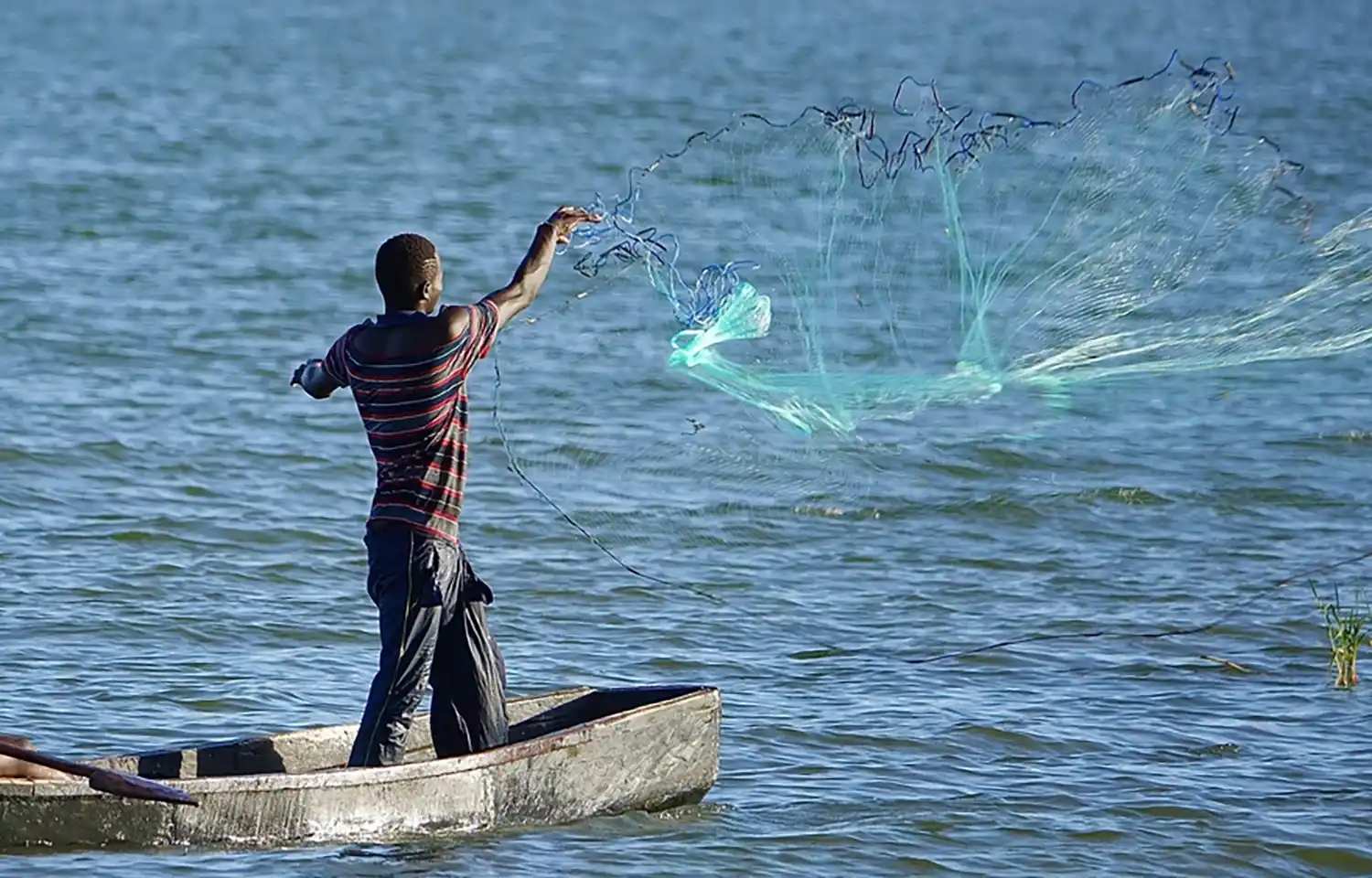
Ruto said Kenya’s approach is focused on enabling communities directly. That includes fish landing sites, aquaculture centres, ports, patrol vessels and support programmes for fishing communities. The goal is to make ocean investment visible at the local level, especially for households and businesses that depend on marine resources.
Mombasa conference raises Africa’s ocean profile
The 11th Our Ocean Conference was significant because it marked the first time the forum was held in Africa. The official Kenyan host platform said the event aimed to shift the ocean agenda from dialogue to delivery while strengthening transparency through a new commitments tracker.
Since 2014, the Our Ocean Conference has mobilised more than 2,900 commitments worth over $169 billion globally. This year’s Mombasa conference added a new African focus, linking ocean protection to jobs, equity, culture and livelihoods. The African setting was important because coastal and island communities are already facing rising sea levels, marine pollution, stronger storms and pressure on fisheries.
The summit also produced international action on illegal fishing. According to AP reporting, 15 countries adopted the Mombasa Declaration to strengthen transparency and combat illegal, unreported and unregulated fishing. The declaration calls for better access to information on vessel ownership, licences and fishing activity, which is critical for protecting marine ecosystems and livelihoods.
Context is everything. Stay ahead of shifting trends with today’s market updates, and uncover emerging opportunities using the Serrari Group Market Index and Marketplace. Then, take control of your own financial future by exploring our Money & Life Reset Transformation Blueprint ™ to build stronger habits, create better systems, and design a path toward lasting wealth.
Financing gap remains the hard test
The biggest challenge now is implementation. Ocean commitments often attract major announcements, but delivery can lag because of weak financing, fragmented governance and limited enforcement capacity. The Our Ocean Conference itself has highlighted the need for measurable action, not just voluntary pledges.
At the close of the Mombasa forum, WRI said global leaders announced 320 new commitments valued at $6.4 billion for ocean conservation, sustainable fisheries, climate resilience and the blue economy. That figure is slightly higher than the more than 300 commitments worth about $5.7 billion cited in Ruto’s closing remarks, likely reflecting a broader final tally of commitments captured by partners.
For Kenya, the credibility of the Sh142 billion pledge will depend on how quickly projects move from announcements to execution. Fish ports, landing sites, aquaculture centres, patrol systems and conservation programmes need budgets, timelines, procurement discipline and measurable community outcomes.
Blue economy becomes a development strategy
Kenya’s blue economy strategy is not only about conservation. It is also about jobs, food security, trade, maritime security and climate adaptation. UNESCO’s IOC noted that Kenya’s National Blue Economy Strategy is organised around fisheries, aquaculture, maritime transport, renewable energy, tourism, governance, financing, innovation and social equity.
That broad structure reflects how ocean policy is changing. Countries are no longer treating marine protection as a narrow environmental issue. They are linking it to development finance, infrastructure, trade, youth employment and coastal resilience.
The opportunity for Kenya is clear. If the pledged funding is delivered effectively, the blue economy could support fishing communities, expand aquaculture, improve port-linked trade and strengthen marine conservation. The risk is that commitments remain fragmented or slow-moving.
Ruto’s closing message therefore set a high bar. The legacy of the Mombasa conference will not be measured by the size of the pledges alone, but by whether Kenya and its partners turn ocean finance into real protection, better livelihoods and sustainable growth.
Sources used: Our Ocean Conference / Our Ocean Kenya / President William Ruto / AP / World Resources Institute / UNESCO IOC / Invest Kenya
Your financial future isn’t something you wait for—it’s something you build.
The real question is: when do you begin?
Move beyond simply staying informed.
Navigate the markets with clarity—track trends through the Serrari Group Market Index, uncover opportunities in the Serrari Marketplace, and build practical knowledge with our Curated Wealth Builder Platform.
Stay connected to what truly matters.
Get daily insights on macro trends and financial movements across Kenya, Africa, and global markets—delivered through the Serrari Newsletter.
Growth opens doors.
Advance your career through professional programs including ACCA, HESI A2, ATI TEAS 7 , HESI EXIT , NCLEX – RN and NCLEX – PN, Financial Literacy!🌟—designed to move you forward with confidence.
See where money is flowing—clearly and in real time.
Track Money Market Funds, Treasury Bills, Treasury Bonds, Green Bonds, and Fixed Deposits, alongside global and African indexes, key economic indicators, and the evolving Crypto and stablecoin landscape—all within Serrari’s Market Index.