The proposed Kenyan stablecoin rules are facing parliamentary scrutiny as lawmakers debate whether stricter reserve requirements could enhance consumer protection or discourage international stablecoin issuers from entering the market.
Key Overview
- Kenyan lawmakers are reviewing draft stablecoin regulations.
- A proposed 30% domestic reserve requirement has sparked debate.
- Stablecoins would still require full reserve backing.
- Questions have been raised about redemption timelines.
- Draft regulations contain inconsistencies on token valuation.
- Stablecoin issuers would require KSh500 million in paid-up capital.
- Monthly reserve checks and annual audits are proposed.
- The CBK and CMA would jointly regulate virtual assets.
- Kenya’s entry requirements are among the highest in the market.
- Legislators want regulations aligned with global standards.
Kenya Stablecoin Regulation Faces Reserve Debate
The proposed Kenya stablecoin regulation framework is facing increased scrutiny from lawmakers who are questioning whether some of the draft provisions could hinder innovation and reduce the country’s attractiveness to international issuers.
Members of the National Assembly’s Committee on Delegated Legislation have raised concerns over Regulation 74, which would require stablecoin issuers to maintain at least 30% of their reserve funds in segregated accounts held at commercial banks in Kenya.
The debate comes as Kenya seeks to establish one of Africa’s most comprehensive virtual asset regulatory frameworks.
Lawmakers are examining whether the proposed localization requirement would genuinely improve consumer protection or merely duplicate safeguards already contained elsewhere in the draft rules.
The discussions also reflect broader efforts to strike a balance between protecting users and ensuring Kenya remains competitive in the rapidly evolving digital asset industry.
As the country moves toward formal regulation, policymakers are increasingly focused on aligning local standards with international best practices.
Kenyan Stablecoin Rules Face Questions Over Reserve Requirements
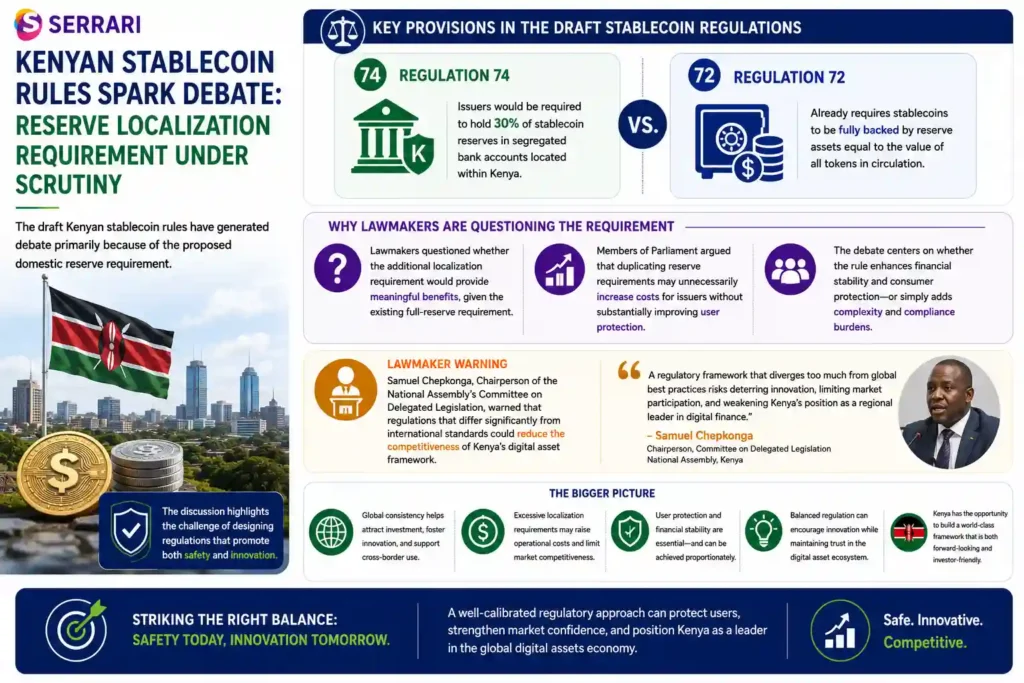
The draft Kenyan stablecoin rules have generated debate primarily because of the proposed domestic reserve requirement.
Under Regulation 74, issuers would be required to hold 30% of stablecoin reserves in segregated bank accounts located within Kenya.
However, Regulation 72 already requires stablecoins to be fully backed by reserve assets equal to the value of all tokens in circulation.
Lawmakers therefore questioned whether the additional localization requirement would provide meaningful benefits.
Samuel Chepkonga, Chairperson of the National Assembly’s Committee on Delegated Legislation, warned that regulations that differ significantly from international standards could reduce the competitiveness of Kenya’s digital asset framework.
Members of Parliament argued that duplicating reserve requirements may unnecessarily increase costs for issuers without substantially improving user protection.
The discussion highlights the challenge of designing regulations that promote both safety and innovation.
Stablecoin Reserve Requirements Kenya Among Highest in the Market
The proposed stablecoin reserve requirements Kenya framework imposes some of the most demanding conditions in the industry.
In addition to maintaining full reserve backing, stablecoin issuers would be required to have KSh500 million in paid-up capital and at least KSh100 million in liquid capital.
The draft regulations also call for monthly reserve examinations and annual independent reviews.
These measures are intended to ensure transparency and strengthen confidence among users.
However, the high capital thresholds could create barriers for smaller companies and discourage international players from entering the Kenyan market.
Lawmakers are therefore evaluating whether the requirements strike an appropriate balance between financial stability and market accessibility.
Supporters argue that strong reserve standards are essential for protecting consumers, while critics believe excessive requirements could limit competition.
The final framework will likely determine how attractive Kenya becomes as a destination for digital asset businesses.
Digital Asset Regulation Expands in Kenya
The proposed framework represents a major step forward in digital asset regulation within Kenya.
The country is seeking to establish clear rules governing stablecoins, exchanges, tokenization platforms and wallet providers.
By introducing regulatory oversight, policymakers hope to create greater certainty for both investors and service providers.
The framework also aims to reduce risks associated with fraud, operational failures and inadequate reserve management.
As digital assets become increasingly integrated into financial systems, regulators around the world are intensifying efforts to establish formal rules.
Kenya’s approach reflects this global trend.
The challenge lies in ensuring that regulations are robust enough to protect users without stifling innovation and growth.
Achieving this balance remains a central objective of the ongoing parliamentary discussions.
Context is everything. Stay ahead of shifting trends with today’s market updates, and uncover emerging opportunities using the Serrari Group Market Index and Marketplace. Then, take control of your own financial future by exploring our Money & Life Reset Transformation Blueprint ™ to build stronger habits, create better systems, and design a path toward lasting wealth.
Cryptocurrency Regulation Kenya Adopts Dual Oversight Model
The proposed cryptocurrency regulation Kenya framework establishes a dual regulatory structure involving two major institutions.
Under the draft rules, the Central Bank of Kenya (CBK) would oversee stablecoin issuers, payment processors and wallet providers.
Meanwhile, the Capital Markets Authority (CMA) would regulate exchanges, tokenization platforms and investment-related activities.
This division of responsibilities is intended to ensure that both payment and investment functions receive appropriate supervision.
The dual structure mirrors regulatory models adopted in several jurisdictions around the world.
By allocating responsibilities between the CBK and CMA, policymakers aim to strengthen oversight and improve regulatory efficiency.
Such an approach could also enhance investor confidence by providing clearer accountability.
The success of the framework, however, will depend on effective coordination between the two agencies.
Stablecoin Policy Raises Redemption Concerns
The emerging stablecoin policy has also raised questions regarding redemption procedures.
Lawmakers expressed concern over provisions requiring stablecoins to be redeemable “at any time” without specifying how quickly payments must be made.
Kathiani MP Robert Mbui warned that issuers could potentially delay repayments while still claiming compliance with the rules.
The committee also identified inconsistencies between Regulations 68 and 77.
Regulation 68 requires stablecoins to be redeemed on demand and at par value.
However, Regulation 77 refers to redemption based on market value.
These differences have raised concerns about legal clarity and consumer protection.
Parliamentarians are therefore seeking greater precision to avoid confusion and ensure that users understand their rights.
Clear redemption standards are considered essential for maintaining trust in stablecoin systems.
Virtual Assets Kenya Framework Sets High Entry Standards
The proposed virtual assets Kenya framework introduces substantial capital requirements across different segments of the industry.
Stablecoin issuers would need KSh500 million in paid-up capital.
Exchanges and wallet providers would require KSh150 million, while tokenization and initial coin offering platforms would need KSh200 million.
These thresholds rank among the highest in the market.
Supporters argue that strong capital requirements will enhance financial stability and reduce operational risks.
Critics, however, warn that such requirements may discourage innovation and limit competition.
The framework’s final structure will play a key role in determining the future development of Kenya’s digital asset ecosystem.
Its success will depend on finding the right balance between prudential safeguards and market accessibility.
Conclusion
The proposed Kenya stablecoin regulation framework represents an important step toward establishing formal oversight for digital assets. However, lawmakers continue to debate whether some provisions, particularly the 30% domestic reserve requirement, could create unnecessary barriers for issuers.
With questions also emerging around redemption standards and capital requirements, Parliament is seeking to ensure that the final regulations protect consumers while maintaining Kenya’s competitiveness within the global digital asset industry.
FAQs
1. What is the proposed 30% reserve rule?
Regulation 74 would require stablecoin issuers to hold at least 30% of their reserves in segregated accounts at Kenyan commercial banks. Lawmakers are examining whether this requirement strengthens protection or duplicates existing safeguards.
2. Who will regulate stablecoins in Kenya?
Under the draft framework, the Central Bank of Kenya will supervise stablecoin issuers, wallet providers and payment processors, while the Capital Markets Authority will oversee exchanges and tokenization platforms.
3. What capital requirements are proposed for stablecoin issuers?
Stablecoin issuers would be required to maintain KSh500 million in paid-up capital and at least KSh100 million in liquid capital. These requirements are among the highest in the digital asset industry.
4. Why are lawmakers concerned about redemption rules?
Parliamentarians have raised concerns because the draft regulations do not clearly specify redemption timelines. They have also identified inconsistencies between provisions that refer to redemption at par value and those referencing market value.
Sources: Coin Edition, Kenya Wallstreet, Bidget
Your financial future isn’t something you wait for—it’s something you build.
The real question is: when do you begin?
Move beyond simply staying informed.
Navigate the markets with clarity—track trends through the Serrari Group Market Index, uncover opportunities in the Serrari Marketplace, and build practical knowledge with our Curated Wealth Builder Platform.
Stay connected to what truly matters.
Get daily insights on macro trends and financial movements across Kenya, Africa, and global markets—delivered through the Serrari Newsletter.
Growth opens doors.
Advance your career through professional programs including ACCA, HESI A2, ATI TEAS 7 , HESI EXIT , NCLEX – RN and NCLEX – PN, Financial Literacy!🌟—designed to move you forward with confidence.
See where money is flowing—clearly and in real time.
Track Money Market Funds, Treasury Bills, Treasury Bonds, Green Bonds, and Fixed Deposits, alongside global and African indexes, key economic indicators, and the evolving Crypto and stablecoin landscape—all within Serrari’s Market Index.