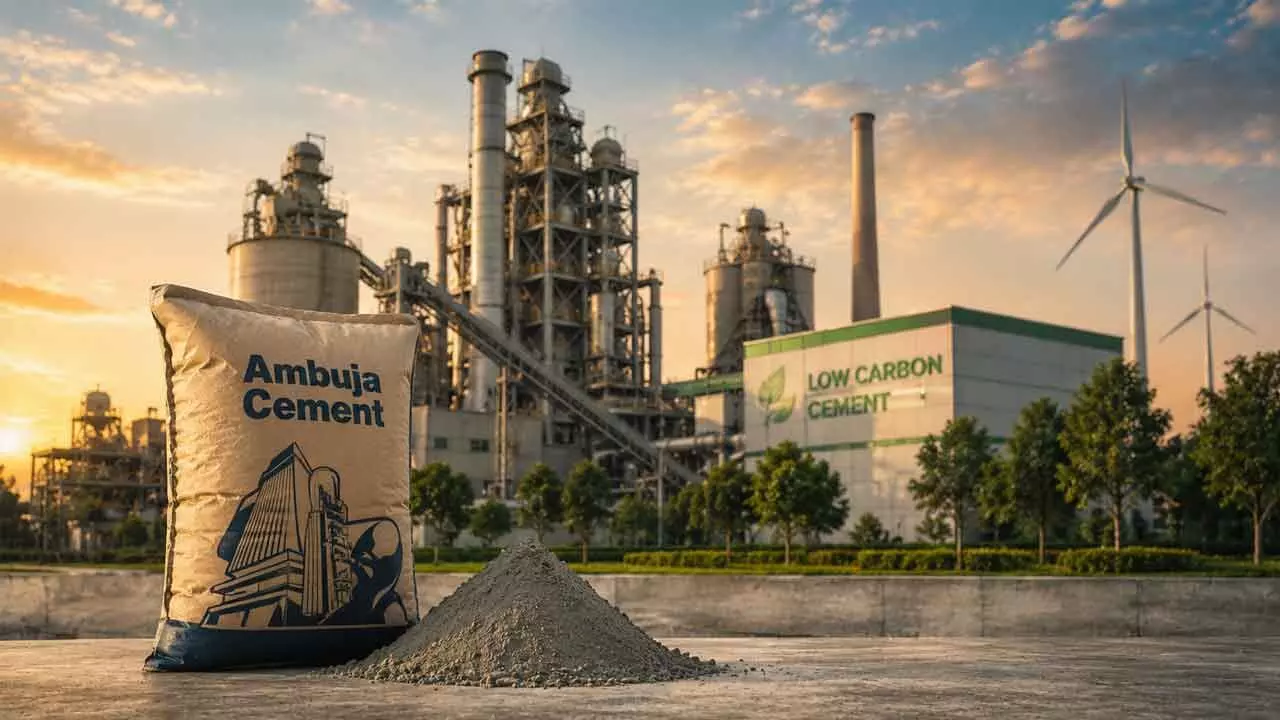
Ambuja Cements has partnered with UK-based clean technology company Leilac to develop one of the world’s largest commercial-scale low-carbon cement pathways in India. The project will evaluate carbon capture and hybrid electrification technologies at the Sanghipuram cement plant in Gujarat, supporting the company’s net-zero goals.
Key Overview
- Ambuja partners with Leilac on low-carbon cement technology.
- The project will be developed at the Sanghipuram plant in Gujarat.
- The facility has a production capacity of 6.6 MTPA.
- The technology combines carbon capture and electrification.
- The project supports Ambuja’s net-zero target for 2050.
- Renewable electricity will play a larger role in production.
- The project could eventually capture over 1 million tonnes of CO₂ annually.
- The initiative supports industrial decarbonization in India.
Carbon Capture Moves Into Cement Manufacturing
Ambuja Cements, the cement and building materials company of the Adani Group, has entered into a strategic partnership with UK-based clean technology firm Leilac to develop one of the world’s largest commercial-scale pathways for low-carbon cement production.
The collaboration will focus on Ambuja’s Sanghipuram cement plant in Gujarat’s Kutch district and represents a major step in reducing emissions from one of the world’s most carbon-intensive industries.
The project supports Ambuja’s Science Based Targets initiative (SBTi)-validated commitment to achieve net-zero emissions by 2050.
Demonstration Project Planned at Sanghipuram
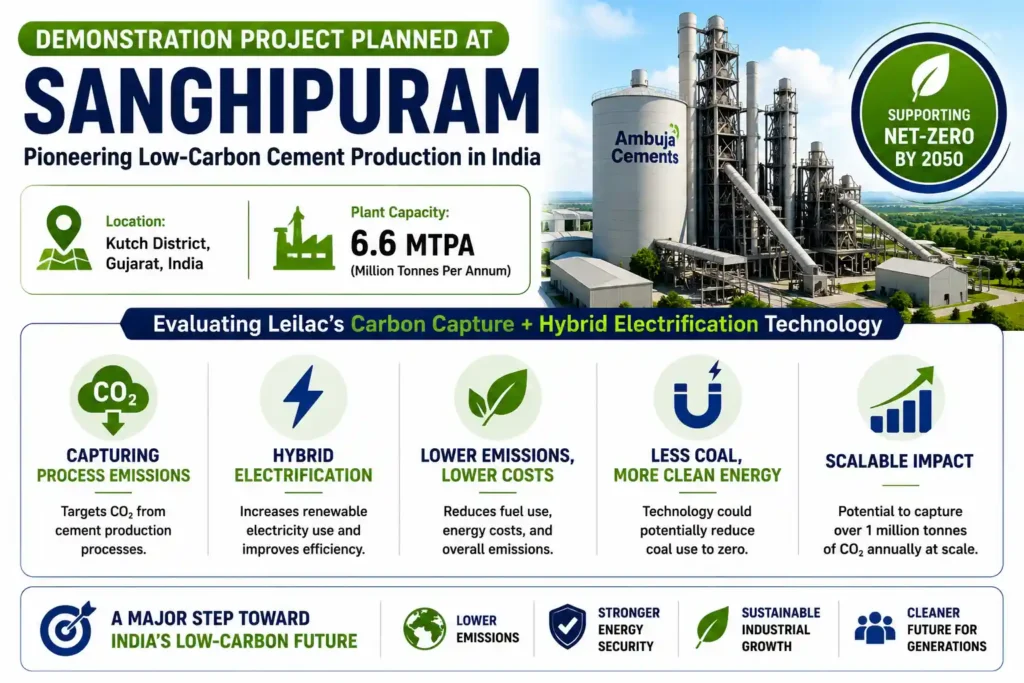
The two companies will evaluate Leilac’s carbon capture and hybrid electrification technology through a commercial demonstration project at the Sanghipuram facility.
The plant currently has a production capacity of 6.6 million tonnes per annum and represents one of Ambuja’s major manufacturing sites.
The first phase of the agreement focuses on technical and commercial feasibility studies before any final investment decisions are made.
Company officials indicated that no cost commitments or implementation timelines have yet been announced.
Tackling One of Cement’s Biggest Emissions Challenges
Cement manufacturing remains one of the most difficult industrial sectors to decarbonize.
Globally, cement production accounts for approximately 7-8% of carbon dioxide emissions, while India’s cement industry contributes around 5.8% of the country’s CO₂ emissions.
A significant portion of these emissions comes from the chemical process of clinker production itself rather than from fuel combustion.
This makes conventional renewable energy solutions insufficient on their own, increasing the importance of carbon capture technologies.
Leilac Technology Targets Process Emissions
Leilac’s technology focuses on indirectly heated calcination, which enables the capture of high-purity carbon dioxide emissions generated during cement production.
The system is designed to:
- Reduce process emissions.
- Lower fuel consumption.
- Increase renewable electricity use.
- Support alternative fuels.
- Improve energy efficiency.
- Reduce coal dependence.
The hybrid electrification technology also supports the use of renewable electricity in the manufacturing process.
According to the companies, the technology could potentially reduce coal consumption to zero.
Context is everything. Stay ahead of shifting trends with today’s market updates, and uncover emerging opportunities using the Serrari Group Market Index and Marketplace. Then, take control of your own financial future by exploring our Money & Life Reset Transformation Blueprint ™ to build stronger habits, create better systems, and design a path toward lasting wealth.
Supporting Ambuja’s Net-Zero Strategy
The project forms part of Ambuja Cements’ broader decarbonization strategy.
The company has been expanding renewable energy use and currently has nearly 1GW of captive green power capacity supporting its operations.
Karan Adani, Director of Ambuja Cements, said the transition toward lower-carbon cement production requires technological innovation and industry collaboration.
The company views carbon capture as one of the critical technologies needed to reduce hard-to-abate emissions within the cement industry.
Potential to Capture Over One Million Tonnes of CO₂
If the demonstration project proves successful, the technology could eventually be expanded significantly.
Company estimates indicate the project could scale seven to eight times beyond the initial demonstration phase.
At full scale, the technology could capture more than one million tonnes of carbon dioxide annually.
This would make the facility one of the largest industrial carbon capture projects within the global cement sector.
The large-scale deployment could also improve the economics of carbon capture and strengthen the business case for wider adoption throughout the industry.
Industrial Decarbonization in India
India is one of the world’s largest cement producers, making industrial decarbonization particularly important for the country’s climate goals.
Ambuja is currently the world’s ninth-largest cement producer, with:
- 109 million tonnes of annual production capacity.
- 24 integrated manufacturing plants.
- 22 grinding units.
As international markets increasingly adopt carbon regulations and low-carbon procurement requirements, cleaner cement production could become an important competitive advantage.
The project also demonstrates growing interest in carbon capture technologies as India seeks to balance industrial growth with climate objectives.
Outlook
The partnership between Ambuja Cements and Leilac represents an important step toward reducing emissions from one of the world’s most carbon-intensive industries. By combining carbon capture with electrification and renewable energy, the companies aim to establish a scalable pathway for low-carbon cement production.
If successfully demonstrated and expanded, the project could capture more than one million tonnes of carbon dioxide annually while reducing reliance on fossil fuels. The initiative also positions India as an emerging market for industrial decarbonization technologies and could provide a model for cleaner cement production globally.
FAQs
1. What is the purpose of the Ambuja-Leilac partnership?
The partnership aims to develop low-carbon cement production using carbon capture and electrification technologies.
2. Where will the project be developed?
The demonstration project will be developed at Ambuja’s Sanghipuram cement plant in Gujarat’s Kutch district.
3. How much carbon could the project capture?
If fully scaled, the technology could capture more than one million tonnes of carbon dioxide annually.
4. Why is carbon capture important for cement production?
Cement manufacturing produces large process emissions during clinker production, making carbon capture one of the most important technologies for reducing emissions in the sector.
Sources: CemNet, Fortune India, The Economic Times, Adani Group, BusinessLine, Sahi, gasworld
Your financial future isn’t something you wait for—it’s something you build.
The real question is: when do you begin?
Move beyond simply staying informed.
Navigate the markets with clarity—track trends through the Serrari Group Market Index, uncover opportunities in the Serrari Marketplace, and build practical knowledge with our Curated Wealth Builder Platform.
Stay connected to what truly matters.
Get daily insights on macro trends and financial movements across Kenya, Africa, and global markets—delivered through the Serrari Newsletter.
Growth opens doors.
Advance your career through professional programs including ACCA, HESI A2, ATI TEAS 7 , HESI EXIT , NCLEX – RN and NCLEX – PN, Financial Literacy!🌟—designed to move you forward with confidence.
See where money is flowing—clearly and in real time.
Track Money Market Funds, Treasury Bills, Treasury Bonds, Green Bonds, and Fixed Deposits, alongside global and African indexes, key economic indicators, and the evolving Crypto and stablecoin landscape—all within Serrari’s Market Index.