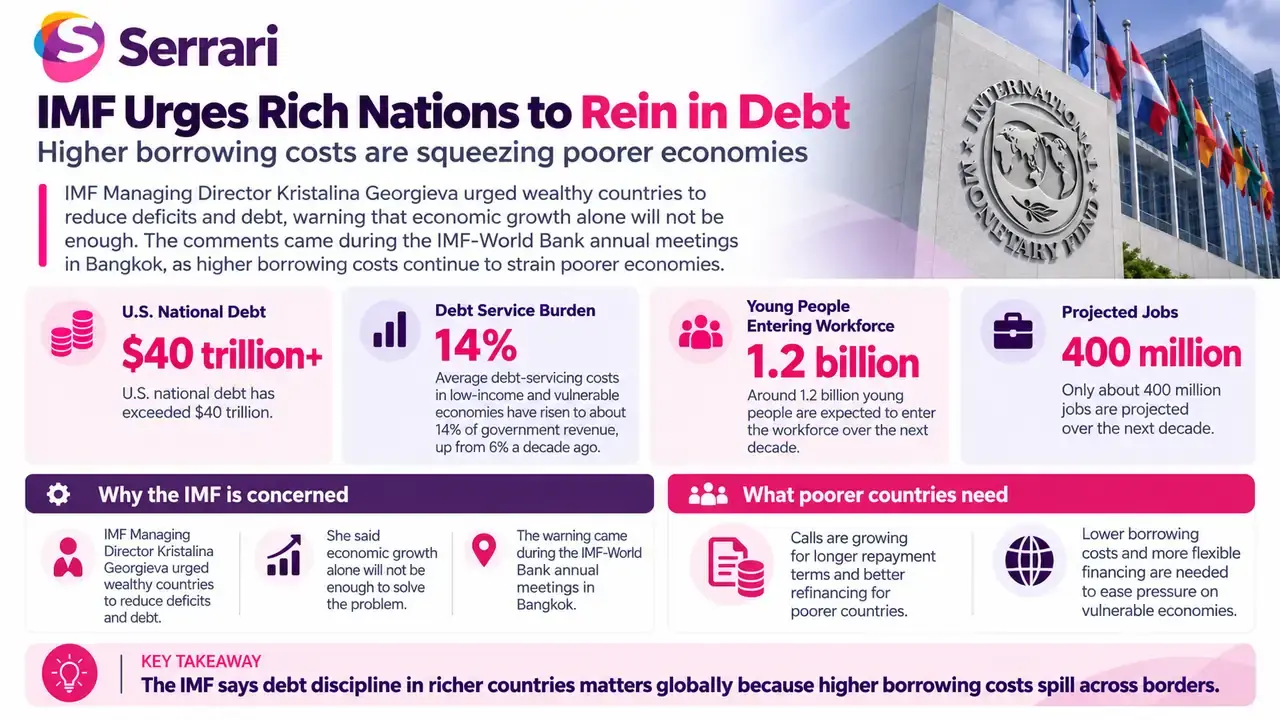
International Monetary Fund (IMF) Managing Director Kristalina Georgieva has urged the United States and other wealthy economies to reduce budget deficits as rising borrowing costs increase pressure on poorer countries. Speaking on October 14, 2026, at the IMF–World Bank annual meetings in Bangkok, she warned that economic growth alone would not be enough to restore fiscal sustainability.
Her remarks come as U.S. national debt exceeds $40 trillion and governments face higher interest costs. The concern extends beyond advanced economies: borrowing conditions in large financial markets can influence the rates paid by developing countries, leaving less money available for essential public services and investment.
Key Overview
- IMF warning: Wealthier governments need credible plans to contain deficits and debt rather than relying on economic growth alone.
- U.S. debt: Gross federal debt has exceeded $40 trillion, intensifying scrutiny of fiscal policy.
- Developing-country pressure: Average debt-servicing costs for low-income and vulnerable countries have risen to about 14% of government revenue, from 6% a decade earlier.
- Debt relief proposals: Longer repayment periods and more affordable refinancing are being discussed to ease fiscal pressure.
- Employment challenge: An estimated 1.2 billion young people will enter the global workforce over the coming decade, compared with projections for 400 million new jobs.
Why the IMF Wants Wealthy Nations to Reduce Debt
Georgieva said U.S. officials recognise that federal deficits and debt are too high. While stronger growth can improve government finances, the IMF argues that tax and spending adjustments will also be needed to put debt on a more sustainable path.
This process, known as fiscal consolidation, generally involves narrowing the gap between government revenue and expenditure. It does not necessarily mean uniform cuts to public spending: the appropriate pace and measures depend on each country’s economy, debt risks and ability to protect vulnerable households.
In its October 2026 fiscal assessment, the IMF warned that high debt, elevated interest rates and persistent spending demands were increasing financial vulnerabilities. When investors demand higher yields on major government bonds, global financing conditions can tighten, raising borrowing costs elsewhere.
Context is everything. Stay ahead of shifting trends with today’s market updates, and uncover emerging opportunities using the Serrari Group Market Index and Marketplace. Then, take control of your own financial future by exploring our Money & Life Reset Transformation Blueprint ™ to build stronger habits, create better systems, and design a path toward lasting wealth.
How Rising Interest Costs Squeeze Poorer Countries
The consequences are particularly severe for governments with limited tax revenue and substantial financing needs. Georgieva said average debt-servicing costs in low-income and vulnerable economies had climbed to around 14% of government revenue, compared with 6% ten years earlier.
As more revenue goes toward debt payments, governments have less flexibility to fund healthcare, education, infrastructure and support for low-income households. Declining development assistance adds pressure, while higher fuel and fertiliser costs can worsen budget and household strains.
The challenge is not simply how much a country owes. The interest rate, repayment schedule, share of debt denominated in foreign currency and strength of public revenue all affect whether borrowing remains manageable. Reducing deficits without protecting essential spending can also create difficult economic and social trade-offs.
Calls for Better Debt Relief and Refinancing Terms
At the Bangkok meetings, British Foreign Secretary Ed Miliband called for a new approach to developing-country debt, including longer repayment periods and refinancing at more affordable rates. He also supported changes that would prevent individual private creditors from obstructing wider restructuring agreements.
Such measures could create fiscal space—the capacity for a government to finance priority programmes without undermining its debt position. However, the proposals are not a completed international agreement, and any benefit would depend on creditor participation and the terms reached by individual countries.
Investment and Jobs Add to Development Pressures
The financial challenge comes alongside a major employment gap. According to new development initiatives announced on October 13, about 1.2 billion young people are expected to enter the workforce during the next decade, against projections of only 400 million jobs being created.
The United Nations Development Programme launched an Investment Accelerator and Jobs for Prosperity Facility to help countries develop investable projects, improve business conditions and connect investment with employment opportunities. The initiatives seek to work with development banks and private investors, but they do not immediately close the projected jobs gap.
Separately, the IMF, World Bank and Bank of Thailand introduced the Bangkok Blueprint, outlining 12 considerations for tackling cyber-enabled financial fraud. The initiative addresses another risk to financial stability, distinct from the immediate challenge of managing public debt.
Sources: International Monetary Fund / Reuters / Associated Press / United Nations Development Programme / World Bank
Your financial future isn’t something you wait for—it’s something you build.
The real question is: when do you begin?
Move beyond simply staying informed.
Navigate the markets with clarity—track trends through the Serrari Group Market Index, uncover opportunities in the Serrari Marketplace, and build practical knowledge with our Curated Wealth Builder Platform.
Stay connected to what truly matters.
Get daily insights on macro trends and financial movements across Kenya, Africa, and global markets—delivered through the Serrari Newsletter.
Growth opens doors.
Advance your career through professional programs including ACCA, HESI A2, ATI TEAS 7 , HESI EXIT , NCLEX – RN and NCLEX – PN, Financial Literacy!🌟—designed to move you forward with confidence.
See where money is flowing—clearly and in real time.
Track Money Market Funds, Treasury Bills, Treasury Bonds, Green Bonds, and Fixed Deposits, alongside global and African indexes, key economic indicators, and the evolving Crypto and stablecoin landscape—all within Serrari’s Market Index.