The International Finance Corporation (IFC) has raised $2 billion through its first U.S. dollar benchmark green bond of fiscal year 2027, marking its return to the U.S. dollar green bond market after eight years. The five-year issuance attracted approximately $8 billion in investor demand from 120 investors and will finance climate mitigation, resilience, biodiversity, water protection, and circular economy projects across emerging markets under IFC’s updated Green Bond Framework.
Key Overview
- IFC raised $2 billion through its first FY2027 U.S. dollar green bond.
- Investor demand reached approximately $8 billion from 120 investors.
- The bond marks IFC’s first U.S. dollar green benchmark issuance since 2017.
- Proceeds will finance climate, biodiversity, resilience, and circular economy projects.
- Central banks and official institutions accounted for 61% of investor participation.
Strong Investor Demand Marks IFC’s Return to Green Bond Market
The International Finance Corporation (IFC), the private-sector investment arm of the World Bank Group, has successfully raised $2 billion through its inaugural U.S. dollar benchmark green bond of fiscal year 2027, underscoring continued global demand for high-quality sustainable investments despite ongoing economic uncertainty.
The five-year bond attracted exceptional investor interest, with the order book reaching approximately $8 billion from around 120 investors, making it one of IFC’s strongest benchmark green bond issuances in recent years.
The transaction also represents IFC’s first U.S. dollar-denominated green benchmark bond since 2017, marking the institution’s return to the global dollar green bond market after an eight-year gap.
The issuance highlights growing investor appetite for sustainable finance instruments that combine strong credit quality with measurable environmental and development impact across emerging markets.
Bond Issued Under IFC’s Updated Green Bond Framework
The latest issuance is the first benchmark green bond launched under IFC’s updated Green Bond Framework, published in July 2026.
The revised framework received a Second Party Opinion from S&P Global Ratings, confirming that it is fully aligned with the Green Bond Principles established by the International Capital Market Association (ICMA), one of the world’s leading standards for sustainable bond issuance.
The bond carries a 4.25% semi-annual coupon, was priced at 1.7 basis points above the reference U.S. Treasury, and will be listed on the Luxembourg Stock Exchange.
The transaction was jointly managed by BMO Capital Markets, Citigroup Global Markets Limited, Goldman Sachs International, and J.P. Morgan.
Jorge Familiar, Vice President and Treasurer at the World Bank Group, said the overwhelming investor response demonstrates strong confidence in IFC’s mission.
“The exceptional investor response to IFC’s inaugural US dollar benchmark bond of the fiscal year underscores the global depth of demand for high-quality sustainable investments. Our bonds help build more sustainable and competitive economies, providing investors the opportunity to support emerging markets through high-grade liquid products in multiple currencies.”
Central Banks Led Global Investor Participation
Official institutions formed the largest share of investors participating in the issuance, reflecting continued confidence in IFC’s strong credit profile and development mandate.
Investor Distribution by Type
- Central Banks and Official Institutions: 61%
- Banks, Bank Treasuries and Corporates: 21%
- Asset Managers, Insurers and Pension Funds: 18%
Investor participation was also geographically diversified.
Regional Distribution
The broad participation demonstrates sustained global interest in investment-grade green bonds that finance environmental and climate-related projects while offering high levels of liquidity and credit quality.
Funds Will Support Climate and Sustainable Development Projects
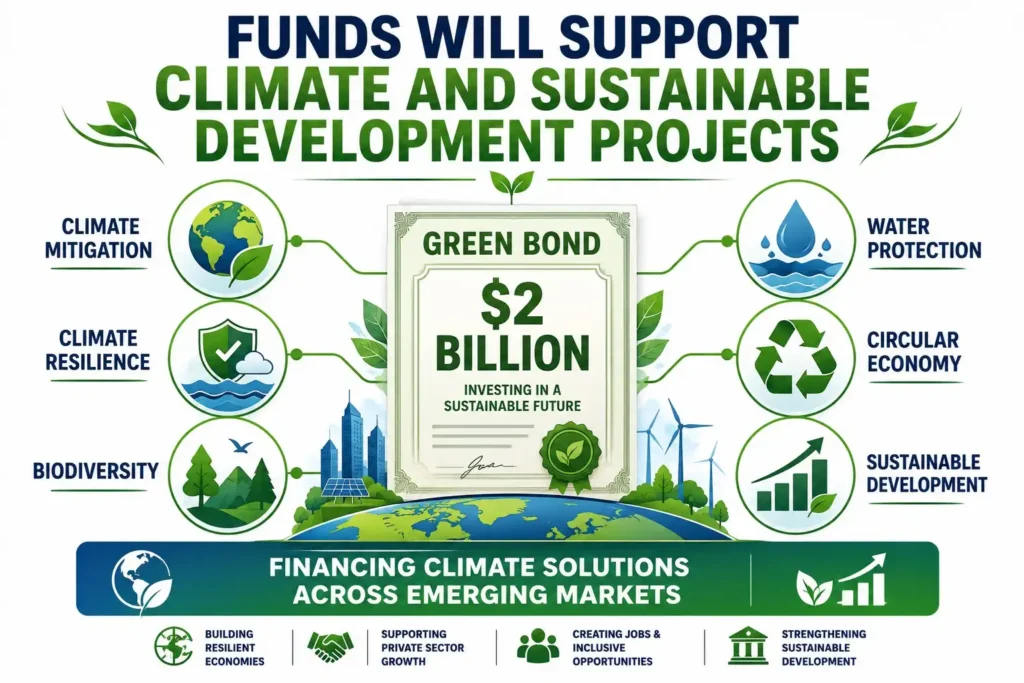
Proceeds from the green bond will finance private sector projects that contribute to environmental sustainability across developing economies.
Eligible projects include investments supporting:
- Climate change mitigation
- Climate adaptation and resilience
- Biodiversity and nature conservation
- Ocean and water protection
- Circular economy initiatives
Under its updated Green Bond Framework, IFC has also expanded its focus beyond environmental outcomes to include wider development objectives such as quality employment, resilient livelihoods, and inclusive economic participation.
The framework reflects IFC’s strategy of supporting climate-smart businesses that simultaneously promote sustainable economic growth and strengthen resilience in emerging markets.
Context is everything. Stay ahead of shifting trends with today’s market updates, and uncover emerging opportunities using the Serrari Group Market Index and Marketplace. Then, take control of your own financial future by exploring our Money & Life Reset Transformation Blueprint ™ to build stronger habits, create better systems, and design a path toward lasting wealth.
Green Bonds Remain Central to IFC’s Funding Strategy
IFC has issued US dollar-denominated global bonds each year since 2000 and continues to diversify its funding programme through thematic green bonds, social bonds, private placements, and local-currency issuances that support domestic capital market development across emerging economies.
Sean Hayes, Managing Director and Global Head of Syndicate at BMO Capital Markets, described the transaction as a strong endorsement of IFC’s market position.
“IFC kicks off its new fiscal year with a resounding success. The orderbook of $8 billion underscores the market’s confidence and support in IFC’s mission and credit.”
The successful issuance reinforces the growing importance of sustainable debt markets in mobilizing private capital toward climate action and inclusive development, particularly in emerging economies where investment needs remain substantial.
Sustainable Finance Continues to Expand Globally
Global demand for green bonds has continued to grow as governments, development institutions, and private investors increase funding for climate-related projects and sustainable infrastructure.
Multilateral development banks such as IFC play an important role by raising capital from international investors and directing proceeds toward projects that help countries reduce emissions, strengthen climate resilience, protect natural ecosystems, and improve access to sustainable economic opportunities.
As investors increasingly integrate environmental, social, and governance (ESG) considerations into portfolio decisions, high-grade issuers like IFC continue to attract strong demand from institutional investors seeking both financial stability and measurable sustainability outcomes.
Outlook
IFC’s successful $2 billion green bond issuance demonstrates the continued strength of global investor demand for sustainable finance despite evolving market conditions. The strong oversubscription highlights growing confidence in green investment opportunities that combine high credit quality with measurable climate and development impact. As financing needs for climate adaptation, resilience, biodiversity protection, and low-carbon infrastructure continue expanding across emerging markets, IFC is expected to remain one of the world’s leading issuers of sustainable bonds. Through its updated Green Bond Framework, the institution is also broadening its focus to ensure climate investments generate wider economic benefits, including quality jobs, resilient livelihoods, and more inclusive growth across developing economies.
FAQs
1. How much did IFC raise through its latest green bond?
IFC raised $2 billion through a five-year U.S. dollar benchmark green bond, its first green benchmark issuance of fiscal year 2027.
2. How strong was investor demand for the bond?
The issuance attracted approximately $8 billion in orders from around 120 investors, making it one of IFC’s strongest benchmark green bond offerings in recent years.
3. What projects will the green bond finance?
The proceeds will support projects focused on climate mitigation, climate adaptation, biodiversity conservation, ocean and water protection, circular economy initiatives, and other environmentally sustainable investments across developing countries.
4. Why is this green bond significant?
The bond marks IFC’s first U.S. dollar green benchmark bond since 2017 and the first issued under its updated Green Bond Framework, reflecting growing global demand for sustainable finance and climate-focused investment opportunities.
Sources: Africa Business Communities, Mirage News, Dealroom, PressReleasePoint
Your financial future isn’t something you wait for—it’s something you build.
The real question is: when do you begin?
Move beyond simply staying informed.
Navigate the markets with clarity—track trends through the Serrari Group Market Index, uncover opportunities in the Serrari Marketplace, and build practical knowledge with our Curated Wealth Builder Platform.
Stay connected to what truly matters.
Get daily insights on macro trends and financial movements across Kenya, Africa, and global markets—delivered through the Serrari Newsletter.
Growth opens doors.
Advance your career through professional programs including ACCA, HESI A2, ATI TEAS 7 , HESI EXIT , NCLEX – RN and NCLEX – PN, Financial Literacy!🌟—designed to move you forward with confidence.
See where money is flowing—clearly and in real time.
Track Money Market Funds, Treasury Bills, Treasury Bonds, Green Bonds, and Fixed Deposits, alongside global and African indexes, key economic indicators, and the evolving Crypto and stablecoin landscape—all within Serrari’s Market Index.