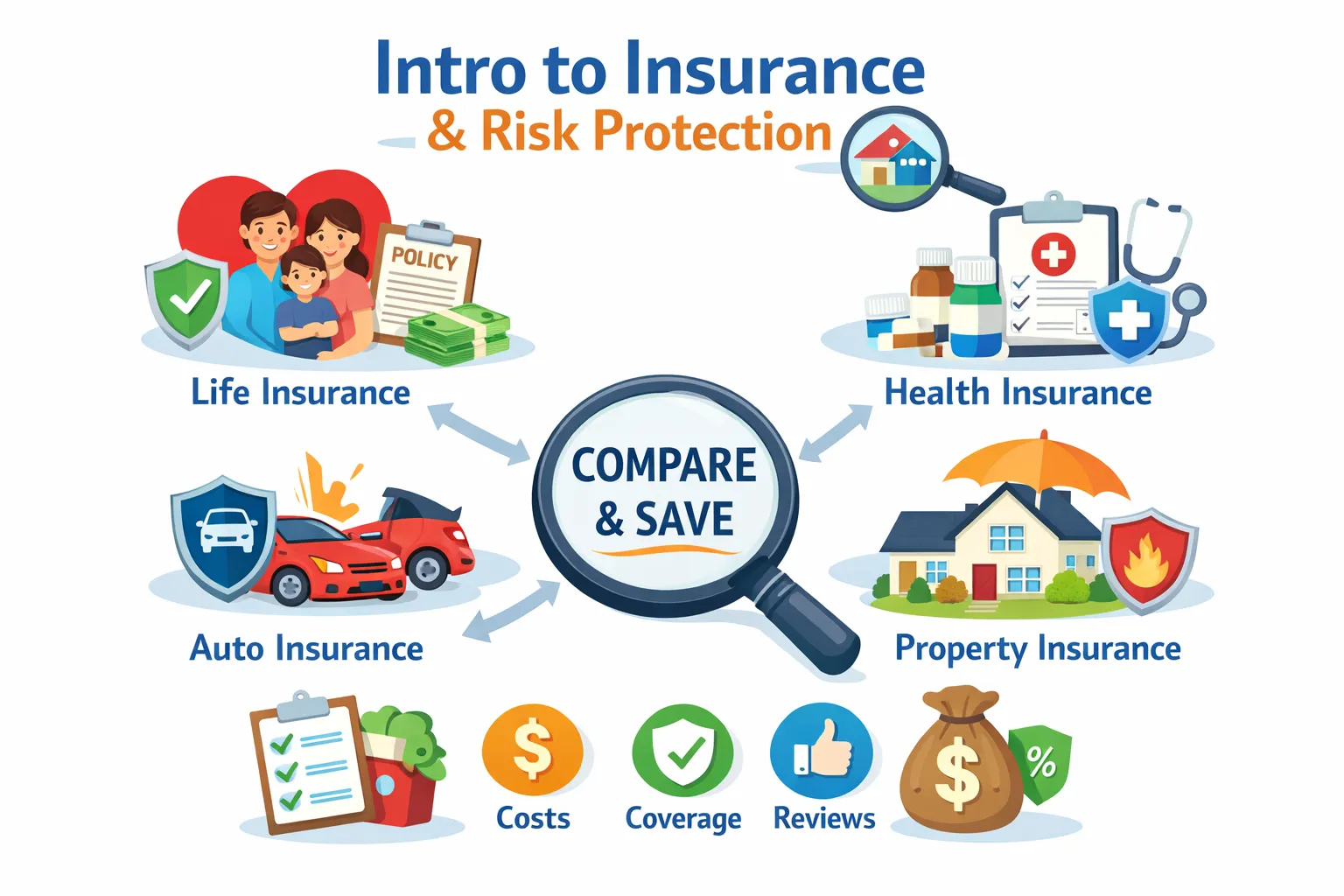
In a world where a single medical emergency, car accident, or property loss can wipe out years of savings overnight, insurance is not a luxury — it is a financial necessity. Insurance is the protection layer that sits beneath your entire wealth-building strategy, ensuring that one unexpected event does not undo everything you have worked to build.
Yet despite its importance, insurance remains one of the most misunderstood financial tools. Many people either buy coverage they do not need, underinsure themselves in areas that matter most, or avoid insurance altogether because the options feel overwhelming. This guide cuts through that confusion by breaking down the four essential types of insurance — life, health, auto, and property — and showing you exactly what to compare before you commit to any policy.
Insurance is just one pillar of a sound financial plan. The Financial Triangle framework — which balances protection, savings, and growth — positions insurance as the foundation on which all other wealth-building activities rest. Without adequate protection, even the most aggressive investment strategy is one crisis away from collapse.
Markets move fast, and staying ahead requires both protection and opportunity. The Serrari Group Market Index tracks live yields, interest rates, and market movements across Kenya, Africa, and global markets daily. Pair that real-time data with the Serrari Wealth Builder Marketplace to compare investment products, and use the Wealth Builder platform to build a strategy that covers both growth and protection.
What You Will Learn
By the end of this guide, you will understand the four essential types of insurance and what each one protects, the key factors to compare when evaluating any insurance policy, how deductibles, premiums, coverage limits, and exclusions interact, and how to build a comprehensive insurance plan that fits your life stage, budget, and financial goals.
Why Insurance Is the Foundation of Every Financial Plan
Before discussing individual insurance types, it is important to understand where insurance fits in your overall financial strategy. Insurance is not an investment — it does not generate returns or grow your wealth. Its purpose is entirely defensive: to prevent financial catastrophe when life takes an unexpected turn.
Think of it this way. Your emergency fund (three to six months of living expenses in a liquid, low-risk account like a money market fund) handles predictable disruptions — a car repair, a brief gap between jobs. Insurance handles the unpredictable and potentially devastating events — a serious illness, a house fire, a liability lawsuit, or the death of a breadwinner.
Without both layers in place, any investment strategy you build on top is vulnerable. The guide How to Build an Essential Insurance Plan Before It’s Too Late provides a step-by-step framework for assembling your protection layer from scratch.
Life Insurance: Protecting the People Who Depend on You

What It Covers
Life insurance pays a lump sum (the death benefit) to your designated beneficiaries when you pass away. Its primary purpose is income replacement — ensuring your family can maintain their standard of living, pay off debts, cover school fees, and meet ongoing expenses even after losing the household’s primary earner.
Key Factors to Compare
Coverage amount (sum assured): This is the most critical decision. The payout should be large enough to cover your family’s essential financial obligations — outstanding mortgages, children’s education costs, living expenses for the surviving spouse, and any other debts. A common rule of thumb is 10 to 15 times your annual income, though the right amount depends on your specific household situation.
Premiums: The monthly or annual cost of maintaining the policy. Premiums vary based on your age, health, smoking status, and the coverage amount. The cheapest policy is not always the best — what matters is that the premium fits comfortably within your budget over the full policy term without forcing you to lapse.
Policy duration (term): Term life insurance covers you for a fixed period (10, 20, or 30 years), while whole life insurance provides lifelong coverage with a savings component. Term life is significantly cheaper and is the right choice for most people whose goal is income protection during their working years. Choose a term that matches your longest financial obligation — typically until your youngest child is financially independent or your mortgage is paid off.
Additional benefits (riders): Many life insurance policies offer optional riders at additional cost. Critical illness riders pay out a portion of the death benefit if you are diagnosed with a serious condition like cancer or heart disease. Waiver of premium riders keep your policy active if you become disabled and cannot work. Evaluate which riders add genuine value based on your health history and family circumstances.
Health Insurance: Safeguarding Your Wellbeing and Finances

What It Covers
Health insurance covers medical costs — from routine doctor visits and prescription medications to hospitalisation, surgery, and specialist care. In Kenya, where out-of-pocket medical costs can be substantial, health insurance is one of the most important financial protections you can have. A single hospital admission can cost hundreds of thousands of shillings, and without coverage, that bill comes directly out of your savings or investments.
Key Factors to Compare
Coverage options and scope: Not all health plans cover the same things. Examine whether the policy includes outpatient care (GP visits, diagnostics, minor procedures), inpatient care (hospitalisation, surgery), maternity benefits, dental and optical coverage, and mental health services. The broader the coverage, the higher the premium — so prioritise the categories that match your actual health needs and family composition.
Provider network: Most health insurance plans operate through a network of approved hospitals, clinics, and doctors. “In-network” providers offer better coverage rates and lower out-of-pocket costs. Before choosing a plan, verify that your preferred healthcare providers are included. If you have an existing relationship with a specialist or hospital, switching to a plan that excludes them could be costly and disruptive.
Deductibles and co-pays: The deductible is the amount you pay out of pocket before insurance kicks in. A higher deductible lowers your monthly premium but increases your costs when you actually need care. Co-pays are fixed amounts you pay at each visit (for example, KES 500 per GP consultation). Evaluate these costs against how frequently you and your family typically use healthcare services.
Prescription drug coverage: If you or a family member takes regular medication, confirm that those specific drugs are covered under the plan’s formulary and at what co-pay level. Generic drug coverage is standard, but brand-name or specialised medications may require higher co-pays or prior authorisation.
Context is everything. While you follow today’s updates, use the Serrari Group Market Index and the Marketplace to spot emerging shifts in markets and investment products. Need to sharpen your edge? The Wealth Builder platform turns these insights into a professional-grade strategy.
Auto Insurance: Driving With Financial Confidence

What It Covers
Auto insurance protects you from the financial consequences of road accidents, theft, vandalism, and third-party liability claims. In Kenya, third-party motor insurance is a legal requirement for all vehicle owners, but the minimum legal cover is often insufficient to protect you fully in a serious incident.
Key Factors to Compare
Coverage types: Auto insurance comes in several tiers, and understanding the difference is essential. Third-party only covers damage or injury you cause to other people and their property — it does not cover your own vehicle. Third-party, fire, and theft adds protection for your car against fire damage and theft. Comprehensive cover is the highest tier, protecting your vehicle against all of the above plus accidental damage to your own car, regardless of who is at fault. If your vehicle is financed or leased, comprehensive coverage is typically required.
Deductibles (excess): The deductible is what you pay out of pocket per claim before the insurer covers the rest. Choosing a higher deductible reduces your annual premium but means you bear more cost per incident. For drivers with clean records who rarely make claims, a higher deductible can be a cost-effective strategy. For newer or less experienced drivers, a lower deductible provides more protection against the unexpected.
Discounts: Many insurers offer premium reductions that can significantly lower your costs. Common discounts include no-claims bonuses (for years without filing a claim), multi-vehicle discounts (insuring more than one car on the same policy), safe driver discounts, and bundle savings when you combine auto insurance with home or life insurance from the same provider. Always ask about available discounts — they are not always advertised prominently.
Claims process and reputation: The true test of any insurance company is how it handles claims. A policy is only as good as its payout record. Before committing, research the insurer’s claims settlement ratio (the percentage of claims they actually pay out), average turnaround time, and customer reviews. An insurer that is difficult to deal with during a claim defeats the purpose of having coverage in the first place.
Property Insurance: Protecting Your Home and Belongings

What It Covers
Property insurance — also called homeowner’s insurance or home insurance — covers the structure of your home, your personal belongings inside it, and in many cases your liability if someone is injured on your property. For renters, renter’s insurance covers personal belongings and liability without covering the building structure itself (which is the landlord’s responsibility).
Key Factors to Compare
Coverage limits: Your policy should cover the full replacement cost of your property and its contents — not just the market value, which may be lower. Underinsurance is one of the most common and costly mistakes. If your home would cost KES 15 million to rebuild but your policy only covers KES 10 million, you are personally liable for the KES 5 million gap. Review and update your coverage limits periodically, especially after renovations, major purchases, or changes in construction costs.
Deductibles: As with other insurance types, a higher deductible lowers your premium but increases your out-of-pocket cost per claim. For property insurance, deductibles can be expressed as a fixed amount or a percentage of the insured value. Understand which format your policy uses and calculate your actual exposure before agreeing to a high deductible.
Exclusions: This is where many policyholders get caught by surprise. Standard property insurance policies typically exclude certain perils — flood damage, earthquake damage, and wear-and-tear are common exclusions. Read the exclusions section carefully, and if you live in an area prone to specific risks (flooding, landslides), consider purchasing supplemental coverage or a rider that addresses those gaps.
Provider reputation and claims history: As with auto insurance, the insurer’s track record on claims is more important than the price of the premium. Check independent reviews, the insurer’s financial stability rating, and their claims settlement history. A reliable insurer with a slightly higher premium is almost always a better choice than a cheap policy from a company that fights every claim.
Insurance Comparison at a Glance
| Insurance Type | Primary Purpose | Key Cost Factor | Who Needs It Most | Critical Check |
|---|---|---|---|---|
| Life Insurance | Income replacement for dependents | Age, health, coverage amount | Anyone with financial dependents | Sum assured vs. actual family needs |
| Health Insurance | Medical cost protection | Scope of coverage, network size | Everyone, especially families | Provider network and drug formulary |
| Auto Insurance | Vehicle and liability protection | Vehicle value, driving history | All vehicle owners (legally required) | Claims settlement ratio |
| Property Insurance | Home and belongings protection | Property value, location risk | Homeowners and renters with valuable assets | Exclusions and coverage limits |
How to Compare Insurance Policies: A Step-by-Step Framework
When evaluating any insurance product — regardless of type — follow this structured approach to ensure you are making an informed decision rather than a reactive one.
Step 1: Define Your Risk Profile
Start by identifying what you need to protect and why. A single professional with no dependents has very different insurance needs than a parent with three children and a mortgage. Your risk profile determines which insurance types are essential, which are optional, and how much coverage you need in each category.
Step 2: Compare Coverage, Not Just Price
The cheapest policy is rarely the best. Compare the scope of what is covered, the limits and sub-limits on specific categories, the exclusions that could leave you exposed, and the additional benefits or riders included. Two policies with identical premiums can have vastly different coverage scopes — always read beyond the headline number.
Step 3: Evaluate Deductibles Against Your Cash Reserves
A high deductible saves money on premiums but requires you to have cash available to cover the gap. If you do not have an adequate emergency fund, a high-deductible policy could leave you unable to afford the very protection you are paying for. Match your deductible to your liquidity.
Step 4: Check the Insurer’s Claims Track Record
Research the company’s claims settlement ratio, average payout time, and customer satisfaction ratings. An insurer that denies or delays a high percentage of claims is not providing the protection you are paying for, regardless of how attractive the premium looks on paper.
Step 5: Review and Update Annually
Your insurance needs change as your life changes. Marriage, children, a new home, a business venture, or a significant change in income all warrant a review of your coverage. Set an annual reminder to reassess your policies and ensure they still match your current situation. The guide How to Build a Personal Finance Plan can help you integrate this review into a broader financial planning routine.
Common Insurance Mistakes to Avoid
Buying insurance based solely on premium price is the most common — and most dangerous — mistake consumers make. A low premium often means a high deductible, narrow coverage, or extensive exclusions that leave you unprotected precisely when you need help.
Underinsuring is equally damaging. Insuring your home for less than its replacement cost, or carrying only the legal minimum auto coverage, creates a gap that comes out of your own pocket during a claim. Failing to read the exclusions section means you discover what is not covered only after filing a claim, which is the worst possible time to learn.
Not bundling policies with the same insurer means you miss multi-policy discounts that can reduce your overall insurance cost by 10–25%. And failing to update your coverage after major life changes — a marriage, a child, a new property — means your existing policies no longer reflect your actual risk exposure.
Insurance is not something you buy once and forget. It is a living component of your financial plan that requires periodic attention, just like your investments. For a broader perspective on how protection, savings, and growth work together as a system, explore the Financial Triangle framework.
Where Insurance Fits in Your Wealth-Building Journey
Insurance is not separate from your investment strategy — it is the foundation that makes your investment strategy viable. Without adequate protection, a single adverse event can force you to liquidate investments at a loss, deplete your emergency fund, or take on debt to cover costs that insurance should have handled.
The smartest approach is to build your financial plan in layers. First, establish your protection layer (insurance). Second, build your liquidity layer (emergency fund in a money market fund or similar low-risk instrument). Third, build your stability layer (bonds, treasury instruments). And finally, build your growth layer (equities, real estate, diversified portfolios). This layered approach — explored in detail in the Best Investments in Kenya 2026 guide — ensures that each tier supports the one above it.
If you are at the beginning of this journey and want a clear roadmap, the guide Investing Explained: A Beginner’s Guide to Growing Wealth walks you through the fundamentals of building wealth from scratch.
Start Protecting What You Are Building
With the right information, insurance does not have to be confusing. By comparing policies thoughtfully — evaluating coverage scope, deductibles, exclusions, and provider reputation rather than simply chasing the lowest premium — you can protect yourself, your loved ones, and your assets without overpaying or leaving critical gaps.
Your financial future is not something you wait for — it is something you build. And the foundation of that future is protection. The real question is: have you built yours?
Move beyond simply staying informed. Navigate the markets with clarity — track trends through the Serrari Group Market Index, uncover opportunities in the Serrari Marketplace, and build practical knowledge with the Wealth Builder platform.
Get daily insights on macro trends and financial movements across Kenya, Africa, and global markets — delivered through the Serrari Newsletter.
Growth opens doors beyond investing. Advance your career and sharpen your financial knowledge through professional programs including ACCA, HESI A2, ATI TEAS 7, HESI EXIT, NCLEX-RN, NCLEX-PN, and Financial Literacy — all available through Serrari Online Learning.
See where money is flowing — clearly and in real time. Track Money Market Funds, Treasury Bills, Treasury Bonds, Green Bonds, and Fixed Deposits, alongside global and African indexes, key economic indicators, and the evolving crypto and stablecoin landscape — all within the Serrari Market Index.
Frequently Asked Questions (FAQ)
What types of insurance do I need in Kenya?
At minimum, every Kenyan adult should consider health insurance and, if they own a vehicle, auto insurance (third-party is legally required). If you have financial dependents — a spouse, children, or parents who rely on your income — life insurance is essential. Property insurance is important for homeowners and renters with valuable belongings. The guide How to Build an Essential Insurance Plan provides a step-by-step approach.
What is the difference between term life and whole life insurance?
Term life insurance covers you for a fixed period (for example, 20 years) and pays a death benefit only if you pass away during that term. It is significantly cheaper because it has no savings component. Whole life insurance covers you for your entire life and includes a cash value component that grows over time, but premiums are substantially higher. For most people whose primary goal is income protection for dependents, term life offers the best value.
How do I choose between a high and low deductible?
Your choice depends on your cash reserves and claims frequency. A high deductible lowers your premium but means you pay more out of pocket per claim. If you have a strong emergency fund and rarely make claims, a higher deductible can save money overall. If your cash reserves are limited, a lower deductible provides more immediate protection despite the higher premium.
Is comprehensive auto insurance worth the extra cost?
For newer or higher-value vehicles, comprehensive coverage is generally worth the additional premium because it covers damage to your own car — not just third-party liability. For older vehicles with low market value, the cost of comprehensive coverage may exceed the potential payout, making third-party or third-party-fire-and-theft a more economical choice. Calculate whether the annual premium difference is justified by your vehicle’s current value.
What does property insurance typically exclude?
Standard property insurance policies commonly exclude flood damage, earthquake damage, general wear and tear, pest infestations, and damage caused by war or civil unrest. If you live in a flood-prone or seismically active area, you may need supplemental coverage or specific riders. Always read the exclusions section before signing a policy.
How often should I review my insurance coverage?
At minimum, review all your insurance policies once a year. Major life events — marriage, having children, buying property, starting a business, or a significant income change — should also trigger an immediate review. Your insurance needs evolve as your life changes, and outdated coverage creates dangerous gaps.