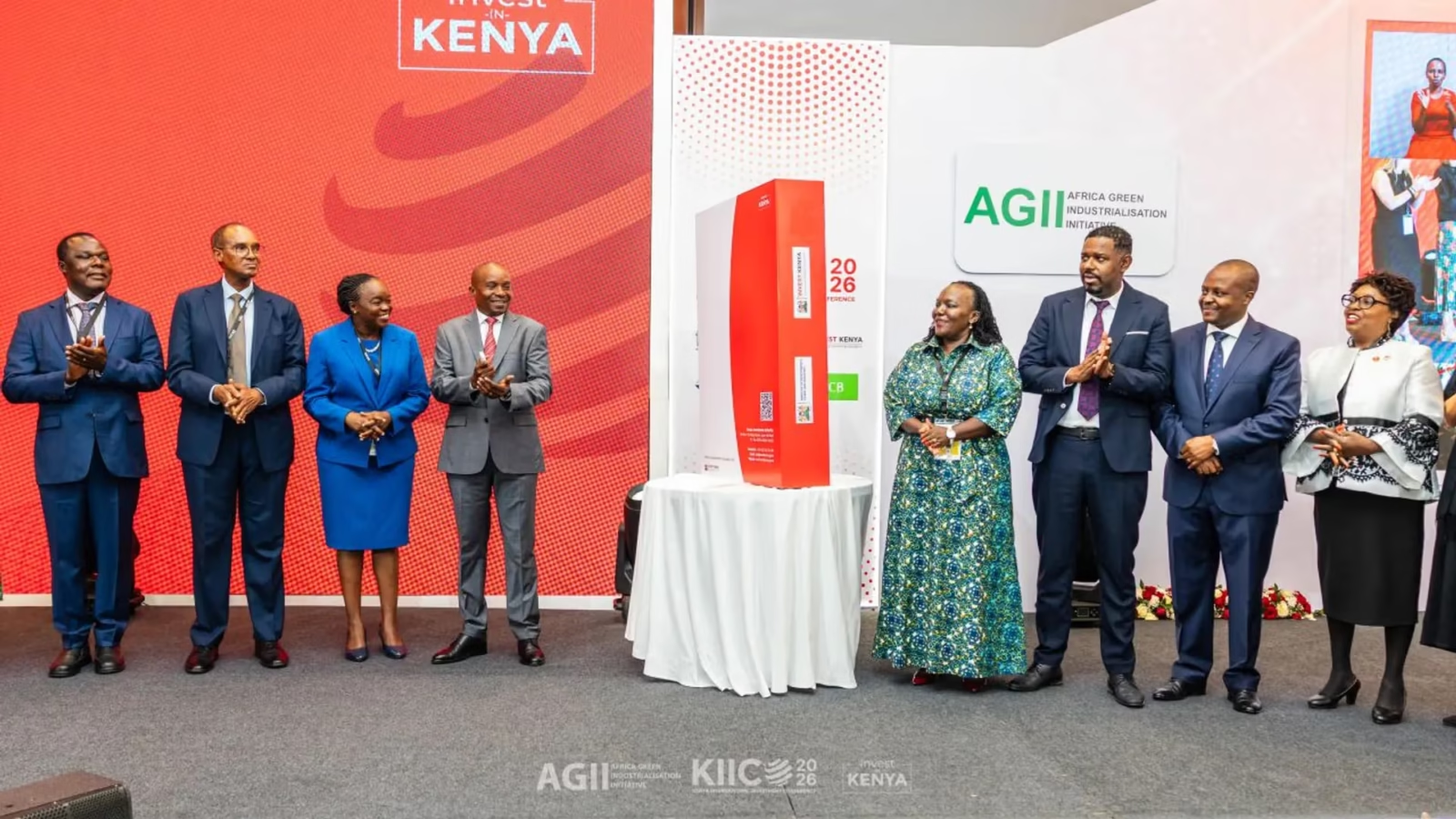
Invest Kenya has launched a new investment prospectus titled Waste Management and Circular Economy: Investment Pathways and Opportunities in Kenya, aimed at channelling private capital into the country’s largely untapped waste management and circular economy sectors. Unveiled at the Kenya International Investment Conference (KIICO 2026) in Nairobi — where President William Ruto announced $2.9 billion in total investment deals — the prospectus highlights that Kenya generates approximately 22,000 tonnes of waste daily, yet recycles only about 4 percent. It identifies opportunities across five waste sectors that could unlock over $700 million in economic value and contribute roughly 0.5 percent to Kenya’s GDP by 2030. Developed in collaboration with Systemiq, ALN Kenya, and TakaTaka Ni Mali, the prospectus arrives at a critical moment as Kenya’s new Extended Producer Responsibility regulations and the Sustainable Waste Management Act create a more favourable environment for circular economy investment.
Key Overview
- Daily waste generation: ~22,000 tonnes across Kenya
- Current recycling rate: ~4 percent
- Economic opportunity identified: Over $700 million across five waste sectors
- GDP contribution potential: ~0.5 percent by 2030
- Circular economy businesses in Kenya: 120+ operating across the value chain
- Prospectus partners: Invest Kenya, Systemiq, ALN Kenya, TakaTaka Ni Mali
- KIICO 2026 total investment deals: $2.9 billion (63,000+ jobs expected)
- Policy enablers: Sustainable Waste Management Act (2022), EPR Regulations (gazetted November 2024)
- Context: Africa holds ~40% of global renewable energy potential but received only ~2% of global renewable energy investment over the past decade
Markets move fast; don’t get left behind. We’ve paired the Serrari Group Market Index with a curated Marketplace and a comprehensive Wealth Builder Course to ensure you have the data—and the skills—to act on it.
A New Investment Playbook for Kenya’s Waste Sector
At the Kenya International Investment Conference in Nairobi, Invest Kenya unveiled what may become a defining document for the country’s green economy transition. The new investment prospectus, Waste Management and Circular Economy: Investment Pathways and Opportunities in Kenya, reframes the nation’s waste challenge as a commercial proposition, mapping out where private capital can generate returns while simultaneously building domestic supply chains and reducing environmental harm.
The prospectus was developed in collaboration with Systemiq, a global system change advisory firm, ALN Kenya, and TakaTaka Ni Mali, a tech-enabled social enterprise operating in Kenya’s waste management space. It focuses on investment opportunities that could accelerate the country’s circular economy transition over the next three to seven years, identifying five waste sectors where converting discarded materials into value could unlock more than $700 million in economic benefit and add approximately 0.5 percent to national GDP by 2030.
The launch took place at the Africa Green Industrialisation Initiative (AGII) forum, a key component of KIICO 2026, which brought together policymakers, investors, entrepreneurs, and development partners to discuss opportunities for scaling circular economy solutions and accelerating green investment across the continent.
KIICO 2026: A $2.9 Billion Statement of Investor Confidence
The waste prospectus launch was part of a much larger investment story. KIICO 2026 opened with President William Ruto announcing investment deals worth over $2.9 billion expected to create more than 63,000 direct jobs across the country. The 20 deals showcased at the conference span agriculture, mining, manufacturing, healthcare, ICT, real estate, and energy, signalling broad investor confidence in the Kenyan economy.
Agriculture and agro-processing accounted for approximately $890 million of the total, with a focus on value addition in rice, sugar, and horticulture. The conference also featured the COMESA Investment Forum, convening investors and policymakers from Eastern and Southern Africa to explore cross-border opportunities, alongside AGII’s focus on renewable energy, e-mobility, circular economy, and waste management.
Invest Kenya CEO John Mwendwa noted that the results were already tangible and pointed to a robust pipeline of green deals being actively facilitated toward closure. He revealed that the agency is fast-tracking a Project Preparation Facility to develop investment-ready, bankable projects while expanding de-risking instruments, including guarantees, blended finance, and risk-sharing mechanisms. Mwendwa had previously indicated that Kenya closed $1.7 billion in investments in 2023, positioning the KIICO 2026 outcomes as a significant acceleration of investment momentum.
The conference attracted a diverse pool of local and international investors from key FDI markets including the United States, United Kingdom, United Arab Emirates, China, India, and South Korea, reinforcing Kenya’s position as a key investment gateway into East and Central Africa.
Kenya’s Waste Crisis: The Scale of the Problem
The investment case for Kenya’s waste sector is built on a stark reality. The country generates approximately 22,000 tonnes of waste every day, according to data from the National Environment Management Authority (NEMA), yet only around 4 percent of that waste is currently recycled. The vast majority ends up in landfills, informal dumpsites, waterways, or is burned — creating significant public health hazards and environmental degradation.
The capital city alone illustrates the magnitude of the challenge. Nairobi generates an estimated 2,000 to 2,500 tonnes of solid waste daily, with a significant share ending up in the Dandora dumpsite — the city’s sole official landfill — or in hundreds of illegal dump sites scattered across low-income neighbourhoods. NEMA estimates that 62 percent of waste generated in Nairobi is incinerated or disposed of improperly, contributing to air and water pollution.
Organic waste, paper and cardboard, and plastic account for 86 percent of the waste generated in Kenya, according to research compiled by ANDE and other organisations. A significant portion of these waste streams could be substantially reduced given the high recyclability of organic materials, PET plastics, and HDPE plastics — but infrastructure, financing, and regulatory gaps have historically prevented this from happening at scale.
Context is everything. While you follow today’s updates, use the Serrari Group Market Index and Marketplace to spot emerging shifts. Need to sharpen your edge? Our Wealth Builder Course turns these insights into a professional-grade strategy.
A Growing Ecosystem of Circular Economy Businesses
Despite the challenges, Kenya has quietly built one of Africa’s most active circular economy ecosystems. The prospectus notes that more than 120 circular economy businesses are already operating across the value chain, spanning waste collection, sorting, recycling, upcycling, and manufacturing of secondary materials.
Enterprises like Mr. Green Africa, which offers waste collection and recycling services to businesses and households, and TakaTaka Ni Mali, which has worked with micro-retailers in Nairobi’s informal settlements to integrate small businesses into the waste value chain, represent the kind of tech-enabled, scalable solutions that the prospectus aims to attract investment toward. Other players including Sanergy, Sistema Bio, and Insect Pro are converting organic waste into high-protein animal feeds, organic fertilisers, and biogas — creating new revenue streams from materials that would otherwise decompose in landfills.
The prospectus reframes waste not merely as an environmental problem requiring government intervention, but as a strategic economic opportunity for Kenya. By recovering materials that would otherwise be lost, the country can create new industries, strengthen manufacturing value chains, and reduce its reliance on imported raw materials — a particularly important consideration as global supply chain disruptions drive greater demand for recycled and secondary materials.
Policy Tailwinds: The EPR Regulations and Sustainable Waste Management Act
A critical factor behind the timing of this prospectus is the rapidly evolving policy landscape. Kenya gazetted the Sustainable Waste Management (Extended Producer Responsibility) Regulations on 4 November 2024, operationalising the EPR provisions of the Sustainable Waste Management Act of 2022. These regulations place responsibility on producers, importers, and brand owners to manage the entire lifecycle of their products, from production to end-of-life disposal.
Under the EPR framework, firms must register with NEMA, develop four-year EPR plans, design products and packaging that minimise waste and facilitate recycling, and establish post-consumer collection and take-back schemes. The regulations cover a broad range of products including packaging for non-hazardous goods, electrical and electronic equipment, batteries, end-of-life motor vehicles, and non-packaging items such as rubber and sanitary products.
These regulatory developments stem from the Sustainable Waste Management Act of 2022, which codified principles including the polluter-pays model, zero-waste ideology, and circular economy frameworks. Previous measures — notably the pioneering 2017 single-use plastic bag ban that drew global attention — addressed specific pollution issues, but the EPR regulations represent a far more comprehensive, lifecycle-focused approach to waste management.
Producer responsibility organisations (PROs) such as the Kenya Extended Producer Responsibility Organisation (KEPRO) have emerged to support businesses in meeting compliance requirements, while programmes like the KEPRO Circular Economy Accelerator are helping SMEs turn sustainability requirements into competitive advantages.
However, the EPR implementation has not been without friction. Some industry stakeholders have raised concerns about import fees and cost impacts on consumers, and conservatory court orders temporarily paused enforcement while legal challenges were addressed. Despite these growing pains, the regulatory direction is clear — Kenya is building the institutional foundations for a formal, investable circular economy.
Africa’s Climate Moment and the Renewable Energy Gap
Deputy President Kithure Kindiki placed Kenya’s waste investment agenda within a broader continental narrative. Speaking at the KIICO closing, he stressed that climate commitments are reshaping industries globally and that investors are looking for destinations combining sustainability, competitiveness, and long-term growth.
Kindiki’s remarks echoed themes articulated in the Nairobi Declaration on Climate Change, adopted at the inaugural Africa Climate Summit in September 2023. That declaration, signed by African heads of state at the Kenyatta International Convention Centre, set ambitious targets including increasing the continent’s renewable energy generation capacity from 56 GW to 300 GW by 2030 — a goal requiring an estimated $600 billion in investment.
The Deputy President highlighted a stark imbalance: while Africa holds approximately 40 percent of the world’s renewable energy potential, the continent received only about 2 percent of global renewable energy investment over the past decade — just $60 billion out of $3 trillion invested globally. Correcting this disparity, he argued, is both a climate imperative and a generational investment opportunity.
This framing positions Kenya’s circular economy push as part of a larger effort to demonstrate that African markets can deliver both sustainability outcomes and competitive returns for investors willing to engage with the continent’s green growth potential.
Addressing the Information Gap
One of the most significant barriers to waste sector investment in Kenya — and indeed across much of the developing world — has been fragmented information about the opportunity. Investors have historically lacked clear visibility into emerging businesses, project pipelines, and the regulatory landscape, making it difficult to assess risk and allocate capital.
The Invest Kenya prospectus aims to close this gap by providing a structured overview of investment opportunities across circular economy value chains. By mapping where private capital can generate commercial returns while supporting scalable solutions, the document serves as a bridge between Kenya’s growing ecosystem of circular economy entrepreneurs and the international investment community.
Invest Kenya’s approach reflects a broader trend in climate and sustainability finance, where institutions are increasingly recognising that investment-ready project preparation — not just policy frameworks — is the critical bottleneck preventing capital from flowing to green opportunities in emerging markets. The agency’s fast-tracking of a Project Preparation Facility, combined with blended finance instruments and risk-sharing mechanisms, suggests a sophisticated understanding of what it takes to convert investor interest into deployed capital.
Looking Ahead: From Prospectus to Investment Pipeline
The launch of this prospectus marks a starting point rather than a conclusion. Kenya’s ability to convert the identified $700 million-plus opportunity into actual investments will depend on several factors: continued policy certainty around EPR implementation, strengthened waste management infrastructure at the county level, growth in the capacity and credibility of local circular economy businesses, and sustained investor education and engagement.
The country has significant advantages in this effort. A young, entrepreneurial population is already driving innovation in the waste space. The policy environment, while still maturing, is among the most progressive in sub-Saharan Africa. International development partners — including Denmark, which has maintained a decade-long strategic cooperation with Kenya on circular economy and waste management — provide technical expertise and institutional support.
With the KIICO 2026 investment deals providing momentum and global appetite for sustainable investment growing, Kenya’s pitch to reframe waste as value may well find receptive ears among the investors, developers, and entrepreneurs needed to turn this prospectus into a pipeline of operating businesses and functioning infrastructure.
Your financial future isn’t something you wait for—it’s something you build.
The real question is: when do you begin?
Move beyond simply staying informed.
Navigate the markets with clarity—track trends through the Serrari Group Market Index, uncover opportunities in the Serrari Marketplace, and build practical knowledge with our Curated Wealth Builder Course.
Stay connected to what truly matters.
Get daily insights on macro trends and financial movements across Kenya, Africa, and global markets—delivered through the Serrari Newsletter.
Growth opens doors.
Advance your career through professional programs including ACCA, HESI A2, ATI TEAS 7 , HESI EXIT , NCLEX – RN and NCLEX – PN, Financial Literacy!🌟—designed to move you forward with confidence.
See where money is flowing—clearly and in real time.
Track Money Market Funds, Treasury Bills, Treasury Bonds, Green Bonds, and Fixed Deposits, alongside global and African indexes, key economic indicators, and the evolving Crypto and stablecoin landscape—all within Serrari’s Market Index.