Family offices and ultra-high-net-worth investors are increasingly moving into oil and gas, targeting pipelines, export facilities, producing assets and smaller non-operated opportunities. Rising energy prices, supply risks linked to the war in Iran and growing energy demand from the AI boom are driving interest, while competition from commodity traders and hedge funds is intensifying.
Key Overview
- Family offices are increasingly targeting pipelines, export facilities and producing oil and gas assets.
- Oil and gas M&A spending reached a two-year high in the first half of 2026.
- Commodity traders and hedge funds including Gunvor, Citadel and Vitol are expanding into physical U.S. shale assets.
- Managed money net-long crude positions have increased as global supply risks intensify.
- Brent crude rose above $105 per barrel, while U.S. diesel reached a record above $6.20 per gallon.
- Smaller family offices can still find opportunities in non-operated assets worth less than $100 million.
Family Offices Increase Oil and Gas Exposure
Family offices and ultra-wealthy investors are increasingly looking to the energy sector as a structural investment opportunity, with particular interest in pipelines, export facilities and producing assets.
The shift comes as energy prices have risen amid supply risks linked to the war in Iran, while rapidly growing energy demand from the AI boom is also attracting investors to the sector.
According to wealth intelligence firm Altrata, the combined wealth of the world’s billionaires increased 12.8% year over year to a record $15.1 trillion in 2025. The number of billionaires reached a record 3,795, with the AI boom helping drive wealth creation globally.
While technology has been a major source of new wealth, ultra-high-net-worth investors and family offices are increasingly following the smart money into energy.
Andrew Dock, head of energy wealth management for Bank of America, said family offices are taking a longer-term interest in infrastructure assets such as pipelines and export facilities.
“It’s not a cyclical play. This isn’t a commodity trade anymore. It’s a structural shift,” Dock said.
Competition for Energy Assets Intensifies
The growing interest from family offices comes as competition for oil and gas assets increases.
According to Wood Mackenzie, oil and gas merger and acquisition spending reached a two-year high during the first half of 2026. Major transactions included Devon’s $25 billion merger with Coterra Energy and Shell’s $16 billion acquisition of ARC Resources.
However, smaller investors can still target opportunities outside the largest transactions.
Cody Carper, partner and co-chair of the oil and gas practice at Baker Botts, said family offices can focus on smaller non-operated assets.
“A family office can dive in and buy a $30 million non-operated asset that’s really kind of undervalued because there’s just not a huge buyer universe that is focused on that band of value,” he said.
The infrastructure market itself has a limited number of opportunities coming to market because of constraints including permitting timelines and construction complexity.
Hedge Funds and Commodity Traders Enter Physical Energy
Family offices are also competing with commodity trading houses and hedge funds that are moving beyond exchange trading into physical U.S. shale production assets.
Swiss commodities trader Gunvor Group is in early-stage talks to acquire natural gas assets in the Haynesville shale basin from Silver Hill Energy Partners for between $1.2 billion and $1.5 billion. Gunvor is also backing Oklahoma City-based Western Natural Resources to acquire and operate domestic shale assets.
Meanwhile, Citadel expanded into upstream energy by acquiring Paloma Natural Gas, later rebranded as Apex Natural Gas, in a transaction valued at approximately $1.2 billion. The hedge fund has also held multi-million-dollar asset acquisition talks with private equity firms and bid on WildFire Energy in the Texas Eagle Ford shale.
Vitol Group has pursued a similar strategy for years, buying U.S. upstream assets during periods of lower oil prices and selling them when valuations rise.
In July, Vitol announced the sale of its southern Delaware Basin venture, VTX Energy Partners, to Verde Operating Company for approximately $2.3 billion. Vitol had acquired the assets in March 2023, when oil prices were significantly lower.
Context is everything. Stay ahead of shifting trends with today’s market updates, and uncover emerging opportunities using the Serrari Group Market Index and Marketplace. Then, take control of your own financial future by exploring our Money & Life Reset Transformation Blueprint ™ to build stronger habits, create better systems, and design a path toward lasting wealth.
Investors Seek Cash Flow and Inflation Protection
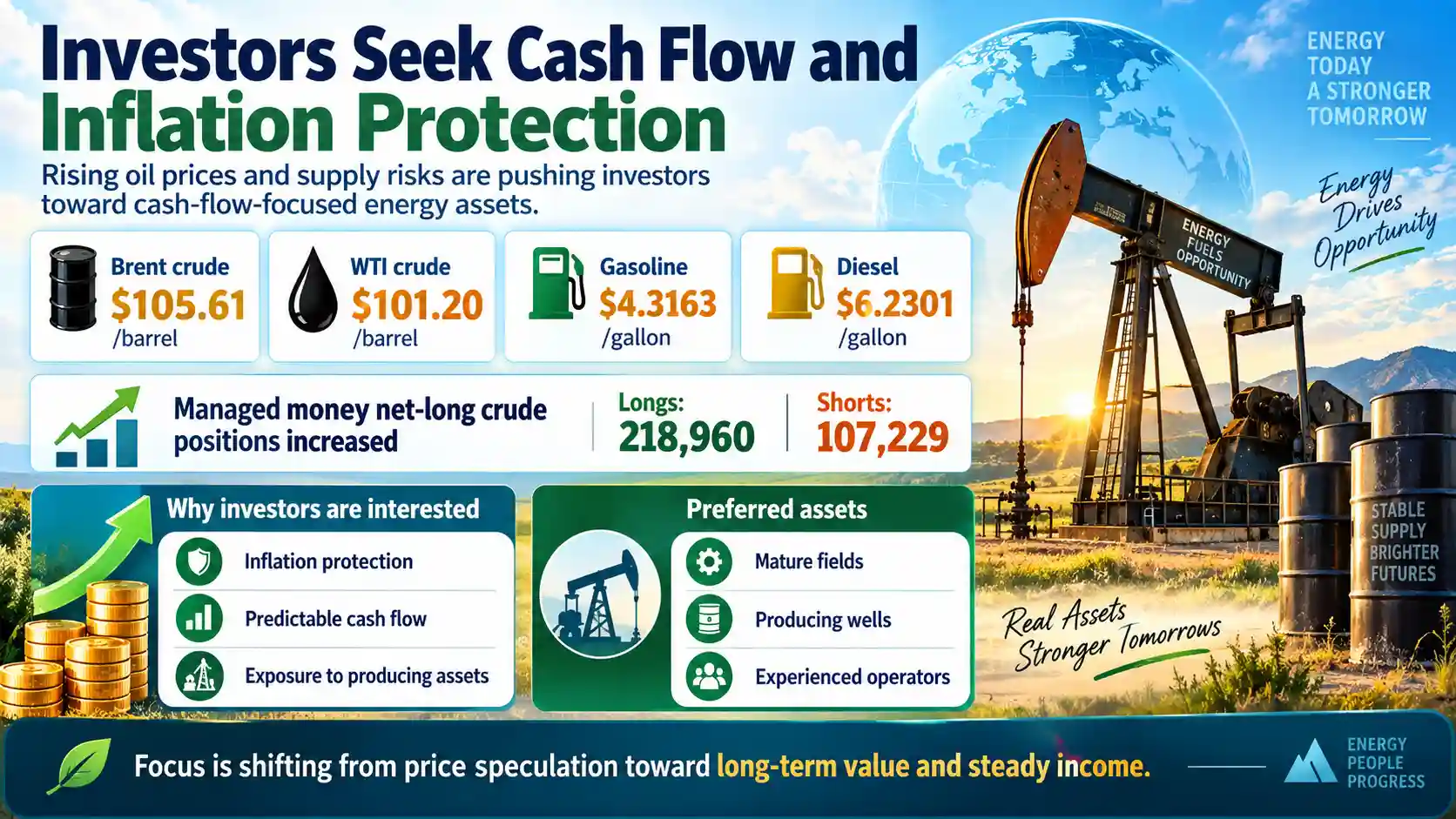
Money managers and hedge funds are also becoming more bullish on oil and gas.
Recent CFTC Commitments of Traders data showed managed money increasing net-long positions in crude oil futures as global supply risks intensified. Long contracts increased by 13,660 to 218,960, while short positions fell by 3,790 to 107,229 contracts.
Oil prices have also continued to rise. Brent crude for November delivery increased 1% to $105.61 per barrel, while WTI crude for October delivery rose 1.1% to $101.20/bbl.
The fuel-price increase has also continued, with average gasoline reaching $4.3163 per gallon and diesel climbing to an all-time high of $6.2301/gallon.
However, volatility remains a challenge. Since the beginning of June, Brent has traded as low as $70.14 a barrel and as high as $102, a spread of about 45%, while prices jumped almost 10% in a single session in July.
Peter Suberlak, director of investments at Tolleson Wealth Management, said clients are typically not betting on price swings. Instead, they seek to hedge against inflation and obtain relatively predictable cash flow.
Investors often target mature fields with producing wells, where experienced operators can reduce costs or improve production, potentially providing reliable income and upside potential.
Outlook
The growing participation of family offices, commodity traders and hedge funds reflects increasing interest in energy assets as investors take longer-term views of demand. While competition and commodity-price volatility remain challenges, smaller opportunities in non-operated assets and producing fields can still attract investors seeking cash flow and longer-term value creation.
As Suberlak noted, longer investment horizons can give family offices time for value creation to emerge, while favoring quality cash-flow investments reduces dependence on accurately predicting commodity prices and the broader market cycle.
FAQs
1. Why are family offices investing more in oil and gas?
Family offices are increasingly interested in oil and gas because of rising energy demand, higher prices and growing supply risks. They are particularly looking at pipelines, export facilities and producing assets as longer-term investments.
2. What types of oil and gas assets are family offices targeting?
Family offices can target smaller opportunities, including non-operated assets worth less than $100 million and mature fields with producing wells that may provide relatively predictable cash flow.
3. Are hedge funds and commodity traders also investing in physical oil and gas assets?
Yes. Firms including Gunvor, Citadel and Vitol have expanded from exchange trading into physical U.S. shale assets and upstream energy production.
4. Why are investors interested in energy infrastructure?
Investors are taking a longer-term view of energy demand and see infrastructure such as pipelines and export facilities as a structural opportunity rather than simply a bet on commodity price movements.
Sources: Crude Oil Prices Today, Yahoo Finance, PRESSBEE
Your financial future isn’t something you wait for—it’s something you build.
The real question is: when do you begin?
Move beyond simply staying informed.
Navigate the markets with clarity—track trends through the Serrari Group Market Index, uncover opportunities in the Serrari Marketplace, and build practical knowledge with our Curated Wealth Builder Platform.
Stay connected to what truly matters.
Get daily insights on macro trends and financial movements across Kenya, Africa, and global markets—delivered through the Serrari Newsletter.
Growth opens doors.
Advance your career through professional programs including ACCA, HESI A2, ATI TEAS 7 , HESI EXIT , NCLEX – RN and NCLEX – PN, Financial Literacy!🌟—designed to move you forward with confidence.
See where money is flowing—clearly and in real time.
Track Money Market Funds, Treasury Bills, Treasury Bonds, Green Bonds, and Fixed Deposits, alongside global and African indexes, key economic indicators, and the evolving Crypto and stablecoin landscape—all within Serrari’s Market Index.