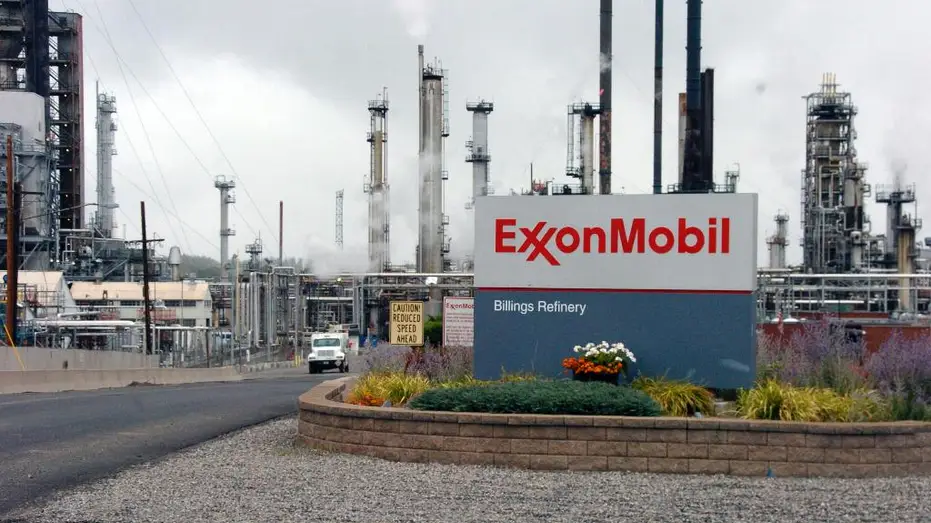
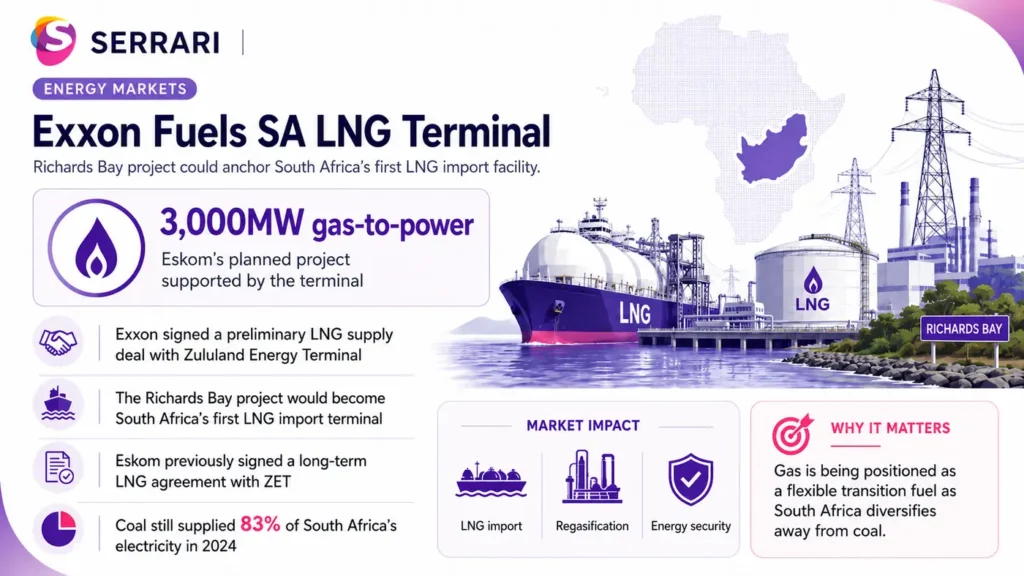
Exxon Mobil has signed a preliminary agreement to supply liquefied natural gas to the planned Zululand Energy Terminal in Richards Bay, a project expected to become South Africa’s first LNG import facility once built. The agreement gives fresh momentum to South Africa’s gas-to-power plans at a time when the country is trying to reduce pressure on coal-fired generation while improving electricity reliability.
The deal follows a separate long-term framework between Eskom and Zululand Energy Terminal, which gives the state utility foundation customer status at the proposed terminal. According to Eskom and ZET’s joint statement, the infrastructure is intended to support Eskom’s planned 3,000MW gas-to-power programme in Richards Bay.
Key Overview
- Exxon Mobil has signed a preliminary LNG supply deal with Zululand Energy Terminal.
- The Richards Bay facility is planned as South Africa’s first LNG import terminal.
- Eskom has signed a heads of agreement with ZET to support a 3,000MW gas-to-power programme.
- The terminal is expected to provide LNG import, storage and regasification infrastructure.
- South Africa still relies heavily on coal, which accounted for 83% of local electricity generation in 2024.
- Exxon has identified South Africa as a priority LNG market as it expands its global LNG portfolio.
- The project supports South Africa’s wider push to diversify power supply and strengthen energy security.
Exxon enters South Africa’s LNG buildout
Exxon’s agreement with Zululand Energy Terminal is preliminary, but strategically important. According to Reuters reporting, the company will supply LNG to the Richards Bay terminal, which is being positioned as the country’s first import facility for the fuel.
For South Africa, the agreement helps address one of the biggest missing pieces in its gas strategy: reliable LNG supply. Building a terminal alone is not enough. The project also needs credible long-term suppliers, commercial offtakers, port infrastructure, regulatory approvals and power demand to anchor the economics.
That is why Exxon’s participation matters. The company has global LNG production and marketing experience and has been working to expand its LNG portfolio. In earlier comments, Exxon said it viewed South Africa as a top-priority market for long-term LNG sales, with South Africa identified as a destination where LNG import infrastructure would need to be developed with partners.
Eskom anchors the demand side
The Exxon-ZET supply arrangement builds on Eskom’s separate agreement with the terminal developer. Eskom and ZET signed a heads of agreement on 5 June 2026, establishing a framework for a long-term strategic partnership. Under that arrangement, Eskom will become a foundation customer at the proposed terminal.
The terminal is designed to offer open-access LNG import, storage and regasification capacity. Regasification is the process of converting imported LNG back into gas so it can be used by power plants and industrial customers. For Eskom, this infrastructure is intended to supply its planned 3,000MW Richards Bay gas-to-power project.
Eskom’s statement says the Richards Bay project will use regasified LNG as the primary fuel source, with the plant expected to operate mainly as a mid-merit facility. That means it would likely run between baseload coal and peak-demand diesel generation, helping balance the grid when demand rises or renewable output fluctuates.
Context is everything. Stay ahead of shifting trends with today’s market updates, and uncover emerging opportunities using the Serrari Group Market Index and Marketplace. Then, take control of your own financial future by exploring our Money & Life Reset Transformation Blueprint ™ to build stronger habits, create better systems, and design a path toward lasting wealth.
Coal dependence drives the gas push
South Africa’s electricity system remains heavily coal-based. According to Statistics South Africa’s energy mix breakdown, coal generated 83% of local electricity in 2024. That dependence has created challenges for emissions, plant reliability and long-term energy security.
Gas is being positioned as part of the transition rather than a full replacement for coal. Supporters argue that LNG can provide flexible generation to back up renewables, reduce dependence on diesel peaking plants and support industrial users that need stable energy supply. Critics, however, often warn that gas infrastructure can lock in fossil fuel use if not carefully managed within a broader decarbonisation strategy.
The trade-off is particularly important for South Africa because it has faced years of electricity shortages and load-shedding risk. The country needs new capacity, but it also needs cleaner and more flexible power sources. LNG-backed gas generation is one route being pursued alongside renewables, transmission expansion and private sector power investment.
Richards Bay becomes a strategic energy hub
Richards Bay is emerging as a key location in South Africa’s energy transition. The port already plays an important role in bulk commodities, and the LNG terminal would add a new layer to its strategic importance. ZET director Oliver Naidu said Exxon’s participation reinforces the role of Richards Bay as an LNG entry point and supports plans to unlock a competitive gas market.
South Africa’s energy guide notes that coal will continue to provide most electricity for the next decade, but the system is undergoing a major shift as private wind, solar and energy infrastructure investment accelerates. The country’s energy market guide also highlights the need for new generation and diversification away from ageing coal-fired power plants.
If completed, the ZET project could become a gateway for LNG imports serving both power generation and industrial demand. The bigger test will be execution: final commercial agreements, financing, permitting, port readiness and grid integration must all align before the terminal and gas-to-power programme can deliver at scale.
For now, Exxon’s supply agreement gives South Africa’s LNG strategy a stronger international partner and moves the country closer to building the import infrastructure needed for a more diversified electricity system.
Sources used: Reuters / Eskom / Zululand Energy Terminal / Statistics South Africa / International Trade Administration
Your financial future isn’t something you wait for—it’s something you build.
The real question is: when do you begin?
Move beyond simply staying informed.
Navigate the markets with clarity—track trends through the Serrari Group Market Index, uncover opportunities in the Serrari Marketplace, and build practical knowledge with our Curated Wealth Builder Platform.
Stay connected to what truly matters.
Get daily insights on macro trends and financial movements across Kenya, Africa, and global markets—delivered through the Serrari Newsletter.
Growth opens doors.
Advance your career through professional programs including ACCA, HESI A2, ATI TEAS 7 , HESI EXIT , NCLEX – RN and NCLEX – PN, Financial Literacy!🌟—designed to move you forward with confidence.
See where money is flowing—clearly and in real time.
Track Money Market Funds, Treasury Bills, Treasury Bonds, Green Bonds, and Fixed Deposits, alongside global and African indexes, key economic indicators, and the evolving Crypto and stablecoin landscape—all within Serrari’s Market Index.