
The European Central Bank (ECB) has begun applying a new climate risk factor within its collateral framework, allowing it to adjust the value of corporate bonds pledged by banks according to their exposure to climate transition risks. The measure aims to strengthen financial stability by ensuring climate-related risks are reflected in monetary policy operations while encouraging greater corporate transparency and credible decarbonization strategies.
Key Overview
- ECB has introduced a new climate factor in its collateral framework.
- Corporate bond values used as collateral will now reflect climate transition risks.
- Companies with higher emissions or weaker transition plans may receive larger valuation haircuts.
- The framework supports the ECB’s broader climate-focused monetary policy strategy.
- The immediate impact on banks is expected to remain limited.
ECB Integrates Climate Risk into Collateral Valuations
The European Central Bank (ECB) has officially begun applying a new “climate factor” within its collateral framework, marking another significant step in integrating climate-related financial risks into Europe’s monetary policy operations.
The new mechanism allows the ECB to adjust the value assigned to corporate bonds pledged by commercial banks as collateral when accessing central bank funding. Bonds issued by companies considered more exposed to climate transition risks will receive larger valuation discounts, reducing the amount banks can borrow against those assets.
The rollout follows plans announced by the ECB last year after climate stress tests on the Eurosystem’s balance sheet showed that climate-related shocks could materially affect the value of financial assets and potentially expose the central bank to financial losses.
Climate Factor Adjusts Corporate Bond Haircuts
Under the new framework, the ECB applies an additional climate-related adjustment to the “haircuts” already used when valuing corporate bonds accepted as collateral.
A haircut refers to the percentage reduction applied to the market value of an asset before determining how much a bank can borrow against it.
With the introduction of the climate factor, corporate bonds issued by companies facing higher climate transition risks will receive larger haircuts, effectively reducing their collateral value.
According to the ECB:
“Put simply, if a corporate issuer is more exposed to future climate transition shocks, a bank may be able to borrow less against the same value of bonds.”
The policy is intended to better reflect climate-related financial risks that traditional valuation models may overlook.
How the ECB Measures Climate Risk
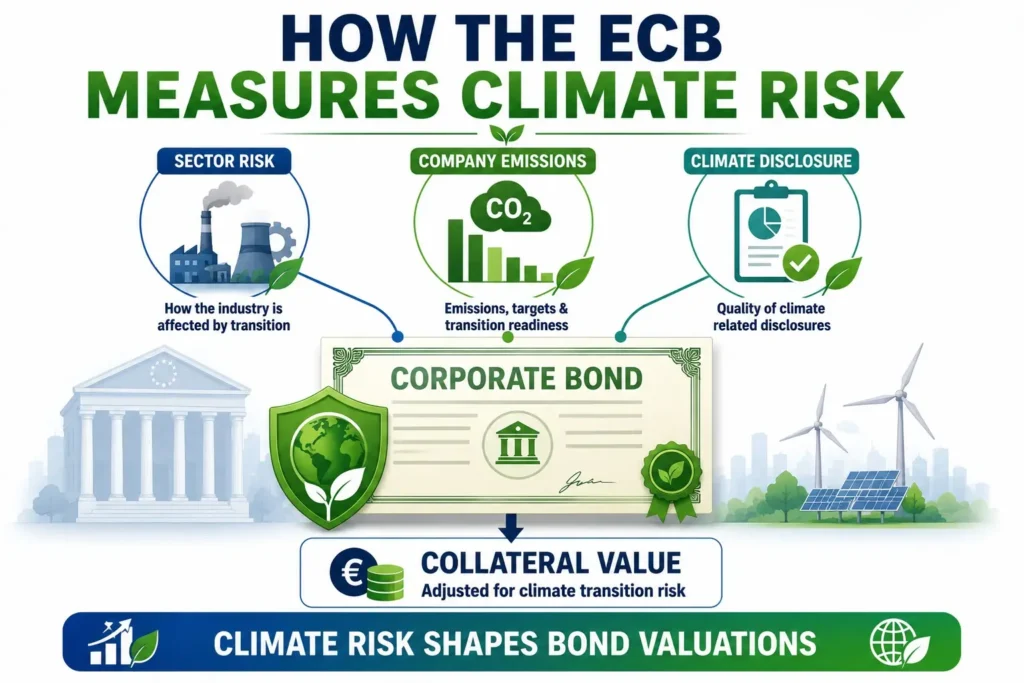
Unlike conventional financial risks that rely heavily on historical market data, climate-related risks require forward-looking analysis because many future climate impacts have no historical precedent.
To address this challenge, the ECB assigns each eligible corporate bond an “uncertainty score“, which measures how vulnerable the issuer is to future climate transition shocks.
The score combines three main components:
- Sector-level stressors, assessing how different industries could be affected by the transition to a low-carbon economy.
- Firm-level exposure, including greenhouse gas emissions, decarbonization targets, and the quality of climate-related disclosures.
- Asset-level vulnerability, evaluating how climate risks could affect the value of specific financial assets.
Companies with high emissions, weak climate transition plans, or limited sustainability disclosures are expected to receive higher uncertainty scores, leading to larger valuation reductions.
High-Emission Industries Face Greater Impact
The ECB expects some sectors to experience greater effects from the new framework than others.
Industries such as utilities, materials, and transportation are considered particularly vulnerable because they typically have:
- Higher greenhouse gas emissions
- Greater dependence on fossil fuels
- Higher capital intensity
- Increased exposure to evolving climate regulations
These characteristics make them more susceptible to policy changes, technological disruption, and shifting consumer preferences associated with Europe’s transition toward a low-carbon economy.
As a result, bonds issued by companies operating in these sectors may receive relatively larger climate haircuts.
Context is everything. Stay ahead of shifting trends with today’s market updates, and uncover emerging opportunities using the Serrari Group Market Index and Marketplace. Then, take control of your own financial future by exploring our Money & Life Reset Transformation Blueprint ™ to build stronger habits, create better systems, and design a path toward lasting wealth.
Part of ECB’s Broader Climate Strategy
The climate factor represents the latest phase of the ECB’s broader effort to incorporate climate considerations into monetary policy.
Since announcing its climate roadmap in 2022, the ECB has introduced several initiatives, including:
- Decarbonizing its corporate bond portfolio.
- Introducing climate-related disclosure requirements for collateral.
- Conducting climate stress tests across the Eurosystem.
- Integrating climate risk into collateral valuation methodologies.
The central bank says these measures are designed to protect the financial system from risks associated with climate change while ensuring its monetary policy framework remains resilient over the long term.
Immediate Impact Expected to Be Limited
Although the policy introduces a significant structural change, the ECB expects its short-term impact on banks to remain relatively modest.
Current borrowing from the central bank remains low, while corporate bonds represent only a limited share of the collateral currently pledged by banks.
The ECB also noted that it will regularly review the climate factor, including its methodology and calibration, as climate data quality improves, disclosure standards evolve, and risk assessment techniques become more sophisticated.
The move follows a broader international trend. The Bank of England recently announced that it will also begin integrating climate transition-related risk factors in its methodology for valuing corporate bonds pledged by banks as collateral, reflecting growing recognition among central banks that climate change represents a material financial stability risk.
Growing Global Shift Toward Climate-Aware Central Banking
Central banks around the world are increasingly incorporating climate-related considerations into financial supervision and monetary policy.
Organizations such as the Organisation for Economic Co-operation and Development (OECD) and the Network for Greening the Financial System (NGFS) have encouraged monetary authorities to better account for climate-related financial risks that could threaten long-term economic stability.
Rather than promoting environmental policy directly, these institutions argue that climate risks increasingly affect asset prices, credit quality, market stability, and financial resilience—making them relevant to central banks’ core mandates.
The ECB’s latest measure reflects this evolving approach by ensuring collateral valuations better capture future climate-related risks alongside traditional financial considerations.
Outlook
The ECB’s introduction of a climate factor into its collateral framework marks another important milestone in integrating climate-related financial risks into central banking. While the immediate impact on banks is expected to remain limited, the new methodology establishes a more forward-looking approach to asset valuation that reflects the growing influence of climate transition risks on financial markets. As climate disclosure standards improve and decarbonization policies continue evolving, similar frameworks are likely to become increasingly common among major central banks. The move also sends a broader market signal that companies with credible transition strategies, stronger climate governance, and greater transparency may benefit from improved financing conditions as sustainable finance continues to mature.
FAQs
1. What is the ECB’s new climate factor?
It is a new mechanism that adjusts the collateral value of corporate bonds based on their exposure to climate transition risks.
2. How does the climate factor affect banks?
Banks may be able to borrow less against corporate bonds issued by companies that face higher climate-related financial risks because those bonds receive larger valuation haircuts.
3. Which companies are most affected?
Firms with higher greenhouse gas emissions, weaker decarbonization plans, or limited climate disclosures—particularly in sectors such as utilities, transportation, and materials—are expected to face larger collateral discounts.
4. Why has the ECB introduced this policy?
The ECB aims to strengthen financial stability by ensuring climate-related risks are reflected in its collateral framework and broader monetary policy operations while improving resilience against future climate-related financial shocks.
Sources: ESG Today, Briefs.co, Luxembourg Times
Your financial future isn’t something you wait for—it’s something you build.
The real question is: when do you begin?
Move beyond simply staying informed.
Navigate the markets with clarity—track trends through the Serrari Group Market Index, uncover opportunities in the Serrari Marketplace, and build practical knowledge with our Curated Wealth Builder Platform.
Stay connected to what truly matters.
Get daily insights on macro trends and financial movements across Kenya, Africa, and global markets—delivered through the Serrari Newsletter.
Growth opens doors.
Advance your career through professional programs including ACCA, HESI A2, ATI TEAS 7 , HESI EXIT , NCLEX – RN and NCLEX – PN, Financial Literacy!🌟—designed to move you forward with confidence.
See where money is flowing—clearly and in real time.
Track Money Market Funds, Treasury Bills, Treasury Bonds, Green Bonds, and Fixed Deposits, alongside global and African indexes, key economic indicators, and the evolving Crypto and stablecoin landscape—all within Serrari’s Market Index.