
The European Central Bank (ECB) will expand the use of its climate factor within the Eurosystem’s collateral framework by applying it to eligible non-financial corporate loans, significantly broadening how climate-related transition risks are reflected in central bank lending operations. The move strengthens the ECB’s risk management framework and highlights the growing integration of climate risk into financial regulation.
Key Overview
- The ECB will extend its climate factor to eligible corporate loans used as collateral.
- Corporate loans account for 29% of pledged collateral, compared with less than 2% for corporate bonds.
- Climate-related reductions in collateral value will be capped at 5%.
- The new framework is expected to be implemented no earlier than the end of 2027.
- The policy embeds climate transition risk more deeply into the Eurosystem’s monetary operations.
ECB Expands Climate Factor to Corporate Loans
The European Central Bank (ECB) has announced plans to extend the application of its climate factor to eligible non-financial corporate bonds claims, significantly expanding the role of climate-related risk within the Eurosystem’s collateral framework.
The climate factor, which took effect for non-financial corporate bonds on 15 June 2026, adjusts the value of assets pledged by banks as collateral when borrowing from the central bank. The latest expansion will apply the same principle to corporate loans—a much larger asset class representing around 29% of pledged collateral, compared with less than 2% for corporate bonds.
The ECB said the move is designed to strengthen its risk management framework by better accounting for financial uncertainties associated with the transition to a low-carbon economy.
Why Climate Risk Matters for Collateral
Under the Eurosystem’s collateral framework, banks pledge assets in exchange for receiving money from central banks.
The ECB said assets exposed to greater climate-related transition risks could experience unexpected declines in value, making them more difficult to liquidate during periods of financial stress. As a result, more climate-sensitive assets will receive larger reductions in their collateral value.
Transition risks considered under the framework include changes in climate policy, technological developments, shifts in consumer preferences, climate-related litigation and broader macroeconomic adjustments that may affect companies’ financial performance.
The central bank emphasized that these risks are treated as financial risks capable of influencing the quality and value of collateral held on the Eurosystem’s balance sheet.
How the Climate Factor Will Be Calculated
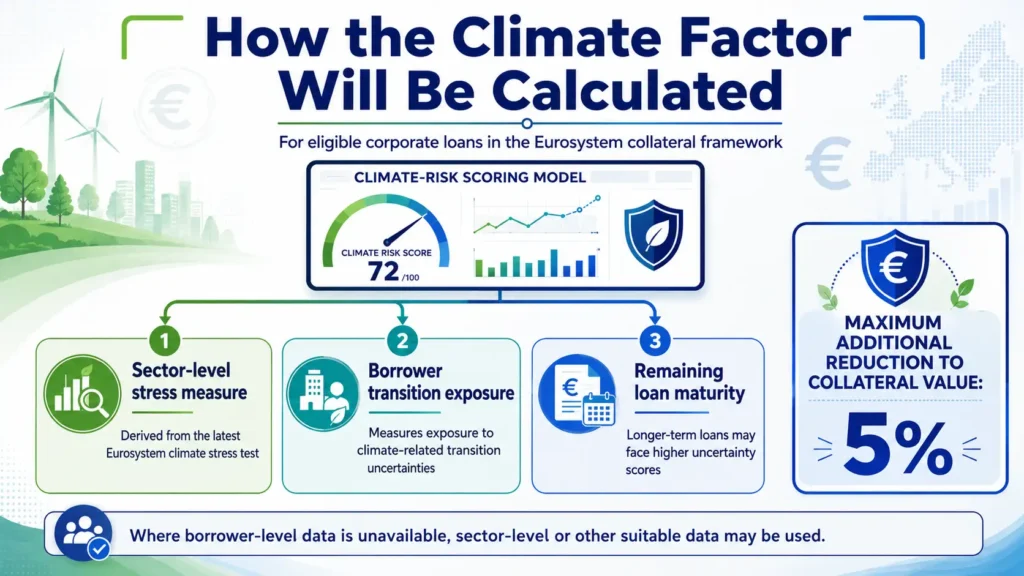
For eligible corporate loans, the climate factor will be based on an asset-level uncertainty score that measures exposure to climate-related transition risks.
The score will combine three main components:
- A sector-level stress measure derived from the latest Eurosystem climate stress test.
- The borrower’s exposure to climate transition uncertainties.
- The remaining maturity of the loan.
Longer-term loans may receive higher uncertainty scores because climate policies, technologies and market conditions are more likely to change over extended periods.
Where detailed borrower-level information is unavailable, the Eurosystem may rely on sector-level or other suitable data to assess climate-related risks.
Across both corporate bonds and corporate loans, the maximum additional reduction applied to collateral value will be 5%. The ECB also confirmed that individual climate factor scores assigned to specific loans will remain confidential.
Implications for Banks
The expanded framework increases the importance of climate-related information within banks’ lending and risk management processes.
Banks may need more comprehensive data on corporate emissions, sector exposure, transition strategies and business resilience to assess how eligible loans could be treated under the collateral framework.
Lower collateral values also affect funding economics. When the ECB assigns a greater haircut to pledged assets, banks receive less central bank liquidity against the same collateral, potentially influencing funding costs, loan pricing and portfolio management decisions.
The policy could encourage lenders to place greater emphasis on borrowers’ transition plans, particularly in sectors facing higher climate-related risks.
Context is everything. Stay ahead of shifting trends with today’s market updates, and uncover emerging opportunities using the Serrari Group Market Index and Marketplace. Then, take control of your own financial future by exploring our Money & Life Reset Transformation Blueprint ™ to build stronger habits, create better systems, and design a path toward lasting wealth.
Building on Earlier Climate Measures
The latest announcement builds on the ECB’s climate factor for corporate bonds, approved in July 2025 and took effect on 15 June 2026.
The initiative follows climate stress tests conducted on the Eurosystem’s balance sheet, which found that climate-related uncertainties could significantly affect the value of financial assets and expose the central bank to losses during periods of market disruption.
The ECB expects to implement the extension to corporate loans no earlier than the end of 2027, with climate factor values updated annually using the latest available climate-related data.
Climate Risk Becomes Core Financial Risk
The decision marks another step in integrating climate considerations into mainstream financial supervision and monetary policy.
Rather than directing capital toward specific sectors, the ECB said the framework reflects its responsibility to manage financial risks affecting collateral quality and the stability of the Eurosystem.
As climate transition risks increasingly influence corporate performance, lenders and investors are expected to place greater emphasis on climate data, transition planning and long-term business resilience when assessing creditworthiness and financial risk.
Outlook
The ECB’s decision signals that climate-related transition risk is becoming a permanent component of Europe’s financial architecture rather than a standalone sustainability consideration. By extending climate adjustments to corporate loans—the largest category of collateral pledged by banks—the central bank is embedding climate risk into day-to-day monetary operations and bank funding. As implementation approaches, euro area lenders are likely to invest more heavily in climate data, borrower assessments and transition-risk analysis, while companies may face greater pressure to demonstrate credible decarbonization strategies. The move also reinforces a broader global trend of financial regulators treating climate risk as a material financial stability issue that influences lending, capital allocation and risk management.
FAQs
1. What is the ECB’s climate factor?
It is a risk adjustment that reduces the collateral value of assets exposed to higher climate-related transition risks when banks borrow from the Eurosystem.
2. What assets will the new rules apply to?
The climate factor will be extended to eligible non-financial corporate loans, in addition to corporate bonds.
3. When will the new framework take effect?
The ECB expects to implement the extension no earlier than the end of 2027, with annual updates thereafter.
4. Why is the ECB introducing these changes?
The central bank aims to strengthen its risk management framework by accounting for the financial risks that climate transition uncertainties can pose to collateral values and financial stability.
Sources: Green Central Banking, ESG Today, The Brussels Times, ESG News
Your financial future isn’t something you wait for—it’s something you build.
The real question is: when do you begin?
Move beyond simply staying informed.
Navigate the markets with clarity—track trends through the Serrari Group Market Index, uncover opportunities in the Serrari Marketplace, and build practical knowledge with our Curated Wealth Builder Platform.
Stay connected to what truly matters.
Get daily insights on macro trends and financial movements across Kenya, Africa, and global markets—delivered through the Serrari Newsletter.
Growth opens doors.
Advance your career through professional programs including ACCA, HESI A2, ATI TEAS 7 , HESI EXIT , NCLEX – RN and NCLEX – PN, Financial Literacy!🌟—designed to move you forward with confidence.
See where money is flowing—clearly and in real time.
Track Money Market Funds, Treasury Bills, Treasury Bonds, Green Bonds, and Fixed Deposits, alongside global and African indexes, key economic indicators, and the evolving Crypto and stablecoin landscape—all within Serrari’s Market Index.