Climate-related risks across EU and EEA banks remained broadly stable during the second half of 2025, according to the European Banking Authority’s ESG risk dashboard. Banks’ exposure to sectors considered major contributors to climate change remained at 62%, while physical climate risk exposure also showed little overall change. At the same time, the EBA reported gradual improvements in the availability and quality of climate-related data, particularly for mortgage portfolios and energy-efficiency assessments.
Key Overview
- EU and EEA banks’ climate risk exposure remained broadly stable between June and December 2025.
- Exposure to sectors considered major contributors to climate change remained at 62%.
- The overall transition risk profile across the EU/EEA banking sector changed little.
- Mortgage portfolios showed gradual improvements in energy-efficiency data quality and availability.
- The share of highly energy-efficient mortgage exposures increased slightly.
- Banks’ exposure to physical climate risks remained broadly unchanged across most jurisdictions.
- Physical climate risk exposure varied significantly between countries, ranging from below 10% to above 55%.
European Banks Maintain Stable Climate Risk Exposure
Climate-related risks across the European banking sector remained broadly stable during the second half of 2025, while banks continued to make gradual progress in collecting and reporting climate-related information.
The findings come from the European Banking Authority (EBA) ESG risk dashboard, which monitors banks’ exposure to environmental, social and governance risks, including both transition and physical climate risks.
Transition risks arise as economies shift towards lower-carbon models, potentially affecting businesses and assets exposed to carbon-intensive activities. Physical risks, meanwhile, stem from the direct effects of climate change, such as extreme weather events and changing environmental conditions.
According to the EBA’s latest assessment, neither risk category showed major changes across the EU and European Economic Area (EEA) banking sector between June to December 2025.
However, the authority noted that improvements in climate-related data are gradually giving banks a stronger basis for identifying and monitoring these risks.
Climate-Intensive Sector Exposure Holds at 62%
One of the key indicators monitored by the EBA is banks’ exposure to sectors considered major contributors to climate change.
Between June and December 2025, these exposures remained broadly unchanged across the EU and EEA at 62 per cent.
Although some individual jurisdictions recorded changes during the period, these movements were not sufficient to materially alter the overall transition risk picture at European level.
The countries and banks with the highest levels of transition-risk exposure also remained largely unchanged.
The stability suggests that the underlying composition of banks’ exposure to climate-sensitive economic activities has not shifted substantially over the period.
For banks and financial regulators, this provides an important measure of how quickly transition-related vulnerabilities are changing as European economies move towards lower-carbon production and investment.
Mortgage Climate Data Continues to Improve
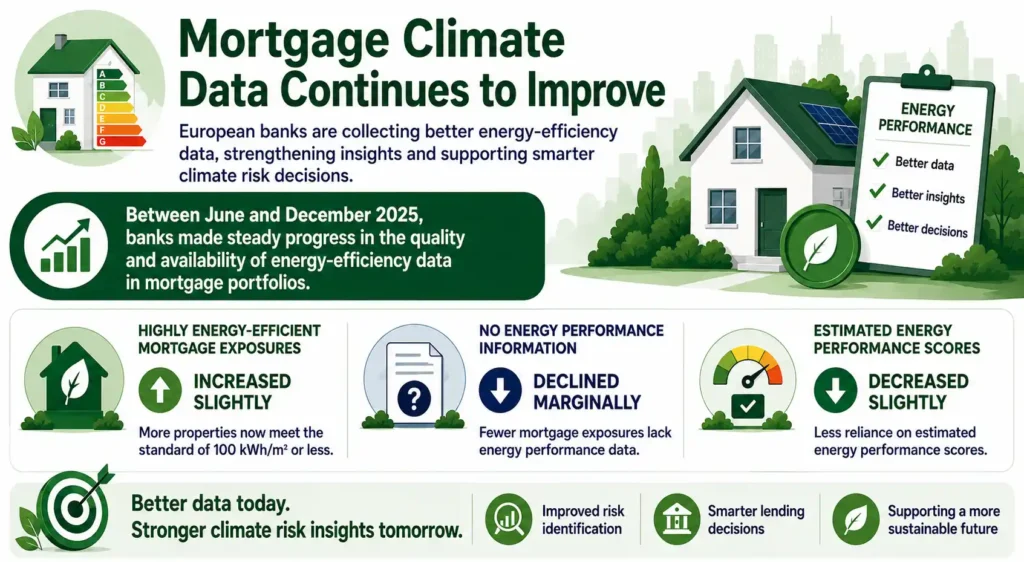
Mortgage portfolios also remained broadly stable, but the EBA identified gradual improvements in the quality of information available on the energy efficiency of properties.
The share of mortgage exposures classified as highly energy efficient, defined by the EBA as properties with energy consumption of 100 kWh per square metre or less, increased slightly.
At the same time, the proportion of mortgage exposures for which no energy performance information was available declined marginally.
The share of mortgage exposures relying on estimated energy performance scores also decreased slightly.
These developments suggest that banks are gradually obtaining more complete and reliable information about the energy characteristics of properties underlying their mortgage portfolios.
Better data can improve banks’ ability to identify climate-related vulnerabilities within real estate lending and strengthen their assessment of potential transition risks associated with energy-inefficient buildings.
Physical Climate Risk Exposure Varies Across Countries
Banks’ exposures considered sensitive to physical climate risks also remained broadly unchanged across most jurisdictions.
However, the EBA highlighted substantial differences between countries.
Average exposure shares ranged from below 10 per cent in some jurisdictions to more than 55 per cent in others.
The variation reflects differences in geographical, economic and sectoral characteristics across European countries. It also reflects differences in how physical climate risks are classified and assessed.
Countries with greater exposure to particular climate hazards or economic activities vulnerable to those hazards may therefore have significantly different risk profiles from other jurisdictions.
The wide variation also highlights why climate risk assessments need to account for country-specific characteristics rather than relying solely on EU-wide averages.
Context is everything. Stay ahead of shifting trends with today’s market updates, and uncover emerging opportunities using the Serrari Group Market Index and Marketplace. Then, take control of your own financial future by exploring our Money & Life Reset Transformation Blueprint ™ to build stronger habits, create better systems, and design a path toward lasting wealth.
Better Climate Data Supports Risk Monitoring
Although the overall level of climate-related exposure remained stable, the EBA’s findings point to gradual progress in the quality and availability of climate-related reporting data.
This is particularly relevant for banks because assessing climate risks requires detailed information about assets, borrowers and underlying economic activities.
For mortgage portfolios, for example, information on energy consumption and building efficiency can help banks better understand their exposure to risks associated with the transition to more energy-efficient buildings.
A reduction in the proportion of mortgages without energy performance information means that banks are gradually gaining greater visibility over the characteristics of their portfolios.
The improvement in data availability can also support more consistent risk assessment and strengthen the ability of regulators and financial institutions to compare exposures.
Implications for Banks and Regulators
The EBA’s findings suggest that climate risk remains a significant consideration for European banks even though overall exposure levels have not changed substantially.
For banks, the continued high exposure to climate-sensitive sectors means that transition risks remain embedded within parts of their lending and investment portfolios.
At the same time, the improvements in climate data provide a stronger foundation for identifying vulnerabilities and integrating climate considerations into risk management.
For regulators, monitoring changes in both exposure levels and data quality remains important. Stable exposure does not necessarily mean that climate risks are static, particularly as the physical impacts of climate change and policy measures supporting the transition to a lower-carbon economy continue to evolve.
The EBA’s dashboard therefore provides an ongoing view of how climate-related risks are developing across the European banking sector.
Outlook
The EBA’s latest ESG risk dashboard indicates that climate-related exposures across EU and EEA banks remained broadly stable during the second half of 2025. Exposure to climate-intensive sectors remained at 62%, while physical climate risk exposure changed little across most jurisdictions.
However, the gradual improvement in climate-related data is an important development. Better information on energy efficiency, particularly within mortgage portfolios, can help banks improve the measurement and management of climate-related financial risks.
Going forward, changes in regulation, energy efficiency requirements, climate impacts and the pace of the low-carbon transition could influence banks’ exposure profiles. Continued improvements in data availability will therefore remain important for European banks and regulators seeking to assess and manage climate risks more effectively.
FAQs
1. What did the EBA find about climate risk exposure in European banks?
The EBA found that climate-related risk exposure across EU and EEA banks remained broadly stable during the second half of 2025.
2. What percentage of bank exposures are linked to climate-intensive sectors?
The share remained at approximately 62% across the EU and EEA between June and December 2025.
3. Is climate-related data improving for European banks?
Yes. The EBA reported gradual improvements in the availability and quality of climate-related data, particularly information on the energy efficiency of properties in mortgage portfolios.
4. How different is physical climate risk exposure between countries?
Exposure varies considerably. Average shares ranged from below 10% in some jurisdictions to more than 55% in others, reflecting differences in geography, economic structures, sectors and risk-assessment approaches.
Sources: Cyprus Mail, European Banking Authority, FinTech Global
Your financial future isn’t something you wait for—it’s something you build.
The real question is: when do you begin?
Move beyond simply staying informed.
Navigate the markets with clarity—track trends through the Serrari Group Market Index, uncover opportunities in the Serrari Marketplace, and build practical knowledge with our Curated Wealth Builder Platform.
Stay connected to what truly matters.
Get daily insights on macro trends and financial movements across Kenya, Africa, and global markets—delivered through the Serrari Newsletter.
Growth opens doors.
Advance your career through professional programs including ACCA, HESI A2, ATI TEAS 7 , HESI EXIT , NCLEX – RN and NCLEX – PN, Financial Literacy!🌟—designed to move you forward with confidence.
See where money is flowing—clearly and in real time.
Track Money Market Funds, Treasury Bills, Treasury Bonds, Green Bonds, and Fixed Deposits, alongside global and African indexes, key economic indicators, and the evolving Crypto and stablecoin landscape—all within Serrari’s Market Index.