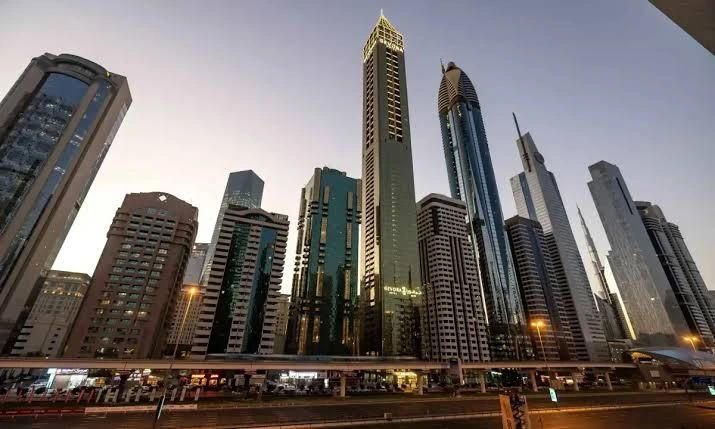
The Dubai real estate market is showing signs of cooling as the Middle East conflict weighs on investor sentiment and expands room for price negotiations. While property prices have softened and transaction values have declined, developers remain optimistic that demand in the UAE housing market will recover as economic conditions stabilize.
Key Overview
- Dubai real estate shifts toward a buyer’s market.
- Middle East conflict dampens investor sentiment.
- Property prices decline by 5% to 20% in many areas.
- Luxury property transactions weaken significantly.
- Domestic buyers continue supporting demand.
- Emaar launches a $55 billion development project.
- Developers remain confident in long-term market recovery.
- Analysts expect demand to improve after the summer.
Dubai Real Estate Market Cools as Buyers Gain Negotiating Power
The Dubai real estate market is entering a period of adjustment as uncertainty surrounding the Middle East conflict has softened buyer sentiment and shifted market dynamics in favor of purchasers. After several years of rapid price appreciation, the market is experiencing slower activity, declining transaction values and greater flexibility in pricing, creating new opportunities for homebuyers and long-term real estate investment.
Despite the recent slowdown, leading developers and market analysts remain confident that the UAE housing market will recover as geopolitical tensions ease and seasonal demand returns.
Middle East Conflict Reshapes Market Sentiment
Real estate professionals say the ongoing Middle East conflict has created uncertainty among both local and international buyers, resulting in more cautious purchasing decisions.
According to market participants, investor sentiment has become divided. While some buyers believe the conflict could have lasting implications for the region’s property market, others view the current conditions as an attractive opportunity to acquire assets at more favorable prices. Although buyer activity has not disappeared, negotiations have become more flexible as sellers adjust expectations to changing market conditions.
The shift has transformed what was previously a strong seller’s market into one where buyers have considerably greater negotiating power.
Property Prices Ease After Years of Rapid Growth
The recent slowdown follows an extraordinary period of growth in Dubai property values.
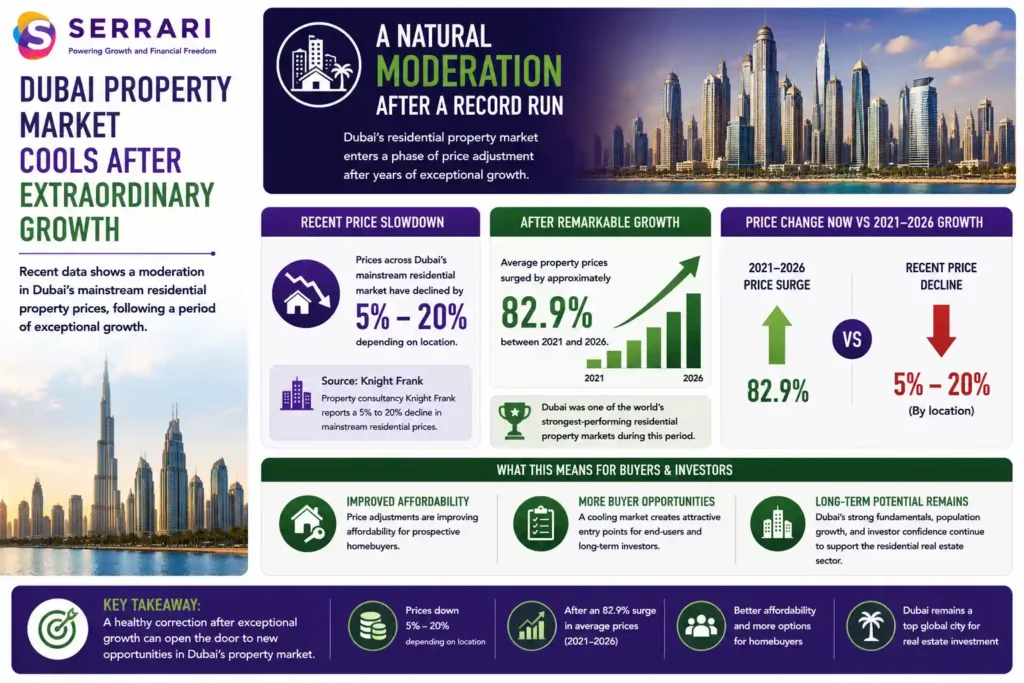
According to property consultancy Knight Frank, prices across the city’s mainstream residential market have declined by between 5% and 20%, depending on location. The moderation comes after average property prices surged by approximately 82.9% between 2021 and 2026, making Dubai one of the world’s strongest-performing residential property markets during that period.
While the recent price adjustments may concern some investors, they also improve affordability for prospective homebuyers seeking opportunities in the city’s residential real estate sector.
Luxury Segment Experiences Sharp Decline
The slowdown has been particularly noticeable within Dubai’s luxury property market.
According to Betterhomes, citing official market data, the total value of property transactions during the second quarter of 2026 declined by 45% compared with the same period a year earlier. High-end residential properties accounted for much of this decline as affluent buyers adopted a more cautious approach amid regional uncertainty.
Despite weaker transaction volumes, the market continues to record significant high-value sales. Developer Binghatti reported selling two luxury apartments in central Dubai during June for approximately $54 million and $19 million, demonstrating that demand remains present for premium assets even as broader market activity slows.
Context is everything. Stay ahead of shifting trends with today’s market updates and uncover emerging opportunities using the Serrari Group Market Index and Marketplace. Then, take control of your own financial future by exploring our Money & Life Reset Transformation Blueprint ™ to build stronger habits, create better systems, and design a path toward lasting wealth.
Domestic Buyers Continue Supporting Demand
Although international investor activity has softened, Dubai residents continue to play an increasingly important role in sustaining the market.
Industry leaders note that much of the current real estate demand is being driven by local buyers rather than overseas investors. This shift has helped stabilize activity despite reduced foreign investment and reflects the growing participation of residents seeking long-term housing or investment opportunities within the emirate.
Market analysts also point out that the current period traditionally represents a seasonal slowdown, suggesting that part of the decline reflects normal market patterns rather than geopolitical developments alone.
Developers Remain Confident in Long-Term Growth
Despite the recent cooling, major developers continue to demonstrate confidence in the long-term outlook for Dubai real estate.
Last month, Emaar unveiled a $55 billion mixed-use development in the heart of Dubai that is expected to accommodate approximately 150,000 residents. The announcement signals continued confidence in the city’s long-term population growth and its ability to attract residents, businesses and investors once market conditions stabilize.
Large-scale projects of this nature suggest developers continue to view the current slowdown as temporary rather than a structural shift in the Gulf property market.
Recovery Expected After the Summer
Industry experts believe activity is already beginning to improve following the initial market disruption.
According to Betterhomes, buyer inquiries and completed transactions started increasing during June and continued to strengthen into July. Market participants expect real estate demand to recover further as Dubai moves beyond the traditional summer slowdown and geopolitical uncertainty gradually subsides.
If regional stability improves, investor confidence could return, supporting renewed activity across both mainstream and luxury segments of the UAE housing market.
Outlook for Dubai Real Estate
The recent slowdown in Dubai real estate reflects the impact of the Middle East conflict on investor sentiment rather than a collapse in the market’s underlying fundamentals. Although property prices have moderated and transaction values have declined, continued demand from Dubai residents, ongoing large-scale development projects and expectations of stronger activity after the summer suggest that the market retains solid long-term prospects.
For homebuyers, the current environment offers greater negotiating power and improved affordability compared with recent years. For investors, the coming months will provide important insight into whether confidence returns as geopolitical tensions ease and activity across the Gulf property market recovers.
FAQs
Why is Dubai real estate slowing down?
The Dubai real estate market has cooled as uncertainty surrounding the Middle East conflict has made many investors more cautious. At the same time, the market is entering its traditional summer slowdown, contributing to weaker transaction activity.
How much have Dubai property prices fallen?
According to Knight Frank, property prices across Dubai’s mainstream residential market have declined by between 5% and 20%, depending on location, following several years of strong growth.
Is demand for Dubai property disappearing?
No. While international investor activity has softened, Dubai residents continue to support real estate demand, and market participants report that buyer activity has begun recovering in recent weeks.
What is the outlook for the UAE housing market?
The outlook for the UAE housing market remains cautiously positive. Although geopolitical uncertainty has affected short-term sentiment, continued investment by major developers and expectations of stronger demand after the summer suggest the market could regain momentum as conditions stabilize.
Your financial future isn’t something you wait for—it’s something you build.
The real question is: when do you begin?
Move beyond simply staying informed.
Navigate the markets with clarity—track trends through the Serrari Group Market Index, uncover opportunities in the Serrari Marketplace, and build practical knowledge with our Curated Wealth Builder Platform.
Stay connected to what truly matters.
Get daily insights on macro trends and financial movements across Kenya, Africa, and global markets—delivered through the Serrari Newsletter.
Growth opens doors.
Advance your career through professional programs including ACCA, HESI A2, ATI TEAS 7 , HESI EXIT , NCLEX – RN and NCLEX – PN, Financial Literacy!🌟—designed to move you forward with confidence.
See where money is flowing—clearly and in real time.
Track Money Market Funds, Treasury Bills, Treasury Bonds, Green Bonds, and Fixed Deposits, alongside global and African indexes, key economic indicators, and the evolving Crypto and stablecoin landscape—all within Serrari’s Market Index.