
The CBK crypto rules establish Kenya’s first comprehensive regulatory framework for virtual asset service providers (VASPs), introducing licensing, capital and liquidity requirements for cryptocurrency businesses. The regulations are designed to strengthen financial regulation, enhance consumer protection and support the sustainable growth of Kenya fintech while safeguarding the country’s rapidly expanding digital assets market.
Key Overview
- CBK introduces comprehensive crypto regulations.
- Stablecoin issuers require KSh300 million in capital.
- Virtual asset exchanges need KSh100 million minimum capital.
- Wallet providers must maintain KSh150 million in paid-up capital.
- The new licensing framework covers all virtual asset service providers.
- Regulations strengthen investor protection and AML compliance.
- Kenya aims to create a safer digital assets ecosystem.
- New rules take effect under Legal Notice No. 134 of 2026.
CBK Crypto Rules Introduce New Licensing and Capital Requirements
The Central Bank of Kenya (CBK) has introduced sweeping CBK crypto rules that establish the country’s first comprehensive framework for regulating cryptocurrency businesses. Published under Legal Notice No. 134 of 2026, the new regulations set out licensing, capital, liquidity and consumer protection requirements for virtual asset service providers (VASPs) operating in Kenya. The move represents a major milestone for the country’s digital finance sector, providing greater regulatory certainty for businesses while strengthening safeguards for investors participating in the growing digital assets market.
The regulations come as Kenya continues to rank among Africa’s leading cryptocurrency markets, driven by widespread mobile money adoption, a vibrant fintech ecosystem and increasing use of digital assets for investment and cross-border payments.
CBK Sets New Capital Requirements for Crypto Firms
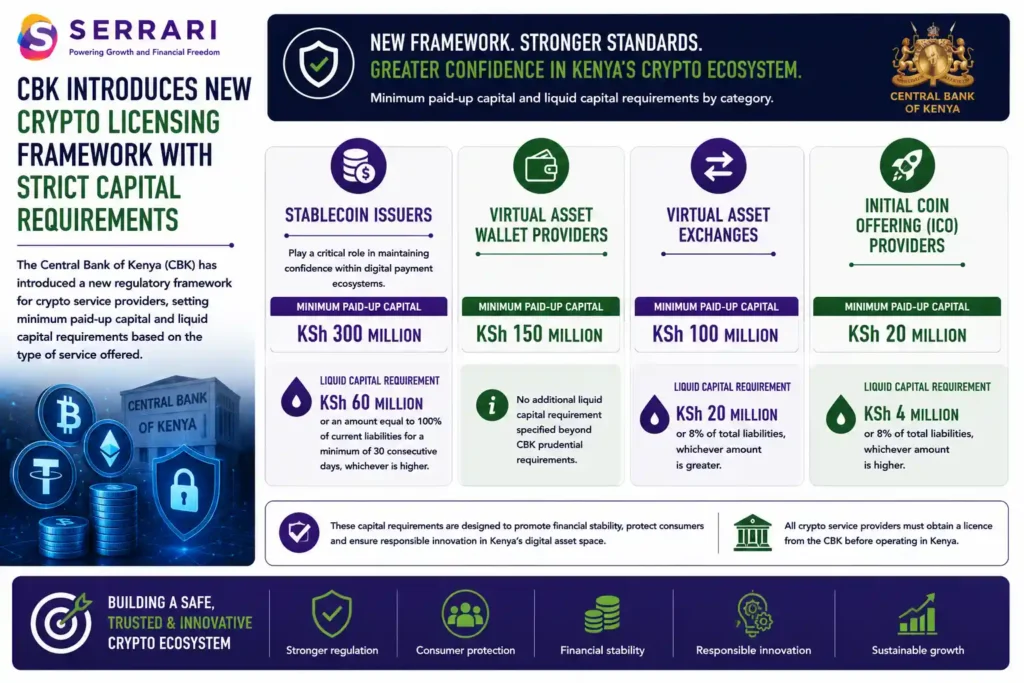
Under the new framework, different categories of crypto firms will be required to meet minimum paid-up capital thresholds before receiving operating licences.
Stablecoin issuers face the highest requirement, with a minimum paid-up capital of KSh300 million. They must also maintain liquid capital of at least KSh60 million, or an amount equal to 100% of their current liabilities for a minimum of 30 consecutive days, whichever is higher. The requirement reflects the critical role stablecoin issuers play in maintaining confidence within digital payment ecosystems.
Virtual asset wallet providers are required to maintain a minimum paid-up capital of KSh150 million, while virtual asset exchanges must hold at least KSh100 million in paid-up capital. Exchanges must also maintain liquid capital of KSh20 million or 8% of their total liabilities, whichever amount is greater.
Meanwhile, providers facilitating Initial Coin Offerings (ICOs) will need a minimum paid-up capital of KSh20 million, alongside liquid capital of at least KSh4 million or 8% of total liabilities, whichever is higher.
Context is everything. Stay ahead of shifting trends with today’s market updates and uncover emerging opportunities using the Serrari Group Market Index and Marketplace. Then, take control of your own financial future by exploring our Money & Life Reset Transformation Blueprint ™ to build stronger habits, create better systems, and design a path toward lasting wealth.
New Framework Strengthens Crypto Licensing
The regulations introduce a formal crypto licensing regime that establishes clear entry requirements for businesses seeking to operate within Kenya’s cryptocurrency industry.
In addition to meeting capital and liquidity standards, firms will be required to comply with operational, governance and consumer protection obligations before obtaining approval to offer virtual asset services. The framework is expected to provide greater regulatory certainty for both domestic and international firms looking to expand within Kenya’s rapidly growing digital finance sector.
By establishing clear licensing standards, the Central Bank of Kenya (CBK) aims to encourage responsible innovation while reducing risks associated with unregulated cryptocurrency activities.
Investor Protection and Financial Regulation
A key objective of the new CBK crypto rules is strengthening financial regulation and protecting consumers participating in the virtual assets market.
The capital and liquidity requirements are intended to ensure licensed providers maintain sufficient financial resources to meet customer obligations and continue operating during periods of market stress. Higher capital thresholds also reduce the risk of insolvency while encouraging stronger governance and financial management practices across the industry.
The framework provides investors with greater confidence that licensed operators meet minimum financial standards established by regulators.
Anti-Money Laundering Measures Remain a Priority
The new regulations also reinforce Kenya’s efforts to strengthen anti-money laundering (AML) safeguards within the cryptocurrency sector.
By introducing formal licensing requirements and prudential standards for virtual asset service providers (VASPs), the framework supports greater regulatory oversight of businesses involved in digital asset transactions. Enhanced supervision is expected to improve transparency while helping authorities monitor compliance with existing financial crime regulations.
These measures align with broader international efforts to strengthen oversight of virtual asset markets while reducing opportunities for illicit financial activity.
Supporting Kenya’s Growing Digital Assets Market
Kenya has emerged as one of Africa’s most active cryptocurrency markets, supported by widespread smartphone adoption, advanced mobile payment systems and increasing public interest in blockchain technology.
According to government estimates, Kenyans hold approximately KSh155 trillion in virtual assets, while the country’s virtual currency market was estimated at around KSh520 billion in 2024. Industry observers believe the market has expanded significantly over the past two years as digital asset adoption continues to accelerate.
The regulations are intended to balance innovation with oversight by creating a more predictable operating environment for businesses while protecting consumers participating in the fast-growing digital assets ecosystem.
Capital Requirements Lower Than Earlier Proposal
Although the regulations introduce substantial capital requirements, they are less stringent than those proposed in the earlier draft framework.
Following consultations with industry stakeholders, the government reduced the minimum paid-up capital requirement for stablecoin issuers from KSh500 million to KSh300 million, representing a 40% reduction. The revision lowers one of the biggest barriers to market entry while maintaining robust financial safeguards for firms operating within the sector.
The adjustment reflects a regulatory approach that seeks to encourage innovation without compromising financial stability or investor protection.
Outlook for Kenya’s Cryptocurrency Regulation
The new CBK crypto rules mark a significant step forward in the development of cryptocurrency regulation in Kenya. By introducing clear licensing requirements, differentiated capital thresholds and stronger prudential standards for crypto firms, the Central Bank of Kenya (CBK) is creating a more structured regulatory environment for the country’s rapidly expanding digital assets market.
As adoption of cryptocurrencies and stablecoins continues to grow, the new framework is expected to strengthen investor confidence, improve anti-money laundering (AML) compliance and support the long-term development of Kenya fintech. With greater regulatory clarity now in place, licensed virtual asset service providers (VASPs) will be better positioned to innovate while operating within a transparent and well-supervised financial system.
FAQs
What are the new CBK crypto rules?
The CBK crypto rules, introduced under Legal Notice No. 134 of 2026, establish Kenya’s first comprehensive regulatory framework for virtual asset service providers (VASPs). They include licensing, capital, liquidity and consumer protection requirements for cryptocurrency businesses.
How much capital must stablecoin issuers maintain?
Stablecoin issuers must maintain a minimum paid-up capital of KSh300 million and liquid capital of at least KSh60 million, or an amount equal to 100% of their current liabilities for at least 30 consecutive days, whichever is higher.
What are the capital requirements for other crypto firms?
Virtual asset wallet providers are required to maintain KSh150 million in paid-up capital, cryptocurrency exchanges must hold KSh100 million, while ICO service providers are required to maintain KSh20 million in paid-up capital together with prescribed liquidity requirements.
Why has CBK introduced these regulations?
The regulations are intended to strengthen cryptocurrency regulation, improve investor protection, enhance anti-money laundering (AML) compliance and create a predictable regulatory framework that supports innovation and sustainable growth across Kenya fintech and the broader digital assets industry.
Sources: Kenyan Wallstreet, The Star, Kenyans.co, Tuko
Your financial future isn’t something you wait for—it’s something you build.
The real question is: when do you begin?
Move beyond simply staying informed.
Navigate the markets with clarity—track trends through the Serrari Group Market Index, uncover opportunities in the Serrari Marketplace, and build practical knowledge with our Curated Wealth Builder Platform.
Stay connected to what truly matters.
Get daily insights on macro trends and financial movements across Kenya, Africa, and global markets—delivered through the Serrari Newsletter.
Growth opens doors.
Advance your career through professional programs including ACCA, HESI A2, ATI TEAS 7 , HESI EXIT , NCLEX – RN and NCLEX – PN, Financial Literacy!🌟—designed to move you forward with confidence.
See where money is flowing—clearly and in real time.
Track Money Market Funds, Treasury Bills, Treasury Bonds, Green Bonds, and Fixed Deposits, alongside global and African indexes, key economic indicators, and the evolving Crypto and stablecoin landscape—all within Serrari’s Market Index.