Brazil’s central bank will restrict virtual assets, including stablecoins, from settling a specific type of international payment flow from October 1. The rule targets the settlement leg between regulated foreign-exchange providers and their overseas counterparties, while individual international virtual-asset transfers remain permitted.
Key Overview
- The restriction takes effect on October 1.
- It applies to the settlement leg between regulated FX providers and overseas counterparties.
- Settlement must use a licensed FX transaction or qualifying non-resident real account.
- Individual international transfers using virtual assets remain permitted.
- The rule addresses ambiguity under Brazil’s 2022 virtual assets law.
- Stablecoins accounted for close to 80% of Brazil’s declared crypto volume in 2025.
Brazil Tightens Stablecoin Settlement Rules
Brazil’s central bank will bar virtual assets, including stablecoins, from settling one specific type of international payment flow starting October 1.
Resolution 561 targets the settlement leg between regulated foreign-exchange providers and their overseas counterparties. Under the new requirement, that settlement leg must run through a licensed foreign-exchange transaction or a qualifying non-resident real account.
However, individual international transfers using virtual assets remain permitted under Brazil’s existing framework.
Oscar Guillermo Farah Osorio, founding partner at Zanella & Farah, described the move to CryptoSlate as resolving what he viewed as genuine ambiguity.
Brazil’s 2022 virtual assets law had already given the central bank authority to determine which crypto operations count as foreign-exchange activity. Specific rules had not followed, leaving a gap that some market participants used.
How the eFX Model Is Affected
The eFX model allows providers to bundle multiple individual payments together, netting balances across an entire day before settling once with their foreign counterparty.
This structure is particularly suited to high-volume, low-value transactions such as streaming subscriptions, online gaming payments and e-commerce transactions.
Farah said Resolution 561 directly closes the ambiguity by giving the central bank clearer visibility into flows that previously could not be fully seen within the formal exchange system.
The practical effect is the removal of one settlement method rather than the elimination of the broader structure. Providers can still consolidate balances before settlement through permitted channels and can also use individual virtual-asset transfers outside the restricted eFX settlement arrangement.
What Remains Possible With Stablecoins
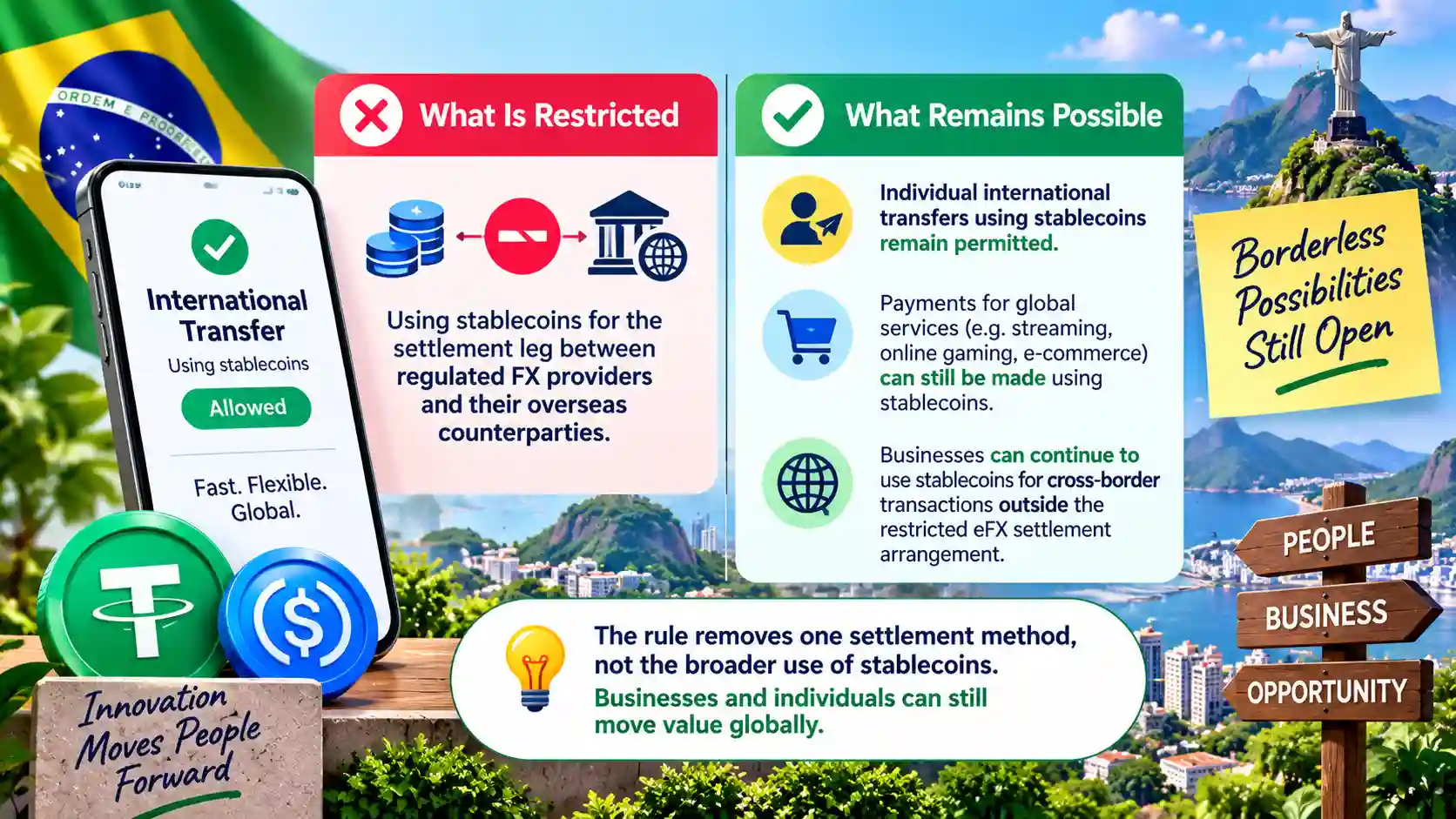
The specific combination of stablecoin settlement with bulk aggregation is what disappears under the new rule.
Farah argued that this combination was where much of the cost advantage existed. Losing that option could require businesses to absorb Brazil’s financial transaction tax on conventional FX conversions.
They could also face correspondent-bank and SWIFT-network fees that stablecoin settlement previously avoided. Farah expects these additional costs could eventually reach Brazilian consumers and businesses.
Brazil’s tax authority recorded R$1.13 trillion in declared stablecoin transactions between August 2019 and December 2025, representing roughly 72% of all declared crypto activity during that period. Stablecoins accounted for close to 80% of declared volume in 2025, with USDT representing nearly 89% of the stablecoin total.
Stablecoin Costs and Cross-Border Payments
A July Bank of Italy study examined USDC transfers of $200 across ten international corridors, including Brazil. The study found total costs ranging from 0.3% to nearly 9%, with no consistent advantage over conventional payment channels.
The study did not specifically examine Resolution 561. It also found that the blockchain transfer itself represented only a marginal portion of total costs, while currency conversion and local payment infrastructure accounted for most of the expense.
Settlement took less than 20 minutes where instant payment systems existed, while it took one to two business days elsewhere.
The Financial Stability Board reached a similar conclusion in July, according to the source.
Context is everything. Stay ahead of shifting trends with today’s market updates, and uncover emerging opportunities using the Serrari Group Market Index and Marketplace. Then, take control of your own financial future by exploring our Money & Life Reset Transformation Blueprint ™ to build stronger habits, create better systems, and design a path toward lasting wealth.
Stablecoins as Financial Infrastructure
The source suggests that stablecoins’ near-term value could increasingly sit within hybrid arrangements built around existing bank money and settlement systems rather than functioning as standalone global payment rails.
Cregis CEO Shawn Yan said brokers are using stablecoins for treasury management, liquidity movement between entities and internal settlement, much of which remains invisible to end customers.
As volumes grow, Yan said the question is shifting toward how much of this infrastructure brokers want to control directly, including fund location, transaction speed and internal approval processes.
He said the core business remains FX, while the infrastructure supporting it is changing.
“You can’t build the model around one assumption about how stablecoins will be treated everywhere.”
Regulatory Uncertainty Remains
Farah also raised a question about why individual international stablecoin transfers remain permitted while the aggregated eFX version does not.
He noted that regulated providers could potentially supply the same underlying transaction data to the central bank under either structure.
Farah interprets the rule primarily as an effort to keep flows within channels the central bank can already see and control, rather than a conceptual change in how regulators classify stablecoins.
Outlook
The source presents two possible outcomes.
Under one scenario, Brazil’s explicit boundary could reduce legal uncertainty, with larger firms obtaining the necessary permissions, partnering with licensed institutions and developing standardized compliance processes.
Under another, the required settlement path could add enough FX, banking and correspondent costs to reduce the advantage of stablecoins for Brazil-linked flows. Smaller payment firms could also find it difficult to justify separate infrastructure for one market.
Brazil’s October rule therefore highlights how the practical use of stablecoins for cross-border payments can depend on the specific settlement structure and regulatory requirements of each market.
FAQs
1. What does Brazil’s Resolution 561 restrict?
It restricts the use of virtual assets, including stablecoins, to settle the settlement leg between regulated foreign-exchange providers and their overseas counterparties.
2. When does the new restriction take effect?
The restriction takes effect on October 1.
3. Can individuals still make international transfers using stablecoins?
Yes. Individual international transfers using virtual assets remain permitted under Brazil’s existing framework.
4. Why could the new rule increase costs?
The restricted settlement structure could require businesses to use conventional FX conversions, correspondent banks and SWIFT networks, potentially adding financial transaction, banking and settlement costs.
Your financial future isn’t something you wait for—it’s something you build.
The real question is: when do you begin?
Move beyond simply staying informed.
Navigate the markets with clarity—track trends through the Serrari Group Market Index, uncover opportunities in the Serrari Marketplace, and build practical knowledge with our Curated Wealth Builder Platform.
Stay connected to what truly matters.
Get daily insights on macro trends and financial movements across Kenya, Africa, and global markets—delivered through the Serrari Newsletter.
Growth opens doors.
Advance your career through professional programs including ACCA, HESI A2, ATI TEAS 7 , HESI EXIT , NCLEX – RN and NCLEX – PN, Financial Literacy!🌟—designed to move you forward with confidence.
See where money is flowing—clearly and in real time.
Track Money Market Funds, Treasury Bills, Treasury Bonds, Green Bonds, and Fixed Deposits, alongside global and African indexes, key economic indicators, and the evolving Crypto and stablecoin landscape—all within Serrari’s Market Index.