Africa could unlock significantly more capital for its own development by redirecting part of the continent’s banking liquidity and foreign-exchange reserves toward domestic and regional investment, according to Central Bank of Egypt Governor Hassan Abdalla.
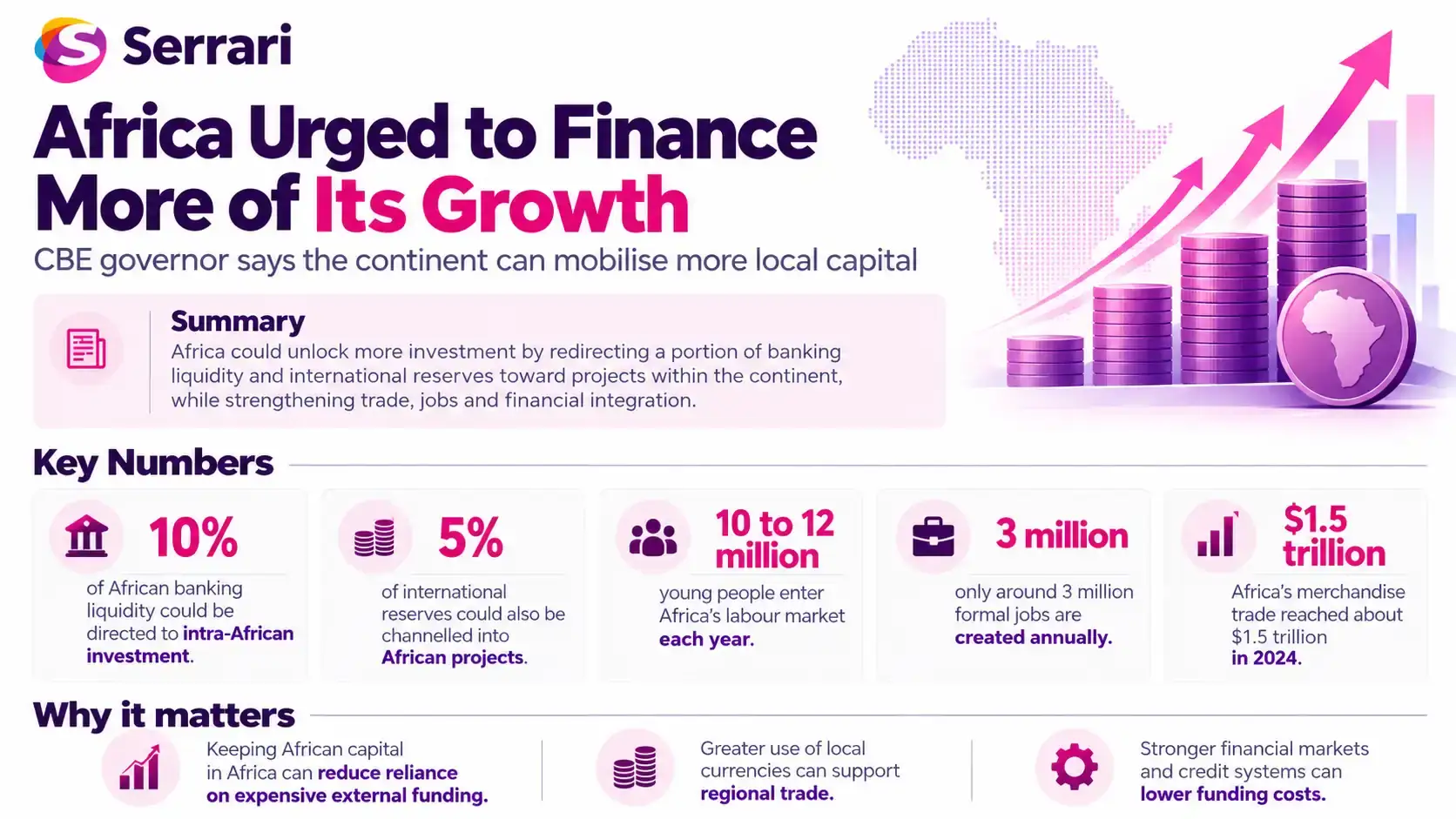
Speaking at the inaugural Alamein Africa Forum in Egypt, Abdalla proposed that African economies consider directing 10% of banking liquidity and 5% of international reserves toward investments within the continent.
The proposal reflects a broader push to reduce Africa’s dependence on expensive external financing, strengthen regional financial markets and ensure that more African savings are ultimately deployed to finance African businesses, infrastructure and trade.
Key Overview
- Africa could direct 10% of banking liquidity toward investments within the continent.
- A further 5% of international reserves could potentially support intra-African investment.
- Greater use of African currencies could reduce reliance on external reserve currencies in regional trade.
- Between 10 million and 12 million young Africans enter the labour force each year, compared with about 3 million formal jobs created annually.
- Africa needs deeper capital markets, stronger banks and improved credit-rating systems to attract investment.
- Egypt has signed around 15 cooperation agreements with African central banks.
- Africa’s merchandise trade reached approximately $1.5 trillion in 2024, highlighting the scale of capital required to support regional commerce.
Keeping More African Capital Within Africa
A major challenge facing African economies is that locally generated savings often leave the continent before returning through international investment vehicles at a higher cost.
Abdalla argued that keeping more of this capital within African markets could strengthen investment, support financial integration and reduce dependence on foreign financing.
Redirecting even a relatively small portion of banking liquidity could create a larger pool of capital for infrastructure, industrial development, energy, agriculture and private-sector expansion.
The proposal does not mean countries would simply spend their reserves. Foreign-exchange reserves remain critical for exchange-rate stability, imports and external debt obligations. Any reallocation would therefore need clear risk-management rules, liquidity safeguards and appropriate investment structures.
The broader objective is to develop financial instruments capable of converting Africa’s accumulated savings into productive long-term investment.
Local Currencies Could Strengthen Regional Trade
Abdalla also called for greater use of African currencies in trade between countries on the continent.
Today, many cross-border African transactions require conversion through currencies such as the US dollar or euro. This can increase transaction costs and create additional demand for scarce foreign currency.
Africa is already building systems designed to reduce these inefficiencies. Recent payment infrastructure developments now allow participating institutions to make cross-border settlements in local currencies, reducing reliance on traditional correspondent banking arrangements.
Expanding such systems could become increasingly important as the African Continental Free Trade Area encourages higher volumes of regional commerce.
The potential market is substantial. Africa’s total merchandise trade reached about $1.5 trillion in 2024, while trade between African countries increased 12.4% to $220.3 billion.
Capturing a larger share of those transactions through African financial institutions could help retain liquidity within the continent.
Context is everything. Stay ahead of shifting trends with today’s market updates, and uncover emerging opportunities using the Serrari Group Market Index and Marketplace. Then, take control of your own financial future by exploring our Money & Life Reset Transformation Blueprint ™ to build stronger habits, create better systems, and design a path toward lasting wealth.
Africa’s Jobs Challenge Adds Urgency
Mobilising investment is particularly important because Africa’s demographic growth is rapidly increasing demand for employment.
Around 10 million to 12 million young people enter Africa’s workforce annually, while the continent creates only about three million formal jobs each year.
That imbalance means millions of young Africans enter informal employment, remain unemployed or struggle to find opportunities matching their skills.
Greater investment alone will not solve the problem, but directing capital toward productive businesses, manufacturing, technology, agriculture and infrastructure could help expand the private sector and increase employment capacity.
Education and skills development will also be essential if Africa’s rapidly expanding working-age population is to become a long-term economic advantage.
Stronger Financial Architecture Could Lower Capital Costs
Abdalla also highlighted the importance of stronger African financial markets and more effective systems for evaluating sovereign and corporate creditworthiness.
Improved credit assessment could make it easier for investors to distinguish between risks across countries and projects rather than applying broad risk premiums to the continent as a whole.
Deeper local bond markets, stronger banking systems and transparent investment rules could also give governments and businesses more alternatives to borrowing internationally.
For Egypt, greater continental financial cooperation is already becoming part of this strategy. The country has signed around 15 memoranda of understanding with African central banks, covering areas including training, governance and institutional capacity building.
Egypt’s own external buffers have also strengthened, with net international reserves reaching $57.2 billion at the end of August 2026.
The broader argument emerging from the Alamein forum is that Africa may already possess a meaningful portion of the resources required to finance its next phase of growth. The challenge is creating credible financial systems that can mobilise that capital efficiently, safely and increasingly within the continent itself.
Sources: Ahram Online / World Bank / African Export-Import Bank / Pan-African Payment and Settlement System / Central Bank of Egypt / State Information Service
Your financial future isn’t something you wait for—it’s something you build.
The real question is: when do you begin?
Move beyond simply staying informed.
Navigate the markets with clarity—track trends through the Serrari Group Market Index, uncover opportunities in the Serrari Marketplace, and build practical knowledge with our Curated Wealth Builder Platform.
Stay connected to what truly matters.
Get daily insights on macro trends and financial movements across Kenya, Africa, and global markets—delivered through the Serrari Newsletter.
Growth opens doors.
Advance your career through professional programs including ACCA, HESI A2, ATI TEAS 7 , HESI EXIT , NCLEX – RN and NCLEX – PN, Financial Literacy!🌟—designed to move you forward with confidence.
See where money is flowing—clearly and in real time.
Track Money Market Funds, Treasury Bills, Treasury Bonds, Green Bonds, and Fixed Deposits, alongside global and African indexes, key economic indicators, and the evolving Crypto and stablecoin landscape—all within Serrari’s Market Index.
See where money is flowing—clearly and in real time.
Track Money Market Funds, Treasury Bills, Treasury Bonds, Green Bonds, and Fixed Deposits, alongside global and African indexes, key economic indicators, and the evolving Crypto and stablecoin landscape—all within Serrari’s Market Index.