
















See who’s pulling ahead, who’s falling behind, and why the gap is widening
| The bottom line – Africa in 2026 is not one economy — it is at least four. Frontier East and West African economies (Rwanda, Côte d’Ivoire, Tanzania, Senegal) are running at 5.5–7% growth. Diversified anchors (Egypt, Morocco, Kenya) sit in a steady 4–5% band. Resource-dependent economies (Nigeria, Angola, Algeria) are slowly recovering but remain commodity-captive. And fragile or debt-stressed states (Ethiopia, Ghana, Zambia, Chad) are rebuilding from restructurings that have taken years. The continental average of 4.3% hides this dispersion. The investor who takes Africa as a single bet misreads it; the investor who reads the divergence owns the opportunity. |
1. Executive Summary
Africa’s aggregate growth is holding up remarkably well against a brutal global backdrop. Real GDP on the continent expanded by 4.2% in 2025, up from 3.1% in 2024, comfortably eclipsing the 3.1% world average. The African Development Bank projects 4.3% for 2026 and 4.5% for 2027; the IMF’s April 2026 Regional Economic Outlook for sub-Saharan Africa marks this as a 0.2-percentage-point downgrade from January on the back of the Middle East oil shock. Twenty-two African countries grew above 5% in 2025, and six grew above 7%. The story is real.
But the divergence is the real story. East Africa is now running at 5.3% in 2025 and is forecast to accelerate to 6.1% in 2026 — the fastest region on the continent. Southern Africa, dragged down by South Africa’s structural underperformance, is stuck at 3.0–3.1%. That gap of roughly three percentage points is the widest in a decade, and it is expected to persist. At country level, the spread is even starker: Rwanda and Côte d’Ivoire are projected at 7.0% and 6.3% in 2026 while South Africa is at 1.2% — a dispersion of nearly six percentage points across major economies.
Three cross-cutting themes shape the 2026 outlook. First, disinflation is widespread but uneven — continental average inflation dropped from 21.8% in 2024 to 13.6% in 2025, with 35 countries projected to print below 5% in 2026, but Nigeria, Egypt, Angola, and Ethiopia remain in double digits. Second, debt is the slow-moving crisis — public debt has risen 170% since 2010 to over USD 1.8 trillion, external debt service will cost Africa roughly USD 96 billion in 2026, and Ethiopia, Ghana, Zambia, and Chad are still working through G20 Common Framework restructurings that have taken years. Third, FX performance is bifurcating — Ghana’s cedi appreciated 40% in 2025, South Africa’s rand 14%, while the Ethiopian birr lost 25% and the South Sudanese pound 42%.
| What this means for allocation – The investment case for Africa is no longer ‘buy the continent’. It is ‘pick the regime’. Frontier East African sovereign yields offer compelling risk-adjusted returns in a disinflation environment. South Africa offers depth and liquidity but limited growth. North African reformers (Egypt, Morocco) remain IMF-anchored equity stories. Ghana and Zambia are post-restructuring reflation plays for higher-risk capital. Nigeria’s reforms are real but the payoff horizon is 12–24 months. Diaspora and long-horizon investors should think regionally, not nationally — and should think in hard currency overlay terms wherever possible. |
Markets move fast; don’t get left behind. We’ve paired the Serrari Group Market Index with a curated Marketplace and a comprehensive Wealth Builder Platform to ensure you have the data—and the skills—to act on it.
2. Continental Snapshot
Africa’s top-line numbers mask wide variation beneath them. The snapshot below captures the continental aggregate; section 4 decomposes it by region and country.
| INDICATOR | LATEST | DIRECTION |
|---|---|---|
| Africa real GDP growth (2025) | 4.2% | ↑ from 3.1% in 2024 |
| Africa forecast (2026) | 4.3% | Above global avg of 3.3% |
| Sub-Saharan Africa (2026 f) | 4.3% | ↓ from 4.5% pre-Iran war |
| Countries growing > 5% (2025) | 22 | 6 above 7% |
| Africa inflation average (2025) | 13.6% | ↓ from 21.8% in 2024 |
| Inflation projection (2026) | 10.3% | Further disinflation |
| Public debt stock (2024) | USD 1.8T | +170% since 2010 |
| Debt-to-GDP median (2025 f) | < 65% | Slowly declining |
| External debt service (2026) | USD 96bn | Highest on record |
| FDI inflows (2024) | USD 97bn | +75% YoY |
| Remittances (2024) | USD 104.6bn | +14% YoY; > FDI |
| Intra-African trade (2025) | USD 220bn | ≈16% of total trade |
| Intra-African trade (2026 f) | USD 230bn | +10% under AfCFTA |
Sources: AfDB MEO 2026; IMF WEO April 2026; UNCTAD; Afreximbank African Trade and Economic Outlook 2026.
3. The regional picture: four speeds, not one
Any serious Africa outlook has to begin with the fact that the continent is not growing at one speed. The 4.2% continental average for 2025 is composed of regional aggregates that differ by three percentage points or more — and the gap is forecast to widen, not narrow, in 2026.
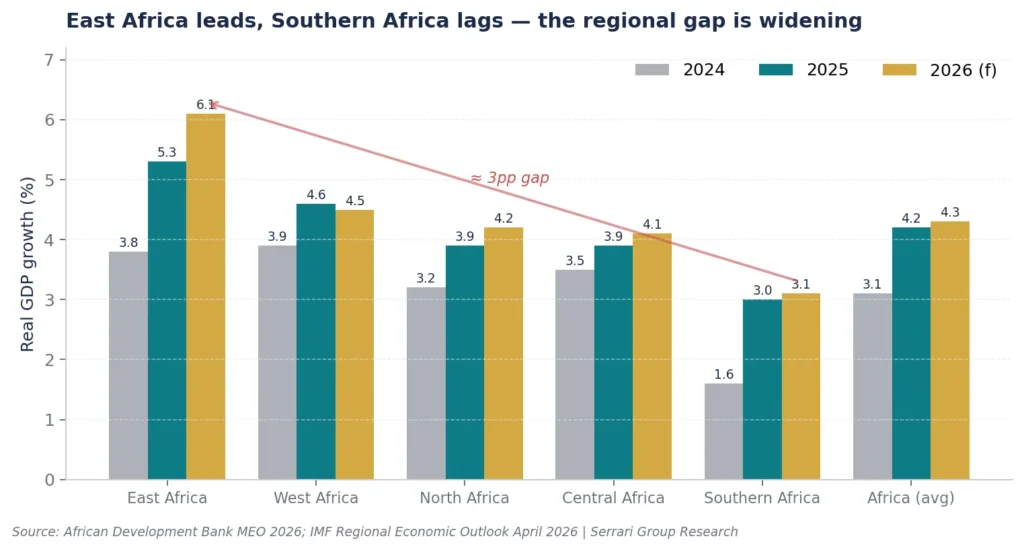
Figure 1 — Regional GDP growth. East Africa leads; Southern Africa lags.
East Africa — the continent’s growth engine
East Africa is the standout. Regional growth hit 5.3% in 2025 and is projected at 6.1% in 2026. Kenya, Tanzania, Uganda, Rwanda, and Ethiopia are all tracking above the continental average. Kenya’s recovery (5.0% in 2025, 5.2% base case for 2026) is covered in detail in our separate Kenya Economic Outlook. Rwanda is the fastest-growing major economy on the continent at 7.0% for 2026. Tanzania, despite October 2025 election turbulence, is still projected at 5.9%. The region benefits from diversified services sectors, strong agricultural bases, accelerating digital economy adoption, and relatively disciplined macro management — though Uganda’s January 2026 election and ongoing oil-sector FDI flows create both opportunity and risk.
West Africa — commodity dependence meets reform
West Africa is projected at 4.5% in 2026, marginally lower than 2025’s 4.6%. Côte d’Ivoire remains the region’s star at 6.3% — driven by a diversified agricultural base, CFA Franc stability, and consistent infrastructure investment. Senegal is tracking near 5.8%, supported by nascent oil and gas production. Nigeria, the region’s giant, is the slow giant: the CBN projects 4.49% in 2026 on the back of its 2023 reforms finally bearing fruit, but the IMF is more cautious at 4.0%. Ghana is the region’s rehabilitation story — the cedi’s extraordinary 40% appreciation in 2025, driven by gold-reserve accumulation, has slashed external debt by USD 14 billion and put debt-to-GDP within reach of the IMF 55% target three years ahead of schedule.
North Africa — IMF-anchored reform plays
North Africa is projected at 4.2% in 2026, up from 3.9% in 2025. Egypt remains the region’s macro story — GDP growth of 5.3% in H1 FY25/26 before the IMF downgrade to 4.2% on Middle East risk, inflation that fell from a peak of 38% in 2024 to 15.2% in March 2026, debt-to-GDP down 13 percentage points, and an active USD 8 billion IMF programme. Morocco continues its reliable 4% trajectory, supported by European demand, automotive exports, and a strong tourism sector. Algeria and Libya remain hostage to oil prices and internal politics. The Middle East war directly hits North Africa through Suez Canal revenue — Egypt’s canal receipts were down 52% in early 2026 — and this explains the downgrade cycle we saw at the IMF/World Bank Spring Meetings.
Central Africa — slow recovery from commodity volatility
Central Africa is projected at 4.1% in 2026. The region is dominated by oil producers (Republic of Congo, Gabon, Equatorial Guinea) and the Democratic Republic of the Congo, which is primarily a copper and cobalt economy. DRC’s commodity exposure — cobalt in particular — makes it a direct beneficiary of the global energy transition, and Chinese demand for battery metals remains a core structural tailwind. But political volatility (Gabon’s post-coup election, Sassou Nguesso’s 2026 succession question in Congo) limits the risk-adjusted returns.
Southern Africa — the drag
Southern Africa is the weak link. Regional growth is forecast at just 3.1% in 2026, up from 3.0% in 2025 but well below every other region. South Africa — which represents roughly 60% of regional GDP — is tracking at just 1.2% for 2026, with the IMF having cut the projection to 1.0% on oil-shock concerns. Four consecutive quarters of positive growth are a genuine improvement, but the level is simply too low to absorb the region’s unemployed workforce (31.9% headline unemployment, 46% youth). Zambia’s post-restructuring rebound is real, but from a very low base. Angola is oil-dependent and the kwanza has lost ground. Mozambique’s LNG project cycle has been disrupted by security concerns in the north.
4. Country-level dispersion
Regional averages smooth over the most interesting variation. The 2026 forecasts across fifteen of the continent’s major economies span nearly six percentage points — from Rwanda’s 7.0% to South Africa’s 1.2%. The taxonomy below groups countries by growth model rather than by geography, because that’s the distinction that matters for capital allocation.
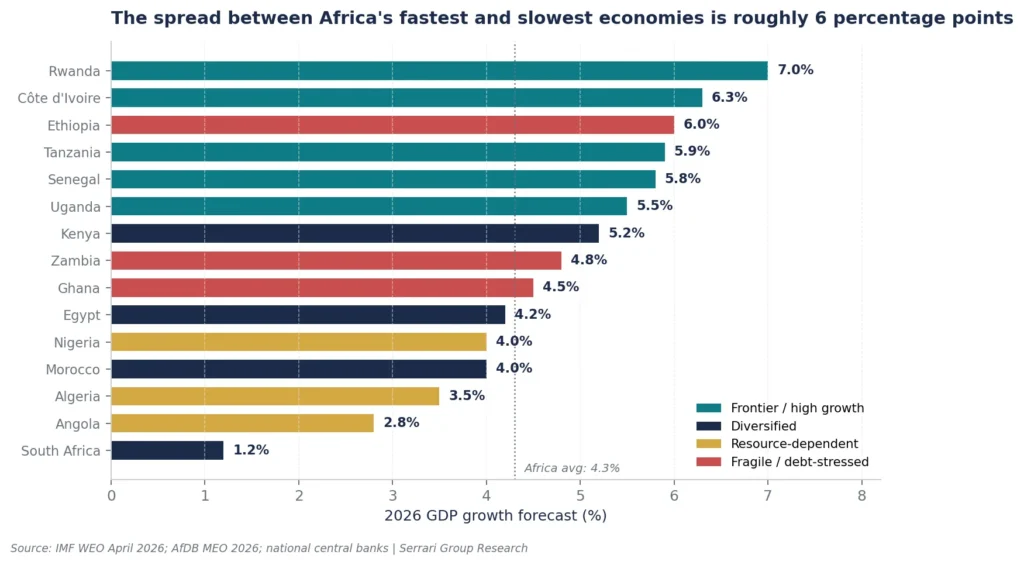
Figure 2 — 2026 GDP forecasts across major African economies, grouped by growth model
Frontier / high-growth (teal)
Rwanda, Côte d’Ivoire, Tanzania, Senegal, Uganda. These economies share a few features: growth of 5.5–7%, services and construction as leading sectors, relatively stable currencies, young and growing populations, and significant infrastructure pipelines. They offer the highest returns on capital but are smaller markets and often less liquid. Rwanda’s positioning as an East African services and technology hub, Senegal’s emerging hydrocarbons, and Côte d’Ivoire’s reliable 6%+ expansion make these the most attractive structural stories on the continent.
Diversified anchors (navy)
Kenya, Egypt, Morocco, South Africa. These are the region’s most liquid, most investable economies, with deep capital markets, established banking sectors, and diversified GDP compositions. Returns are more moderate but so is volatility. The IMF programmes underwriting Egypt (USD 8bn EFF+RSF) and the reform momentum in Morocco make these predictable policy environments. South Africa’s growth problem is structural — power, logistics, fiscal — not cyclical; it offers defensive exposure to the rand and precious metals rather than a growth story.
Resource-dependent (gold)
Nigeria, Angola, Algeria. Growth is correlated with oil prices. Nigeria’s 2023–25 reform programme — fuel subsidy removal, FX unification, tax code overhaul — is finally showing through in 2026 projections, but the Middle East oil shock has been a mixed blessing: higher oil revenue supports the sovereign, but it complicates the disinflation story. Angola remains roughly 60% dependent on oil for its external position. Algeria’s hydrocarbon wealth masks structural problems. These markets are best approached as cyclical or yield-focused plays rather than structural growth stories.
Fragile / debt-stressed (red)
Ethiopia, Ghana, Zambia, Chad. All four are currently working through G20 Common Framework debt restructurings. Ghana’s cedi rally and debt-to-GDP normalisation are the most successful rehabilitation story in recent years — though the IMF still rates Ghana at high risk of debt distress. Zambia completed its restructuring in mid-2024 after more than three years of delays and is now in reflation mode. Ethiopia remains ‘unsustainable and in distress’ per the IMF’s January 2026 review and has used its geopolitical significance to negotiate favourable Chinese treatment. These countries offer high-risk, high-reward exposure — suitable only for sophisticated investors with explicit distressed or frontier mandates.
| The Ghana-Ethiopia contrast – Two countries, same G20 framework, very different outcomes. Ghana built gold reserves, let the cedi rally 40%, and used currency appreciation to wipe USD 14 billion off external debt. Ethiopia has spent five years in negotiation limbo and had its USD 1 billion Eurobond payment rejected. The lesson: in debt restructuring, macroeconomic luck — commodity wins, currency moves, timing of global cycles — matters as much as framework design. Ghana was lucky and disciplined; Ethiopia has been neither. |
5. Country spotlights
Five countries represent the major archetypes on the continent. These spotlights capture the core investable story for each.
| Nigeria Reform payoff, finally GDP ’26: 4.0–4.5% CPI: 15.4% Mar’26 FX: Naira +6.9% ’25 | The slow giant. After the 2023 ‘big bang’ — fuel subsidy removal, FX unification, aggressive CBN tightening — Nigeria is finally showing the payoff. GDP growth accelerated from 3.38% in 2024 to 3.89% in 2025, and the CBN projects 4.49% in 2026; the IMF is at 4.0%, the World Bank around 4.4%. Inflation averaged 21.26% in 2025 after the CPI rebasing but has moderated to 15.4% in March 2026, with the CBN targeting 12.94% for full-year 2026. The naira has steadied in 2025 after its brutal 2024 decline, with external reserves projected to rise to USD 51 billion. The MPR has been held at 26.5%, with cuts likely once disinflation re-establishes. Nigerian equities hit record highs in early 2026 and the banking recapitalisation is delivering. The challenge is consistency: Nigerian macro cycles are violent, and an incomplete reform package is always reversible. |
| South Africa Depth without velocity GDP ’26: 1.2% CPI: 3.6% (target: 3%) FX: ZAR +14% ’25 | The depth story. South Africa has Africa’s most sophisticated capital markets, most liquid sovereign and corporate bond market, and biggest listed equity exchange — but it cannot find growth. GDP is forecast at just 1.2% for 2026, with IMF downgrades to 1.0%. Inflation is anchored at 3.6% — in fact so low that the SARB moved the target from 4.5% to 3% in late 2025. The repo rate is held at 6.75% after 100 bps of cuts through 2025. The rand appreciated 14% in 2025, supported by record gold and platinum prices and South Africa’s October 2025 removal from the FATF grey list. The debt-to-GDP ratio is 77% but declining. South Africa is best approached as a defensive, liquid, hard-asset-linked allocation — gold miners, bank bonds, and REITs offer a cleaner expression than broader equity or growth exposure. |
| Egypt IMF-anchored reformer GDP ’26: 4.2% CPI: 15.2% Mar’26 FX: EGP 51.8/USD | The recovery story. Egypt’s economy grew 5.3% in H1 FY25/26 on the back of private investment, tourism, and non-oil exports — a significant upgrade from the crisis period. The IMF has programmed USD 8 billion through an EFF and RSF; USD 2.3 billion was disbursed in February 2026. Inflation has fallen from a peak of 38% in 2024 to 15.2% in March 2026, though it ticked up from 11.9% in January as fuel prices rose. Debt-to-GDP has dropped 13 percentage points in two fiscal years. The Egyptian pound trades at 51.8 to the dollar and the gap to the parallel market has narrowed to 3–5% from 70% at the crisis peak. The key vulnerability is the fiscal arithmetic: interest payments are projected at EGP 2.3 trillion out of a total EGP 4.4 trillion 2026 budget — more than half of expenditure. Suez Canal revenue is down 52% on the Iran conflict, which is the single largest near-term risk. |
| Ghana The rehabilitation GDP ’26: 4.5% CPI: 11.5% ’26 f FX: Cedi +40% ’25 | The post-restructuring bounce. Ghana’s cedi appreciated roughly 40% against the US dollar in 2025 — the best FX performance on the continent by a wide margin — driven by the Bank of Ghana’s deliberate strategy of building up gold reserves. The currency gain has mechanically reduced external debt by USD 14 billion, more than 24% of the total, and debt-to-GDP is now approaching the IMF 55% target three years ahead of schedule. Inflation has fallen from 22.8% a year ago to an estimated 11.5% for full-year 2026. The Bank of Ghana has cut the policy rate from 27% to 16% over twelve months — the most aggressive easing cycle on the continent. Growth is projected around 4.5% for 2026. The risk: the IMF still rates Ghana at high risk of debt distress because currency gains can reverse. Ghana is a reflation play — attractive for tactical allocation but not a structural hold. |
| Côte d’Ivoire The quiet champion GDP ’26: 6.3% CPI: 2.9% FX: CFA stable | The consistent compounder. Côte d’Ivoire is projected at 6.3% growth in 2026, the second-highest among major African economies, with inflation at 2.9% — well below the BCEAO 3% target. The CFA Franc’s euro peg provides currency stability and eliminates a class of risk that investors in Nigeria, Ghana, or Ethiopia must actively manage. Economic growth is broad-based: cocoa (still the world’s largest producer), emerging hydrocarbons, manufacturing, and services. Public debt is manageable at ~58% of GDP. The upcoming 2026 presidential election, with President Ouattara securing a fourth term, introduces a political risk layer — the exclusion of Gbagbo and Thiam from candidacy has generated protests. But the macroeconomic foundations are as solid as anywhere on the continent, and the WAEMU regional bond market provides depth for fixed income allocations. |
6. Inflation: widespread disinflation, uneven pace
Africa’s inflation is falling — broadly. Continental average inflation dropped from 21.8% in 2024 to 13.6% in 2025, and is projected at 10.3% in 2026. Crucially, 35 of Africa’s 54 countries are expected to print inflation below 5% in 2026, supported by strengthening domestic currencies, improved weather conditions, and easing food and fuel prices. But the continental average is dragged up by a handful of high-inflation outliers, and those outliers are precisely the large economies most investors care about.
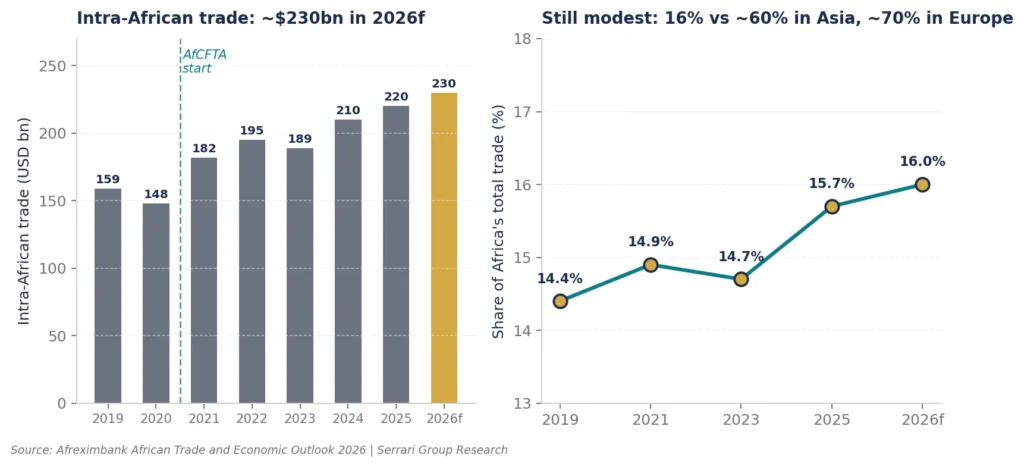
Figure 3 — Inflation across major economies, March 2025 vs March 2026
The disinflation has two sources. The first is base effects: the 2022–24 inflation shock was driven by global energy and food prices (war in Ukraine, dollar strength, disrupted supply chains), all of which have now substantially reversed. The second is monetary policy: after aggressive tightening in 2023–24, real rates across the continent are now positive in most major economies, and the transmission mechanism is working. Nigeria, Egypt, and Ghana are the three most important examples — in each case, policy rates above 20% for extended periods have broken the back of inflation, and the easing cycle is now underway.
The Middle East oil shock is the active near-term risk. The effects transmit through three channels: direct fuel pass-through, imported food costs (fertiliser prices), and transport/logistics. Kenya has seen this most clearly — the CBK’s April 2026 inflation forecast jumped from a benign 4.4% in March to a projected peak of 6.2% in July. The same pattern is visible in Egypt (15.2% in March, up from 11.9% in January after fuel price increases), Nigeria (15.4% in March, breaking an 11-month disinflation trend), and South Africa (still inside target but with upward pressure on the 2026 projection). None of these are crisis-level moves, but they complicate central bank easing paths and could delay rate cuts by two to three quarters.
7. Monetary policy: five regimes, five stories
Africa’s major central banks are operating in different phases of the cycle. There is no unified ‘African monetary policy’ — and the spread between the tightest and loosest regimes is the widest it has been in years.
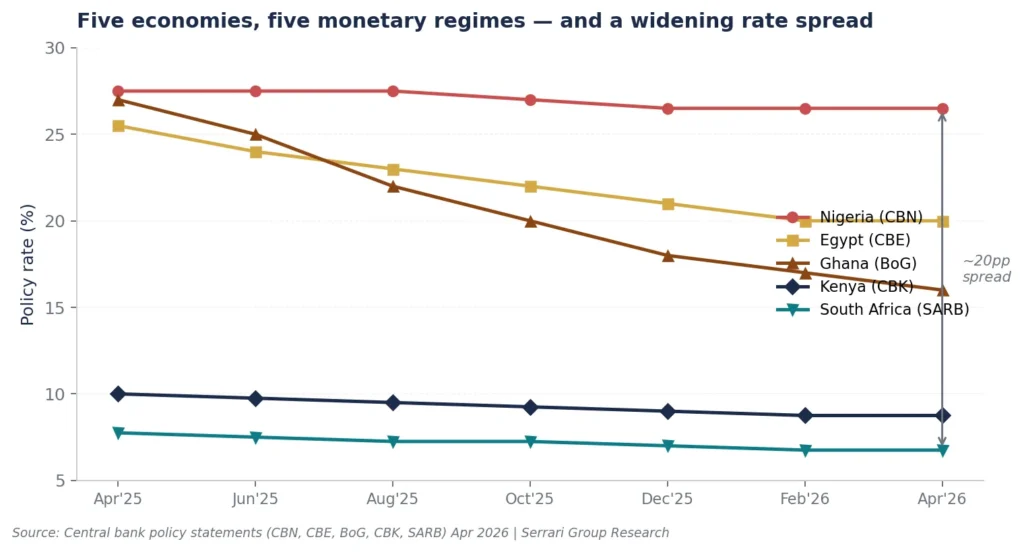
Figure 4 — Policy rates across five major central banks, April 2025 to April 2026
The Central Bank of Nigeria is the tightest at 26.5%. It has started a shallow easing cycle but remains committed to anchoring inflation expectations after the 2023 reform-induced price spike. The Central Bank of Egypt has cut from 25.5% to 20.0% over the year but paused in early 2026 as the Middle East crisis reintroduced inflation pressure. The Bank of Ghana has run the most aggressive easing cycle on the continent, cutting from 27.0% to 16.0% as inflation normalised and the cedi rallied.
The Central Bank of Kenya cut from 10.0% to 8.75% over four MPC meetings and then paused in April 2026 as oil-shock inflation risk emerged. The South African Reserve Bank has cut 100 basis points to 6.75% and held in January 2026 after the inflation-targeting regime was tightened from 4.5% to 3.0%. The ~20 percentage point spread between CBN and SARB policy rates captures the scale of macroeconomic divergence on the continent.
| What this means for fixed income – Nigeria offers the highest absolute yields but also the highest FX risk. Egypt’s EFF anchor provides a floor for dollar investors willing to hold through the 2026 volatility. Ghana’s rate cuts have already delivered much of the bond price appreciation — the easy money is made. Kenya and South Africa offer genuine carry trades, with relatively stable currencies and positive real yields. For Serrari’s diaspora audience, the currency-hedged yield differential between Kenyan T-bonds and South African government bonds is the pair trade worth understanding. |
Context is everything. While you follow today’s updates, use the Serrari Group Market Index and Marketplace to spot emerging shifts. Need to sharpen your edge? Our Wealth Builder Platform turns these insights into a professional-grade strategy.
8. Debt: the slow-moving crisis
Africa’s debt story is now the single most important medium-term risk facing the continent. Public debt has risen 170% since 2010 to over USD 1.8 trillion. Debt composition has shifted decisively away from concessional lending toward external commercial sources, non-Paris Club creditors (primarily China), and domestic borrowing. Nine African countries are currently in debt distress; nineteen more are classified as high risk. Debt servicing in 2026 will cost the continent approximately USD 96 billion — the largest single year on record.
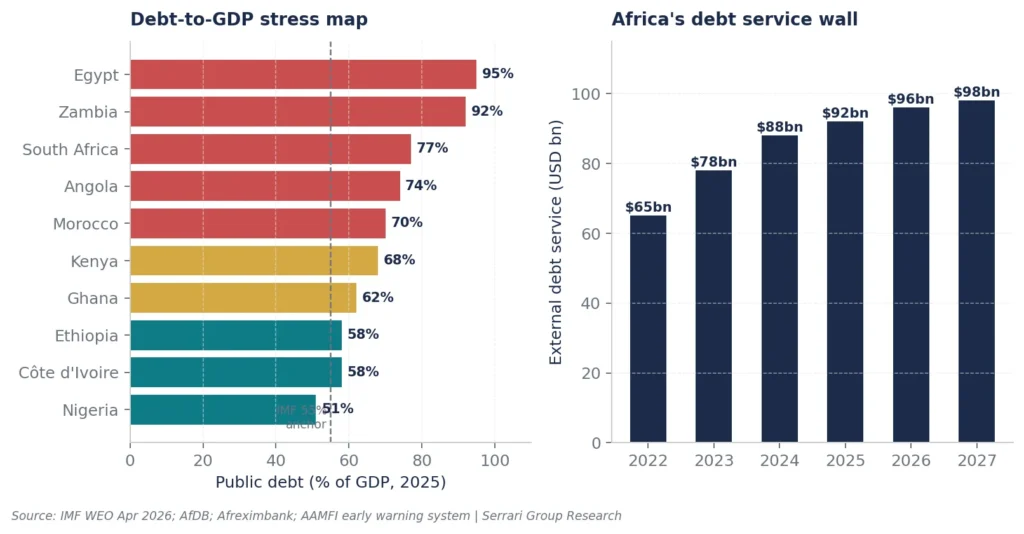
Figure 5 — Debt-to-GDP stress map and Africa’s rising debt service wall
The good news is that the median debt-to-GDP ratio is actually falling — from 66.3% in 2023 to 65.5% in 2024 and projected below 65% in 2025 and 2026. Currency appreciation (notably Ghana’s cedi), stronger growth, and disinflation are all working together. But the distribution is heavily skewed: Egypt sits at roughly 95% of GDP, Zambia at 92%, Angola at 74%, South Africa at 77%, and Kenya at 68% — all above the IMF’s 55% anchor.
The G20 Common Framework — the international mechanism for coordinating sovereign debt restructuring — has been widely criticised for being slow and producing limited aggregate relief. According to a ONE Campaign analysis, Common Framework restructurings have reduced only about 7% of the combined external debt stock of high-risk lower-income countries in distress — roughly USD 13.6 billion out of USD 171–184 billion. The bulk of this relief has accrued to Ghana and Zambia; Ethiopia and Chad have seen little to no measurable debt reduction. Zambia needed more than three years to complete a deal; Ethiopia is in its fifth year of negotiations.
For 2026, the debt watch-list is: Ethiopia (ongoing restructuring, recent Chinese resolution constructive), Kenya (68% debt-to-GDP and widening deficit — see our separate Kenya outlook), Egypt (interest payments consuming 52% of the budget), Angola (oil-dependent and debt-heavy), and Tunisia (chronically vulnerable). The opportunity set for investors: post-restructuring reflation plays in Zambia; post-rally locked-in yields in Ghana; and IMF-programme-anchored hard currency bonds in Egypt and Ivory Coast.
9. Foreign exchange: winners, losers, and the long tail
African currencies in 2025 produced extreme dispersion. The top performers — Ghana’s cedi (+40%) and South Africa’s rand (+14%) — delivered hard-currency equivalent returns that rivalled anything in global emerging markets. The bottom tier — Ethiopian birr (−25%), South Sudanese pound (−42%) — destroyed dollar wealth at rates rarely seen outside formal devaluations. The lesson is not that African FX is volatile in aggregate; it is that currency outcomes are now explicitly driven by country-specific policy and commodity choices.
Figure 6 — African currency performance against the USD during 2025
Four structural factors explain the dispersion. First, commodity tailwinds — gold, copper, and critical minerals have driven the cedi, kwacha, and Congolese franc stories (though DRC’s political risk overwhelmed its commodity support in 2025). Second, policy discipline — Nigeria’s FX unification, Egypt’s flexible rate, and Kenya’s active CBK defence have all produced stability. Third, dollar weakness in 2025 — the broad USD sold off against most currencies globally, helping reformers retain their gains. Fourth, political and fiscal fragility — where governments lost control of the fiscal story (Ethiopia, South Sudan, post-conflict states), currencies followed.
| The Pan-African Payment and Settlement System (PAPSS) – Quietly one of the most important developments of 2025 was the operational expansion of PAPSS to 18 countries. PAPSS allows cross-border trade settlement in local currencies rather than routing through USD correspondent banking — reducing FX costs, settlement delays, and dependency on dollar liquidity. For AfCFTA’s trade agenda, PAPSS is arguably the most material enabler. For investors, it opens a genuinely new channel: intra-African fintech exposure is now investable in a way it wasn’t two years ago. |
10. Commodity exposure: who wins, who loses
Africa’s commodity profile is highly heterogeneous. Reading the 2026 outlook requires separating three categories: energy exporters (Nigeria, Angola, Algeria, Libya), metals & mining (South Africa, DRC, Zambia, Ghana, Mali, Guinea), and agricultural exporters (Côte d’Ivoire, Ghana, Ethiopia, Kenya). The Middle East oil shock is a direct positive for the first group, a neutral for the second, and a negative for the third (via imported fertiliser and fuel costs).
Energy: the Middle East windfall
Oil above USD 100 is a clear positive for Nigeria and Angola’s external and fiscal positions, though Nigeria’s lingering production issues (estimated below 1.6 million bpd against a 2 million bpd capacity) mean the upside is capped. Algeria and Libya are both major gas exporters with European market access, and 2024–25 has already seen them capture share lost by Russia. Downstream, refining is the structural story — Dangote’s 650,000 bpd Nigerian refinery continues to ramp, which is a meaningful structural positive for Nigeria’s non-oil revenue and FX balance.
Metals: the energy transition wins
Gold at record highs has been the single biggest driver of the Ghana and South Africa currency stories. Copper demand for electrification supports DRC and Zambia; cobalt demand (especially from EVs) is a structural tailwind for DRC. Platinum group metals — a South African specialty — have similar upside from fuel cell and catalytic converter demand. These are multi-year structural stories, not cyclical trades.
Agriculture: the food-security squeeze
Higher oil means higher fertiliser costs and higher transport costs — a direct negative for African agricultural economies, which are mostly net food importers at the margin. Côte d’Ivoire and Ghana as cocoa producers get a partial offset from strong cocoa prices (which have hit multi-decade highs), but East African tea, coffee, and horticulture exporters face a margin squeeze. Kenya’s 2025 coffee price boom (exports up 73.8% YoY in Q1) is already factored into current forecasts; the 2026 question is whether fertiliser-driven cost pressures erode margins.
11. Trade integration: AfCFTA edges forward
The African Continental Free Trade Area has been both under- and over-promised. Five years after trading officially commenced in 2021, intra-African trade reached roughly USD 220 billion in 2025 (about 16% of total continental trade) and is forecast to hit USD 230 billion in 2026 under Afreximbank’s base case. That’s meaningful growth — but the share of intra-African trade remains far below Asia’s roughly 60% or Europe’s 70%.
Figure 7 — Intra-African trade progression and share of total trade
Progress in 2025 was genuine. The operationalisation of the Pan-African Payment and Settlement System expanded to 18 countries, reducing the FX and banking costs of trade. Rules of origin for textiles were finalised. The AfCFTA Secretariat pushed aggressively on non-tariff barriers and customs harmonisation. Afreximbank expects the manufacturing and agri-food sectors to reach 48–50% of intra-African trade flows in 2026, up from 46% in 2025 — a significant structural shift away from raw commodity exchange and toward value-added trade.
The honest appraisal: AfCFTA is moving from aspiration to operational reality, but the pace is glacial relative to the ambition. National industrial strategies focused on import substitution often conflict with the tariff liberalisation that the agreement requires. Infrastructure gaps — roads, ports, digital connectivity — remain binding constraints. For investors, the AfCFTA story is real but slow: the upside is measured in years, not quarters. Regional champions — African logistics companies, pan-African banks, cross-border fintechs — are the cleanest way to play it.
12. Capital flows: rebounding, but concentrated
Foreign Direct Investment into Africa rebounded sharply in 2024 to approximately USD 97 billion — a 75%+ increase from 2023 and an all-time high. But, as so often in African data, the headline obscures concentration: a handful of large deals in a handful of countries (notably Egypt and South Africa) account for a disproportionate share. On a more normalised basis, the continent still captures only 3.5–4% of global FDI despite housing roughly 18% of the world’s population.
The composition of FDI is shifting in meaningful ways. Historically dominated by extractive industries, Africa’s inward FDI mix is now tilting toward renewable energy, fintech, data centres, and manufacturing. The EY Africa Attractiveness 2024 survey highlighted North and West Africa as the leading FDI destinations by announced projects, with Egypt, Morocco, Nigeria, and Senegal as the standouts. Mozambique’s LNG pipeline and Tanzania’s extractive sector continue to attract resource-seeking capital.
Portfolio flows tell a more nuanced story. 2025 saw reformer markets — South Africa (post-FATF grey list removal), Nigeria (post-reform), Egypt (IMF-anchored), Kenya (stable shilling, easing cycle) — attract meaningful equity inflows. The NSE in Kenya returned ~67% year-on-year, Nigerian equities hit record highs, and South African equities benefited from the FATF upgrade and gold-sector strength. The March 2026 global risk-off episode (Iran conflict) produced a brutal but short correction; the structural re-rating has largely held.
Remittances are the quiet giant. Remittance flows to Africa reached USD 104.6 billion in 2024 (+14% YoY), surpassing both FDI and foreign portfolio investment to become the single largest source of external non-debt financing for the continent. For Serrari’s diaspora audience, this statistic matters: diaspora savings are now a macro-relevant capital stock, and financial products that help diaspora investors allocate into African markets are operating in a genuinely large addressable opportunity.
13. Political risk: a heavy election calendar
2026 is a dense election year on the continent. The year opened with Uganda’s January election, in which President Yoweri Museveni — in power since 1986 — was declared winner with 74.25% of the vote. Ethiopia holds its first general election since the 2022 Tigray peace agreement on 1 June 2026; it is arguably the highest-stakes vote in East Africa in a decade. Benin goes to the polls in April with President Talon stepping down. Côte d’Ivoire’s 2026 election already delivered a fourth term for President Ouattara at the exclusion of Gbagbo and Thiam. Djibouti, Morocco, Gambia, Zambia, Congo, and South Sudan also have votes scheduled.
The broader political economy trend is uncomfortable. The Africa Center for Strategic Studies and Atlas Institute have documented a pattern of cross-border electoral repression across East Africa — tight restrictions on opposition campaigning in Tanzania’s October 2025 election, the abduction of Ugandan opposition figure Kizza Besigye from Kenya in November 2024, and coordinated patterns that suggest regional systems rather than isolated national incidents. This has not, in 2025, translated into sustained disruption of investor sentiment — but it represents a latent risk that could be triggered by specific events.
Then there is pre-election fiscal drift. Historically, the twelve months before an African election coincide with wider fiscal deficits (as incumbents avoid politically costly consolidation), greater policy noise, and caution from foreign portfolio investors. Kenya’s 2027 election (August) means the back half of 2026 will already feel pre-electoral. The Uganda result is settled; the Ethiopia vote in June is the single biggest East African political variable for 2026.
14. Risks and opportunities
Downside risks
Middle East escalation. Oil sustained above USD 100/bbl delays disinflation, squeezes the 35 African economies in net-importer positions, and complicates central bank easing paths. A further escalation into broader regional conflict — particularly one that materially closes the Strait of Hormuz — would push continental growth meaningfully below the AfDB/IMF baseline.
Debt distress in vulnerable countries. Ethiopia, Chad, Tunisia, and a handful of smaller economies remain in active distress. A disorderly default in any of them — particularly Ethiopia, given its systemic weight in East Africa — would reset investor risk perception for the broader region.
China slowdown. China remains Africa’s largest trading partner and a major source of infrastructure lending. A sharper-than-expected Chinese slowdown would hit commodity prices (bad for Angola, Zambia, DRC), curtail new infrastructure financing, and reduce demand for African exports. Chinese property-sector risk is the key variable.
US aid compression. The IMF’s April 2026 Regional Economic Outlook flags the unprecedented scale and speed of official development assistance cuts to Africa. Low-income and fragile states are hit hardest and have limited policy space to absorb the shock. This is a structural risk to fragile-state growth and to public health, education, and food security programs.
Climate and weather shocks. Drought in the Horn of Africa, cyclones in Southern Africa, and Sahel food insecurity remain ever-present risks. Insurance coverage and parametric risk instruments are developing but inadequate relative to exposure.
Upside opportunities
Energy transition metals. Copper, cobalt, nickel, lithium, platinum group metals — Africa holds a structural share of the minerals required for the global electrification build-out. DRC, Zambia, South Africa, Mozambique, and Morocco are all positioned to benefit. The investable vehicles range from direct miners to regional infrastructure plays to sovereign bonds from benefiting economies.
Fintech and digital payments. Africa’s digital finance sector is the fastest-growing on the continent. PAPSS’s expansion, Kenya’s VASP Act, Nigeria’s CBDC, and Egypt’s digital banking overhaul all contribute to a genuinely deepening ecosystem. Mobile money penetration, cross-border remittance infrastructure, and SME digital credit are the three investable verticals.
Regional consumer markets. Rising middle classes in Lagos, Nairobi, Cairo, Accra, Abidjan, and Dar es Salaam are driving demand for formal retail, financial services, healthcare, and consumer technology. Pan-African brands and regional champions are the cleanest way to capture this — less so direct commodity or macro exposure.
Infrastructure. Africa’s infrastructure financing gap is estimated at roughly USD 170 billion annually. Public-private partnerships, blended finance vehicles, and green bonds are emerging as scaled approaches. The green infrastructure subset — grid storage, solar, transmission — is particularly well-matched to global climate capital looking for yield.
The AfCFTA dividend. Slow but real. Manufacturing and agri-food firms able to operate at the pan-African scale will increasingly benefit from tariff harmonisation and PAPSS settlement. The returns are structural, five- to ten-year, rather than cyclical.
15. Forecast: base, upside, downside
Serrari’s 6–12 month scenarios for Africa are built around three assumptions: the trajectory of Middle East oil prices, the pace of Federal Reserve rate cuts, and China’s industrial demand. The scenarios capture the range of plausible outcomes, not a prediction of a single path.
Base case (50% probability)
Continental GDP growth prints at 4.2–4.3% in 2026. Oil stabilises in a USD 85–100 range as the Iran ceasefire holds. Inflation averages 10.5–11% continentally, with major central banks (CBN, CBE, BoG) continuing to cut rates at a measured pace. The cedi holds most of its 2025 gains; the rand trades in a 16.5–18.0 range; the naira stays in the 1,400–1,600 band. FDI and remittances grow mid-single digits. Ethiopia completes substantive phases of its debt restructuring by year-end. Intra-African trade reaches Afreximbank’s USD 230 billion target. The March 2026 equity correction proves to have been a buying opportunity.
Upside case (25%)
Full Middle East ceasefire reduces oil to USD 75–85. Fed cuts faster than expected, further weakening the dollar and supporting African FX. Chinese stimulus lifts commodity demand. Continental growth reaches 4.6–4.8%. Disinflation accelerates sharply; Nigeria prints below 10% inflation by H2 2026. Ghana’s cedi holds its gains; the rand appreciates further. Ethiopia completes its restructuring. African equity markets extend their 2025 re-rating. Elections in Ethiopia, Benin, and Zambia deliver manageable outcomes.
Downside case (25%)
Middle East escalation pushes oil above USD 120. Global risk-off tightens EM financial conditions; dollar strengthens. Continental growth slips to 3.8% or below. Inflation in Nigeria and Egypt re-accelerates; CBN and CBE either hold or tighten. Ghana’s cedi gives back 15–20% of its 2025 gains as the structural foundation reveals itself as more fragile than appreciated. Ethiopia’s restructuring stalls. One or more scheduled elections trigger material unrest. African equity markets retrace another 10–15%.
Allocation framework
Drawing on the country taxonomy from Section 4:
- Core (50–60% of Africa allocation): diversified anchors — Egypt (IMF-backed hard currency bonds), South Africa (gold/platinum exposure and deep bond market), Kenya (T-bills and MMFs, see separate Kenya outlook).
- Growth (25–35%): frontier high-growth — Rwanda, Côte d’Ivoire (WAEMU bonds offer CFA stability), Senegal (hydrocarbons), Tanzania (selective equity exposure).
- Tactical (10–15%): post-restructuring reflation — Ghana (locked-in yields), Zambia (copper and reflation exposure), Nigeria (equities and select banks as reform pays off).
- Satellite (0–5%): distressed / frontier — Ethiopia post-restructuring, DRC mining, other fragile-state specialist exposure.
| Bottom line for the next twelve months – Africa’s aggregate story is good: 4.3% growth, falling inflation, stable to stronger currencies, broadening capital markets, and the beginning of meaningful AfCFTA trade gains. But the aggregate is not the opportunity — the dispersion is. The investor who buys the continent gets mediocre returns. The investor who buys the frontier with diversified anchors, picks the post-restructuring reflation trades, and manages the commodity-cycle exposure can deliver real returns well above global emerging-market alternatives. That is the Serrari thesis on Africa for 2026. |
About this outlook
This outlook is prepared by Serrari Group Research for educational and informational purposes, as a companion to the Kenya Economic Outlook — Q2 2026 edition. It draws on publicly available data from the African Development Bank (Macroeconomic Performance and Outlook 2026), the International Monetary Fund (World Economic Outlook April 2026 and Sub-Saharan Africa Regional Economic Outlook April 2026), the World Bank, national central banks and statistics offices (CBN, CBE, SARB, Bank of Ghana, CBK, KNBS), Afreximbank, UNCTAD, and primary reporting from Reuters, Bloomberg, and regional publications.
All forecasts reflect Serrari base-case scenarios with stated probability weights, and are subject to the downside risks and upside opportunities discussed in Section 14. This is not investment advice. Specific allocation decisions should reflect individual circumstances, time horizons, risk tolerance, tax position, and regulatory status.
Your financial future isn’t something you wait for—it’s something you build.
The real question is: when do you begin?
Move beyond simply staying informed.
Navigate the markets with clarity—track trends through the Serrari Group Market Index, uncover opportunities in the Serrari Marketplace, and build practical knowledge with our Curated Wealth Builder Platform.
Stay connected to what truly matters.
Get daily insights on macro trends and financial movements across Kenya, Africa, and global markets—delivered through the Serrari Newsletter.
Growth opens doors.
Advance your career through professional programs including ACCA, HESI A2, ATI TEAS 7 , HESI EXIT , NCLEX – RN and NCLEX – PN, Financial Literacy!🌟—designed to move you forward with confidence.
See where money is flowing—clearly and in real time.
Track Money Market Funds, Treasury Bills, Treasury Bonds, Green Bonds, and Fixed Deposits, alongside global and African indexes, key economic indicators, and the evolving Crypto and stablecoin landscape—all within Serrari’s Market Index.
Know it. Create it. Grow it. Preserve it.














Comments are closed.