| The bottom line – The global economy sits in the shadow of a war. The IMF’s April 2026 World Economic Outlook was titled exactly that, and it captures the reality: what had been a steady 3.4% global expansion is now a 3.1% expansion clouded by oil-price volatility, central bank paralysis, and a disinflation cycle that broke in March. The Fed, the ECB, and the Bank of England are all on pause. The Bank of Japan is hiking while the PBoC is easing. Oil has traveled from $65 to $106 to $88 and back to $95 in eight weeks. Gold made an all-time high above $5,300 then gave back a third of it. The dollar has weakened 10% over twelve months. The S&P 500 is making new highs — and concentration in seven tech names now accounts for half the index’s return. The next two quarters will decide whether disinflation resumes or whether a new inflation regime has begun. |
1. Executive Summary
The IMF titled its April 2026 World Economic Outlook “Global Economy in the Shadow of War” — an unusually direct framing. Assuming the Middle East conflict remains limited in duration and scope, global growth is now projected at 3.1% in 2026 and 3.2% in 2027, down from the 3.4% achieved in 2025 and well below the pre-pandemic 3.7% average. Global headline inflation is expected to tick up in 2026 before resuming its decline in 2027. A severe-scenario extension — which would imply a 1.3 percentage point hit to global growth — would push the world rate below 2%, a level reached only four times since 1945 and typically associated with global recession.
The composition of this slowdown matters more than the headline. Emerging markets and developing economies are being hit harder than advanced economies — commodity-importing EMs with pre-existing fragilities are the most exposed. India remains the fastest-growing major economy at 6.5% (RBI’s own forecast, with some private estimates at 6.2% and 6.48%). China is tracking 4.4–5.0% depending on the source. The US Federal Reserve’s March dot plot projected 2.1% US growth; the ECB’s March projections cut the Eurozone to 0.9%. The Bank of England is at 1.3%. Japan hovers near 1.0%.
Central banks are unified in one thing: uncertainty. The Fed paused rates for the second consecutive meeting in March at 3.50–3.75% and still projects only one cut for the year. The ECB has held at 2.15%/2.00% for six consecutive meetings. The Bank of England cut to 3.75% in December and paused. The Bank of Japan hiked to 0.75% in December — its highest level since 1995 — and is the only major central bank normalising in the opposite direction. The PBoC continues to ease incrementally. The combined effect is a global monetary environment that is no longer unified around easing, which has implications for carry trades, emerging market flows, and dollar dynamics.
Markets are doing something unusual: the S&P 500 continues to make new highs on 18% projected full-year 2026 EPS growth, with concentration in seven tech names accounting for 53% of 2025 returns. Gold made an all-time high above USD 5,300 per ounce in early February — then gave back a third of it on the Iran ceasefire. The dollar index is down roughly 10% over twelve months. Brent crude has moved in an 80% range — from USD 65 in January to USD 106 in mid-March to USD 88 on the ceasefire to USD 95 on re-escalation. In a few months this has become the single biggest macro variable in the global outlook.
| What this means for allocation – This is not a regime where one simple allocation works. Duration risk and oil risk are the two live trades. Overweight AI-levered US equities if you believe productivity translates into broad earnings; underweight if you think concentration is a warning. Gold earned its place in portfolios in 2025 and still commands one — though from current levels it depends on further dollar weakness. Emerging markets are attractive on valuation but vulnerable to commodity and dollar cycles. Japan is a genuine diversifier. Short-dated high-grade sovereigns pay yields that have not been available in fifteen years. The investor who tries to predict one scenario loses; the investor who holds the scenarios and rebalances into volatility wins. |
Markets move fast; don’t get left behind. We’ve paired the Serrari Group Market Index with a curated Marketplace and a comprehensive Wealth Builder Platform to ensure you have the data—and the skills—to act on it.
2. Global Snapshot
The global state of play as of April 2026. Figures are the latest official prints or consensus where no official figure is available.
| INDICATOR | LATEST | DIRECTION |
|---|---|---|
| Global GDP growth (2025e) | 3.4% | Above 2024’s 3.3% |
| Global GDP forecast (2026) | 3.1% | ↓ 0.2pp on Iran war |
| Emerging markets (2026) | 3.9% | ↓ from 4.2% (Jan) |
| US GDP growth (2026f) | 2.1% | Fed: 2.4%; IMF: 1.8% |
| Eurozone GDP (2026f) | 0.9% | ↓ from 1.2% (Dec) |
| China GDP (2026f) | 4.4–5.0% | Target: 4.5–5% |
| India GDP (FY26f) | 6.5% | Fastest major economy |
| US CPI (Mar 2026) | 3.3% | ↑ from 2.4% (Feb) |
| Eurozone CPI (Mar 2026) | 2.5% | ↑ from 1.9% (Feb) |
| Fed funds rate | 3.50–3.75% | Held 2nd consecutive mtg |
| ECB deposit rate | 2.00% | Held 6th consecutive mtg |
| Brent crude (Apr 20) | ≈ USD 95/bbl | +44% YoY |
| Gold (Apr 20) | ≈ USD 4,800/oz | Peaked > 5,300 in Feb |
| DXY dollar index | ≈ 97 | ≈ −10% over 12 months |
| S&P 500 (Apr 20) | ≈ 6,600 | +66% from Oct ’22 low |
Sources: IMF WEO April 2026; Federal Reserve, ECB, BoE, BoJ, PBoC; BLS, Eurostat; Bloomberg; ICE.
3. Global growth: the war tax on the cycle
Global real GDP growth is projected at 3.1% in 2026 and 3.2% in 2027 under the IMF’s April 2026 reference forecast — a 0.2 percentage point downgrade for 2026 relative to the January update. The revision looks small at the global level, but the IMF is explicit that this average masks a high degree of cross-country dispersion. Growth is holding up in the advanced-economy core; it is cracking in commodity-importing emerging markets with pre-existing vulnerabilities.
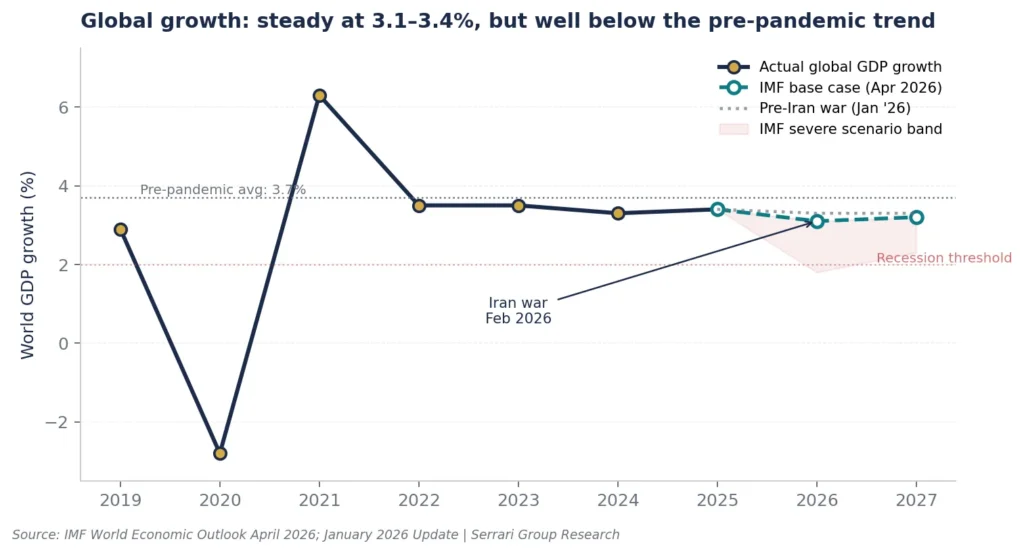
Figure 1 — Global GDP growth with the IMF’s reference and severe scenarios
The medium-term context is worth dwelling on. Even under the base case, 3.1–3.2% global growth sits well below the 3.7% pre-pandemic average (2000–2019). The IMF now expects the world to “settle at about that rate in the medium term,” which is a diplomatic way of saying that the post-pandemic trend has broken. The factors that produced faster growth before 2020 — strong globalisation, cheap capital, low geopolitical tension, synchronous central bank support — are all absent or reversed. The factors that could restore it — AI-driven productivity, a sustained disinflation, a broad de-escalation of trade tensions — remain possibilities rather than base cases.
The severe-scenario analysis is worth taking seriously. If the Middle East conflict extends and broadens — the IMF specifically models Strait of Hormuz closure and deeper energy disruption — global growth drops 1.3 percentage points, implying a 2026 rate of roughly 1.8%. A global growth rate below 2% has occurred only four times since 1945: 1975 (first oil crisis), 1982 (Volcker disinflation), 2009 (GFC), and 2020 (COVID). Each was associated with a global recession.
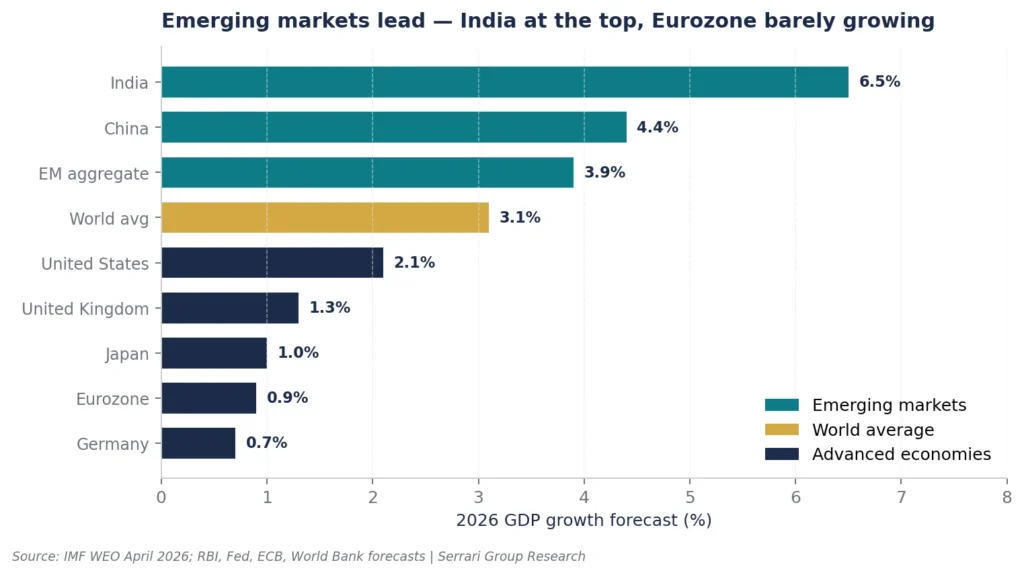
Figure 2 — 2026 GDP growth forecasts for major economies
At the country level, the spread is nearly 6 percentage points — from India’s 6.5% to Germany’s projected 0.7%. Emerging markets are still doing the work: India and China together account for roughly half of global growth. The US, at 2.1%, is the advanced-economy outlier — higher than any other developed peer. The Eurozone at 0.9%, the UK at 1.3%, and Japan at 1.0% are all barely above stall speed. Any one of them could slip into recession on a single shock.
4. Major economy spotlights
Five economies drive two-thirds of global activity and virtually all of global risk. Each has a distinct story for 2026.
| United States The AI-levered stall GDP ’26: 2.1% CPI: 3.3% (Mar’26) Policy rate: 3.50–3.75% | The divergent story. The US economy is growing at 2.1% in 2026 — faster than any other advanced economy but slower than trend. Inflation at 3.3% in March jumped from 2.4% in February on Iran-driven fuel prices; core CPI held at 2.6%. The Fed paused at 3.50–3.75% for the second meeting, projecting just one cut in 2026. Unemployment is at 4.4% with no one on the FOMC forecasting a 5-handle. Non-farm business productivity surged 4.1% in Q2 and 4.9% in Q3 of 2025 — possibly the clearest signal so far that AI adoption is translating to measurable productivity gains. The S&P 500 is making new highs on projected 18% full-year EPS growth, though 53% of 2025 returns came from seven tech names. The real risk is not a recession — it is that a second inflation shock anchors a ‘higher for longer’ regime, with political pressure on the Fed already visible (Powell’s potential successor Kevin Warsh mentioned in Axios coverage). |
| Eurozone Stall speed plus war GDP ’26: 0.9% CPI: 2.5% (Mar’26) Policy rate: 2.15% / 2.00% | The vulnerable block. The ECB cut its 2026 growth forecast to 0.9% in its March projections, citing the global effects of the Iran war on commodity markets, real incomes, and confidence. Headline inflation jumped from 1.9% in February to 2.5% in March — back above the 2% target for the first time in months. Germany (the bloc’s largest economy) saw inflation accelerate to 2.8%. The ECB has held rates at 2.15%/2.00% for six consecutive meetings and is now genuinely stuck: cutting risks fuelling inflation, holding risks deepening the growth slowdown. The one bright spot is defence spending expansion — which the IMF flags as a structural budget line in most European economies and which will support growth at the margin. The EU-India free trade agreement announced in January 2026 — described as the mother of all deals after 20 years of negotiation — is an upside surprise that could become meaningful by 2027. |
| China Steady, strategic, slow GDP ’26: 4.4–5.0% CPI: 0.5% (Mar’26) Policy rate: 7-day repo: 1.30% | The deliberate slowdown. China set a 2026 GDP growth target of 4.5–5.0% at the Two Sessions in March — slightly below the 2025 goal, and consistent with the government’s pivot from stimulus-driven demand to supply-side strategic investment under the new 15th Five-Year Plan (2026–2030). The World Bank forecasts 4.4%. GDP grew 4.8% in Q3 2025 despite US tariffs reaching 145% on select Chinese goods. Inflation is essentially zero — the PBoC is actively trying to prevent deflationary expectations from anchoring. The property sector remains in gradual adjustment. A major institutional upgrade for 2026: policy consistency assessments, designed to reduce contradictions between macro stimulus and regulatory tightening. Exports are forecast to slow to 3.0% in 2026 from 5.1% in 2025, but Chinese manufacturers continue to defend global market share through quality upgrades. |
| India The world’s engine GDP ’26: 6.5% (FY26) CPI: Low single digits Policy rate: Repo: 5.25% | The standout. India’s real GDP grew 8.2% in Q2 FY25/26 — one of the strongest prints among major economies anywhere — with the RBI projecting 6.5% for the full fiscal year. This marks India as the fastest-growing major economy, roughly three times the US rate. However, India’s global GDP rank slipped from 4th to 6th in April 2026, behind the UK and Japan; the IMF attributed this to rupee depreciation during the Iran war rather than underlying weakness. The RBI cut the repo rate to 5.25% in December and retained FY26 growth at 6.5%. Domestic demand, GST rationalisation, softer crude, and front-loaded government capex are the four key supports. The EU-India free trade agreement signed in principle in January 2026, with full implementation targeted for early 2027, is a material medium-term positive. India is on track to regain 4th place by 2027 and pass Japan by 2028. |
| Japan Normalising, finally GDP ’26: 1.0% CPI: 2.2% (Mar’26) Policy rate: 0.75% | The quiet normalisation. The Bank of Japan hiked rates by 25 basis points to 0.75% at its December 19, 2025 meeting — the highest level since 1995. That’s the single most important monetary development in a generation of Japanese economic history. After decades of zero rates and negative rates, and more than twenty years of deflation, Japan is operating a ‘normal’ monetary policy. The trigger: sustained inflation near the 2% target, real wage growth, and a stable yen. Growth will print around 1.0% in 2026 — modest, but the composition (wage growth, sustained corporate investment, BOJ normalisation) is structurally important. The yen’s trajectory against the dollar will be a key leading indicator for Asian FX and for the carry trade: if Japan keeps hiking while the Fed cuts, yen strength is mechanical, and that reshapes global capital flows. |
5. Inflation: the disinflation that broke
The disinflation cycle that defined 2023–2025 cracked in March 2026. Headline inflation rose across every major advanced economy in a single month, directly attributable to the Iran war’s energy shock. This is the single most consequential near-term macro development — because it reshapes every central bank’s reaction function and by extension every asset market.
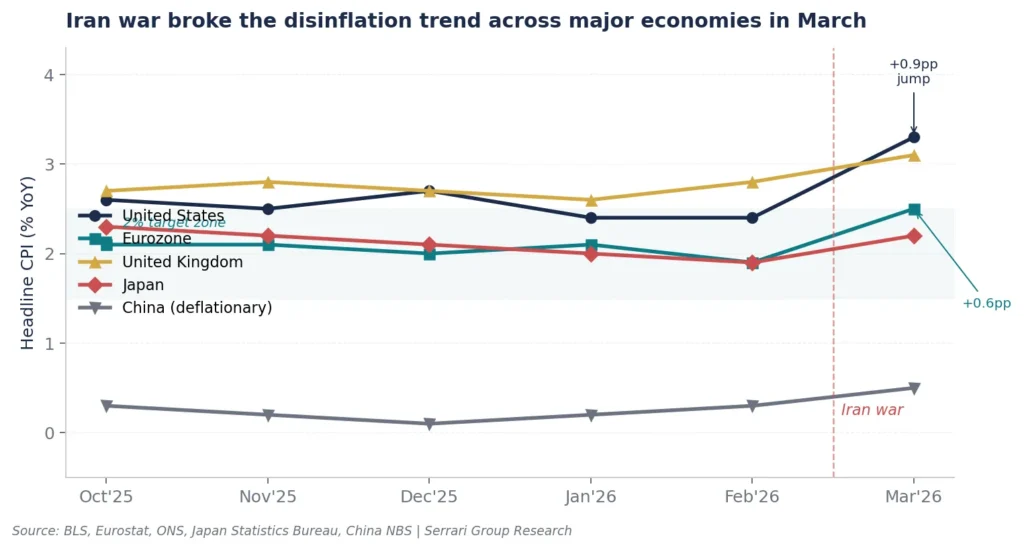
Figure 3 — Headline inflation trajectory across major economies, October 2025 to March 2026
US CPI jumped from 2.4% in February to 3.3% in March 2026 — the highest reading since May 2024. The month-on-month CPI rise of 0.9% was the largest since June 2022. Energy prices rose 12.5% year-on-year, with gasoline up 18.9% and fuel oil up 44.2%. Eurozone headline inflation rose from 1.9% to 2.5% — back above target. UK inflation moved from 2.8% to 3.1%. Japan crept up to 2.2%. Only China remained near-deflationary at 0.5%, and that’s a problem of its own kind.
Crucially, core inflation held up better. US core CPI at 2.6%, Eurozone core at 2.3% (easing from 2.4%). This suggests that the March move was primarily an energy shock rather than a broad re-inflation — which is what central banks need to see in order to ‘look through’ it. Powell explicitly said at the March FOMC press conference that “oil shocks are something the Fed typically looks through” — a signal that the committee is trying to avoid over-reacting. The question is how long core holds if energy pass-through accelerates in April and May.
The forward inflation path depends almost entirely on the duration of the Middle East conflict. Under the IMF’s reference forecast (short war), headline inflation rises modestly in 2026 before resuming its decline in 2027 toward most central bank targets. Under the severe scenario, headline inflation in emerging markets rises materially, and advanced-economy expectations risk becoming unanchored. The single indicator to watch is core inflation in the US and Eurozone through Q2 2026 — if it holds at current levels, the shock is contained; if it moves above 3% in either region, the inflation story changes.
6. Monetary policy: five central banks, no consensus
For the first time in five years, the world’s major central banks are operating at genuinely different points of the cycle. This is a structural shift with real implications for global liquidity, currency dynamics, and capital flows.
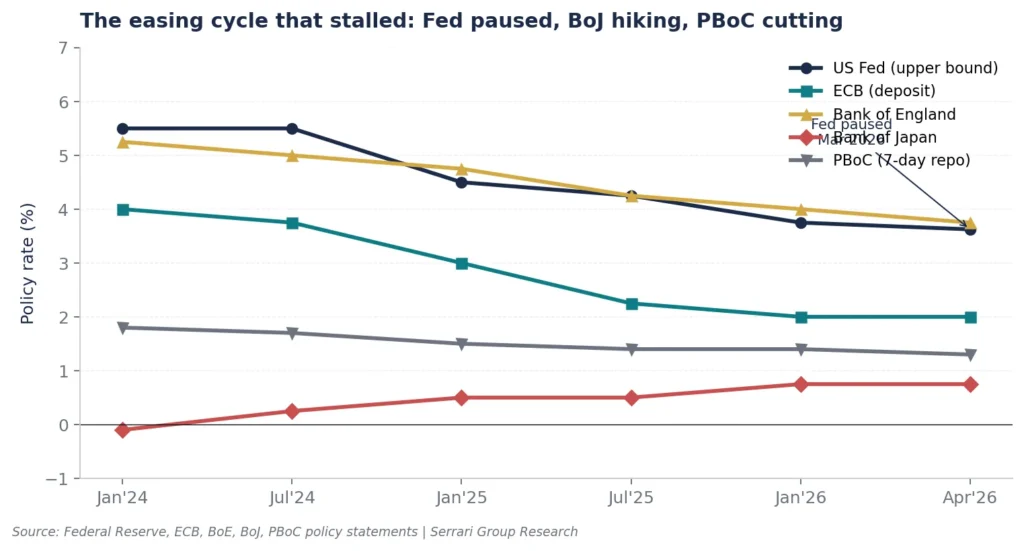
Figure 4 — Major central bank policy rates, January 2024 to April 2026
The Fed: pause, divided, one cut projected
The Federal Reserve held rates at 3.50–3.75% at its March 17–18 meeting for the second consecutive time. The dot plot still projects just one cut for 2026. Dissent is visible: Stephen Miran wanted a 25 bps cut at the March meeting, while minutes released April 8 showed some officials wanted rate hikes on the table given inflation risk. The committee is genuinely divided, and the April 28–29 meeting is the next inflection point. Powell’s term ends in May 2026 — potential successor Kevin Warsh will inherit a committee that is not unified. J.P. Morgan Global Research now sees the Fed holding rates steady for the rest of 2026, with the next move a hike of 25 bps in Q3 2027 — a meaningful shift from the easing narrative that dominated late 2025.
The ECB: six holds, cutting growth not rates
The ECB has held its deposit rate at 2.00% through six consecutive meetings since its June 2024 cutting cycle ended. The March 2026 meeting took the unusual step of cutting the growth forecast while holding rates — normally these move together. Lagarde explicitly cited the Middle East war as creating upside risks for inflation and downside risks for growth, a stagflation-lite framing. Inflation projections were revised up: 2.6% in 2026, 2.0% in 2027. The ECB is now materially stuck.
Bank of England: 25 bps to 3.75%, then pause
The BoE cut to 3.75% in December 2025 and has paused since. UK inflation at 3.1% in March is well above target, and services inflation in particular remains sticky. The BoE is likely to be the last advanced-economy central bank to cut meaningfully, and may hold through 2026.
Bank of Japan: hiking alone
The BoJ is the only major central bank still tightening. The December 2025 hike to 0.75% was its highest level since 1995. Japan is now operating a “normal” monetary policy for the first time in a generation. Further hikes in 2026 are possible if wage growth sustains above 3% — a plausible scenario.
PBoC: accommodative, but modest
The PBoC is the outlier on the dovish side. With inflation essentially zero and property adjustment ongoing, the central bank is expected to cut the 7-day reverse repo rate by a further 10 bps and the RRR by 50 bps in 2026. M2 growth targeted at 7–8%. The constraint is structural: banks’ net interest margins are compressed, limiting how aggressive the easing can be.
| What the divergence means – When major central banks move together, global liquidity moves with them. When they diverge, capital flows become the story. In 2026, expect: (1) a structurally weaker dollar as the Fed-BoJ gap narrows; (2) carry trade unwinds as yen funding becomes more expensive; (3) EM currencies supported by dollar weakness but pressured by commodity volatility; (4) credit spreads widening where central banks can no longer provide a put. The ‘Fed put’ — the idea that the central bank will cut to save markets — is effectively not in force at these price levels. |
7. Commodities: oil, gold, and the war-driven regime
Oil is the single most important macro variable for 2026. It drives inflation, shapes central bank reaction functions, reshapes current accounts, and transfers wealth between regions. The last eight weeks have been one of the most volatile oil regimes since 2008.
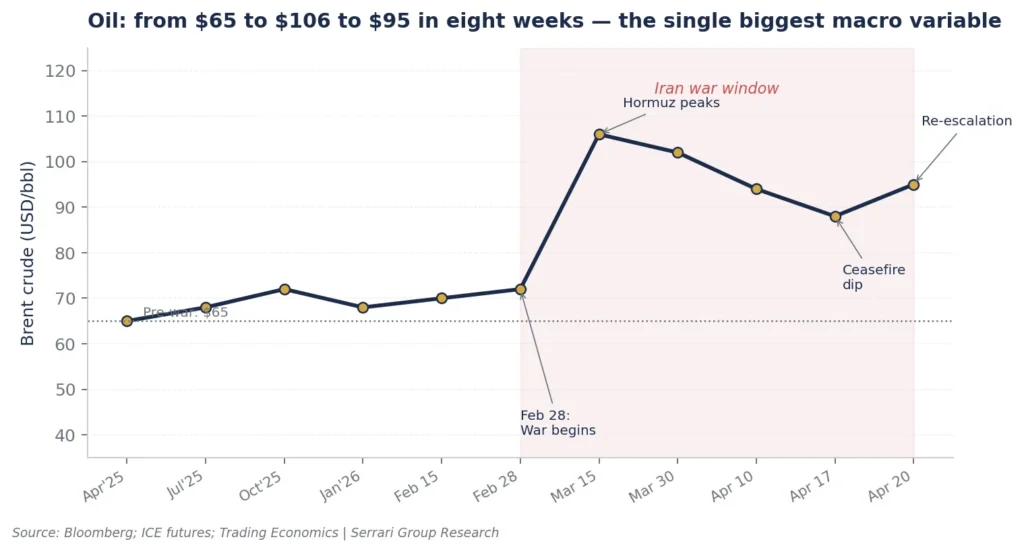
Figure 5 — Brent crude timeline, April 2025 to April 2026
The sequence: Brent at USD 65 in January 2026, quietly rising to USD 72 by late February. The US-Israel strikes on Iran on 28 February took Brent to USD 106 within two weeks as Iran closed the Strait of Hormuz — where 20 million barrels per day of crude normally transit. Brent held above USD 100 for the first three weeks of March. The US-Iran ceasefire announcement on the evening of 16 April triggered an 11.5% collapse to USD 88 in a single session. Re-escalation over the weekend of 18–19 April — the US seizing an Iranian-flagged cargo vessel, Iran reasserting control over Hormuz — sent Brent back up over 5% to USD 95.
Where prices settle from here depends on four variables: whether the ceasefire holds; whether sanctions on Iranian oil are lifted; OPEC+ production decisions; and the resilience of US shale production, which has shown surprising resilience at USD 90+. JP Morgan’s base case is Brent stabilising in the USD 85–100 range through the year. The adverse case — Hormuz closure for 60+ days — takes Brent to USD 120 and pushes global growth below 2%.
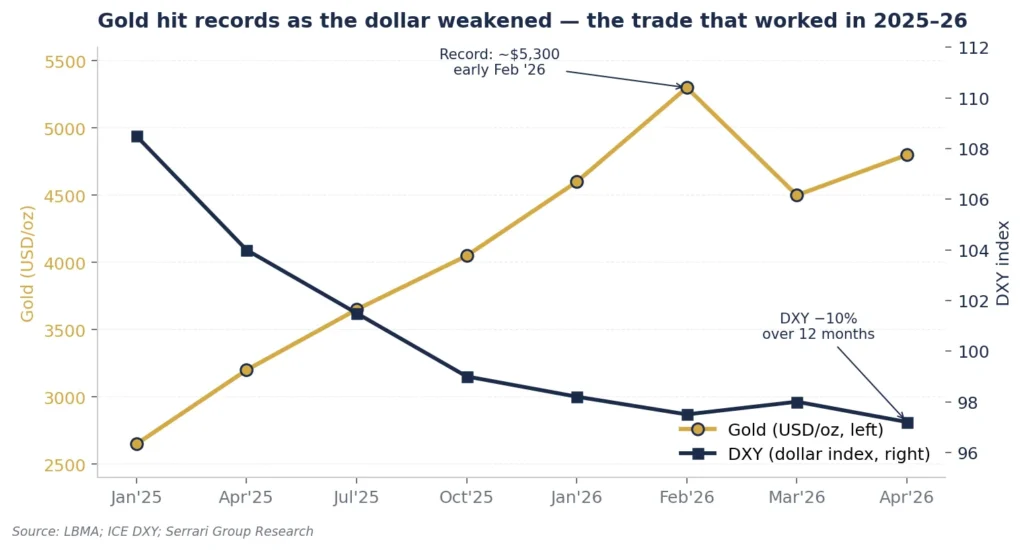
Figure 6 — Gold and the dollar index. The inverse correlation that defined 2025–2026
Gold’s move is the other side of the story. Gold rose roughly 65% in 2025, climbing from around USD 2,623 per ounce at the start of the year to a peak above USD 4,700 by early 2026 — then went to a record high of approximately USD 5,300 in early February 2026 before giving back a third of the gain on the April ceasefire. The driver was a combination of central bank reserve buying (over 1,000 tonnes in 2025), safe-haven demand during the conflict, persistent dollar weakness (DXY down ~10% over twelve months), and structural retail and ETF flow. Goldman Sachs and JP Morgan have USD 5,000/oz base cases for year-end 2026; Citi is the lone sceptic at USD 2,700. The wide dispersion reflects the fact that gold’s move has been both a dollar trade and a geopolitical trade — both can reverse.
Industrial metals tell a more nuanced story. Copper is supported by the energy transition but has been pressured by US-China trade tensions (tariffs hit 145% on some Chinese goods in early April). Aluminum, platinum group metals, lithium, and cobalt all benefit structurally from electrification but are cyclically exposed to Chinese demand and dollar strength. Agricultural commodities — wheat, corn, soy — have been supported by fertiliser costs (a direct war derivative) and by geopolitical supply risk. Coffee and cocoa remain at multi-decade highs on idiosyncratic weather and supply stories.
Context is everything. While you follow today’s updates, use the Serrari Group Market Index and Marketplace to spot emerging shifts. Need to sharpen your edge? Our Wealth Builder Platform turns these insights into a professional-grade strategy.
8. Currencies: the dollar cycle turns
The US dollar index (DXY) is down roughly 10% over twelve months and trades around 97. That’s a meaningful move and a structurally important one: a weaker dollar eases global financial conditions, supports emerging-market currencies, reduces dollar-denominated debt burdens, and — per the standard inverse correlation — supports gold and commodity prices denominated in dollars.
Three drivers explain the 2025–26 dollar weakness. First, Fed policy is now broadly neutral rather than restrictive, reducing the US real-rate advantage. Second, political and fiscal dynamics under the second Trump administration have introduced meaningful policy noise, from aggressive tariff threats to visible pressure on the Federal Reserve’s independence. Third, central bank reserve diversification continues — countries have been steadily moving reserves away from the dollar, a trend that has accelerated on geopolitical grounds.
Major pairs tell a consistent story. The euro has appreciated roughly 8% against the dollar over twelve months despite the Eurozone’s weaker growth. The yen has been supported by BoJ hikes and safe-haven flows — carry trade unwinds in the yen pair have been a recurring feature. Sterling has held up despite weak UK growth. The Chinese renminbi has been kept stable by PBoC management; the PBoC has explicitly said it will not use depreciation as a trade weapon. Emerging-market currencies have broadly benefited — India’s rupee is a notable exception, weakening enough to take the country down from 4th to 6th in global GDP rankings.
| The dollar thesis for 2026 The most consensus call in the market is continued dollar weakness. The DXY forecasting community (FX Empire, long-range forecasters) generally sees a move to 92–95 as plausible through 2026, with 89.7 as a technical target if the 2014 trendline breaks. But consensus trades get over-owned. If Fed hikes return to the table, if the Middle East escalates meaningfully, or if risk aversion spikes, the dollar can rally aggressively even from here. The diaspora and emerging-market investor who is positioned for a one-way dollar move is exposed to a classic reversal. |
9. Equities: new highs on narrow breadth
The S&P 500 is making new highs. As of mid-April 2026, the index trades around 6,600, having recorded 39 new record highs during 2025 and gained more than 16% for the year. Goldman Sachs forecasts another 12% return for 2026 on 12% EPS growth. FactSet’s Q1 2026 earnings tracking shows 86% of reporters beating expectations, with full-year 2026 EPS growth projected at 18.0% year-over-year — a stronger pace than any year since 2021.
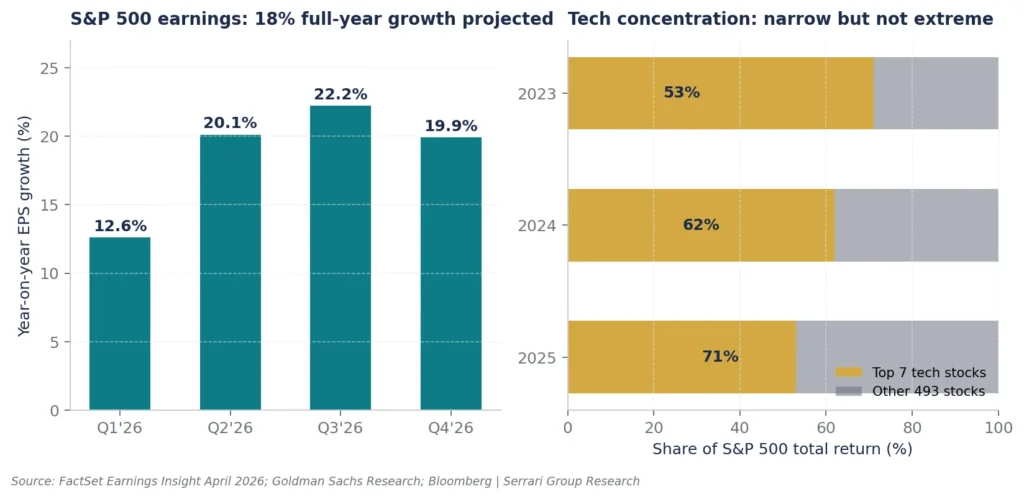
Figure 7 — S&P 500 projected quarterly EPS growth and tech concentration
The uncomfortable truth is that earnings growth is highly concentrated. Information technology is projected to grow earnings 45% year-on-year in Q1 2026, accounting for roughly 87% of the total S&P 500 earnings growth. The seven largest stocks — Nvidia, Microsoft, Apple, Amazon, Alphabet, Broadcom, and Meta — accounted for 53% of 2025 returns. That’s less concentrated than 2024 (62%) or 2023 (71%), but still an extreme figure by historical standards. The Q1 2026 earnings season is effectively a test of whether AI capital expenditure translates into AI capex efficiency — 40% of S&P 500 companies have now integrated agentic AI into supply chain and customer service operations, with consumer-discretionary operating margins up 150 basis points on average.
The valuation framework matters here. The forward 12-month P/E is 20.9x — above the 5-year average of 19.9x and above the 10-year average of 18.9x. VIX is at 13.4, near historical lows and signalling no systemic anxiety. This combination — elevated valuations, low volatility, concentrated earnings — is typical of late-cycle markets rather than early-cycle markets.
Outside the US, European equities have had a more muted year — the Stoxx 600 is positive but has underperformed the S&P 500. Japanese equities (Nikkei) have benefited from sustained corporate reform and BoJ normalisation. Chinese equities have oscillated with policy signals. Emerging-market equities as a group have tracked the dollar story: up when the dollar weakens, down when it strengthens, with India and select commodity exporters leading on idiosyncratic stories.
10. Bonds and credit: yields, spreads, and the fiscal frame
The US 10-year Treasury yield traded around 4.26% in mid-April 2026, with the 2-year at 3.73% — a modest positive slope after the inversion of 2023–24. European 10-year yields (Bund at ~2.4%, OAT at ~3.1%, BTP at ~3.8%) reflect both ECB policy and the varying fiscal credibility of individual sovereigns. UK gilts at 4.1% reflect a BoE that is stuck. Japanese 10-year yields at 1.4% — highest since 2010 — reflect the BoJ’s normalisation.
Credit spreads are tight. US investment-grade corporate spreads are near decade lows; high-yield spreads have widened modestly from their tights but remain below historical averages. This is consistent with the “late cycle, no recession” view. Default rates have stayed low. The risk is that spread levels this tight offer very limited compensation for any meaningful downturn, and position unwind could be abrupt.
The fiscal frame is where bond markets will likely find their next catalyst. Public debt is at post-war highs in most advanced economies — the US debt-to-GDP ratio is above 120%, Japan above 240%, Italy above 140%, France above 115%. Defence spending is rising globally: the IMF’s April 2026 WEO dedicated a chapter to defence spending booms, noting that typical booms raise outlays by 2.7 percentage points of GDP over two-and-a-half years, with two-thirds financed through deficit. In an environment where central banks cannot easily cut rates and governments cannot easily consolidate, term premia can re-expand. This is particularly important for emerging-market sovereigns that issue in dollars and for highly indebted developed economies.
11. Geopolitics: the shadow on the cycle
The Middle East war
The active military conflict that began on 28 February 2026 remains the primary global risk. Key developments have been: initial US-Israel strikes on Iranian nuclear facilities; Iran’s response including closure of the Strait of Hormuz (which normally transits 20 million barrels per day); the mid-April ceasefire; and the late-April re-escalation. As of 21 April, the situation is unstable. An extended closure of Hormuz is the single largest downside risk in the global outlook.
US-China relations
US tariffs on Chinese goods reached 145% on select categories in early April 2026, triggering a risk-off move that contributed to gold’s rally to USD 5,300. China has so far responded asymmetrically — restricting rare earth exports, targeting US agricultural imports, and leveraging its position in critical mineral supply chains. The trade war framework of 2018–2020 has resumed in more aggressive form, but with meaningful differences: global supply chains are more diversified, the EU has its own trade posture, and India has become a parallel option for Western capital.
Fed independence
Less discussed but quietly important: political pressure on Federal Reserve independence has intensified. Powell’s term ends in May 2026, and the Treasury’s preferred successor (reportedly Kevin Warsh) will inherit a committee that is already visibly divided on rates. The IMF’s April 2026 WEO explicitly flagged “intensification of political pressure on independent central banks” as a factor that could erode public confidence and unanchor inflation expectations. A credible Fed matters enormously for asset prices; a less credible Fed would reshape global risk premia.
Trade policy broadly
Beyond US-China, the broader trade policy landscape includes: US tariffs on Mexico, Canada, and selected European goods; the EU-India FTA signed in January 2026 (full implementation targeted 2027); AfCFTA accelerating in the African regional context; the Strategic Trade and Investment Partnership in progress. The IMF’s WEO explicitly flags “easing of trade tensions” as an upside scenario that could lift global growth above the base case.
Elections and political risk
Major 2026 elections with macro implications include: the US midterms (November), which will shape the second half of the Trump administration’s policy path; Brazil’s October election; multiple African elections (Uganda, Ethiopia, Côte d’Ivoire, Benin — covered in our separate Africa outlook); and the ongoing succession questions in Japan’s LDP and China’s leadership structure. Policy continuity varies across all of these.
12. Technology and AI: the productivity question
The most important structural variable for global growth in 2026 and beyond is whether AI adoption translates into measurable productivity gains. The US data is, for the first time, starting to provide positive evidence. Non-farm business productivity rose 4.1% in Q2 2025 and 4.9% in Q3 2025 — the strongest readings in decades. Manufacturing productivity growth lagged, suggesting the gains are concentrated in knowledge-sector adoption (finance, legal, consulting, customer service, software). 40% of S&P 500 companies had integrated autonomous AI agents into operations by April 2026.
The investment is enormous. The top seven tech companies are projected to spend collectively over USD 400 billion on AI-related capital expenditure in 2026. Hyperscalers — Microsoft, Alphabet, Amazon, Meta — are leading. Nvidia’s data centre revenue continues to grow well over 30% year-on-year. The critical question for investors in 2026 is whether this capex delivers revenue or just margin compression on the spending side.
The IMF’s reference forecast assumes “faster AI adoption translates into strong productivity gains.” If this proves correct, global potential growth could edge above the post-pandemic trend — a genuinely bullish long-term scenario. If it proves disappointing — if AI capex never flows to the bottom line — the rationale for elevated equity valuations weakens significantly, and the concentration risk becomes a tangible market risk.
| The AI trade, reframed AI is not one trade — it is at least three. (1) The infrastructure trade: chips, data centres, networking, power. This is mature and highly concentrated. (2) The platform trade: hyperscalers and foundation model developers. This is where most 2025 returns came from. (3) The application trade: companies that use AI to reshape their economics. This is the least priced and arguably the largest opportunity — and it cuts across every sector, not just technology. The investor who bought trade 1 in 2023 has been paid. The investor who bought trade 2 in 2024 has been paid. Trade 3 is the story of 2026–2028. |
13. Risks and opportunities
Downside risks
Middle East escalation. An extended closure of the Strait of Hormuz, sustained Brent above USD 120, or direct military action beyond the current US-Iran framework would push global growth below 2% and inflation materially higher. This is the single most consequential scenario.
Disappointing AI productivity. If 2026 earnings reports reveal that AI capex is not flowing to free cash flow generation, equity multiples face compression. The S&P 500’s forward P/E at 20.9x is justified only by continued earnings acceleration.
Trade war escalation. US-China tariffs at 145% are a starting point, not a ceiling. A further round — targeting semiconductors, pharmaceuticals, or rare earths — could trigger broader supply chain disruption and risk-off moves.
Fed independence erosion. The May 2026 chair succession and potential political interference in FOMC decisions could unanchor inflation expectations, which the IMF explicitly flags as a first-order risk.
Emerging-market debt stress. Sub-2% global growth would expose the weakest sovereign borrowers — Ethiopia, Pakistan, Egypt, Angola, Argentina. African and Asian frontier markets are most exposed to any dollar strength reversal.
Upside opportunities
AI productivity through. If Q2 and Q3 2026 earnings reports show AI productivity translating into margin expansion across non-tech sectors, the S&P 500’s high P/E is validated and global potential growth edges higher. This would be a durable multi-year positive.
Trade de-escalation. A credible US-China trade framework — even a partial one — would reduce risk premia across emerging markets, support the dollar cycle turn, and lift global investment.
EM consumption expansion. India, Indonesia, Vietnam, Mexico, and selected African economies are entering a phase where middle-class consumption becomes material. Fintech, e-commerce, financial services, and consumer brands are the cleanest ways to play this.
Energy transition investment. Critical minerals, grid infrastructure, storage, and renewable generation continue to attract capital globally. The IEA estimates USD 2 trillion in annual energy transition investment by 2030 — this is a structural tailwind that is largely independent of the business cycle.
Supply chain diversification dividend. India, Vietnam, Mexico, and selected ASEAN economies are capturing FDI as multinationals diversify away from China-only production. This is likely a 5–10 year structural trend.
14. Forward-looking scenarios
Three scenarios capture the range of plausible paths for the next 6–12 months. Probabilities are Serrari base cases; readers with different macro views can adjust accordingly.
Base case — soft landing with war tax (50% probability)
Middle East conflict de-escalates without full resolution. Brent stabilises in a USD 85–95 range. Global growth prints 3.1% in 2026 consistent with IMF baseline. Headline inflation peaks mid-year then resumes its decline; core inflation holds below 3% in major advanced economies. Fed delivers one cut in Q4 2026 as energy effects fade; ECB cuts 25 bps in H2; BoJ hikes once more. S&P 500 extends to 7,000–7,400 on earnings growth. DXY settles in 94–97 range; gold consolidates in USD 4,500–5,200; EM equities outperform US.
Upside — AI pays off and peace dividend (25%)
Middle East conflict ends with a credible framework. Brent drops to USD 70–80. Q2/Q3 2026 earnings seasons reveal AI capex translating to margin expansion across multiple sectors. Global growth accelerates to 3.4%+ in 2026; emerging markets rally. Fed delivers 50–75 bps of cuts in H2 2026; dollar weakens further; gold moves above USD 5,500; S&P 500 pushes to 8,000+ with breadth improving. EM currencies rally materially. India crosses USD 4.5T and reclaims 4th place.
Downside — conflict extends or AI disappoints (25%)
Hormuz closure extends beyond 60 days, or AI earnings disappoint, or US-China trade war broadens. Brent sustained above USD 110. Global growth falls toward 2% or below — closer to the IMF severe scenario. Advanced-economy inflation re-accelerates above 4%. Fed hikes back on the table; emerging-market debt stress emerges in several sovereigns; Ethiopia, Pakistan, Egypt face funding crises. S&P 500 corrects 15–25%; gold rallies to USD 6,000+; EM currencies weaken sharply; VIX spikes above 30.
Allocation framework
Drawing on the scenarios above and the country spotlights in Section 4, Serrari’s global allocation framework for the 6–12 month horizon:
- Defensive core (30–40%): short-dated high-grade sovereigns (US Treasuries 1–3Y, Bunds, gilts). Real yields of 1.5–2.5% over inflation are available for the first time in 15 years. Money market funds and high-grade floating rate notes for local-currency investors.
- Equity core (25–35%): diversified US large-cap with selective tech exposure; developed-Europe selective (defence, luxury, healthcare); Japanese corporate reform exposure; Indian mid/large-cap as the structural EM story.
- Commodities and real assets (15–20%): gold remains earned in this environment though from current levels the case is less compelling than six months ago; energy transition metals; select energy producers as geopolitical hedge.
- Emerging markets (10–15%): diversified EM index exposure plus selective country tilts per our Africa outlook (Kenya, Egypt, Côte d’Ivoire, Nigeria). Currency-hedged for most investors; unhedged for those with inflation or diaspora considerations.
- Satellite (0–10%): crypto as regulated in relevant jurisdictions; alternative strategies (trend, managed futures) as scenario-volatility hedges; pre-restructuring emerging-market debt for specialist investors.
| Bottom line for the next twelve months – The macro variables you cannot easily hedge against are the ones that matter most: Middle East duration, Fed independence, AI productivity. The macro variables you can position around — inflation, rates, currency, commodity prices — are going to be more volatile than any point since 2022. The portfolio that wins in this environment is not the one that picks the right scenario; it is the one that survives all three, rebalances into volatility, and holds genuine diversification across assets that respond differently to the same shock. For Serrari’s Kenyan and diaspora audience, the ‘think globally, invest regionally’ framework is now more than a slogan — it is genuinely the strategy that captures both the global cycle and the African growth dividend. |
About this outlook
This outlook completes the Serrari Group Q2 2026 market intelligence trilogy — Kenya, Africa, and Global — designed to be read together as a single coherent framework for understanding Kenyan and African investment opportunities in a global context.
Sources include the IMF World Economic Outlook April 2026 (“Global Economy in the Shadow of War”), the Federal Reserve (FOMC statements, dot plots, and minutes through April 2026), the European Central Bank (March 2026 macroeconomic projections and Lagarde press conferences), the Bank of England, Bank of Japan, and People’s Bank of China policy statements, the Bureau of Labor Statistics (March 2026 CPI), Eurostat (March 2026 HICP), Goldman Sachs Global Investment Research, JP Morgan Research, FactSet Earnings Insight, and primary reporting from Reuters, Bloomberg, and the financial press.
All forecasts reflect Serrari base-case scenarios with explicit probability weights. This is not investment advice. Specific allocation decisions should reflect individual circumstances, time horizons, risk tolerance, tax position, and regulatory status.
Your financial future isn’t something you wait for—it’s something you build.
The real question is: when do you begin?
Move beyond simply staying informed.
Navigate the markets with clarity—track trends through the Serrari Group Market Index, uncover opportunities in the Serrari Marketplace, and build practical knowledge with our Curated Wealth Builder Platform.
Stay connected to what truly matters.
Get daily insights on macro trends and financial movements across Kenya, Africa, and global markets—delivered through the Serrari Newsletter.
Growth opens doors.
Advance your career through professional programs including ACCA, HESI A2, ATI TEAS 7 , HESI EXIT , NCLEX – RN and NCLEX – PN, Financial Literacy!🌟—designed to move you forward with confidence.
See where money is flowing—clearly and in real time.
Track Money Market Funds, Treasury Bills, Treasury Bonds, Green Bonds, and Fixed Deposits, alongside global and African indexes, key economic indicators, and the evolving Crypto and stablecoin landscape—all within Serrari’s Market Index.
Know it. Create it. Grow it. Preserve it.