Kia Corporation plans to invest KRW 3 trillion ($2.2 billion) in a new electric vehicle manufacturing facility at its AutoLand complex in Gwangju, South Korea. Expected to be completed by 2029, the investment will transform the site into a strategic production base for software-defined vehicles (SDVs) and zero-emission mobility. Alongside the factory, Kia and its partners will develop an integrated mobility ecosystem involving autonomous public transport, last-mile logistics and accessible transportation. A fleet of 200 autonomous Hyundai Ioniq 5 electric vehicles will support testing and AI development.
Key Takeaways
- Kia plans to invest KRW 3 trillion ($2.2 billion) in a new EV plant at AutoLand Gwangju.
- Construction and investment activities are expected to run through 2029.
- The facility will support the production of software-defined vehicles and zero-emission vehicles.
- Hyundai Motor Group’s wider domestic investment programme amounts to KRW 125 trillion over five years, with one source reporting KRW 125.2 trillion.
- Kia is partnering with local authorities and universities to develop an integrated mobility ecosystem.
- A fleet of 200 autonomous Hyundai Ioniq 5 EVs will support road testing and AI training.
Why Is Kia Investing $2.2 Billion in a New EV Plant?
South Korean automaker Kia Corporation plans to invest 3 trillion won ($2.2 billion) in a new electric vehicle production facility at its AutoLand complex in Gwangju.
The investment, expected to run through 2029, forms part of a broader domestic expansion programme by Hyundai Motor Group, announced in November 2025. The group plans to invest approximately KRW 125 trillion in its South Korean operations over five years.
The Gwangju project will expand the facility’s manufacturing capabilities beyond internal combustion engine vehicles, positioning it as a strategic production base for software-defined vehicles (SDVs) and zero-emission vehicles.
This shift is significant because the automotive industry is increasingly moving beyond conventional vehicle manufacturing towards electric powertrains, connected technologies and software-driven vehicle functions.
By investing in the Gwangju facility, Kia is positioning its production operations to support this changing market. The project also strengthens South Korea’s role in Hyundai Motor Group’s longer-term manufacturing strategy.
What Will the New Gwangju Facility Produce?
The new investment is intended to establish a global production base for future mobility technologies, particularly software-defined and environmentally friendly vehicles.
Software-defined vehicles rely increasingly on software to control and improve vehicle functions, rather than depending entirely on fixed hardware systems. This creates opportunities for manufacturers to introduce new features, improve vehicle performance and support connected mobility services.
Kia’s investment will therefore support more than an expansion of manufacturing capacity. It is part of a wider transition towards vehicles that combine electrification, digital technology and flexible transportation solutions.
The facility’s development also connects with Hyundai Motor Group’s broader ambition to strengthen its domestic automotive and mobility ecosystem.
How Will Gwangju Become a Future Mobility Testing Hub?
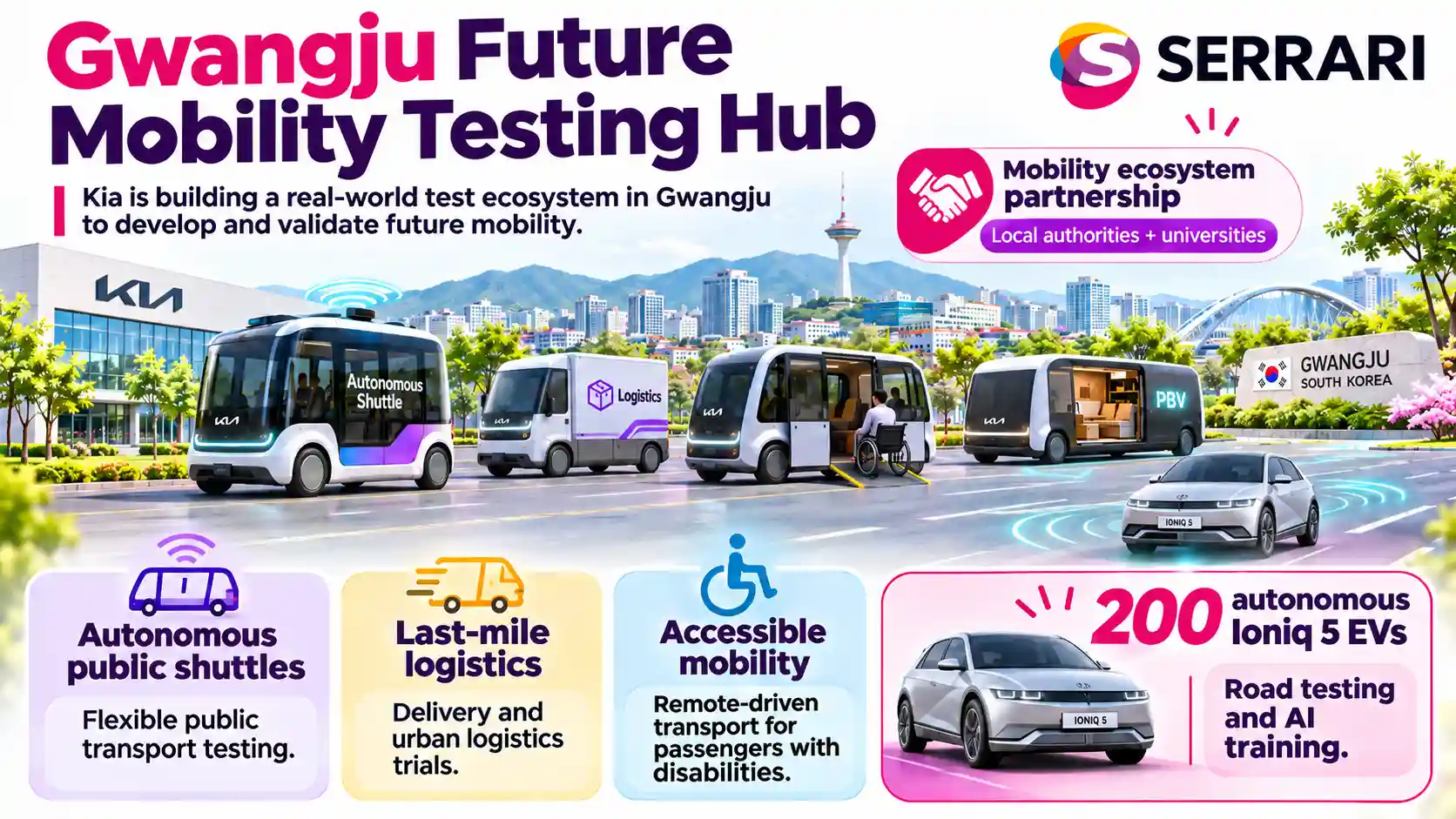
Alongside the factory investment, Kia has signed a memorandum of understanding with the Jeonnam-Gwangju authorities, Chonnam National University and the Gwangju Institute of Science and Technology.
The partnership aims to establish an integrated mobility ecosystem that will test purpose-built vehicles (PBVs) for different transportation needs.
The planned applications include:
- Autonomous public shuttles: Vehicles designed to provide flexible public transportation.
- Demand-responsive transport: Services that can adapt routes and operations to passenger requirements.
- Last-mile logistics: Vans designed to support goods delivery and urban logistics.
- Accessible mobility: Remote-driven vehicles intended to serve passengers with disabilities.
- Reconfigurable vehicles: Designs that can be adapted for passenger transportation or logistics.
The initiative will also test Kia’s PV5 Van remote-driving systems and other purpose-built vehicle technologies.
This approach could help Kia understand how different vehicle designs perform in real-world transportation environments before expanding their commercial applications.
Context is everything. Stay ahead of shifting trends with today’s market updates, and uncover emerging opportunities using the Serrari Group Market Index and Marketplace. Then, take control of your own financial future by exploring our Money & Life Reset Transformation Blueprint ™ to build stronger habits, create better systems, and design a path toward lasting wealth.
Why Will Kia Deploy 200 Autonomous Hyundai Ioniq 5 EVs?
A central part of the initiative is the planned deployment of 200 autonomous Hyundai Ioniq 5 EVs across Gwangju.
The fleet will operate on residential, commercial and urban roads, supporting road testing of the purpose-built vehicles and training their artificial intelligence systems.
Real-world testing is important because autonomous mobility technologies must respond to changing road conditions, traffic patterns and different passenger needs.
The 200-vehicle fleet will provide an environment for testing these technologies beyond controlled settings. It will also help train the AI systems expected to support the future operation of autonomous shuttles and other mobility services.
The initiative therefore connects vehicle manufacturing with the development and practical testing of the software and systems needed to operate future mobility services.
What Does This Mean for South Korea’s Automotive Industry?
Kia’s Gwangju investment reflects a broader shift in the automotive industry, where competition increasingly involves more than vehicle production.
Manufacturers are investing in electric vehicle platforms, software capabilities, autonomous driving systems and new transportation models.
The partnership between Kia, local authorities and academic institutions also demonstrates the importance of collaboration in developing these technologies. Universities and research institutions can contribute technical expertise, while local authorities provide an environment for testing transportation services in real communities.
For Gwangju, the project could strengthen its position as a centre for future mobility research, manufacturing and testing.
For Kia and Hyundai Motor Group, it creates an opportunity to connect production capacity with the development of new mobility technologies.
The Bigger Picture: Why Does This Investment Matter Now?
Kia’s KRW 3 trillion investment is part of a wider transformation in the global automotive industry. Electric vehicles are changing how cars are powered, while software-defined systems and autonomous technologies are changing how vehicles are designed and used.
The Gwangju project brings these developments together through manufacturing investment and real-world mobility testing.
Its significance lies in the combination of three priorities: expanding EV production, developing software-driven vehicles and testing new transportation services.
However, the planned benefits will depend on successful construction, technology development and the ability to translate testing into commercially viable services.
By 2029, Kia aims to have established a strategic production base that supports its future mobility ambitions. The project will also offer a practical test of how manufacturing facilities, AI systems and urban transportation services can be developed together.
Frequently Asked Questions
1. How much is Kia investing in its new Gwangju EV plant?
Kia plans to invest KRW 3 trillion, equivalent to approximately $2.2 billion, in the new electric vehicle facility at AutoLand Gwangju.
2. When will Kia’s new EV plant be completed?
The investment and development programme is expected to run through 2029.
3. What are software-defined vehicles?
Software-defined vehicles are vehicles whose functions and capabilities increasingly depend on software. This allows manufacturers to support connected features, software-based updates and more advanced vehicle systems.
4. Why is Kia deploying 200 autonomous Hyundai Ioniq 5 EVs in Gwangju?
The fleet will support road testing of purpose-built vehicles and help train their artificial intelligence systems across residential, commercial and urban roads.
Your financial future isn’t something you wait for—it’s something you build.
The real question is: when do you begin?
Move beyond simply staying informed.
Navigate the markets with clarity—track trends through the Serrari Group Market Index, uncover opportunities in the Serrari Marketplace, and build practical knowledge with our Curated Wealth Builder Platform.
Stay connected to what truly matters.
Get daily insights on macro trends and financial movements across Kenya, Africa, and global markets—delivered through the Serrari Newsletter.
Growth opens doors.
Advance your career through professional programs including ACCA, HESI A2, ATI TEAS 7 , HESI EXIT , NCLEX – RN and NCLEX – PN, Financial Literacy!🌟—designed to move you forward with confidence.
See where money is flowing—clearly and in real time.
Track Money Market Funds, Treasury Bills, Treasury Bonds, Green Bonds, and Fixed Deposits, alongside global and African indexes, key economic indicators, and the evolving Crypto and stablecoin landscape—all within Serrari’s Market Index.