Nigeria’s Dangote Group is exploring major industrial investments in Egypt as the conglomerate seeks to expand its manufacturing footprint across Africa and strengthen regional production networks in refining, petrochemicals, fertilizers and related industries.
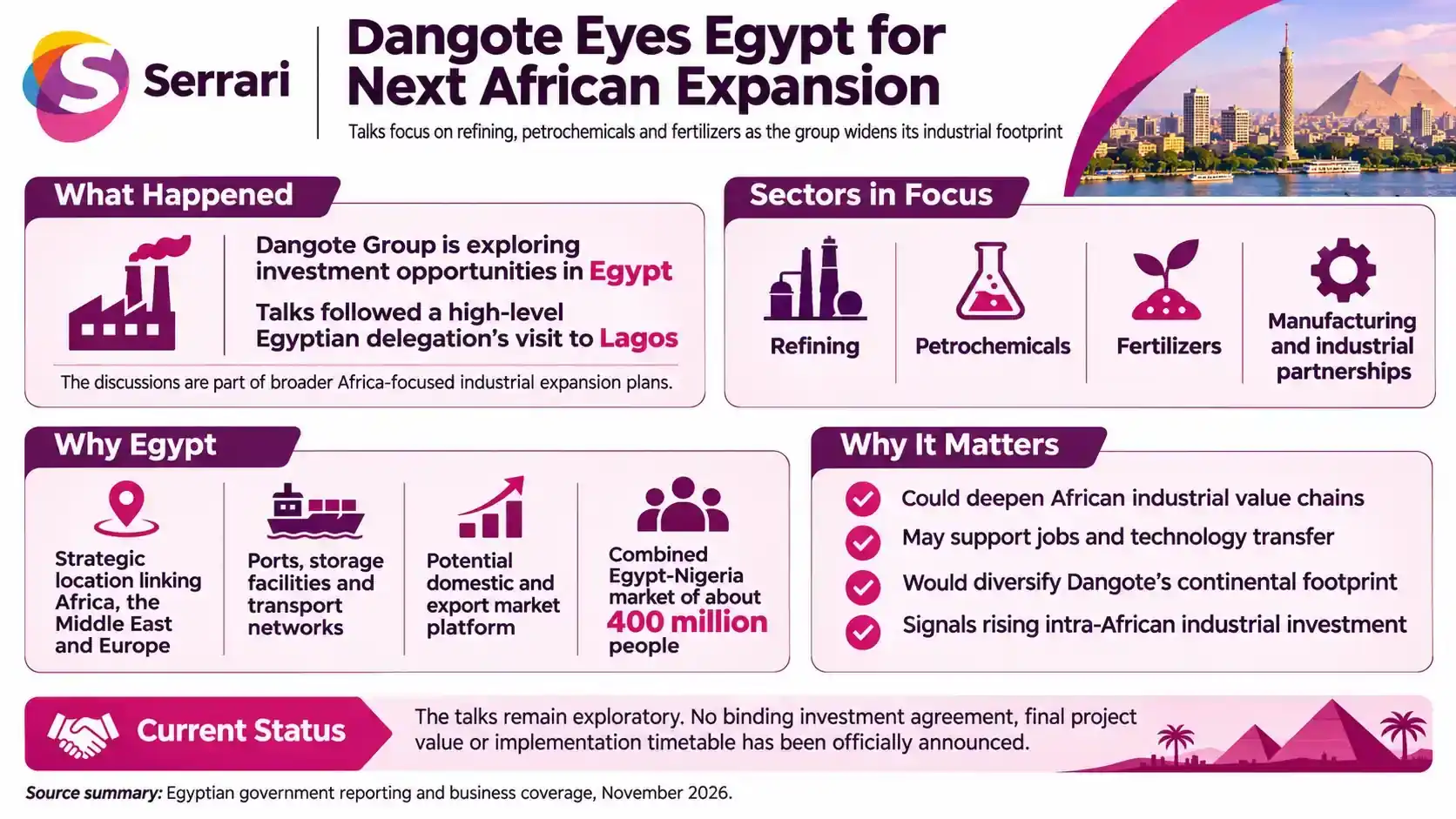
The discussions emerged following a high-level Egyptian delegation’s visit to the Dangote Industrial Complex in Lagos on November 8, 2026, led by Investment and Foreign Trade Minister Mohamed Farid Saleh.
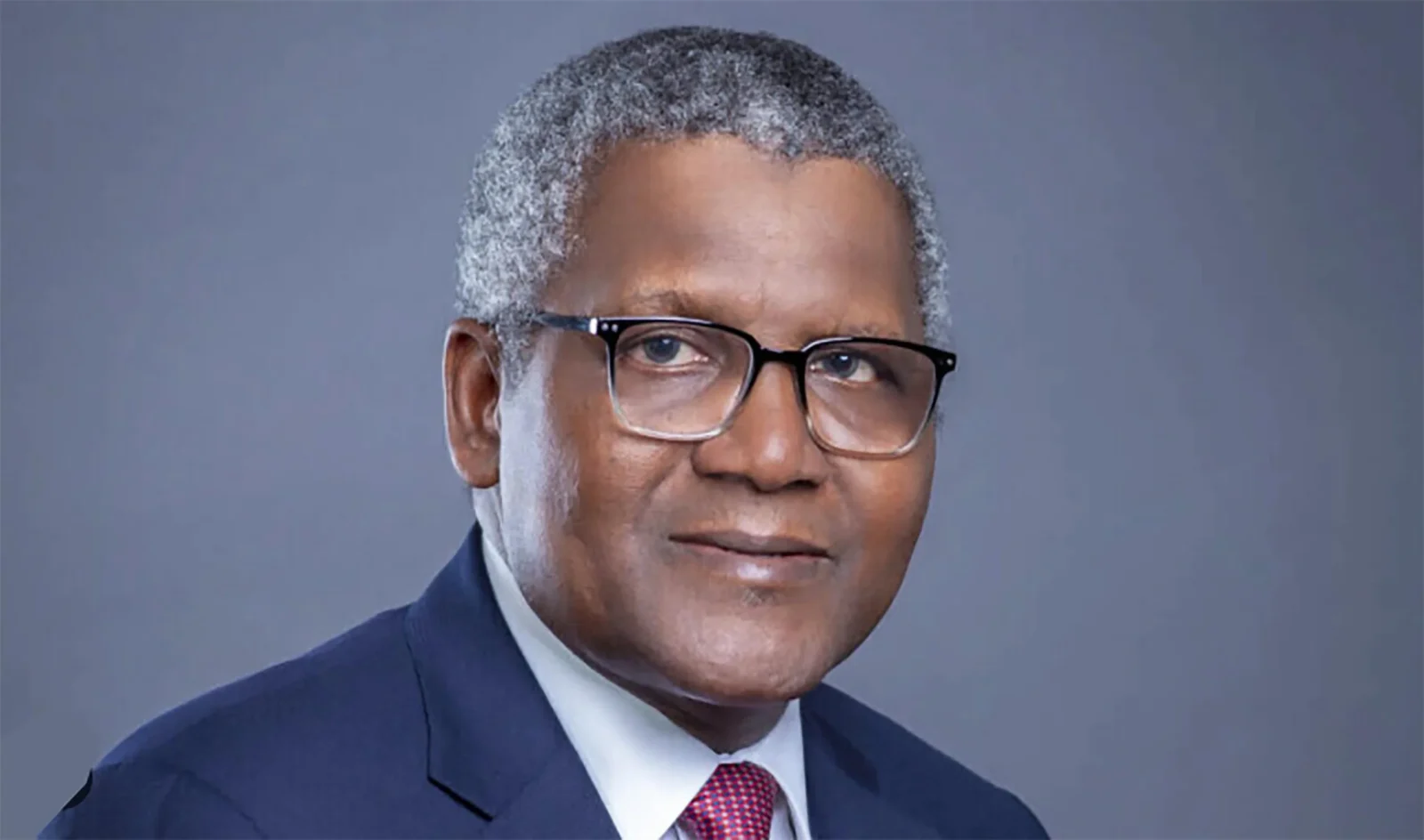
The delegation met Aliko Dangote, chairman and chief executive of the group, to explore potential joint ventures and industrial partnerships that could combine Nigeria’s energy resources with Egypt’s manufacturing capabilities, transport infrastructure and access to international markets.
The proposed expansion forms part of Dangote Group’s Vision 2030 strategy, which seeks to develop larger industrial operations across Africa, strengthen regional value chains and increase the continent’s participation in higher-value manufacturing.
For Egypt, the discussions present an opportunity to attract substantial African private investment while strengthening its ambitions to become a regional manufacturing, energy-processing and export hub.
However, the talks remain exploratory, with no officially confirmed investment amount, binding project agreement or implementation timetable.
Key Overview
- Egypt expansion under consideration: Dangote Group is evaluating investment opportunities in refining, petrochemicals, fertilizers and manufacturing.
- High-level government engagement: Egyptian Investment and Foreign Trade Minister Mohamed Farid led a delegation to the group’s Lagos industrial complex on November 8, 2026.
- Large potential market: Egypt and Nigeria have a combined population of approximately 400 million, offering significant opportunities for industrial production and trade.
- Strategic infrastructure: Egypt’s ports, petroleum storage facilities, industrial zones and transport networks could support export-oriented projects.
- Vision 2030 strategy: Dangote aims to expand industrial production across Africa and strengthen regional supply chains.
- Industrial cooperation: Proposed partnerships could support manufacturing capacity, technology transfer, employment and the development of supporting industries.
- Investment remains unconfirmed: Discussions have not resulted in an announced binding agreement, final project value or construction timetable.
- Broader economic significance: The initiative reflects increasing efforts to mobilise African capital and industrial expertise to reduce dependence on imported manufactured products.
Why Dangote Group Is Considering Egypt for Its Next Expansion
Nigeria’s Dangote Group is considering Egypt as a destination for its next phase of industrial investment, signalling a potential shift toward deeper economic cooperation between two of Africa’s largest economies.
According to the November 8 government announcement, the discussions followed a visit by a senior Egyptian delegation to the Dangote Industrial Complex in Lagos.
The delegation included representatives of Egypt’s petroleum sector, investment authorities and industrial institutions, reflecting the government’s interest in developing partnerships across multiple industries.
The talks focused on oil refining, petrochemical production, fertilizers and related manufacturing activities.
The interest in Egypt is driven by a combination of market access, existing industrial infrastructure and opportunities to establish production facilities serving both domestic consumers and export markets.
Egypt has a relatively developed industrial base, extensive transport connections and access to the Mediterranean and Red Seas.
These characteristics could make the country attractive to manufacturers seeking to supply North African, Middle Eastern and European markets.
For Dangote Group, expanding into Egypt would also support its objective of developing a more geographically diversified industrial business rather than concentrating major investments exclusively in Nigeria.
However, the group has not publicly confirmed a final investment decision.
The discussions represent an assessment of potential opportunities rather than evidence that specific facilities are already being developed.
Egypt’s Strategic Location Offers Access to Multiple Markets
Egypt’s geographical position is one of its strongest advantages in attracting industrial investment.
Located between North Africa and the Middle East, the country provides access to important international shipping routes and commercial markets.
Its Mediterranean ports facilitate connections with European markets, while Red Sea infrastructure supports trade with the Middle East, Asia and East Africa.
The Suez Canal also places Egypt along a major route for international maritime commerce.
These advantages matter particularly for industries involving large volumes of raw materials and finished products.
Refining, petrochemical production and fertilizer manufacturing require reliable access to feedstocks, storage facilities, transportation networks and export terminals.
Establishing industrial operations near existing infrastructure can potentially reduce logistics costs and improve supply-chain efficiency.
During the industrial partnership discussions, Egyptian officials highlighted the country’s petroleum infrastructure, including storage facilities, transport systems and ports capable of handling energy products.
These assets could support projects serving domestic demand while also targeting international customers.
Nevertheless, access to infrastructure does not automatically guarantee commercial viability.
Potential investors must assess energy prices, feedstock availability, financing costs, regulatory requirements and demand for finished products.
For energy-intensive industries, reliable access to competitively priced gas and electricity is particularly important.
Consequently, Egypt’s attractiveness will depend not only on its geographical advantages but also on whether the operating environment supports profitable long-term industrial investment.
Refining and Petrochemicals Emerge as Major Opportunities
Petroleum refining and petrochemical manufacturing were among the leading sectors discussed during the Egyptian delegation’s visit.
Dangote Group has developed substantial experience in large-scale industrial processing through its Nigerian operations.
Its refinery and petrochemical complex represents one of Africa’s most ambitious private-sector industrial investments, designed to strengthen domestic fuel production and support related manufacturing activities.
Expanding similar capabilities into another African market could allow the group to develop new processing capacity, access different customers and broaden its industrial relationships.
For Egypt, cooperation with an established industrial operator could support efforts to expand value-added manufacturing.
Petrochemical industries transform petroleum and natural gas feedstocks into products used in plastics, packaging, textiles, chemicals and other manufacturing activities.
These industries can create demand for supporting businesses, including transport providers, engineering companies, maintenance contractors and equipment suppliers.
However, Egypt’s investment discussions are not limited to constructing a new refinery.
Farid clarified that potential cooperation extends beyond refining, with opportunities available across several manufacturing and energy-related sectors.
This distinction is important because establishing a refinery requires substantial capital, feedstock arrangements and long-term commercial planning.
Alternative investments in petrochemical processing, industrial services or downstream manufacturing could require different financing structures and offer different risk-return profiles.
The eventual direction of the partnership will depend on the commercial opportunities identified through further negotiations.
Fertilizer Production Could Strengthen African Agricultural Supply Chains
Fertilizer manufacturing represents another potential area of cooperation between Dangote Group and Egyptian industrial companies.
Africa’s agricultural sector continues to face constraints associated with fertilizer affordability, distribution and availability.
Many African economies depend on imported agricultural inputs, exposing farmers and distributors to international price fluctuations, exchange-rate movements and transport costs.
Expanding regional production could potentially reduce some of these vulnerabilities.
Dangote Group already operates major fertilizer production facilities in Nigeria, giving it experience in industrial processing and international distribution.
Egypt also possesses an established fertilizer industry, supported by domestic manufacturing capacity and access to international markets.
Partnerships between the two countries could therefore create opportunities for production expansion, technical cooperation and improved distribution networks.
However, the benefits would depend on the products manufactured and their competitiveness in regional markets.
Nitrogen-based fertilizer production, for example, is highly sensitive to natural gas costs because gas is an important feedstock and energy source.
High input costs can weaken competitiveness even when production facilities are located close to major agricultural markets.
Similarly, investments would need to account for transportation costs, distribution arrangements and purchasing power among farmers.
If commercially successful, stronger fertilizer manufacturing could support agricultural productivity and reduce reliance on distant suppliers.
The potential impact extends beyond the fertilizer industry itself because improved access to agricultural inputs can support food production and rural economic activity.
Why Egypt Is Seeking More African Industrial Investment
Egypt’s interest in Dangote Group reflects broader efforts to attract private capital, expand manufacturing and strengthen export competitiveness.
Industrial investment can support economic development by increasing production capacity, creating employment and generating demand for supporting services.
Export-oriented industries can also provide foreign-currency earnings, which are particularly valuable for economies managing external financing pressures.
Egypt’s economic strategy has increasingly emphasised private-sector participation and investment in productive industries.
The involvement of the General Authority for Investment and Free Zones, the Egyptian General Petroleum Corporation, the Egyptian Petrochemicals Holding Company and the Sovereign Fund of Egypt demonstrates the range of institutions participating in discussions.
Their involvement could support investment facilitation, identify industrial opportunities and help structure potential partnerships.
However, government participation in preliminary talks should not be interpreted as confirmation of public financing or investment guarantees.
The commercial structure of any future project would still need to be negotiated.
For Egypt, attracting a major African industrial conglomerate would also demonstrate the potential for investment relationships that extend beyond traditional sources of foreign capital.
Rather than relying exclusively on investors from Europe, Asia or the Gulf, Cairo is seeking opportunities to mobilise capital and industrial expertise from elsewhere on the African continent.
This approach could support wider regional economic cooperation while diversifying sources of investment.
Context is everything. Stay ahead of shifting trends with today’s market updates, and uncover emerging opportunities using the Serrari Group Market Index and Marketplace. Then, take control of your own financial future by exploring our Money & Life Reset Transformation Blueprint ™ to build stronger habits, create better systems, and design a path toward lasting wealth.
A Combined Market of 400 Million People Creates Scale
Egyptian officials highlighted the combined population of approximately 400 million people across Egypt and Nigeria as an important foundation for closer industrial cooperation.
The figure illustrates the potential scale of the two countries’ domestic markets.
Large consumer markets can support demand for manufactured goods, energy products, agricultural inputs and other industrial outputs.
However, population size alone does not determine commercial demand.
Purchasing power, income growth, business activity and infrastructure availability also influence how much consumers and companies can purchase.
The potential advantage lies in connecting production capabilities with markets large enough to support investment in capital-intensive manufacturing.
For example, a manufacturer serving multiple countries may achieve higher production volumes and spread fixed costs across a larger customer base.
This can improve competitiveness where transportation, trade regulations and operating costs are manageable.
Closer cooperation could also allow Egyptian and Nigerian businesses to establish complementary operations rather than duplicating production facilities.
One market might supply raw materials or intermediate goods while another provides specialised processing, manufacturing or distribution services.
Such arrangements could strengthen industrial value chains and improve the efficiency of regional production.
Nevertheless, these opportunities depend on effective trade arrangements, investment protections and reliable logistics.
Without supportive commercial conditions, the existence of large markets may not be sufficient to justify major capital commitments.
Dangote’s Vision 2030 Signals a Broader Industrial Strategy
The proposed Egyptian expansion forms part of Dangote Group’s Vision 2030 strategy, which aims to strengthen its industrial presence across Africa.
The strategy reflects a broader ambition to establish competitive manufacturing operations and reduce the continent’s dependence on imported industrial products.
Africa has substantial natural resources, agricultural potential and growing consumer markets.
However, many countries continue to export raw materials while importing higher-value manufactured goods.
This structure can limit the economic benefits derived from domestic resources.
Investments in refining, petrochemicals, fertilizers and other processing industries offer opportunities to capture more value within African economies.
For Dangote Group, regional expansion could also reduce dependence on a single national market and provide access to different sources of demand.
Geographical diversification may help manage some business risks, although it can introduce additional challenges involving regulations, currencies and political environments.
The group has already established industrial operations across several African countries, particularly in cement production.
The earlier discussions with Egypt’s leadership indicate that the current initiative forms part of continuing engagement rather than an isolated meeting.
Those earlier discussions covered several industrial sectors but did not produce an announced binding investment agreement.
The latest talks therefore suggest further exploration of opportunities rather than the completion of a transaction.
What the Investment Could Mean for Jobs and Technology Transfer
Industrial cooperation between Dangote Group and Egyptian companies could support employment and technical skills development if projects proceed.
Large manufacturing facilities require engineers, technicians, logistics specialists, maintenance personnel and administrative workers.
They can also create indirect demand for construction services, equipment suppliers, transportation businesses and other supporting industries.
For local firms, participation in industrial supply chains may provide opportunities to expand operations and acquire technical expertise.
Technology transfer represents another potential benefit.
Partnerships between established industrial operators and local companies can support training, operational improvements and the introduction of more advanced manufacturing processes.
However, these benefits are not automatic.
The number and quality of jobs created would depend on the scale of investment, production technologies and the extent to which projects use local suppliers and workers.
Highly automated facilities may generate substantial output without employing as many people as conventional manufacturing operations.
Similarly, technology transfer requires deliberate arrangements involving training, knowledge sharing and local participation.
For governments seeking lasting economic benefits, the quality of industrial partnerships may therefore be as important as the amount of capital invested.
Investment Talks Must Overcome Financial and Operational Risks
Despite the strategic opportunities, major industrial projects involve substantial financial and operational risks.
Refining and petrochemical facilities require significant upfront capital and may take years to develop.
Their profitability depends on construction costs, feedstock prices, energy availability, financing arrangements and demand for finished products.
Currency volatility and inflation can also influence project economics, particularly when equipment and financing are denominated in foreign currencies.
Egypt’s energy sector has faced supply pressures, highlighting the importance of reliable fuel and gas availability for prospective investors.
The country’s November 2026 energy cooperation efforts include discussions aimed at strengthening gas supplies, refining arrangements and electricity connections with Libya.
This broader context demonstrates why feedstock security and infrastructure reliability will be important considerations for future industrial projects.
Dangote Group must also consider the financial demands associated with its existing investments and wider expansion ambitions.
A project that appears strategically attractive may still be delayed if capital costs, financing conditions or expected returns are unfavourable.
Although an earlier investment report discussed a possible $10 billion to $15 billion programme, no binding commitment of that amount was established in the November 8 official announcement.
The figures should therefore be treated as exploratory rather than confirmed expenditure.
Investors will need further details about project selection, funding structures, ownership arrangements and implementation schedules before assessing the likely financial impact.
The Bigger Picture: African Capital Financing African Industry
The discussions between Egypt and Dangote Group reflect growing interest in using African private capital to support industrial development across the continent.
Historically, many large industrial projects in Africa have depended heavily on financing, technology or ownership structures involving companies based outside the continent.
Cross-border investments by major African businesses offer an alternative model in which regional capital and expertise contribute directly to manufacturing expansion.
This approach could strengthen commercial relationships between African economies while supporting the development of regional supply chains.
However, intra-African investment alone cannot overcome structural constraints such as inadequate infrastructure, financing costs and regulatory fragmentation.
Successful industrial integration requires competitive operating environments and the ability to move goods efficiently between markets.
The African Continental Free Trade Area provides a broader framework for reducing trade barriers, but its economic benefits depend on effective implementation and business participation.
For Dangote Group, Egypt presents an opportunity to combine existing industrial experience with a new geographical platform.
For Egypt, the opportunity is to attract investment that strengthens domestic production and creates access to wider markets.
The significance of the talks will ultimately depend on whether the proposed cooperation results in commercially sustainable projects rather than remaining at the level of diplomatic engagement.
Conclusion
Dangote Group’s consideration of industrial investment in Egypt represents a potentially important development in Africa’s efforts to expand manufacturing capacity and deepen regional economic cooperation.
The proposed partnerships could combine Nigeria’s industrial expertise and energy resources with Egypt’s manufacturing base, infrastructure and access to international markets.
Refining, petrochemicals, fertilizer production and related industries offer opportunities to develop higher-value manufacturing activities while supporting employment and technology transfer.
However, the discussions remain preliminary, with no confirmed binding investment agreement, final project value or implementation timetable.
The next stage will require detailed commercial assessments, negotiations and financing arrangements capable of supporting viable projects.
For Egypt, securing investment from a major African industrial conglomerate could strengthen its ambitions to become a regional manufacturing and export hub.
For Dangote Group, expanding into Egypt could provide a platform for geographical diversification and further implementation of its Vision 2030 strategy.
The wider significance lies in whether African industrial companies can increasingly deploy capital across national borders to create competitive manufacturing networks, reduce dependence on imported products and capture more value from the continent’s resources.
If the proposed cooperation progresses into productive investments, it could provide an important example of how African-led industrial partnerships can support economic integration and long-term development.
Sources: Egypt State Information Service / Ahram Online / Daily News Egypt / Egypt Oil & Gas / BusinessDay Nigeria / Reuters / Egyptian Gazette
Your financial future isn’t something you wait for—it’s something you build.
The real question is: when do you begin?
Move beyond simply staying informed.
Navigate the markets with clarity—track trends through the Serrari Group Market Index, uncover opportunities in the Serrari Marketplace, and build practical knowledge with our Curated Wealth Builder Platform.
Stay connected to what truly matters.
Get daily insights on macro trends and financial movements across Kenya, Africa, and global markets—delivered through the Serrari Newsletter.
Growth opens doors.
Advance your career through professional programs including ACCA, HESI A2, ATI TEAS 7 , HESI EXIT , NCLEX – RN and NCLEX – PN, Financial Literacy!🌟—designed to move you forward with confidence.
See where money is flowing—clearly and in real time.
Track Money Market Funds, Treasury Bills, Treasury Bonds, Green Bonds, and Fixed Deposits, alongside global and African indexes, key economic indicators, and the evolving Crypto and stablecoin landscape—all within Serrari’s Market Index.