




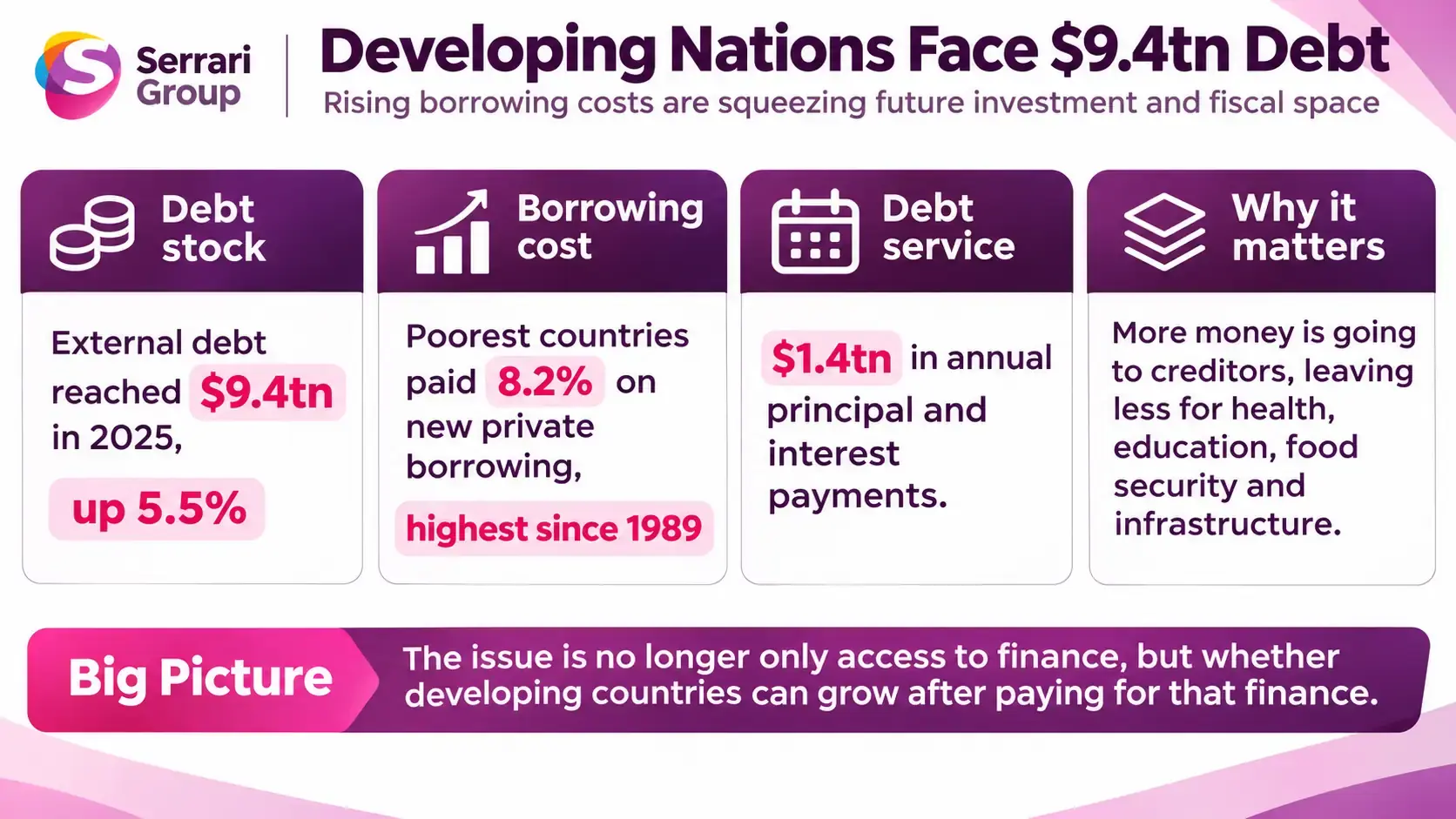
External debt owed by low- and middle-income countries climbed 5.5% to a record $9.4 trillion in 2025, renewing concerns that developing economies are borrowing at rates that limit their ability to fund healthcare, education and infrastructure. The increase was the fastest since 2021 and coincided with the reopening of international bond markets to countries that had previously struggled to raise funds.
But improved access to credit has brought an uncomfortable trade-off. The poorest borrowers face their highest private-creditor interest rates in decades, while total repayments continue absorbing resources needed for development. The findings, released on November 5, 2026, are increasing pressure for reforms to the international debt system ahead of Britain’s 2027 G20 presidency.
Key Overview
- Record external debt: Low- and middle-income countries owed approximately $9.4 trillion at the end of 2025, up 5.5% over the year.
- Poorest countries face steep rates: Countries eligible for concessional assistance paid an average 8.2% on new private-creditor commitments, the highest since 1989; new bond borrowing averaged 9.4%.
- Debt servicing consumes resources: Principal and interest payments reached $1.4 trillion in 2025, marking a fifth consecutive annual increase.
- Private markets reopen: Public-sector international bond issuance rose nearly 35% to $251 billion, but access came with expensive financing terms.
- Vulnerable economies face faster debt growth: External debt in countries eligible for concessional assistance grew 8.1% to approximately $1.3 trillion.
- Debt reform gains urgency: Britain intends to prioritise longer repayment periods, cheaper refinancing and improved restructuring mechanisms during its 2027 G20 presidency.
Why Developing-Country Debt Has Reached a Record
The latest international debt assessment shows that external borrowing has accelerated after several years of restricted capital-market access. Global investors have returned to developing-country debt, giving governments and companies opportunities to borrow abroad or refinance obligations approaching maturity.
The $9.4 trillion total describes external liabilities of low- and middle-income economies, including relevant public and private borrowing. It is not the amount owed exclusively by the world’s poorest countries, nor does it represent only sovereign government debt. Within that total, debt owed by countries eligible for concessional financing rose faster, reaching approximately $1.3 trillion.
Several forces help explain the increase. Governments must refinance existing obligations, fund budget gaps and pay for investment needs, while companies may seek foreign financing for operations and expansion. Renewed bond issuance has enabled some borrowers to return to the market after earlier disruption.
The headline stock also reflects exchange-rate movements, not just additional loans. More than a quarter of the $303 billion increase in public and publicly guaranteed external debt came from the weakening US dollar, which raised the dollar-reported value of obligations denominated in other currencies. A higher reported debt stock therefore does not necessarily mean an equivalent amount of new financing entered an economy.
That distinction matters when assessing whether fresh borrowing actually increases productive capacity or merely changes the measured value and timing of existing liabilities.
Why the Poorest Countries Pay More to Borrow
The striking finding is the price of finance. Countries eligible for concessional assistance paid an average 8.2% on new private-creditor commitments in 2025, the highest level since 1989. For new bonds, the average was 9.4%, compared with 5.5% on new bonds issued by countries eligible only for non-concessional lending from the international development bank.
Investors charge higher rates when they believe a borrower faces greater risks from weak public finances, exchange-rate depreciation, political uncertainty or limited ability to earn foreign currency. Global interest-rate conditions also affect yields, raising the baseline cost of funding even before country-specific risk premiums are considered.
The analysis of financing costs shows that the gap between rates paid by the poorest countries to private and official creditors widened from 3.4 percentage points in 2016 to 5.5 points in 2025. That means the type of lender increasingly determines how much fiscal space a country retains.
The effects compound. Higher interest payments force governments either to raise more revenue, reduce other spending or borrow again. If borrowed funds merely repay old loans rather than generate future income, the debt burden can become harder to manage despite continued access to capital markets.
Why Reopening Bond Markets Has Not Solved the Crisis
Public-sector bond issuance climbed nearly 35% to $251 billion in 2025, the highest in five years. For governments that had been shut out of international markets, the reopening represents progress. It reduces the immediate risk of missing large maturity payments and may ease pressure on foreign-exchange reserves.
Yet many countries issued new bonds to repurchase or refinance older ones. Such transactions can spread repayments over a longer period, but they do not necessarily reduce the principal owed. If replacement bonds carry higher coupons, the country may gain time while accepting a larger interest bill.
The difference between liquidity and solvency is crucial. A government facing a temporary cash shortage may benefit substantially from extending maturities. A government whose expected revenue cannot support its debt burden needs deeper changes, potentially including debt relief or restructuring.
The latest figures underline that tension. Low- and middle-income economies paid $1.4 trillion in debt service in 2025, including $363 billion to bondholders. Across 2022–2025, debt service exceeded new financing received by a cumulative $436 billion. Although long-term flows turned positive in 2025 after an outflow in 2024, one year of renewed borrowing does not erase the pressure accumulated over the preceding period.
The core question is therefore not whether international investors are willing to lend, but whether countries can borrow on terms that support growth rather than consume future budgets.
How Debt Costs Affect Food, Healthcare and Education
The consequences of high debt service are felt far beyond ministries of finance. Every additional payment on external obligations competes with public investment in roads, water systems, hospitals, school facilities and climate resilience.
Governments cannot always reduce debt service quickly because repayments are contractually scheduled and missed payments can have severe financial consequences. When revenue disappoints, spending that is easier to postpone—maintenance, equipment purchases or new development projects—may be squeezed first.
The 2026 debt findings also connect debt vulnerability with food insecurity during global shocks. Countries carrying heavier debt burdens tend to experience greater deterioration in the affordability of healthy diets when external disruptions strike. This is an observed association, not proof that debt alone causes every rise in food prices.
The mechanism is nevertheless clear. If global food or energy prices increase, governments with limited fiscal space have fewer resources to cushion vulnerable households, maintain food-support programmes or finance emergency imports. Currency depreciation can simultaneously raise the local-currency cost of both imports and foreign-debt payments.
Families may then confront the effects through higher living costs, weaker public services and fewer opportunities, even if they have never bought a government bond or followed sovereign-credit markets.
Context is everything. Stay ahead of shifting trends with today’s market updates, and uncover emerging opportunities using the Serrari Group Market Index and Marketplace. Then, take control of your own financial future by exploring our Money & Life Reset Transformation Blueprint ™ to build stronger habits, create better systems, and design a path toward lasting wealth.
Why Kenya and Other African Borrowers Are Exposed
The pressure is especially relevant for African governments that must refinance foreign-currency obligations while meeting domestic development demands. The underlying report and accompanying coverage highlight high borrowing rates for recent transactions involving Kenya, Laos and the Republic of Congo, illustrating that expensive financing is not confined to countries already in default.
For Kenya, a reported 9.2% rate on recent international borrowing demonstrates the premium that can accompany market access. But a transaction-level yield must not be confused with the weighted-average cost of the country’s entire debt stock. Existing concessional loans, local-currency securities and other instruments have different rates and maturities.
Exchange rates create an additional challenge. If a government collects much of its revenue in domestic currency but owes interest and principal in dollars or euros, depreciation can increase the amount of local revenue required for payment. That pressure can remain even when the foreign-currency amount owed does not change.
Other governments face varying combinations of commodity-price exposure, limited export earnings and refinancing concentrations. The appropriate policy response therefore differs by country: some need stronger revenue collection and debt management, while others may require maturity extensions or negotiated reductions in their obligations.
Treating all developing economies as equally distressed would obscure these differences and risk exaggerating the condition of countries whose debt remains manageable.
Why Britain Wants Debt Reform on the 2027 G20 Agenda
Britain’s government is preparing to make developing-country debt a major priority during its 2027 G20 presidency. In an October 14 policy speech, Foreign Secretary Ed Miliband argued for longer repayment periods and refinancing at lower rates to give governments room to invest in development.
Prime Minister Andy Burnham has linked the planned initiative to a wider discussion about historical inequality and the international financial system, while former prime minister Gordon Brown has been tasked with examining possible changes to debt arrangements.
The proposals include exploring how development banks could support refinancing or buybacks, alongside reforms intended to make restructuring more orderly. These ideas remain policy proposals rather than completed agreements, and their costs and safeguards will be central to negotiations.
The push reflects a basic problem with the current system: countries can be required to negotiate with many creditors whose incentives differ. Public lenders may have strategic or development objectives, while bondholders, banks and specialist investors have distinct legal rights and commercial priorities. Reaching an agreement that treats creditors fairly without prolonging financial distress can be difficult.
Why Today’s Debt Problem Differs From the 2005 Relief Campaign
The debt environment has changed considerably since the large relief efforts associated with the 2005 Gleneagles summit. Earlier initiatives focused heavily on obligations to official bilateral and multilateral creditors. Today, private bondholders and commercial lenders are a much larger part of the financing picture.
That makes debt reduction more complex. Bonds may be held by numerous investors across jurisdictions, and individual creditors can have incentives to reject an agreement if they believe litigation or prolonged negotiations may produce a better outcome.
Debt buybacks could help when outstanding bonds trade below face value, allowing a borrower to retire obligations at a discount. However, using development-bank resources to repay existing investors presents difficult questions about who benefits and whether the intervention creates enough fiscal relief to justify its cost.
Longer maturities can reduce near-term payment pressure, but they may increase total interest expenditure if the interest rate is not also reduced. Creditor coordination, transparency and realistic repayment terms are therefore more important than announcing a single headline amount of relief.
What Needs to Change to Make Borrowing Sustainable
A durable response requires more than reopening bond markets. Governments need financing whose repayment schedules match the time required for productive investments to generate returns. Roads, electricity networks and education systems can improve growth over many years, while short-maturity debt demands cash much sooner.
Greater disclosure of creditor identities, guarantees and loan terms would improve risk assessments and reduce surprises during restructuring. Better revenue administration and expenditure management can also strengthen borrowers’ ability to meet obligations without cutting essential services.
Creditors have responsibilities as well. Lending at yields that appear attractive in the short term but become impossible to repay may harm borrowers and lenders alike. More predictable restructuring procedures could limit the economic losses caused by prolonged uncertainty.
Multilateral and concessional financing can play a role where the public benefit is substantial but commercial returns are slow. Yet financial assistance must also be accompanied by credible project selection and oversight so that scarce borrowing capacity supports economic gains rather than unproductive expenditure.
Outlook: The Price of Finance Matters More Than Access Alone
The record $9.4 trillion debt stock is a warning about the terms on which developing economies are financing growth. The renewed willingness of international investors to lend is positive, but it does not resolve the problem when new borrowing arrives at rates that consume an increasing share of future revenue.
The most important measures in coming years will be the cost of new borrowing, the proportion of revenue absorbed by debt service, the maturity profile of obligations and the extent to which borrowed money finances productive investment.
For policymakers, the challenge is to avoid treating every successful bond issue as evidence of financial recovery. For households, the stakes are whether governments can continue investing in essential services and protecting living standards during global shocks. For international creditors, the question is whether financing arrangements are sustainable enough to support repayment without repeated crises.
The central issue is no longer simply how much money developing countries can raise, but how much development they can achieve after paying for it. That is why the debt debate is becoming urgent ahead of the 2027 G20 negotiations.
Sources: World Bank / Reuters / The Guardian / UK Government / UN Trade and Development
Your financial future isn’t something you wait for—it’s something you build.
The real question is: when do you begin?
Move beyond simply staying informed.
Navigate the markets with clarity—track trends through the Serrari Group Market Index, uncover opportunities in the Serrari Marketplace, and build practical knowledge with our Curated Wealth Builder Platform.
Stay connected to what truly matters.
Get daily insights on macro trends and financial movements across Kenya, Africa, and global markets—delivered through the Serrari Newsletter.
Growth opens doors.
Advance your career through professional programs including ACCA, HESI A2, ATI TEAS 7 , HESI EXIT , NCLEX – RN and NCLEX – PN, Financial Literacy!🌟—designed to move you forward with confidence.
See where money is flowing—clearly and in real time.
Track Money Market Funds, Treasury Bills, Treasury Bonds, Green Bonds, and Fixed Deposits, alongside global and African indexes, key economic indicators, and the evolving Crypto and stablecoin landscape—all within Serrari’s Market Index.