Uganda has signed a peaceful nuclear cooperation roadmap with Russia’s Rosatom. The agreement establishes a working group to assess Uganda’s nuclear infrastructure and consider engineering surveys at Nakasongola. It marks a preparatory step, not a commitment to build a nuclear power plant.
Key Takeaways
- Uganda and Rosatom signed a peaceful nuclear cooperation roadmap during the Russia-Africa Summit.
- A joint working group will assess national nuclear infrastructure and explore engineering surveys at Nakasongola.
- The roadmap does not confirm construction, financing, reactor capacity or a project timeline.
- Uganda’s nuclear planning includes several potential sites, with separate evaluation activity at Buyende.
- Rosatom is also discussing potential nuclear projects with Ghana, Ethiopia and Egypt.
Uganda and Rosatom Advance Nuclear Cooperation Roadmap
Uganda has taken another step toward developing nuclear power after signing a peaceful nuclear cooperation roadmap with Russia’s state-owned nuclear company, Rosatom. The agreement establishes a working group to assess the country’s nuclear infrastructure and explore the next steps toward engineering surveys at a proposed site in Nakasongola.
The roadmap was signed during the Russia-Africa Summit by Nikolai Spassky, Rosatom’s deputy director general for international activities, and Irene Batebe, permanent secretary at Uganda’s Ministry of Energy and Mineral Resources. It creates a framework for technical discussions rather than committing either side to construction, financing or a final project schedule.
For Uganda, the agreement is part of a longer effort to evaluate nuclear energy as a source of reliable electricity for economic development in the coming decades. For Rosatom, it adds to a wider set of discussions across Africa as governments consider nuclear power to support growing demand and diversify their energy systems.
Roadmap begins with infrastructure assessment
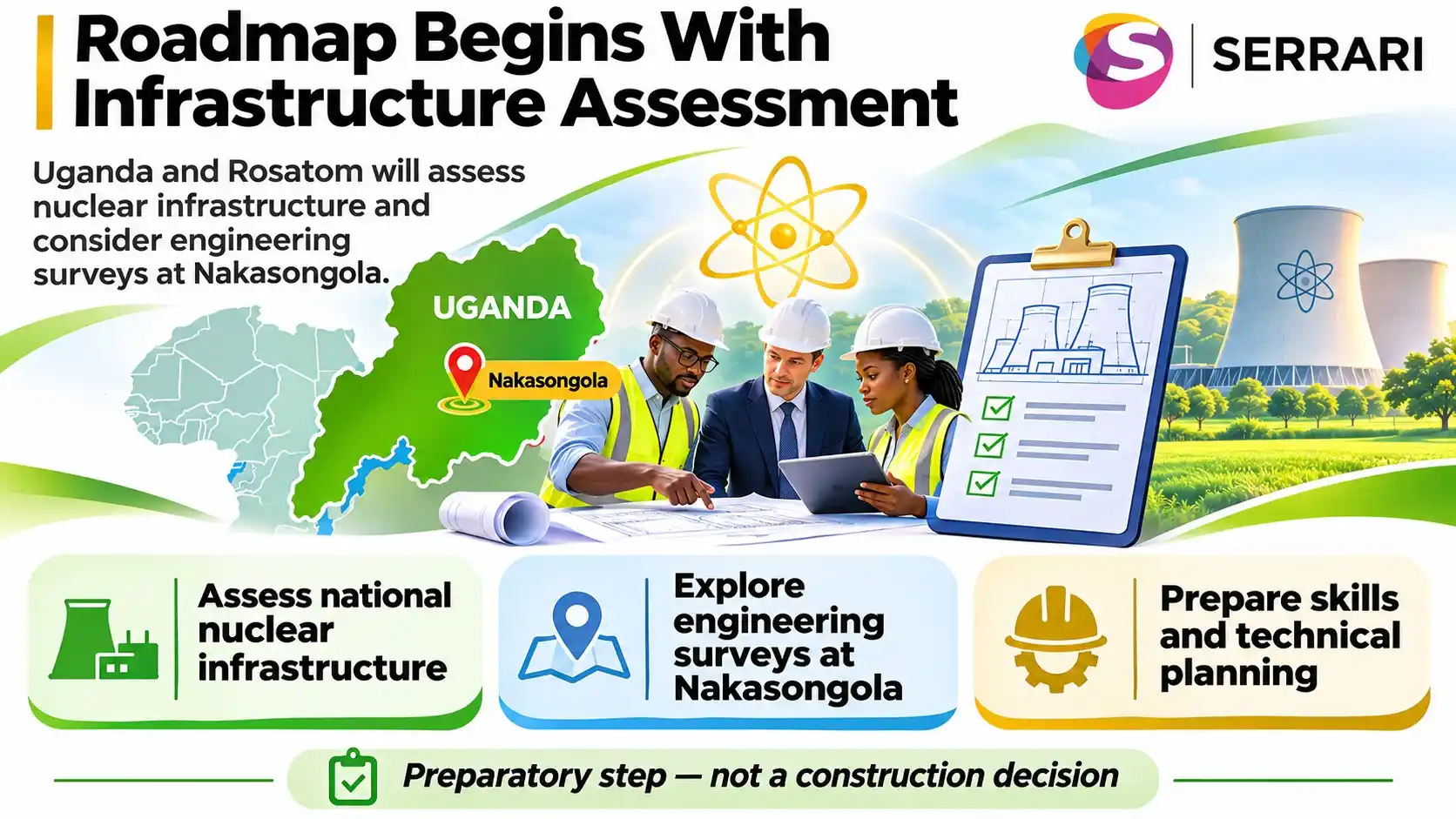
Under the roadmap, a joint working group will study Uganda’s national nuclear infrastructure and identify the steps needed to advance cooperation. The parties will also consider negotiating a contract for engineering surveys at the Nakasongola site.
Rosatom director general Alexey Likhachev said the initial work would focus on assessing the infrastructure required for a nuclear programme, identifying subsequent steps and training Ugandan personnel. The emphasis on assessment and capacity-building indicates that the project remains at an early preparatory stage.
The proposed surveys would help determine whether the location is suitable for a nuclear facility. Such work is distinct from a construction decision: site studies and infrastructure reviews provide information needed before a project can proceed through detailed design, licensing, financing and implementation.
Nakasongola and Uganda’s wider nuclear plans
Nakasongola is one of several locations considered in Uganda’s nuclear planning. The country has previously identified potential sites in areas including Buyende, Nakasongola, Kassanda, Kiruhura and Lamwo. The roadmap’s focus on Nakasongola represents a further step in evaluating the site, while separate work has been underway at Buyende.
Uganda’s nuclear ambitions have developed over many years. The country adopted an Atomic Energy Bill in 2008 and has worked with the International Atomic Energy Agency on establishing the institutions and safeguards needed for peaceful nuclear technology. Nuclear energy has also featured in long-term development planning, reflecting the government’s interest in adding substantial generation capacity as electricity demand rises.
Earlier announcements have described plans for nuclear power stations with large combined capacities, including cooperation with Russia and South Korea. Published planning figures and proposed reactor configurations have varied over time, so they should be understood as evolving plans rather than a single finalized programme.
The distinction between the Nakasongola roadmap and the Buyende process is important. Uganda has pursued parallel discussions and site evaluations, and the new agreement does not by itself replace or finalize those other tracks. The government will need to clarify how the different locations, partners and proposed capacities fit into a coherent national programme.
Context is everything. Stay ahead of shifting trends with today’s market updates, and uncover emerging opportunities using the Serrari Group Market Index and Marketplace. Then, take control of your own financial future by exploring our Money & Life Reset Transformation Blueprint ™ to build stronger habits, create better systems, and design a path toward lasting wealth.
Regional context: Rosatom’s African discussions
The Uganda agreement comes as Rosatom discusses potential large nuclear projects with several African countries. The company has said it is in talks with Uganda, Ghana, Ethiopia and Egypt. These discussions are at different stages and should not be treated as completed contracts.
In Ghana, conversations concern the country’s first nuclear power station, while the government has also considered other international technology providers. In Ethiopia, cooperation has included a roadmap and preliminary work around site selection. In Egypt, Rosatom is building the El Dabaa nuclear power station, and officials have discussed the possibility of expanding the project.
These examples underline that announcements about talks or roadmaps do not necessarily mean a project has secured financing, regulatory approval or a binding construction agreement.
Rosatom has said it is engaging with more than 25 African countries on nuclear energy and related cooperation. However, the commercial and technical details of individual proposals vary, and each country must assess the costs, grid requirements, safety obligations and long-term waste management implications.
Capacity, skills and safeguards
A nuclear power programme requires more than selecting a reactor supplier or site. Uganda would need to develop regulatory oversight, emergency preparedness, security arrangements, waste management systems and a trained workforce. The roadmap’s focus on national infrastructure and personnel training addresses some of these foundational requirements.
The IAEA’s role is also central. Countries pursuing peaceful nuclear energy must establish safeguards and meet international safety and security standards. These obligations continue throughout a plant’s lifecycle, from site selection and construction to operation and decommissioning.
Building domestic expertise is particularly important because nuclear facilities operate over decades. Engineers, operators, regulators and emergency-response teams require specialized training, while institutions must be able to independently evaluate technical submissions and enforce safety requirements.
Financing is another major consideration. Nuclear projects typically involve large upfront capital costs, long development periods and complex contractual structures. Before Uganda can move from studies to construction, it will need clarity on project economics, financing terms, electricity demand, grid integration and the allocation of risks among government, suppliers and investors.
Outlook
The roadmap creates a formal channel for Uganda and Rosatom to continue technical cooperation, but it is not a construction agreement. The immediate next steps are infrastructure assessment, working-group activity and possible negotiations for engineering surveys at Nakasongola.
Progress will depend on the results of those studies and on decisions about Uganda’s wider nuclear strategy. The government will also need to coordinate the Nakasongola process with work at other proposed sites, establish a clear regulatory and financing pathway, and communicate realistic timelines.
For now, the agreement signals continued interest in nuclear power as part of Uganda’s long-term energy planning. Its significance lies in moving cooperation into a structured assessment phase—while leaving the central questions of site suitability, project scale, financing and construction still to be answered.
FAQs
Has Uganda agreed to build a nuclear power plant with Rosatom?
No. The roadmap establishes technical cooperation and assessment work. It does not confirm construction or financing.
Where could the proposed project be located?
The roadmap identifies Nakasongola for potential engineering surveys. Uganda is also evaluating other sites, including Buyende.
What happens next?
A joint working group will assess national nuclear infrastructure, and the parties may negotiate a contract for engineering surveys.
Is Rosatom working with other African countries?
Yes. Rosatom has reported discussions with Ghana, Ethiopia and Egypt, among others, but the stages and commitments differ by country.
Your financial future isn’t something you wait for—it’s something you build.
The real question is: when do you begin?
Move beyond simply staying informed.
Navigate the markets with clarity—track trends through the Serrari Group Market Index, uncover opportunities in the Serrari Marketplace, and build practical knowledge with our Curated Wealth Builder Platform.
Stay connected to what truly matters.
Get daily insights on macro trends and financial movements across Kenya, Africa, and global markets—delivered through the Serrari Newsletter.
Growth opens doors.
Advance your career through professional programs including ACCA, HESI A2, ATI TEAS 7 , HESI EXIT , NCLEX – RN and NCLEX – PN, Financial Literacy!🌟—designed to move you forward with confidence.
See where money is flowing—clearly and in real time.
Track Money Market Funds, Treasury Bills, Treasury Bonds, Green Bonds, and Fixed Deposits, alongside global and African indexes, key economic indicators, and the evolving Crypto and stablecoin landscape—all within Serrari’s Market Index.