
Britain’s October 28, 2026 Budget has prompted sharply different responses from manufacturers, universities, employers and farmers. Chancellor John Healey promised immediate relief from energy costs alongside measures to stimulate regional investment and innovation. Business groups welcomed some initiatives but questioned whether the package would adequately address high operating costs, employment pressures and long-term competitiveness.
Key Overview
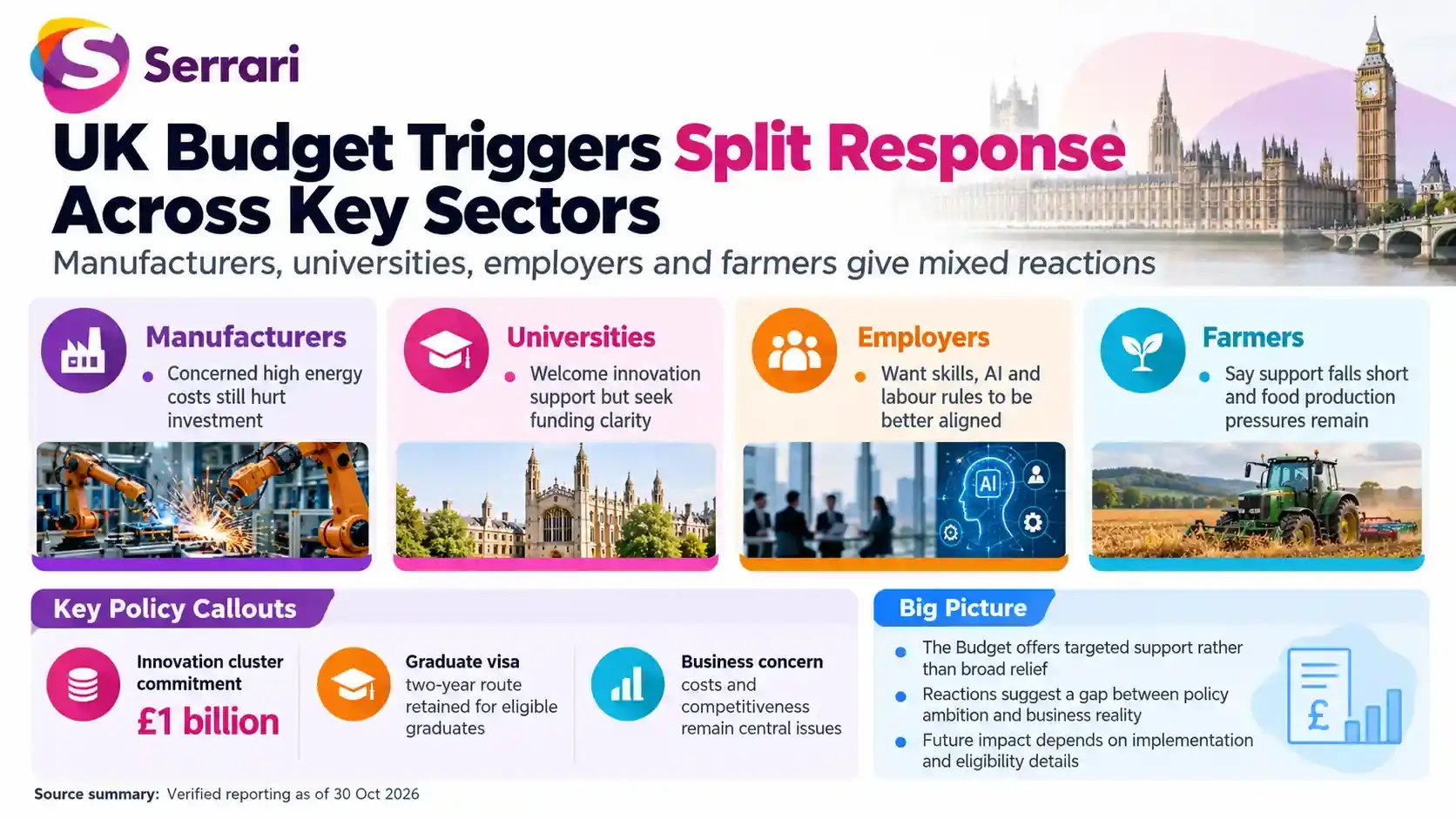
- Manufacturers: Industrial electricity prices remain a major concern despite targeted support.
- Universities: A £1 billion innovation-cluster commitment offers opportunities but reallocates existing research resources.
- Employers: Labour-market groups want skills, AI policy and employment regulation to work together.
- Farmers: Agricultural representatives welcomed red diesel relief but criticised the lack of broader support.
- Global mobility: A two-year Graduate visa for qualifying institutions could support recruitment, although other visa-rule changes may complicate hiring.
Manufacturers Say Energy Support Falls Short
The government’s 2026 Budget package includes measures intended to reduce energy costs, support smaller businesses and encourage investment. Its British Industrial Competitiveness Scheme is due to help eligible firms from April 2027, while the planned Gas Shipper Obligation has been cancelled.
Yet manufacturers argue that the benefits will be uneven. In its response to the Budget, the manufacturing industry body said most producers would not qualify for targeted electricity relief. Chief executive Stephen Phipson warned that persistently high industrial power costs were undermining investment decisions.
The group welcomed slower minimum-wage increases, improved export support and some investment allowances, but said higher employment costs and business rates continued to constrain growth. It also noted that changes to some capital allowances could delay tax relief on longer-term investments.
Universities Welcome Innovation Plans but Question Funding
University-business leaders offered a more qualified assessment. They see potential in devolving fiscal powers, supporting research clusters and helping innovative companies scale outside established economic centres.
However, the £1 billion innovation-cluster commitment involves reprioritising existing UK Research and Innovation resources rather than necessarily adding an equivalent amount of new funding. Rosalind Gill, director of policy, analysis and external affairs at the National Centre for Universities and Business, called for clarity on what other programmes might be affected.
The group also welcomed the decision to preserve a two-year Graduate visa for eligible graduates. Nevertheless, proposed skilled-migration reforms, including the removal of the PhD salary discount, may influence universities’ and employers’ ability to recruit international researchers. The net effect will depend on detailed eligibility rules and implementation.
Context is everything. Stay ahead of shifting trends with today’s market updates, and uncover emerging opportunities using the Serrari Group Market Index and Marketplace. Then, take control of your own financial future by exploring our Money & Life Reset Transformation Blueprint ™ to build stronger habits, create better systems, and design a path toward lasting wealth.
Employers Seek a More Consistent Workforce Strategy
Employers’ representatives said the absence of major unexpected tax increases could provide some reassurance, but warned that policy changes must be considered together. Training incentives may have limited impact when companies face rising payroll expenses and uncertainty over workplace regulation.
Ahead of the Budget, the professional body for people management argued in its workforce-policy recommendations that skills shortages, employment rules, migration and AI adoption should not be handled as disconnected issues.
Chief executive Neil Carberry subsequently welcomed some apprenticeship measures and a pause in equalising younger workers’ minimum-wage rates, while warning that forthcoming employment reforms could increase risks for businesses. The concern is particularly relevant to smaller employers with limited administrative resources.
Farmers Warn Food Production Remains Under Pressure
Agricultural leaders were among the Budget’s strongest critics. National Farmers’ Union president Tom Bradshaw described the measures as a missed opportunity to address strained farm finances and food security.
In his post-Budget assessment, Bradshaw welcomed continued red diesel relief but argued that high fuel prices, tight cash flow and limited investment support would continue to affect producers. He also called for greater recognition of farm infrastructure spending, including reservoirs and poultry housing.
Investment and Mobility Outlook Remains Mixed
The Budget offers targeted relief and new routes for regional development, but reactions underline a gap between policy announcements and businesses’ immediate costs. For international investors and employers relocating talent to Britain, energy prices, regulatory certainty, immigration rules and access to research partnerships may matter as much as headline tax measures.
Whether the Budget improves competitiveness will depend on how quickly its programmes take effect, which businesses qualify and whether support translates into sustained private investment and job creation.
Sources: UK Government / Make UK / National Centre for Universities and Business / CIPD / National Farmers’ Union / Relocate Magazine
Your financial future isn’t something you wait for—it’s something you build.
The real question is: when do you begin?
Move beyond simply staying informed.
Navigate the markets with clarity—track trends through the Serrari Group Market Index, uncover opportunities in the Serrari Marketplace, and build practical knowledge with our Curated Wealth Builder Platform.
Stay connected to what truly matters.
Get daily insights on macro trends and financial movements across Kenya, Africa, and global markets—delivered through the Serrari Newsletter.
Growth opens doors.
Advance your career through professional programs including ACCA, HESI A2, ATI TEAS 7 , HESI EXIT , NCLEX – RN and NCLEX – PN, Financial Literacy!🌟—designed to move you forward with confidence.
See where money is flowing—clearly and in real time.
Track Money Market Funds, Treasury Bills, Treasury Bonds, Green Bonds, and Fixed Deposits, alongside global and African indexes, key economic indicators, and the evolving Crypto and stablecoin landscape—all within Serrari’s Market Index.