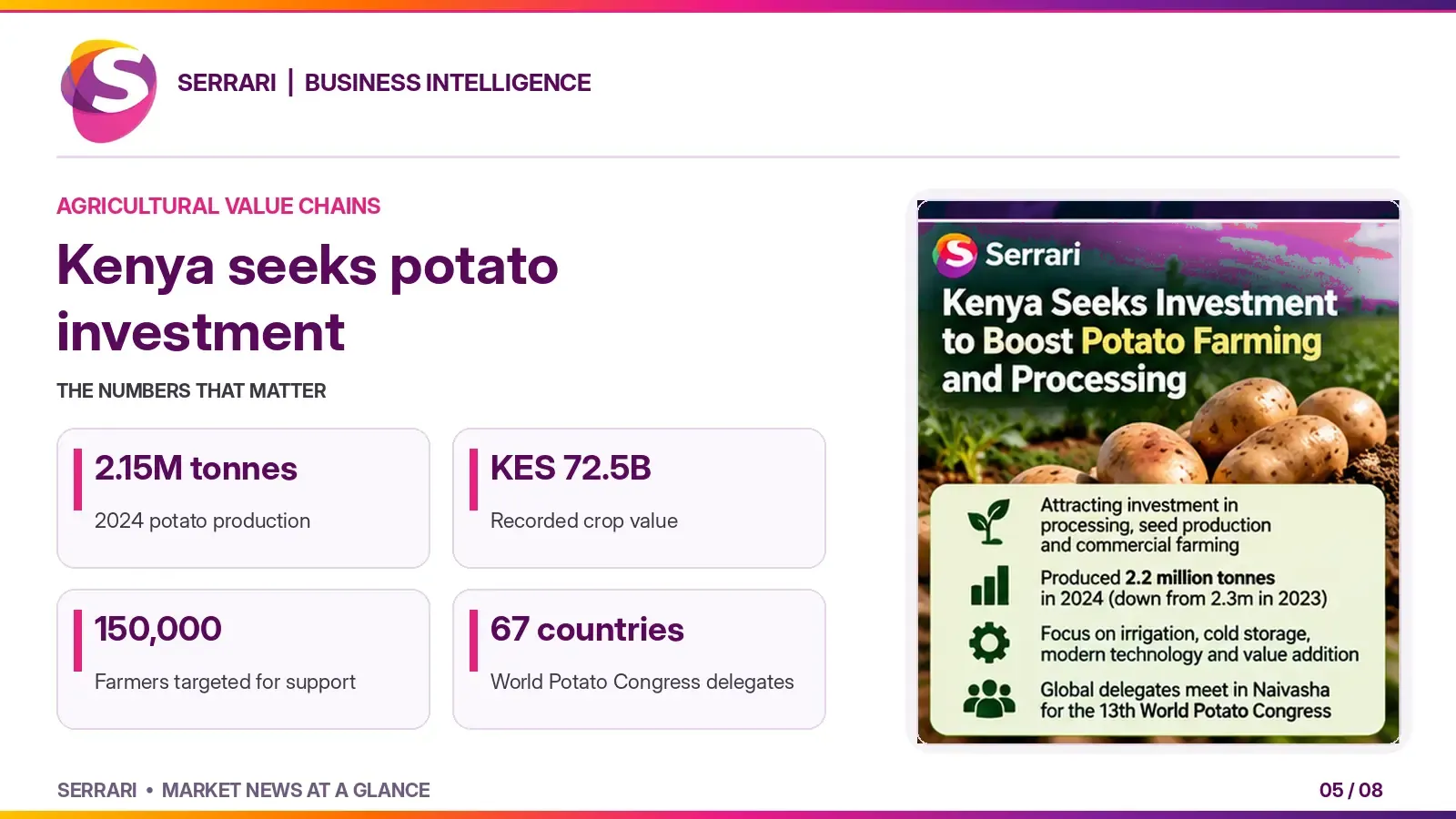
Kenya is seeking private investment in potato processing, certified seed production and commercial farming to reduce dependence on imported potato products and raise farmers’ earnings. Agriculture Cabinet Secretary Mutahi Kagwe outlined the opportunities during the 13th World Potato Congress, bringing together around 1,000 delegates from 67 countries in Naivasha from October 26 to 30, 2026.
Key Overview
- Kenya is courting investors in local processing plants, improved seeds, cold storage and mechanised farming.
- The World Potato Congress is being held in sub-Saharan Africa for the first time.
- Potato output fell from 2.31 million tonnes in 2023 to 2.15 million tonnes in 2024, even as crop value rose to KES 72.5 billion.
- A farmer-support initiative aims to reach 150,000 growers with better seed and climate-smart techniques.
- The government is considering requests to zero-rate potato-processing equipment, but no tax change has been announced.
Processing Investment Targets Imported Potato Products
Speaking at the opening of the congress, Kagwe called for closer links between potato farmers, processors, hotels, restaurants and fast-food operators. More local processing of chips, crisps and other products could create jobs and allow growers to capture more value from their harvests.
He also invited investors to explore the government’s Land Commercialisation Initiative, under which idle public land may be leased for agricultural production. Irrigation, mechanisation and guaranteed markets would be essential to making such projects viable. The government has separately outlined ambitions to build 50 mega dams, 200 medium-sized dams and 1,000 water pans and reservoirs; these remain plans rather than completed irrigation capacity.
Kagwe said he was prepared to discuss proposals to zero-rate processing machinery with the National Treasury and asked businesses to identify the equipment concerned. Any tax relief would require the appropriate policy and legal steps.
Potato Output Falls Despite Higher Crop Value
According to the 2025 national agricultural production report, Kenya harvested 2,153,620 tonnes of Irish potatoes in 2024, down from 2,309,913 tonnes in 2023. Meanwhile, the crop’s recorded value increased from KES 65.9 billion to KES 72.5 billion, reflecting higher prices rather than an increase in production.
The cultivated area also shrank from approximately 239,325 hectares to 225,976 hectares. Poor short rains and excessive long rains contributed to disease outbreaks, including late blight, weakening yields. The figures underline why more reliable irrigation, disease-resistant planting materials and storage facilities are priorities for the sector.
Context is everything. Stay ahead of shifting trends with today’s market updates, and uncover emerging opportunities using the Serrari Group Market Index and Marketplace. Then, take control of your own financial future by exploring our Money & Life Reset Transformation Blueprint ™ to build stronger habits, create better systems, and design a path toward lasting wealth.
Research and Certified Seeds Could Improve Yields
Researchers at the Kenya Agricultural and Livestock Research Organization and the International Potato Center have worked on a late blight-resistant version of the widely grown Shangi potato. It incorporates three resistance genes and has shown promising resistance in field trials, although research progress should not be confused with widespread commercial availability.
Another candidate, Clone IG-70, is undergoing final verification for its drought- and blight-tolerant characteristics. Seed multiplication efforts include rooted apical cuttings for varieties such as Shangi, Unica and Wanjiku, while the Marindas Potato Sub-Centre in Nakuru County is supporting access to planting material.
Through the Kenya Sustainable Potato Initiative, partners including Egerton University and the National Potato Council of Kenya aim to support 150,000 farmers. Certification and disease surveillance remain important because counterfeit or poor-quality seed can undermine productivity.
Cold Storage and Market Access Remain Critical
Kagwe cited cold-chain investments in 12 counties over the past four years, intended to reduce losses and improve farmers’ ability to supply processors consistently. Varieties suited to different processing requirements could also help expand domestic manufacturing, rather than leaving growers dependent on fresh-potato sales alone.
The five-day congress programme includes a Farmer Field Day, activities for young people and a Women in Potato initiative. Its longer-term impact will depend on whether discussions translate into financed processing facilities, dependable seed supply, stronger market contracts and higher farm incomes.
Sources: Kenya News Agency / Kenya National Bureau of Statistics / The Star / World Potato Congress
Your financial future isn’t something you wait for—it’s something you build.
The real question is: when do you begin?
Move beyond simply staying informed.
Navigate the markets with clarity—track trends through the Serrari Group Market Index, uncover opportunities in the Serrari Marketplace, and build practical knowledge with our Curated Wealth Builder Platform.
Stay connected to what truly matters.
Get daily insights on macro trends and financial movements across Kenya, Africa, and global markets—delivered through the Serrari Newsletter.
Growth opens doors.
Advance your career through professional programs including ACCA, HESI A2, ATI TEAS 7 , HESI EXIT , NCLEX – RN and NCLEX – PN, Financial Literacy!🌟—designed to move you forward with confidence.
See where money is flowing—clearly and in real time.
Track Money Market Funds, Treasury Bills, Treasury Bonds, Green Bonds, and Fixed Deposits, alongside global and African indexes, key economic indicators, and the evolving Crypto and stablecoin landscape—all within Serrari’s Market Index.