Investment in artificial intelligence infrastructure is giving the US economy a measurable lift, but economists have yet to see convincing evidence of a sustained acceleration in its underlying growth rate. Companies are spending heavily on servers, computing equipment and data centres, while slower labour-force growth, trade costs and uncertainty over future productivity gains complicate the outlook.
Key Overview
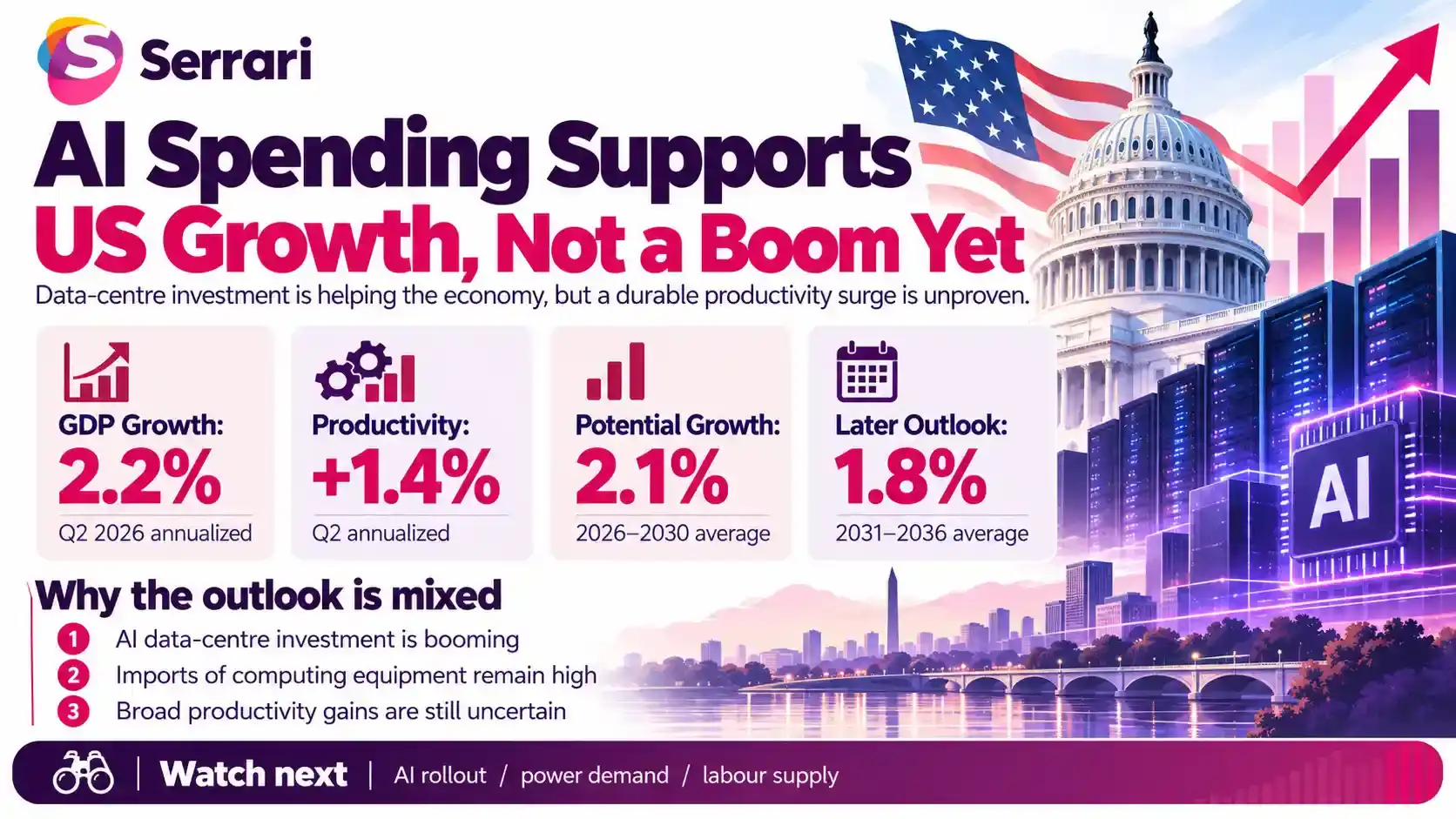
- US real GDP grew at a 2.2% annualized rate in the second quarter of 2026, according to the latest available revision.
- Business spending on equipment, software and research has supported economic activity, partly reflecting the AI buildout.
- Nonfarm business productivity rose 1.4% annualized in the second quarter, but the increase cannot be attributed solely to AI.
- Import demand for computing equipment complicates efforts to reduce reliance on foreign-produced goods.
- Longer-term official projections still point to moderate US growth, rather than a confirmed productivity-led boom.
AI Capital Spending Supports Economic Expansion
The US economy has gained support from companies racing to develop AI models and the infrastructure required to operate them. Data centres require costly computer chips, networking equipment, power connections and construction, generating investment even before the technology produces broad efficiency gains across other industries.
The latest revised GDP figures show real output expanding by 2.2% at an annual rate in the second quarter of 2026, following a revised 2.5% in the first quarter. These rates describe quarter-on-quarter changes expressed at an annual pace, not year-on-year increases.
Investment, household consumption and exports contributed positively in the second quarter, while imports rose. Tax provisions permitting immediate deductions for certain capital investments have also improved incentives for business spending, although it is difficult to isolate their effect from demand generated by AI itself.
Trade Policy Meets Demand for Imported Technology
President Donald Trump’s administration has sought to increase domestic production through tariffs, tax changes, deregulation and restrictions on immigration. Yet AI expansion depends partly on imported computer equipment, creating tension between the drive to build US computing capacity and the goal of reducing imports.
The official economic outlook anticipates that imports of computer equipment used for AI investment will support import growth in 2025 and 2026, with that boost fading after 2027. The same analysis expects higher tariffs to constrain consumption and investment even as domestic production of some competing goods expands.
This leaves the overall trade and manufacturing picture mixed. More domestic data centres do not automatically imply a comparable increase in US production of the hardware installed inside them.
Context is everything. Stay ahead of shifting trends with today’s market updates, and uncover emerging opportunities using the Serrari Group Market Index and Marketplace. Then, take control of your own financial future by exploring our Money & Life Reset Transformation Blueprint ™ to build stronger habits, create better systems, and design a path toward lasting wealth.
Productivity Gains Are Promising but Not Yet Proven
For AI to lift the economy’s long-run growth rate, businesses must ultimately produce more goods and services for each hour of work. Investment in computing capacity alone does not establish that such improvements have occurred across the economy.
The September productivity release recorded a 1.4% annualized increase in nonfarm business output per hour in the second quarter. Productivity was 2.2% above its level one year earlier. But these figures reflect all influences on workplace efficiency, including business processes, equipment and changes in industry composition.
AI could improve programming, research, customer service and administrative work, although deployment costs, quality control and the time required to redesign workflows may delay measurable benefits. Economists therefore remain cautious about assigning recent productivity changes to a single technology.
Electricity Costs and Labour Supply Present Constraints
Expansion of AI facilities also creates challenges outside the technology industry. Data centres place additional demands on power supplies and local infrastructure, while communities have raised concerns about electricity costs and land use. Delays in energy connections or permitting could slow projects despite strong financing commitments.
Demographic pressures add another limitation. An ageing population and slower immigration can restrict workforce growth, leaving productivity as a more important driver of future output. That does not mean faster growth is impossible, but it raises the threshold for a lasting improvement in productive capacity.
Long-Term Forecasts Still Signal Moderate Growth
The 2026–2036 economic projections envisage real GDP growth averaging around 1.8% annually from 2027 to 2036. More specifically, potential GDP growth is forecast to average 2.1% between 2026 and 2030 before slowing to 1.8% from 2031 to 2036.
Those estimates already incorporate some expected benefits from generative AI alongside the effects of fiscal policy, tariffs and demographic change. A substantially stronger growth path would require broader, persistent productivity gains beyond today’s infrastructure investment boom.
For now, the economic evidence points to a significant investment cycle, not yet to a clearly established new era of faster US growth.
Sources: Reuters / U.S. Bureau of Economic Analysis / U.S. Bureau of Labor Statistics / Congressional Budget Office
Your financial future isn’t something you wait for—it’s something you build.
The real question is: when do you begin?
Move beyond simply staying informed.
Navigate the markets with clarity—track trends through the Serrari Group Market Index, uncover opportunities in the Serrari Marketplace, and build practical knowledge with our Curated Wealth Builder Platform.
Stay connected to what truly matters.
Get daily insights on macro trends and financial movements across Kenya, Africa, and global markets—delivered through the Serrari Newsletter.
Growth opens doors.
Advance your career through professional programs including ACCA, HESI A2, ATI TEAS 7 , HESI EXIT , NCLEX – RN and NCLEX – PN, Financial Literacy!🌟—designed to move you forward with confidence.
See where money is flowing—clearly and in real time.
Track Money Market Funds, Treasury Bills, Treasury Bonds, Green Bonds, and Fixed Deposits, alongside global and African indexes, key economic indicators, and the evolving Crypto and stablecoin landscape—all within Serrari’s Market Index.