Artificial intelligence (AI) could accelerate economic growth while widening gaps between rich and poor countries, according to warnings issued by officials from the International Monetary Fund (IMF) and Organisation for Economic Co-operation and Development (OECD) on October 22, 2026. Countries with reliable electricity, digital infrastructure and skilled workers are better positioned to capture the benefits, while developing economies and smaller companies risk falling behind.
Key Overview
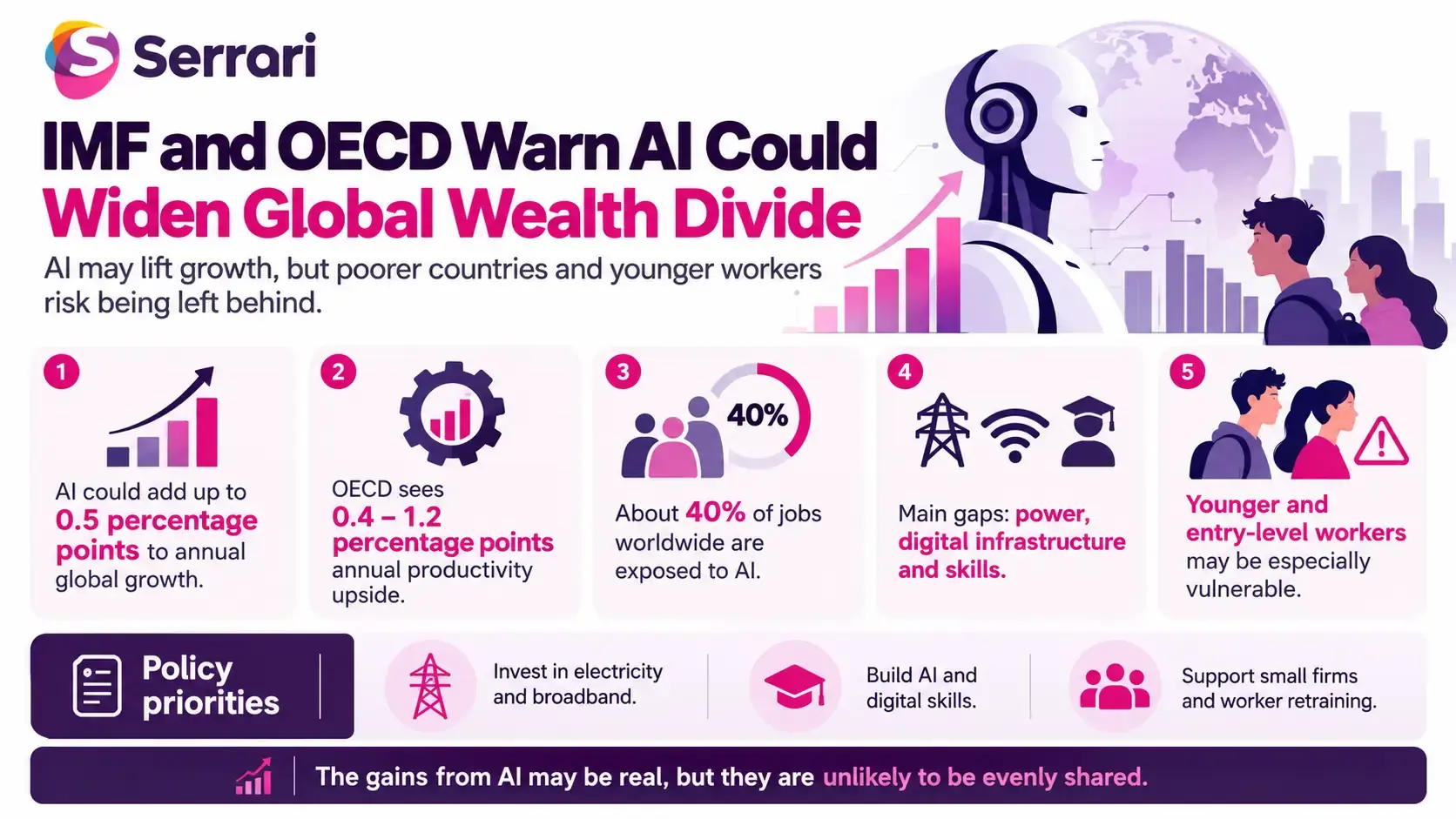
- Growth potential: Effective AI adoption could add up to 0.5 percentage points to annual global growth over the medium term, according to an IMF estimate cited by its official.
- Productivity: OECD officials estimate annual productivity growth could increase by 0.4–1.2 percentage points across member economies, depending on adoption.
- Employment exposure: Around 40% of jobs worldwide are exposed to AI, although exposure does not mean automatic replacement.
- Unequal access: Energy supply, connectivity, computing resources and specialist skills remain major barriers for poorer economies.
- Youth employment: Entry-level employees may be vulnerable if AI automates tasks normally used to build experience.
Why AI Could Widen the Gap Between Countries
The October 22 warning on AI inequality highlights a growing difference between countries able to deploy AI widely and those still struggling with basic digital infrastructure. Economies with strong technology sectors, established data systems and affordable electricity may gain productivity faster than countries facing frequent power disruptions and limited connectivity.
The IMF’s research on AI and the future of work estimates that roughly 60% of jobs in advanced economies are exposed to AI, compared with 40% in emerging markets and 26% in low-income countries. Lower exposure may mean less immediate disruption, but also fewer opportunities to benefit from AI-driven productivity improvements.
This matters for developing economies, including those in Africa, where investment in reliable power, internet access and digital skills will influence whether businesses can integrate the technology into everyday operations.
Context is everything. Stay ahead of shifting trends with today’s market updates, and uncover emerging opportunities using the Serrari Group Market Index and Marketplace. Then, take control of your own financial future by exploring our Money & Life Reset Transformation Blueprint ™ to build stronger habits, create better systems, and design a path toward lasting wealth.
Growth Forecasts Are Promising but Not Guaranteed
Era Dabla-Norris, deputy director of the IMF’s Fiscal Affairs Department, said successful AI adoption could add as much as 0.5 percentage points to annual global growth over the medium term. She cautioned, however, that economy-wide evidence of productivity improvements remains limited.
OECD Chief Economist Stefano Scarpetta similarly pointed to a gap between people experimenting with AI and companies embedding it in core business processes. The organisation’s research on AI productivity indicates that potential gains vary substantially by industry, country and adoption rates.
These estimates are scenarios rather than guaranteed results. Large spending on chips, data centres and software does not automatically translate into higher output or stronger corporate earnings.
Younger Workers and Small Businesses Face Risks
AI could help employees complete research, documentation and customer-service tasks more efficiently. But it could also automate the routine assignments through which junior employees traditionally develop professional judgment and expertise.
The IMF’s labour-market assessment stresses that AI may transform, complement or displace jobs. Its estimate that 40% of global employment is affected should therefore not be interpreted as a forecast that 40% of workers will lose their jobs.
Smaller firms face their own constraints. Unlike large corporations, they may lack the funds, quality data and trained staff required to introduce AI tools safely and productively. As a result, adoption could reinforce existing competitive differences unless access improves.
What Policymakers Can Do to Share AI’s Benefits
Governments can narrow the potential divide by investing in dependable electricity, broadband, digital education and workforce retraining. Policies that help small businesses access affordable technology, while establishing standards for data protection and accountability, could also support wider adoption.
For investors, the key distinction is between heavy spending on AI infrastructure and demonstrated improvements in business performance. For policymakers, the challenge is ensuring that productivity gains reach workers and economies beyond the wealthiest technology markets.
Sources: Reuters / International Monetary Fund / OECD
Your financial future isn’t something you wait for—it’s something you build.
The real question is: when do you begin?
Move beyond simply staying informed.
Navigate the markets with clarity—track trends through the Serrari Group Market Index, uncover opportunities in the Serrari Marketplace, and build practical knowledge with our Curated Wealth Builder Platform.
Stay connected to what truly matters.
Get daily insights on macro trends and financial movements across Kenya, Africa, and global markets—delivered through the Serrari Newsletter.
Growth opens doors.
Advance your career through professional programs including ACCA, HESI A2, ATI TEAS 7 , HESI EXIT , NCLEX – RN and NCLEX – PN, Financial Literacy!🌟—designed to move you forward with confidence.
See where money is flowing—clearly and in real time.
Track Money Market Funds, Treasury Bills, Treasury Bonds, Green Bonds, and Fixed Deposits, alongside global and African indexes, key economic indicators, and the evolving Crypto and stablecoin landscape—all within Serrari’s Market Index.