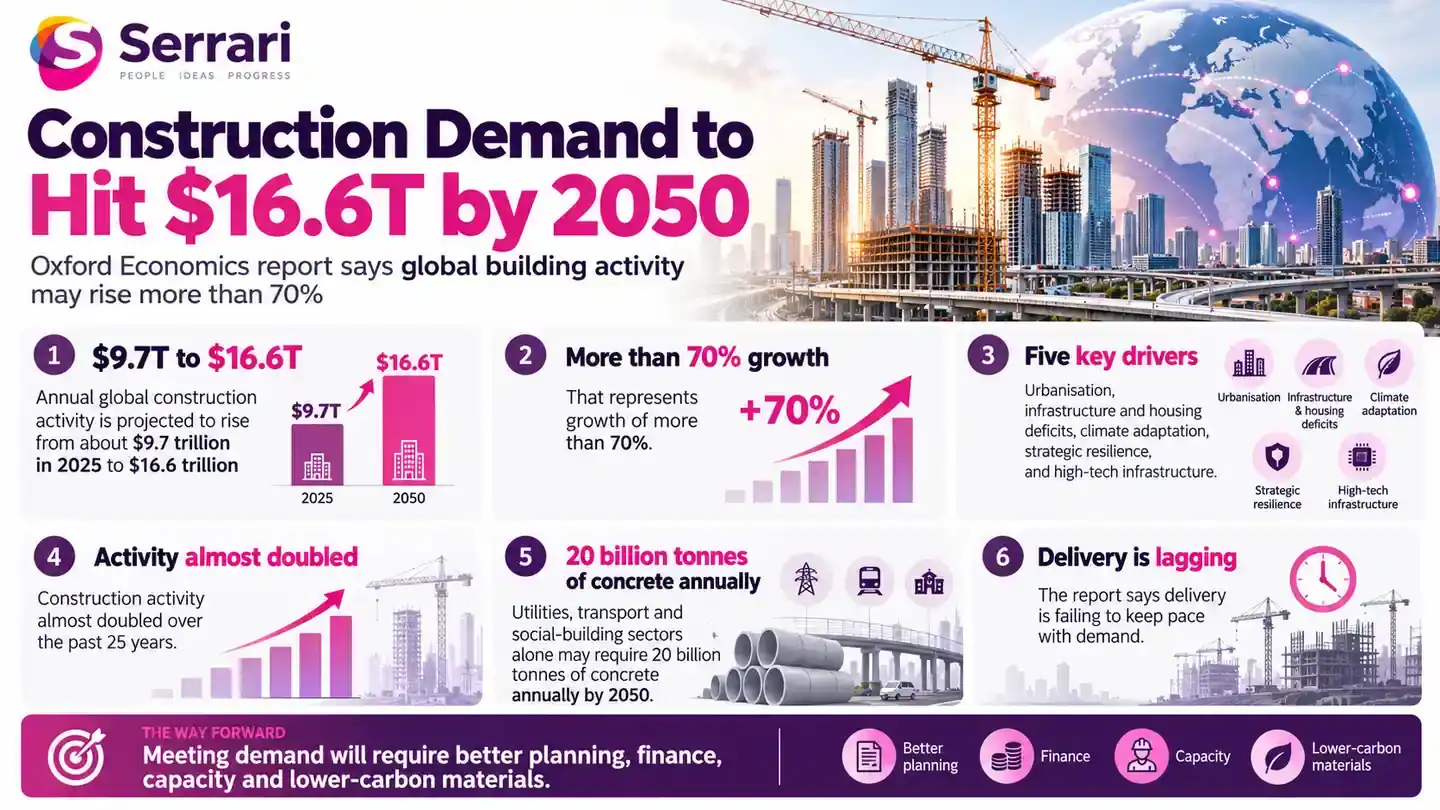
Global construction activity is projected to grow by more than 70% to $16.6 trillion annually by 2050, according to a new study prepared by Oxford Economics for the Global Cement and Concrete Association. The October 2026 construction forecast puts the starting figure at approximately $9.7 trillion in 2025, with demand driven by expanding cities, infrastructure shortages, climate adaptation and new technology facilities.
However, building more roads, homes, power networks and data centres will require more than investment. The report warns that existing infrastructure delivery is already struggling to meet demand, while the industry must also reduce the environmental impact of construction materials.
Key Overview
- Construction outlook: Annual activity is forecast to climb from approximately $9.7 trillion in 2025 to $16.6 trillion by 2050, an increase exceeding 70%.
- Five growth drivers: Urbanisation, housing and infrastructure shortages, climate adaptation, strategic resilience and high-tech infrastructure.
- Concrete demand: Utilities, transport and social-building projects alone could require 20 billion tonnes of concrete annually by 2050.
- Delivery challenge: Governments face planning, financing, procurement and construction-capacity constraints.
- Climate priority: Lower-emission cement and concrete, recycling, efficient design and carbon-capture investment will be important to sustainable expansion.
Five Megatrends Reshaping Construction Demand
Population growth and urbanisation are expected to increase demand for housing, schools, hospitals, roads and public transport. The research findings on future infrastructure indicate that developing economies will need extensive new networks, while wealthier countries will increasingly focus on upgrading ageing assets.
Infrastructure and housing deficits are another major source of demand. Many countries already face gaps in transport, water, sanitation and electricity provision, making project delivery a continuing economic priority.
Climate adaptation adds a new dimension. Flood defences, stronger drainage systems, coastal protection and heat-resilient buildings will be needed alongside investments that reduce emissions. Meanwhile, governments are putting greater emphasis on domestic industrial capacity, secure supply chains and reconstruction readiness.
The fifth driver is high-tech construction. Artificial intelligence, data centres and advanced manufacturing require specialised facilities and dependable electricity, water and transport infrastructure.
Concrete Demand Could Reach 20 Billion Tonnes in Key Sectors
The report estimates that annual concrete demand from utilities, transport and social-building sectors alone will reach 20 billion tonnes by 2050. That estimate does not represent an all-sector forecast for global concrete use.
Concrete remains widely used because it is durable, versatile and generally produced close to construction sites. It supports electricity networks, water systems, transport corridors and public facilities. Local production can create industrial jobs and support regional suppliers, although access to energy, labour, land and raw materials may constrain expansion.
The industry’s construction-demand assessment also highlights the need to improve productivity and ensure reliable material supplies as infrastructure programmes expand.
Context is everything. Stay ahead of shifting trends with today’s market updates, and uncover emerging opportunities using the Serrari Group Market Index and Marketplace. Then, take control of your own financial future by exploring our Money & Life Reset Transformation Blueprint ™ to build stronger habits, create better systems, and design a path toward lasting wealth.
Why Funding and Project Delivery Are Major Obstacles
Higher projected activity does not guarantee that needed projects will be built on schedule. The study calls for stronger procurement systems, clear long-term project pipelines, expanded construction capacity and closer cooperation between public authorities and private investors.
Transparent planning can help contractors and suppliers invest in equipment, training and production capacity. Long-term finance is also crucial for large infrastructure assets that may take years to complete and decades to deliver their full economic benefits.
Low-Carbon Construction Becomes an Investment Priority
Meeting higher demand while lowering emissions will be a central challenge. A global assessment of buildings and construction estimates that the broader sector accounts for around 37% of global carbon dioxide emissions, underscoring the importance of cleaner construction methods. That figure covers buildings and construction broadly, not cement production alone.
The report urges governments and industry to encourage demand for lower-carbon materials, improve circularity, permit suitable waste-derived fuels and support carbon capture technologies. It also recommends assessing infrastructure over its full lifespan, including durability, maintenance, emissions and climate resilience.
What the Outlook Means for Governments and Investors
The projected expansion creates opportunities in housing, transport, clean energy, water infrastructure and digital facilities, as well as in materials and construction technology. But the benefits will depend on affordable financing, effective delivery and credible environmental standards.
The main question is not simply whether global construction spending will grow. It is whether governments and businesses can turn that spending into durable, inclusive infrastructure while reducing emissions and avoiding costly delays.
Sources: Global Cement and Concrete Association / Oxford Economics / Construction Briefing / United Nations Environment Programme
Your financial future isn’t something you wait for—it’s something you build.
The real question is: when do you begin?
Move beyond simply staying informed.
Navigate the markets with clarity—track trends through the Serrari Group Market Index, uncover opportunities in the Serrari Marketplace, and build practical knowledge with our Curated Wealth Builder Platform.
Stay connected to what truly matters.
Get daily insights on macro trends and financial movements across Kenya, Africa, and global markets—delivered through the Serrari Newsletter.
Growth opens doors.
Advance your career through professional programs including ACCA, HESI A2, ATI TEAS 7 , HESI EXIT , NCLEX – RN and NCLEX – PN, Financial Literacy!🌟—designed to move you forward with confidence.
See where money is flowing—clearly and in real time.
Track Money Market Funds, Treasury Bills, Treasury Bonds, Green Bonds, and Fixed Deposits, alongside global and African indexes, key economic indicators, and the evolving Crypto and stablecoin landscape—all within Serrari’s Market Index.