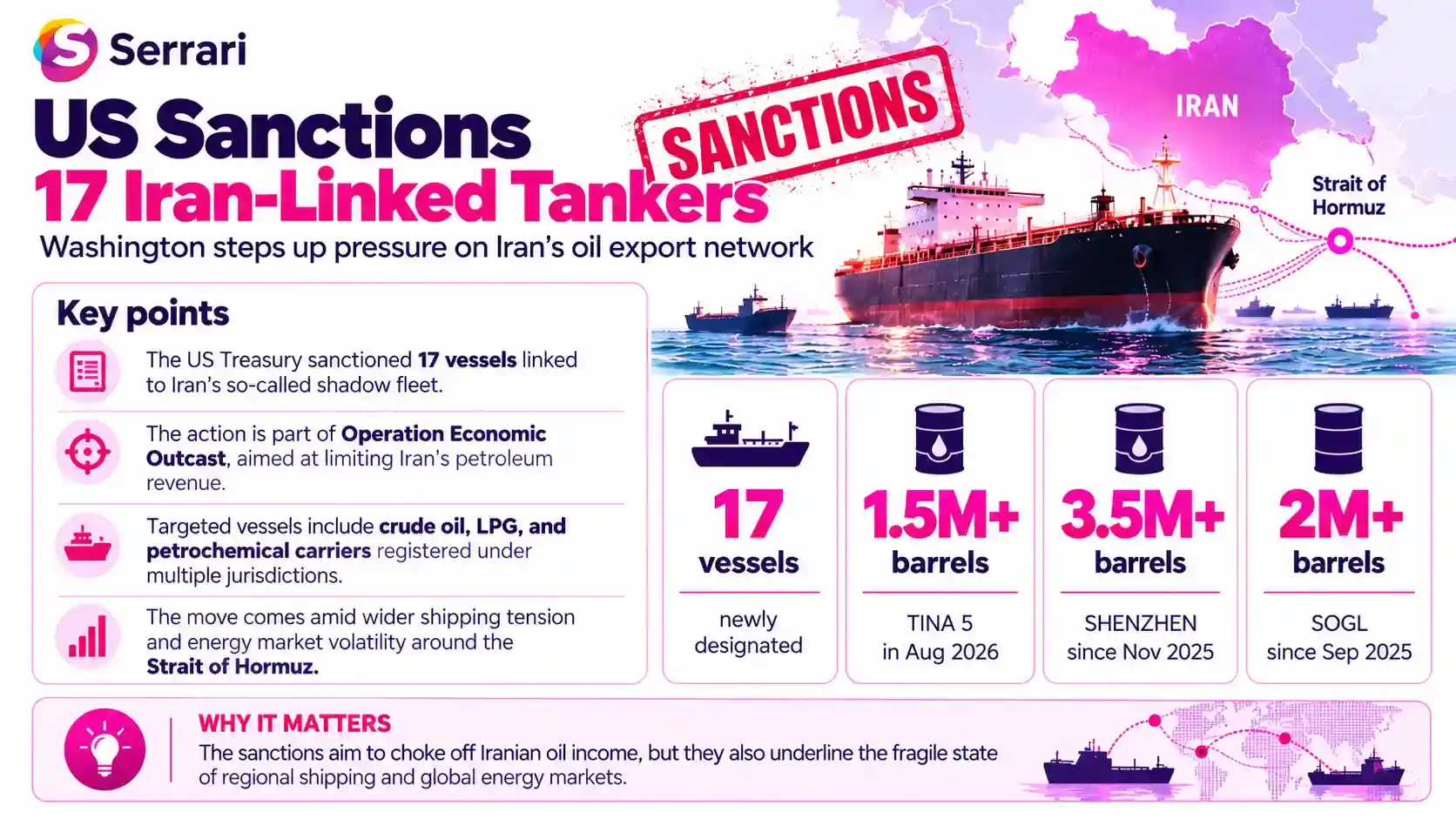
The United States has imposed new sanctions on 17 vessels linked to Iran’s oil transportation network, intensifying efforts to restrict Tehran’s petroleum exports and reduce the revenue available to support its military operations.
The October 8, 2026 sanctions announcement forms part of Operation Economic Outcast, a broader economic pressure campaign targeting Iran’s energy industry, international financial networks and sanctions-evasion activities.
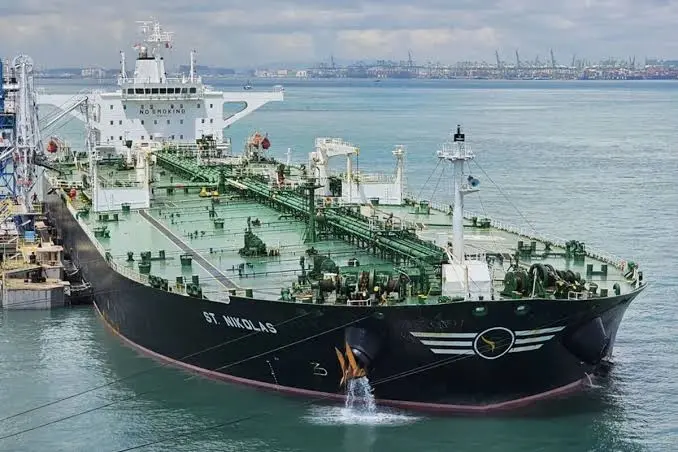
The newly designated vessels include crude oil tankers, liquefied petroleum gas carriers and ships transporting refined petroleum products. U.S. authorities allege that these vessels collectively transported millions of barrels of Iranian energy products to markets across Asia and the Middle East.
The measures come amid continuing military tensions and disruptions in the Strait of Hormuz, a critical maritime corridor for international oil and natural gas shipments.
Key Overview
- 17 vessels sanctioned: The U.S. has targeted additional tankers allegedly involved in transporting Iranian crude oil, petroleum products and petrochemicals.
- Economic pressure campaign: The designations fall under Operation Economic Outcast, which seeks to restrict Iran’s international revenue sources.
- Millions of barrels transported: Several targeted vessels allegedly moved more than one million barrels of Iranian petroleum products individually.
- International shipping network: The vessels operate under flags from multiple jurisdictions, with ownership structures spanning several countries.
- Oil export restrictions: U.S. officials say the ongoing maritime blockade has significantly disrupted Iranian crude shipments.
- Energy market concerns: Continued instability around the Strait of Hormuz is contributing to volatility in international oil prices.
US Treasury Targets Iran’s Shadow Fleet Network
The latest sanctions focus on what American authorities describe as Iran’s shadow fleet, a network of tankers and shipping companies allegedly used to move petroleum products while circumventing international restrictions.
According to the official enforcement announcement, the 17 newly designated vessels operate under flags from more than a dozen jurisdictions and are connected to companies registered across different international shipping centers.
The vessels are accused of transporting Iranian crude oil, liquefied petroleum gas, fuel oil, methanol, naphtha and other petrochemical products.
The measures were imposed under Executive Order 13902, which provides sanctions authorities covering key sectors of Iran’s economy, including petroleum.
Treasury Secretary Scott Bessent said the restrictions are intended to prevent Iran from accessing revenue that Washington alleges is used to finance military activities and regional armed groups.
The U.S. government has also warned that companies facilitating Iranian sanctions evasion could face additional restrictions, including exclusion from parts of the American financial system.
Which Iranian Oil Tankers Were Sanctioned?
The October 8 designations include several vessels accused of transporting substantial quantities of Iranian energy products.
Among the identified shipping operations is TINA 5, a Vanuatu-flagged crude oil tanker that U.S. officials say transported more than 1.5 million barrels of Iranian crude in August 2026 alone.
Another vessel, SHENZHEN, registered under Cameroon’s flag, allegedly transported more than 3.5 million barrels of Iranian crude oil since November 2025.
The Comoros-flagged LPG tanker SOGL is accused of moving more than two million barrels of Iranian propane and butane since September 2025.
Other designated vessels include STARWAY, which allegedly transported more than three million barrels of Iranian naphtha since 2025, and GAS LUCKY, which authorities say moved more than 500,000 barrels of Iranian ethylene during the same period.
The network also includes tankers transporting asphalt, methanol, fuel oil and other petroleum derivatives to customers in Asia and the Middle East.
These shipment figures are U.S. government assessments and do not independently establish the final destination or financial proceeds of every cargo.
Context is everything. Stay ahead of shifting trends with today’s market updates, and uncover emerging opportunities using the Serrari Group Market Index and Marketplace. Then, take control of your own financial future by exploring our Money & Life Reset Transformation Blueprint ™ to build stronger habits, create better systems, and design a path toward lasting wealth.
Operation Economic Outcast Expands Economic Restrictions
The sanctions are part of Operation Economic Outcast, an initiative announced in August 2026 to intensify financial and commercial pressure on Iran.
The campaign targets petroleum exports, financial intermediaries, shipping companies and networks accused of helping Tehran circumvent existing restrictions.
Washington argues that reducing energy-related revenue will constrain Iran’s ability to finance military operations, weapons development and associated organisations.
The latest enforcement measures follow the reinstatement of a U.S. blockade on Iranian ports in July 2026, after an earlier understanding between Washington and Tehran collapsed.
U.S. officials claim the blockade has substantially reduced the movement of crude oil through Iranian ports.
However, the economic effect of the newest vessel designations may be limited in the short term because Iranian exports were already significantly constrained by the blockade and existing restrictions.
The broader effectiveness of the campaign will depend on enforcement, international cooperation and Iran’s ability to find alternative trading arrangements.
Strait of Hormuz Disruptions Pressure Global Oil Markets
The latest sanctions coincide with continued instability in the Strait of Hormuz, one of the world’s most important oil transportation routes.
The narrow waterway connects the Persian Gulf with the Gulf of Oman and provides a major export corridor for petroleum producers including Saudi Arabia, Iraq, Kuwait, Qatar and the United Arab Emirates.
Recent shipping disruptions and security incidents have heightened concerns about the reliability of energy supplies moving through the region.
The uncertainty has contributed to sharp movements in international crude oil prices.
On October 8, oil market reporting showed Brent crude settling at approximately $104.28 per barrel, while U.S. West Texas Intermediate closed near $91.49.
Prices were also influenced by weather-related production disruptions in the Gulf of Mexico, demonstrating how simultaneous supply threats can amplify market volatility.
Prolonged disruptions could increase shipping insurance premiums, freight charges and fuel costs for oil-importing economies.
What the Sanctions Mean for Global Energy Prices
The additional restrictions strengthen Washington’s efforts to isolate Iranian petroleum exports, but their impact on international energy markets remains uncertain.
If enforcement successfully reduces available Iranian supplies, the measures could tighten oil markets further, particularly if shipments through the Strait of Hormuz remain disrupted.
Conversely, any easing of regional hostilities or improvement in shipping conditions could reduce some of the geopolitical risk premium embedded in crude prices.
For energy-importing economies, including Kenya and other African markets, sustained high petroleum prices could increase import bills, transportation costs and inflationary pressures.
Ultimately, the immediate implications will depend less on the number of vessels sanctioned and more on how effectively the measures constrain actual oil deliveries, international shipping activity and access to global energy markets.
Sources
U.S. Department of the Treasury / Reuters / CNBC / The Washington Post / Associated Press
Your financial future isn’t something you wait for—it’s something you build.
The real question is: when do you begin?
Move beyond simply staying informed.
Navigate the markets with clarity—track trends through the Serrari Group Market Index, uncover opportunities in the Serrari Marketplace, and build practical knowledge with our Curated Wealth Builder Platform.
Stay connected to what truly matters.
Get daily insights on macro trends and financial movements across Kenya, Africa, and global markets—delivered through the Serrari Newsletter.
Growth opens doors.
Advance your career through professional programs including ACCA, HESI A2, ATI TEAS 7 , HESI EXIT , NCLEX – RN and NCLEX – PN, Financial Literacy!🌟—designed to move you forward with confidence.
See where money is flowing—clearly and in real time.
Track Money Market Funds, Treasury Bills, Treasury Bonds, Green Bonds, and Fixed Deposits, alongside global and African indexes, key economic indicators, and the evolving Crypto and stablecoin landscape—all within Serrari’s Market Index.