Global food prices climbed to their highest level in nearly four years in September 2026 as disrupted shipping routes, adverse weather and concerns over a strengthening El Niño pushed several major agricultural commodities higher.
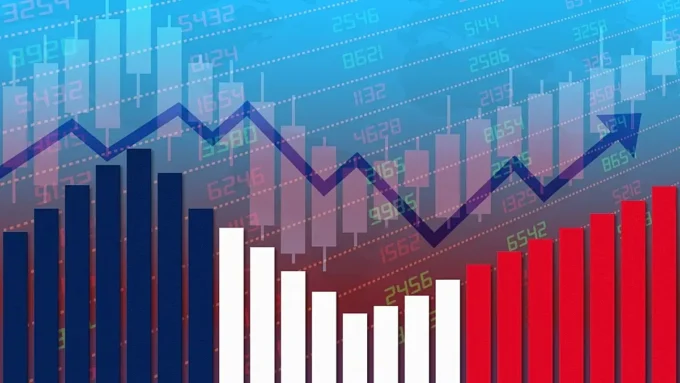
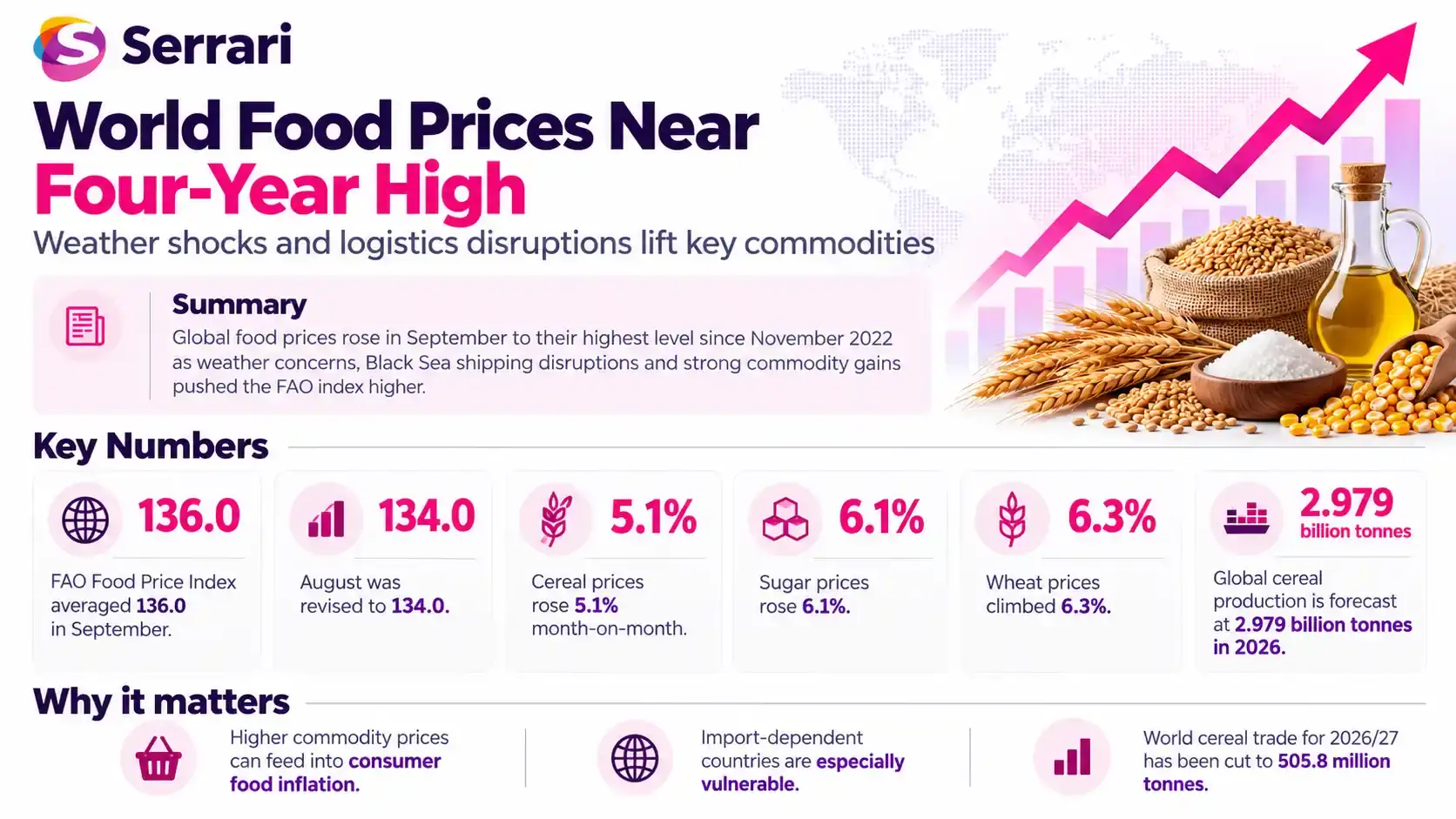
The global food-price benchmark reached 136.0 points during September, up 1.5% from a revised 134.0 in August and 5.8% from a year earlier. The index is now at its highest since November 2022, although it remains 15.1% below the record reached in March 2022.
Key Overview
- The global food-price index rose 1.5% month-on-month to 136.0 points in September.
- Cereal prices jumped 5.1%, while sugar prices increased 6.1%.
- Wheat prices rose 6.3% to their highest level since August 2023.
- Global maize prices climbed 5.6% to a more than three-year high.
- Vegetable oil prices increased 0.9%, driven mainly by palm oil.
- Meat prices declined 1.1%, while dairy prices edged down 0.1%.
- Global cereal production in 2026 is forecast at 2.979 billion tonnes, the second-largest harvest on record.
- World cereal trade for 2026/27 has been cut to 505.8 million tonnes as Black Sea disruptions constrain shipments.
Cereals Lead the September Food-Price Increase
Cereal markets experienced some of the sharpest increases during September, with the cereal price index rising 5.1% from August and standing 17.2% above its level a year earlier.
International wheat prices jumped 6.3%, reaching their highest level since August 2023. Shipping constraints around the Black Sea reduced the availability of grain from major exporters and encouraged importers to seek alternative suppliers.
Dry weather in parts of North America ahead of winter-wheat planting added further pressure. Global maize prices also rose 5.6% to their highest in more than three years as weaker-than-expected US yields, reduced Brazilian export availability and Black Sea transport problems tightened supply expectations.
Rice prices increased by 1.4%, reflecting weather concerns and seasonally tighter supplies of Indica varieties.
El Niño Pushes Sugar and Vegetable Oils Higher
Sugar recorded the largest monthly rise among the main food categories, increasing 6.1% to its highest level since April 2025.
The increase reflected concerns over tightening global sugar supplies during the 2026/27 season. Lower production is expected in Thailand, while below-normal rainfall and strengthening El Niño conditions have raised concerns about India’s crop.
Heavy rainfall has simultaneously disrupted harvesting in Brazil’s key Centre-South sugar-growing region, while adverse conditions and reduced planting are expected to lower European Union sugar-beet production.
Vegetable oil prices increased a more modest 0.9%. Strong global import demand and concerns that dry conditions could hurt Southeast Asian production pushed palm oil prices higher for a fourth consecutive month.
Context is everything. Stay ahead of shifting trends with today’s market updates, and uncover emerging opportunities using the Serrari Group Market Index and Marketplace. Then, take control of your own financial future by exploring our Money & Life Reset Transformation Blueprint ™ to build stronger habits, create better systems, and design a path toward lasting wealth.
Shipping Disruptions Add to Inflation Risks
Food markets are also being affected by broader geopolitical pressures on global trade.
Uncertainty surrounding shipping through the Strait of Hormuz has increased concerns over energy, fertilizer and freight costs. Meanwhile, continuing Black Sea disruptions are directly restricting grain exports and increasing the cost of moving agricultural commodities to global buyers.
These pressures matter because higher international commodity prices can eventually feed into consumer prices, particularly in countries heavily dependent on imported food and energy.
The combination of Black Sea disruptions and adverse weather therefore presents a particular risk for lower-income food-importing economies, where households generally spend a larger share of income on basic necessities.
Global Harvest Remains Large Despite Price Pressures
Higher prices do not necessarily indicate an overall shortage of food.
The latest global cereal-production forecast remains broadly unchanged at 2.979 billion tonnes for 2026. Although that would be 2.1% below the record 2025 harvest, it would still represent the second-largest global cereal crop ever recorded.
Wheat production is projected at 813.9 million tonnes after improved conditions in Australia lifted expectations. However, global coarse-grain production has been revised down to 1.612 billion tonnes because hot and dry weather has reduced maize-yield prospects in the United States and European Union.
Rice output is forecast at 552.5 million tonnes, with weaker prospects in India outweighing improved expectations elsewhere.
Global Cereal Trade Outlook Weakens
While production remains historically high, getting grain from exporters to importing countries is becoming more difficult.
The world cereal-trade forecast has been cut by 0.7% from the previous month’s estimate to 505.8 million tonnes for 2026/27.
That would represent a 3.5% decline from the previous season as constrained Black Sea shipping routes and insufficient alternative transport capacity reduce expected wheat and maize exports.
The divergence between strong overall production and disrupted international trade underscores the current food-market challenge: the world may have substantial supplies, but weather shocks, geopolitical tensions and logistics constraints can still make those supplies more expensive and harder to reach.
Sources: Reuters / Food and Agriculture Organization of the United Nations
Your financial future isn’t something you wait for—it’s something you build.
The real question is: when do you begin?
Move beyond simply staying informed.
Navigate the markets with clarity—track trends through the Serrari Group Market Index, uncover opportunities in the Serrari Marketplace, and build practical knowledge with our Curated Wealth Builder Platform.
Stay connected to what truly matters.
Get daily insights on macro trends and financial movements across Kenya, Africa, and global markets—delivered through the Serrari Newsletter.
Growth opens doors.
Advance your career through professional programs including ACCA, HESI A2, ATI TEAS 7 , HESI EXIT , NCLEX – RN and NCLEX – PN, Financial Literacy!🌟—designed to move you forward with confidence.
See where money is flowing—clearly and in real time.
Track Money Market Funds, Treasury Bills, Treasury Bonds, Green Bonds, and Fixed Deposits, alongside global and African indexes, key economic indicators, and the evolving Crypto and stablecoin landscape—all within Serrari’s Market Index.