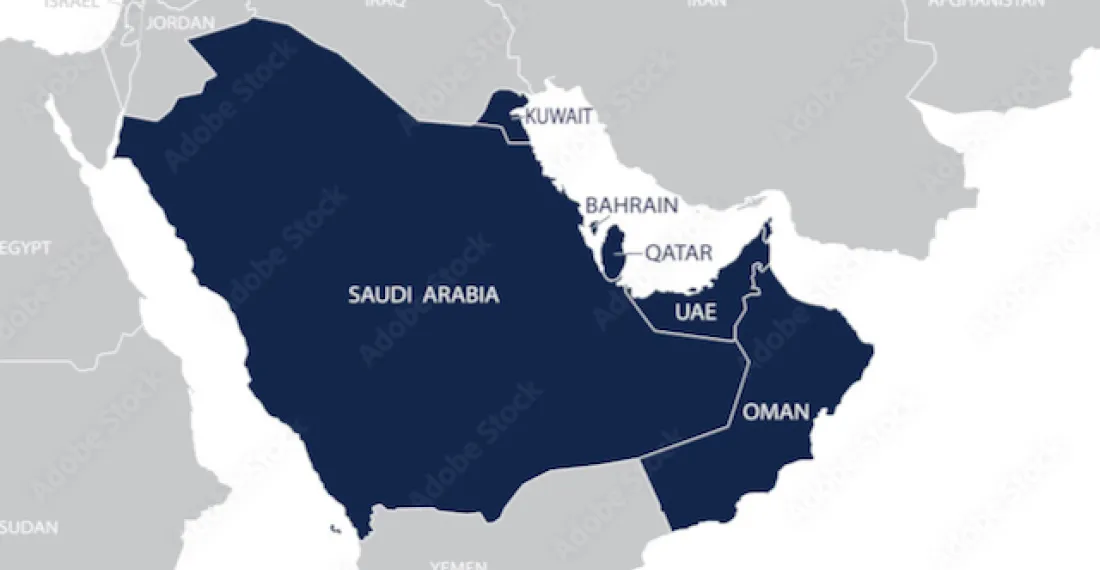
Tourism across the Gulf Cooperation Council has grown into a $254.7 billion economic sector, reinforcing the industry’s importance to regional diversification strategies as Gulf economies invest heavily in aviation, hotels, entertainment, infrastructure and international events.
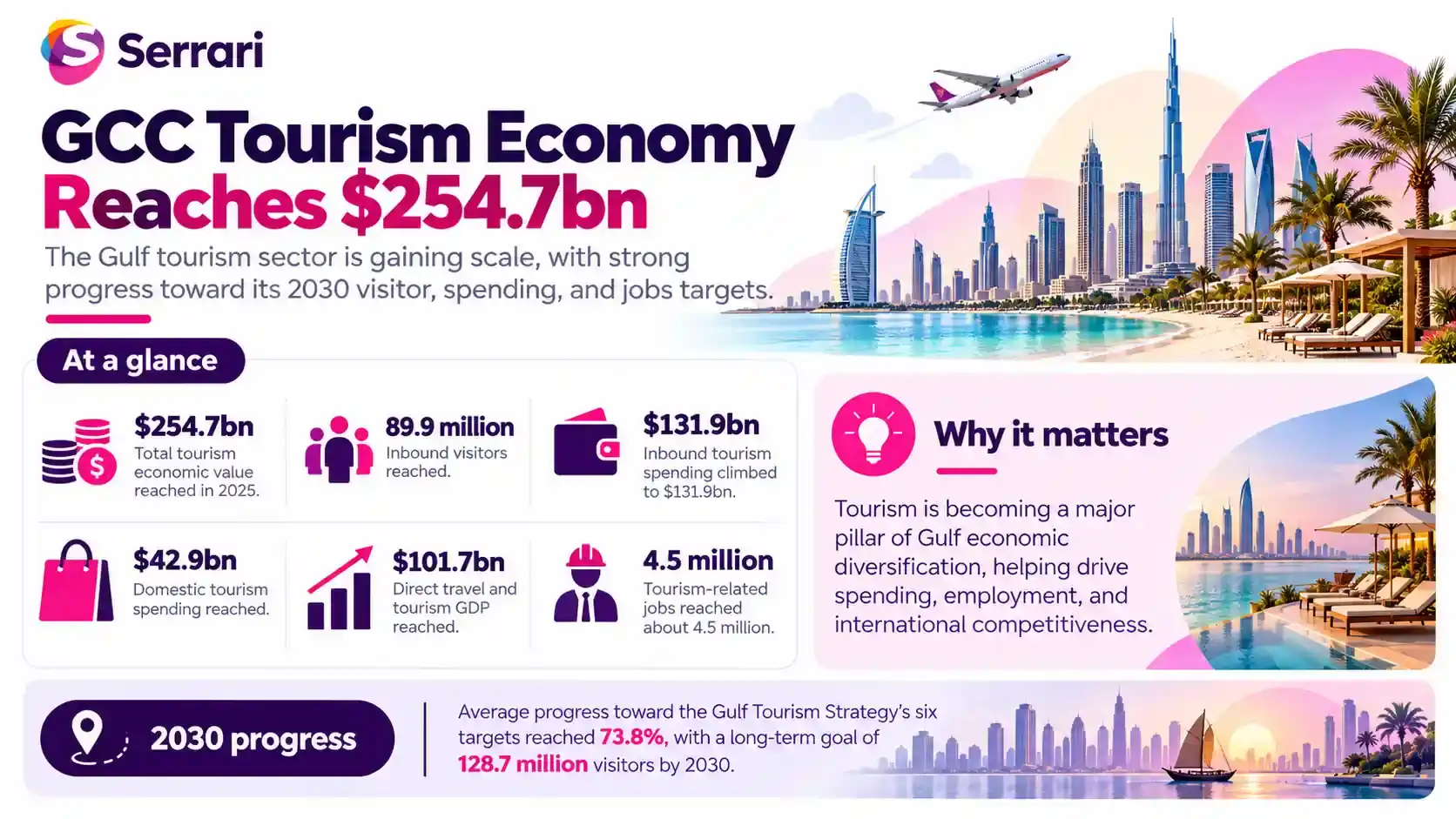
New 2025 data show the six GCC states attracted 89.9 million inbound visitors, while international tourist spending reached $131.9 billion and domestic tourism spending rose to $42.9 billion.
The region has now achieved an average 73.8% of the six major targets set under the Gulf Tourism Strategy 2022–2030, although substantial growth will still be required to reach its ambitions for visitor numbers, tourism GDP and employment by the end of the decade.
Key Overview
- Tourism generated approximately $254.7 billion in direct and indirect economic value across the GCC in 2025.
- Around 4.5 million jobs were directly or indirectly connected to tourism.
- GCC countries welcomed 89.9 million inbound visitors, up 3.1% from 2024.
- Inbound tourism spending climbed to $131.9 billion, rising 9.7% year-on-year.
- Direct travel and tourism GDP reached $101.7 billion.
- Domestic tourist spending rose to $42.9 billion, putting the region closest to its 2030 domestic-spending target.
- The GCC aims to receive 128.7 million visitors annually by 2030.
- Gulf countries accounted for approximately 5% of global international tourism and 6.9% of worldwide tourism receipts in 2025.
GCC Tourism Economy Reaches $254.7 Billion
The combined direct and indirect economic contribution of tourism across the GCC reached approximately $254.7 billion in 2025, highlighting the growing role of travel in economies traditionally dominated by hydrocarbons.
Tourism-related employment reached approximately 4.5 million jobs, covering both people employed directly by travel businesses and workers supported indirectly by the wider tourism economy.
Direct travel and tourism GDP alone reached $101.7 billion, representing 69.8% of the GCC’s 2030 target of $145.8 billion.
The figure increased by 8.8% between 2024 and 2025, showing that the industry’s economic contribution is expanding more quickly than visitor numbers alone.
Tourism’s direct share of GCC GDP also increased to 4.6%, moving the bloc closer to its target of 6.5% by 2030.
Visitor Numbers Approach 90 Million
The region recorded 89.9 million inbound visitors in 2025, equivalent to 69.9% of the 2030 target of 128.7 million.
International arrivals grew by 3.1% from 2024, while the longer-term figures demonstrate the scale of the recovery and expansion that followed the pandemic disruption.
The Gulf Tourism Strategy has made attracting more international travellers one of its central objectives as countries continue expanding airport capacity, airline networks, hotels, entertainment destinations and cultural attractions.
The GCC’s wider global position is also becoming more significant. The region accounted for around 5% of total international tourism in 2025, while capturing 6.9% of global tourism receipts.
The difference suggests that visitors to the Gulf generate a comparatively large share of global tourism spending relative to the region’s share of international arrivals.
International Tourism Spending Hits $131.9 Billion
Spending by inbound visitors reached $131.9 billion in 2025, up 9.7% from the previous year.
That represents 70.2% of the GCC’s 2030 target of $188 billion in annual international visitor expenditure.
The faster growth in expenditure compared with visitor numbers indicates that revenue per visitor remains an important driver of the region’s tourism strategy.
Gulf economies have invested heavily in premium hospitality, luxury tourism, shopping, major sporting events, conferences, entertainment and aviation in an effort to attract higher-spending travellers.
The strategy is therefore focused not only on bringing more tourists into the region but also on increasing the overall economic value generated by each visitor.
Context is everything. Stay ahead of shifting trends with today’s market updates, and uncover emerging opportunities using the Serrari Group Market Index and Marketplace. Then, take control of your own financial future by exploring our Money & Life Reset Transformation Blueprint ™ to build stronger habits, create better systems, and design a path toward lasting wealth.
Domestic Tourism Nears Its 2030 Target
Domestic tourism is one of the strongest-performing indicators under the regional strategy.
Spending by residents travelling within GCC countries reached $42.9 billion in 2025, equivalent to 87.6% of the 2030 goal of $49 billion.
Domestic spending increased 6.2% between 2024 and 2025.
The figure highlights the importance of local and regional travellers in supporting hotels, restaurants, attractions and entertainment venues outside peak international tourism periods.
Stronger domestic tourism can also help make major tourism infrastructure more commercially sustainable by reducing reliance on overseas visitors alone.
GCC Targets 128.7 Million Visitors by 2030
The Gulf Tourism Strategy 2022–2030 tracks six major objectives covering inbound arrivals, direct tourism GDP, international spending, tourism’s contribution to GDP, domestic expenditure and employment.
Average progress across those objectives reached approximately 73.8% by 2025.
By 2030, GCC countries aim to attract 128.7 million visitors, generate $145.8 billion in direct tourism GDP and raise international visitor expenditure to $188 billion.
The region also wants direct employment in travel and tourism to reach approximately 2.9 million jobs. In 2025, direct employment stood at 2.2 million, equivalent to 74.7% of that target.
These ambitions mean tourism will remain an important component of Gulf economic diversification throughout the remainder of the decade.
Gulf Passports Strengthen International Mobility
The expansion of tourism has coincided with improvements in international mobility for GCC citizens.
Gulf states occupied the top six Arab positions for passport strength in the 2026 rankings referenced by the regional tourism report.
Compared with 2016, GCC passports had improved their global positions by between six and 36 places as of July 16, 2026.
Greater connectivity is increasingly reinforcing both inbound and outbound tourism as Gulf carriers expand their networks and governments develop the region as an international transport, leisure and business-travel hub.
With nearly 90 million international visitors already arriving annually and tourism generating more than a quarter of a trillion dollars in economic value, the GCC enters the second half of its 2030 strategy with significant momentum. Meeting the remaining targets will depend on sustaining visitor growth, raising expenditure and continuing to translate large tourism investments into lasting employment and economic activity.
Sources: GCC Statistical Centre / Emirates News Agency / Oman News Agency / The Peninsula Qatar / TradeArabia / Times of Oman
Your financial future isn’t something you wait for—it’s something you build.
The real question is: when do you begin?
Move beyond simply staying informed.
Navigate the markets with clarity—track trends through the Serrari Group Market Index, uncover opportunities in the Serrari Marketplace, and build practical knowledge with our Curated Wealth Builder Platform.
Stay connected to what truly matters.
Get daily insights on macro trends and financial movements across Kenya, Africa, and global markets—delivered through the Serrari Newsletter.
Growth opens doors.
Advance your career through professional programs including ACCA, HESI A2, ATI TEAS 7 , HESI EXIT , NCLEX – RN and NCLEX – PN, Financial Literacy!🌟—designed to move you forward with confidence.
See where money is flowing—clearly and in real time.
Track Money Market Funds, Treasury Bills, Treasury Bonds, Green Bonds, and Fixed Deposits, alongside global and African indexes, key economic indicators, and the evolving Crypto and stablecoin landscape—all within Serrari’s Market Index.