Standard Bank Group is positioning Kenya as an important part of its East African expansion while maintaining a preference for building its existing Stanbic franchise organically rather than relying on acquisitions.
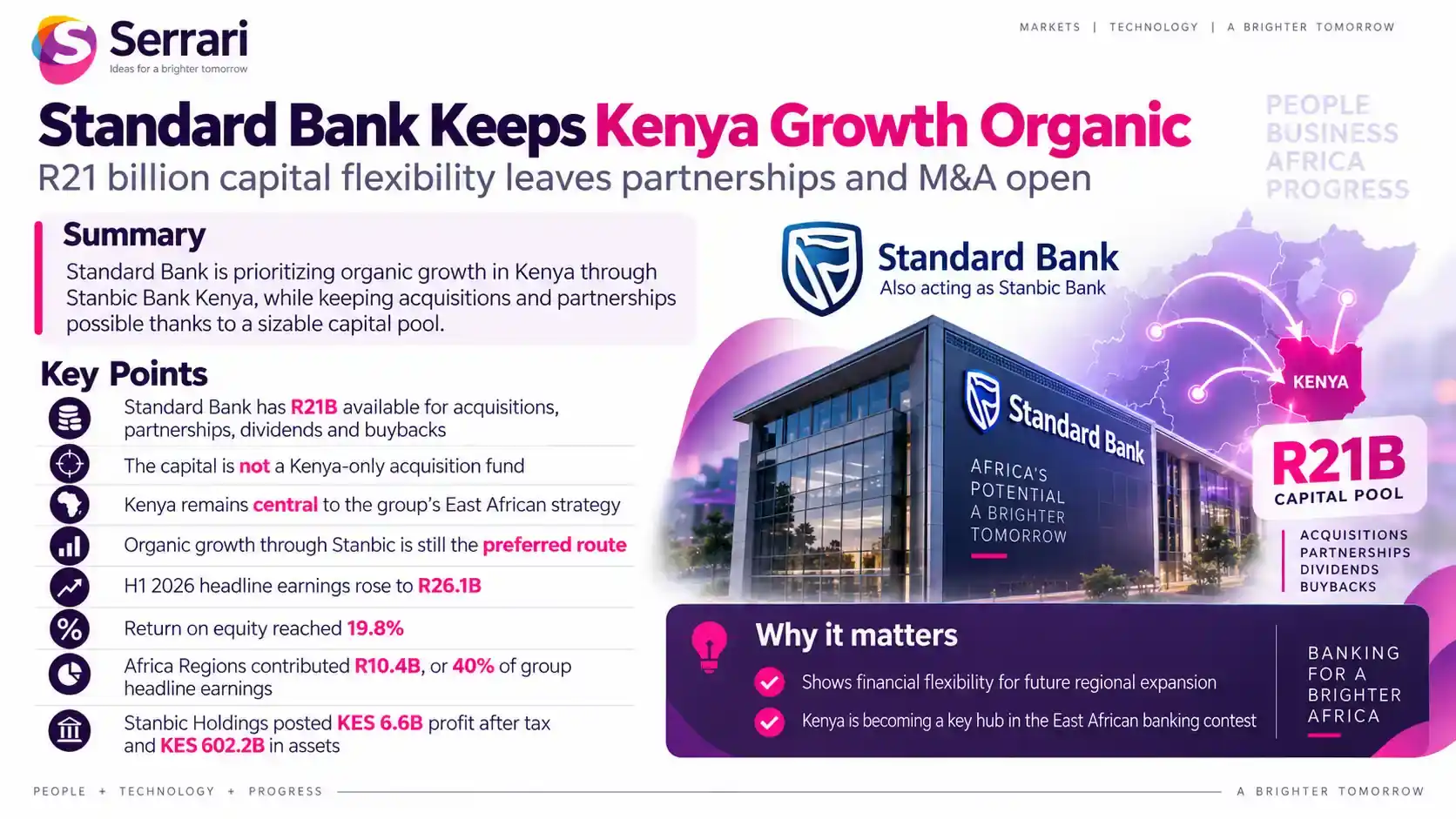
The group nevertheless has significant financial flexibility. Management says it currently has R21 billion, equivalent to roughly KES 167 billion at recently cited exchange rates, that can be allocated among acquisitions, partnerships, dividends and share buybacks.
That capital is not reserved for Kenya. Instead, it gives Africa’s largest banking group by assets the ability to respond selectively to opportunities across its footprint while continuing to invest in existing businesses.
Key Overview
- Standard Bank has R21 billion available for acquisitions, partnerships, dividends and share buybacks.
- The capital is not a dedicated Kenya acquisition fund.
- Kenya remains central to the group’s ambitions to expand its East African banking franchise.
- Standard Bank currently prefers organic expansion through Stanbic Bank Kenya, while leaving acquisitions and partnerships open.
- Group headline earnings rose 10% to R26.1 billion in H1 2026.
- Africa Regions generated R10.4 billion, representing 40% of group headline earnings.
- Stanbic Holdings reported KES 6.6 billion profit after tax and assets of KES 602.2 billion for H1 2026.
- Competition for Kenyan banking scale is intensifying as Nedbank progresses its acquisition of up to 66% of NCBA.
R21 Billion Gives Standard Bank Strategic Flexibility
Standard Bank’s capital position is one of the strongest elements supporting its African expansion strategy. Management disclosed that it has R21 billion available for investments, partnerships and shareholder distributions, giving the group room to pursue opportunities without committing to a specific transaction.
Importantly, the money should not be interpreted as a KES 167 billion war chest specifically earmarked for buying a Kenyan bank. It forms part of a wider capital-allocation framework under which management can choose between organic investment, acquisitions, partnerships, dividends and share repurchases.
The group’s balance sheet supports that flexibility. During the first half of 2026, Standard Bank reported headline earnings of R26.1 billion, an increase of 10%, while return on equity improved to 19.8%.
Its common equity tier 1 ratio stood at 13.6%, providing a sizeable buffer above regulatory requirements and allowing management to remain selective rather than pursue acquisitions simply to achieve growth targets.
Kenya Remains Central to East African Expansion
Standard Bank already operates a substantial Kenyan platform through Stanbic, giving it a different starting point from banks attempting to enter the market through acquisitions.
The group’s stated approach has traditionally been to build from corporate and investment banking into business and commercial banking before expanding further into retail. Its longer-term ambition is to establish a stronger universal banking presence across East Africa, with Kenya serving as an important regional hub.
Stanbic’s existing balance sheet provides a foundation for that expansion. Its H1 2026 financial results show total assets reaching KES 602.2 billion, up 27.1% year-on-year, while customer deposits increased to KES 421.7 billion and customer loans rose to KES 289.8 billion.
Profit after tax reached KES 6.6 billion, compared with KES 6.5 billion a year earlier, showing relatively modest earnings growth despite the rapid balance-sheet expansion.
Context is everything. Stay ahead of shifting trends with today’s market updates, and uncover emerging opportunities using the Serrari Group Market Index and Marketplace. Then, take control of your own financial future by exploring our Money & Life Reset Transformation Blueprint ™ to build stronger habits, create better systems, and design a path toward lasting wealth.
New Leadership Arrives as Stanbic Expands
Stanbic Bank Kenya also entered the second half of 2026 under new leadership. Michael Mutiga became chief executive effective August 1, bringing more than two decades of experience spanning banking, telecommunications, corporate finance and digital financial services.
His appointment comes as the lender seeks to expand beyond its traditional corporate strengths and deepen relationships across commercial, personal and digital banking.
Standard Bank’s wider payments business could support that strategy. During H1 2026, domestic electronic payment values increased 11%, while cross-border payment values grew 7%, giving the group another avenue for connecting Kenyan companies with regional trade and payment flows.
Competition for Kenyan Banking Scale Intensifies
Standard Bank’s organic approach comes as other major African banking groups pursue expansion through acquisitions.
Nedbank has received regulatory approval to acquire up to 66% of NCBA, although the acquisition takes effect upon completion of the transaction under the agreed terms.
If completed, the deal would give Nedbank immediate scale across a financial group with operations in several African markets. Standard Bank, by contrast, already owns an established Kenyan franchise and can choose between expanding it internally or using partnerships and acquisitions to accelerate growth if an attractive opportunity emerges.
Capital Is Already Moving Across Africa
Standard Bank is not simply accumulating capital while waiting for acquisitions. The group deployed additional capital into Tanzania in July and has said it intends to increase its ownership of its Angola operation during the second half of 2026.
Africa Regions already contributed R10.4 billion, or 40% of group headline earnings, during the first half of the year. Kenya was among the eight largest contributors to earnings from the regional portfolio.
For Kenya, the implication is that Standard Bank has both an existing platform and financial capacity to expand. For now, organic growth through Stanbic remains the preferred path, but the R21 billion of flexible capital means management can change pace if a strategically attractive partnership or acquisition emerges.
Sources: Standard Bank Group / Stanbic Bank Kenya / Central Bank of Kenya / NCBA Group / Nedbank Group / Business Daily Africa / TechTrendsKE
Your financial future isn’t something you wait for—it’s something you build.
The real question is: when do you begin?
Move beyond simply staying informed.
Navigate the markets with clarity—track trends through the Serrari Group Market Index, uncover opportunities in the Serrari Marketplace, and build practical knowledge with our Curated Wealth Builder Platform.
Stay connected to what truly matters.
Get daily insights on macro trends and financial movements across Kenya, Africa, and global markets—delivered through the Serrari Newsletter.
Growth opens doors.
Advance your career through professional programs including ACCA, HESI A2, ATI TEAS 7 , HESI EXIT , NCLEX – RN and NCLEX – PN, Financial Literacy!🌟—designed to move you forward with confidence.
See where money is flowing—clearly and in real time.
Track Money Market Funds, Treasury Bills, Treasury Bonds, Green Bonds, and Fixed Deposits, alongside global and African indexes, key economic indicators, and the evolving Crypto and stablecoin landscape—all within Serrari’s Market Index.