U.S. stock futures edged higher on Monday after the Dow Jones Industrial Average recorded a third consecutive weekly decline. Investors entered the new week balancing several competing forces: renewed Middle East tensions, oil prices still near $100 a barrel, Treasury yields close to 5%, tighter Federal Reserve policy and a high-profile U.S.-China summit later in the week.
Key Overview
- U.S. equity futures opened higher, with technology-linked contracts leading the gains.
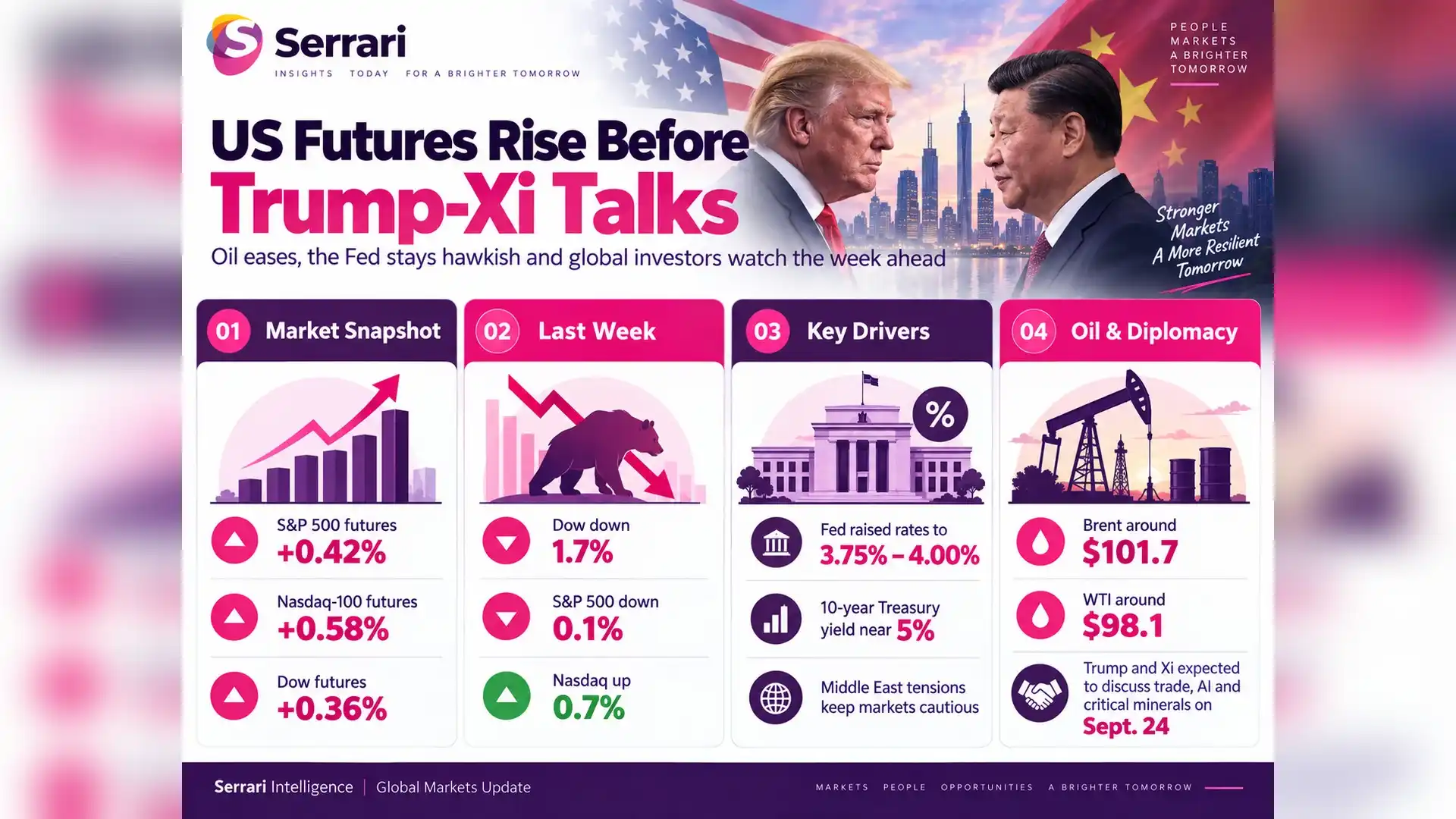
- The Dow fell 1.7% last week, while the S&P 500 slipped 0.1% and the Nasdaq gained 0.7%.
- The Federal Reserve raised its benchmark rate by 25 basis points to 3.75%–4.00%.
- Brent and U.S. crude prices fell Monday despite continued Middle East security risks.
- Houthi missile and drone attacks on Saudi Arabia kept energy-supply concerns elevated.
- President Donald Trump and Chinese President Xi Jinping are due to meet on September 24, with trade, AI and critical minerals among the expected topics.
Futures Recover After a Weak Week for the Dow
U.S. stock futures started the week on firmer ground, with S&P 500 and Nasdaq futures rising as easing oil prices offered some relief from inflation concerns. Technology-linked futures led the advance, while Dow futures also moved higher.
The rebound followed a difficult week for blue-chip stocks. The Dow fell 1.7% over the week, marking its third consecutive weekly loss and its weakest weekly performance since March. The S&P 500 declined about 0.1%, while the Nasdaq Composite gained 0.7% as semiconductor and other technology shares provided support.
Bond markets remain an important pressure point. The 10-year Treasury yield finished last week around the 5% level, keeping financing costs elevated and reducing the relative appeal of some risk assets.
Context is everything. Stay ahead of shifting trends with today’s market updates, and uncover emerging opportunities using the Serrari Group Market Index and Marketplace. Then, take control of your own financial future by exploring our Money & Life Reset Transformation Blueprint ™ to build stronger habits, create better systems, and design a path toward lasting wealth.
Fed Tightening Keeps Inflation in Focus
Markets are also digesting the Federal Reserve’s latest policy move. On September 16, policymakers raised the federal funds target range by a quarter percentage point to 3.75%–4.00%, the first rate increase in roughly three years.
The central bank said economic activity remained solid but inflation was still elevated. That combination has left investors sensitive to any development that could keep energy prices high or add to broader price pressures.
The link between oil and monetary policy has therefore become especially important. Higher crude prices can feed into transport, manufacturing and consumer costs, while persistent inflation can encourage policymakers to keep interest rates restrictive for longer.
Oil Falls Despite Renewed Middle East Tensions
Oil prices moved lower on Monday even as the security situation in the Middle East remained tense. Brent crude fell to around $101.70 a barrel, while U.S. West Texas Intermediate traded near $98.15.
The decline reflected signs that regional crude flows were holding up better than feared and hopes that Saudi shipments could recover further. Analysts estimated that Middle East oil flows averaged about 17.1 million barrels per day over the previous 10 days despite disruptions to Saudi Arabia’s East-West pipeline.
However, supply risks have not disappeared. Yemen’s Iran-backed Houthis claimed missile and drone attacks on Saudi targets, adding another layer of uncertainty around key Gulf energy infrastructure.
Travel risks have also increased. U.S. authorities continue to advise Americans to reconsider travel to Saudi Arabia because of armed-conflict and missile or drone risks.
Trump-Xi Summit Adds Another Market Catalyst
Attention is now shifting toward the September 24 meeting between President Donald Trump and Chinese President Xi Jinping in Washington. The summit is expected to cover trade, artificial intelligence and critical minerals, alongside broader geopolitical issues.
Ahead of the meeting, U.S. Treasury Secretary Scott Bessent and Chinese Vice Premier He Lifeng held talks in New York aimed at narrowing differences and preparing possible areas of agreement. Discussions included tariffs, critical-mineral supplies and a proposed mechanism for communication on AI-related security incidents.
For investors, the combination of energy-market volatility, high bond yields, restrictive monetary policy and U.S.-China negotiations means the week begins with several major variables capable of influencing global equities, currencies and commodities.
Sources: CNBC / Reuters / Federal Reserve / U.S. Department of State
Your financial future isn’t something you wait for—it’s something you build.
The real question is: when do you begin?
Move beyond simply staying informed.
Navigate the markets with clarity—track trends through the Serrari Group Market Index, uncover opportunities in the Serrari Marketplace, and build practical knowledge with our Curated Wealth Builder Platform.
Stay connected to what truly matters.
Get daily insights on macro trends and financial movements across Kenya, Africa, and global markets—delivered through the Serrari Newsletter.
Growth opens doors.
Advance your career through professional programs including ACCA, HESI A2, ATI TEAS 7 , HESI EXIT , NCLEX – RN and NCLEX – PN, Financial Literacy!🌟—designed to move you forward with confidence.
See where money is flowing—clearly and in real time.
Track Money Market Funds, Treasury Bills, Treasury Bonds, Green Bonds, and Fixed Deposits, alongside global and African indexes, key economic indicators, and the evolving Crypto and stablecoin landscape—all within Serrari’s Market Index.