




Deutsche Bank plans to launch a regulated cryptocurrency custody service for institutional and corporate clients by the end of 2026. The initial offering will support Bitcoin, Ethereum and selected stablecoins and e-money tokens, including USDC, EURC and EURAU. The bank says clients will be able to store digital assets and transfer them to third parties while Deutsche Bank manages wallets and private keys on their behalf.
Key Overview
- Deutsche Bank plans to launch its crypto custody service by the end of 2026.
- The service will initially support Bitcoin, Ethereum, USDC, EURC and EURAU.
- Clients will include corporations, asset managers, hedge funds, custodians, brokers and sovereign institutions.
- Deutsche Bank will manage wallets and private keys for clients.
- The service will use multiple layers of operational and technical controls.
- Future development may include additional digital assets and tokenized financial instruments.
Deutsche Bank Plans Institutional Crypto Custody
German lender Deutsche Bank (NYSE: $DB) plans to offer cryptocurrency custody to its institutional clients, with the service expected to go live by the end of 2026.
Germany’s largest bank said the service will provide European institutional and corporate clients with regulated custody of cryptocurrencies such as Bitcoin. At launch, the offering will support a select range of digital assets, including Bitcoin, Ethereum and stablecoins.
In particular, Deutsche Bank plans to support Bitcoin, Ethereum, USDC, EURC and EURAU.
Crypto custody involves the secure storage and management of private keys that prove ownership of digital assets and allow assets to be transferred on a blockchain. Under Deutsche Bank’s planned service, clients will be able to store digital assets and transfer them to third parties, while the bank manages wallets and private keys on their behalf.
This means clients will not need to build and maintain their own custody infrastructure.
Service Targets Institutional and Corporate Clients
The initial audience will consist of clients of Deutsche Bank’s Corporate Bank and Investment Bank. These include corporations, asset managers, hedge funds, custodians, brokers and sovereign institutions.
Onboarding will follow the bank’s customer due diligence procedures, client criteria and risk assessment processes.
The service comes as institutions and corporations adopt a growing number of digital assets, particularly stablecoins used for digital payments. The bank said the service is intended to provide clients with regulated access to the digital asset market.
“Digital assets are not a replacement for the traditional financial system, but an important complement to it,” said Gerald Podobnik, co-head of Corporate Bank at Deutsche Bank.
“We see them as new rails that coexist with existing marketing infrastructures. The service will be developed in line with client demand, regulatory requirements and the bank’s risk appetite,” Podobnik added.
Deutsche Bank was previously reported to be preparing a crypto custody service alongside exchange Bitpanda, with a potential 2026 debut.
More Digital Assets Could Be Added
At launch, Deutsche Bank will offer custody for a limited set of assets. Alongside Bitcoin and Ethereum, the service will support selected stablecoins and e-money tokens, including USDC, EURC, and EURAU.
The bank said the list could expand depending on client demand, internal product approval procedures, risk management and regulatory processes.
Its roadmap also includes tokenized financial instruments, indicating that the planned service could eventually extend beyond cryptocurrency custody.
Context is everything. Stay ahead of shifting trends with today’s market updates, and uncover emerging opportunities using the Serrari Group Market Index and Marketplace. Then, take control of your own financial future by exploring our Money & Life Reset Transformation Blueprint ™ to build stronger habits, create better systems, and design a path toward lasting wealth.
Multi-Layered Protection for Digital Assets
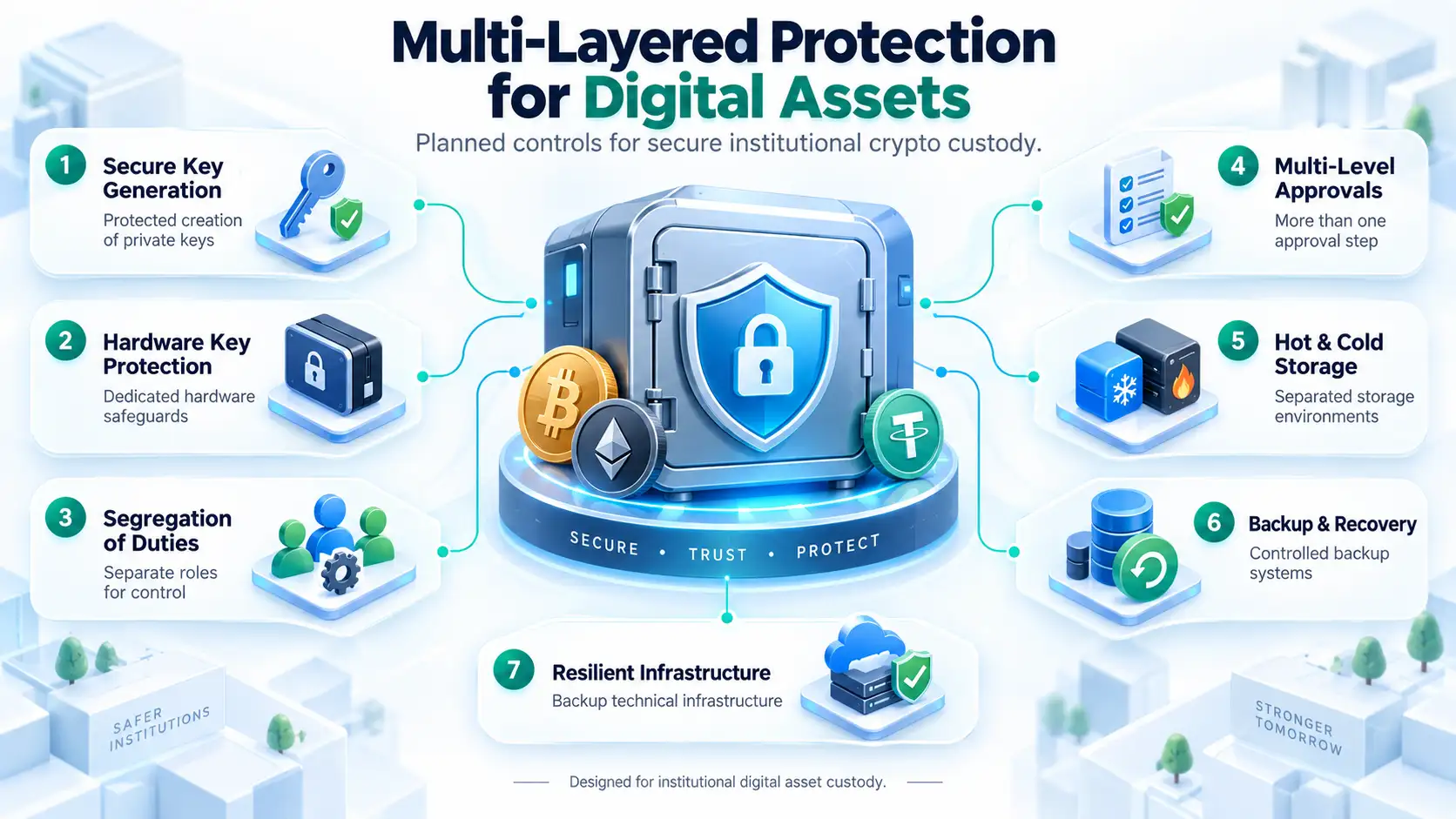
Deutsche Bank said the custody solution was developed with corporate governance procedures and multiple layers of operational controls.
Planned mechanisms include secure key generation and hardware-based key protection, segregation of duties among employees, multi-level approval procedures, and separate environments for hot and cold storage.
The bank also plans to use backup technical infrastructure and controlled backup and recovery mechanisms. For certain technical components, Deutsche Bank expects to engage third-party technology and infrastructure providers.
The bank highlighted risks associated with digital assets, including price volatility, fraud, cyber incidents and potential disruptions involving market participants. It also noted that crypto assets are not covered by a deposit guarantee scheme similar to the one applying to bank deposits.
Deutsche Bank’s Existing Crypto Infrastructure
Deutsche Bank has already obtained a crypto asset custody license in Germany, according to the supplied information. Germany has required authorization from the Federal Financial Supervisory Authority (BaFin) for crypto custody operations since 2020.
The bank’s service is expected to operate within this existing licensing framework. In the European Union, the Markets in Crypto-Assets regulation is also being phased in, with requirements covering areas including capital, segregation of client assets and secure private key storage.
Deutsche Bank’s service design includes several of the operational controls associated with secure digital asset custody.
Outlook
Deutsche Bank expects its cryptocurrency custody service to launch by the end of 2026, initially covering Bitcoin, Ethereum and selected stablecoins and e-money tokens. Future expansion will depend on client demand, internal approvals, risk management and regulatory processes. The bank has also identified tokenized financial instruments as part of its roadmap.
At the time of the announcement, details including target jurisdictions, minimum assets under custody and whether additional regulatory approvals will be required had not been disclosed.
The bank’s stock was trading at $38.35 per share, up 5% over the previous 12 months, while Bitcoin was trading at $75,650 on September 16.
FAQs
1. When will Deutsche Bank launch its crypto custody service?
Deutsche Bank plans to launch its cryptocurrency custody service by the end of 2026.
2. Which cryptocurrencies will Deutsche Bank support?
At launch, the service will support Bitcoin, Ethereum, USDC, EURC and EURAU, with the possibility of adding more digital assets later.
3. Who will be eligible to use Deutsche Bank’s crypto custody service?
The initial clients will include corporations, asset managers, hedge funds, custodians, brokers and sovereign institutions served by Deutsche Bank’s Corporate Bank and Investment Bank.
4. How will Deutsche Bank protect clients’ digital assets?
The bank plans to use secure key generation, hardware-based key protection, segregation of duties, multi-level approvals, hot and cold storage, backup infrastructure, and controlled backup and recovery mechanisms.
Sources: Yahoo Finance, Incrypted, BigGo Finance
Your financial future isn’t something you wait for—it’s something you build.
The real question is: when do you begin?
Move beyond simply staying informed.
Navigate the markets with clarity—track trends through the Serrari Group Market Index, uncover opportunities in the Serrari Marketplace, and build practical knowledge with our Curated Wealth Builder Platform.
Stay connected to what truly matters.
Get daily insights on macro trends and financial movements across Kenya, Africa, and global markets—delivered through the Serrari Newsletter.
Growth opens doors.
Advance your career through professional programs including ACCA, HESI A2, ATI TEAS 7 , HESI EXIT , NCLEX – RN and NCLEX – PN, Financial Literacy!🌟—designed to move you forward with confidence.
See where money is flowing—clearly and in real time.
Track Money Market Funds, Treasury Bills, Treasury Bonds, Green Bonds, and Fixed Deposits, alongside global and African indexes, key economic indicators, and the evolving Crypto and stablecoin landscape—all within Serrari’s Market Index.





















Comments are closed.