
Japan’s Financial Services Agency will increase monitoring of lending to the real estate sector as rising interest rates create new credit risks. The regulator will also examine ultralong mortgages, lending to overseas funds and data centers, and banks’ asset and liability management.
Key Overview
- Japan’s FSA will monitor real estate lending as interest rates rise.
- The regulator will examine 40- to 50-year mortgages and borrowers’ repayment capacity.
- Banks face increasing competition for deposits as funding costs rise.
- Lending to overseas funds and data centers will also be reviewed.
- The FSA will assess governance and risk management at major banking groups.
- The strategic priorities cover the agency’s action plans for the year ending next June.
FSA Steps Up Monitoring of Real Estate Lending
Japan’s Financial Services Agency (FSA) is set to increase its monitoring of lending to the real estate sector as part of efforts to assess risks arising from the country’s rising interest rates.
Real estate is among several areas on the regulator’s watchlist for credit risks as lenders and borrowers adjust to higher borrowing costs following years of deflation. The FSA will also examine lending to overseas funds, data centers and other exposures under its annual strategic policies announced Tuesday.
The Bank of Japan is expected to raise interest rates for the third time in less than 10 months on Friday. The move would mark the fastest pace of rate increases since Japan’s asset bubble in 1990.
With the benchmark rate at a 31-year high, the FSA said it will monitor how banks are managing their assets and liabilities, including funding costs. The regulator noted that competition for deposits is intensifying.
Rising Home Prices and Longer Mortgages
Japan’s residential property market has been recovering from years of stagnation, with home prices surging in Tokyo and other cities.
At the same time, some lenders have started offering mortgages with repayment periods of as long as 50 years, allowing homebuyers to spread their repayment obligations over a longer period.
The FSA said banks are offering mortgages “with significantly longer repayment periods than in the past” and that it wants to ensure these loans are appropriate for borrowers’ expected income trajectory.
The agency is also stepping up scrutiny of ultralong mortgage lending, according to an FSA official cited in the source.
FSA Examines Borrowers’ Repayment Capacity
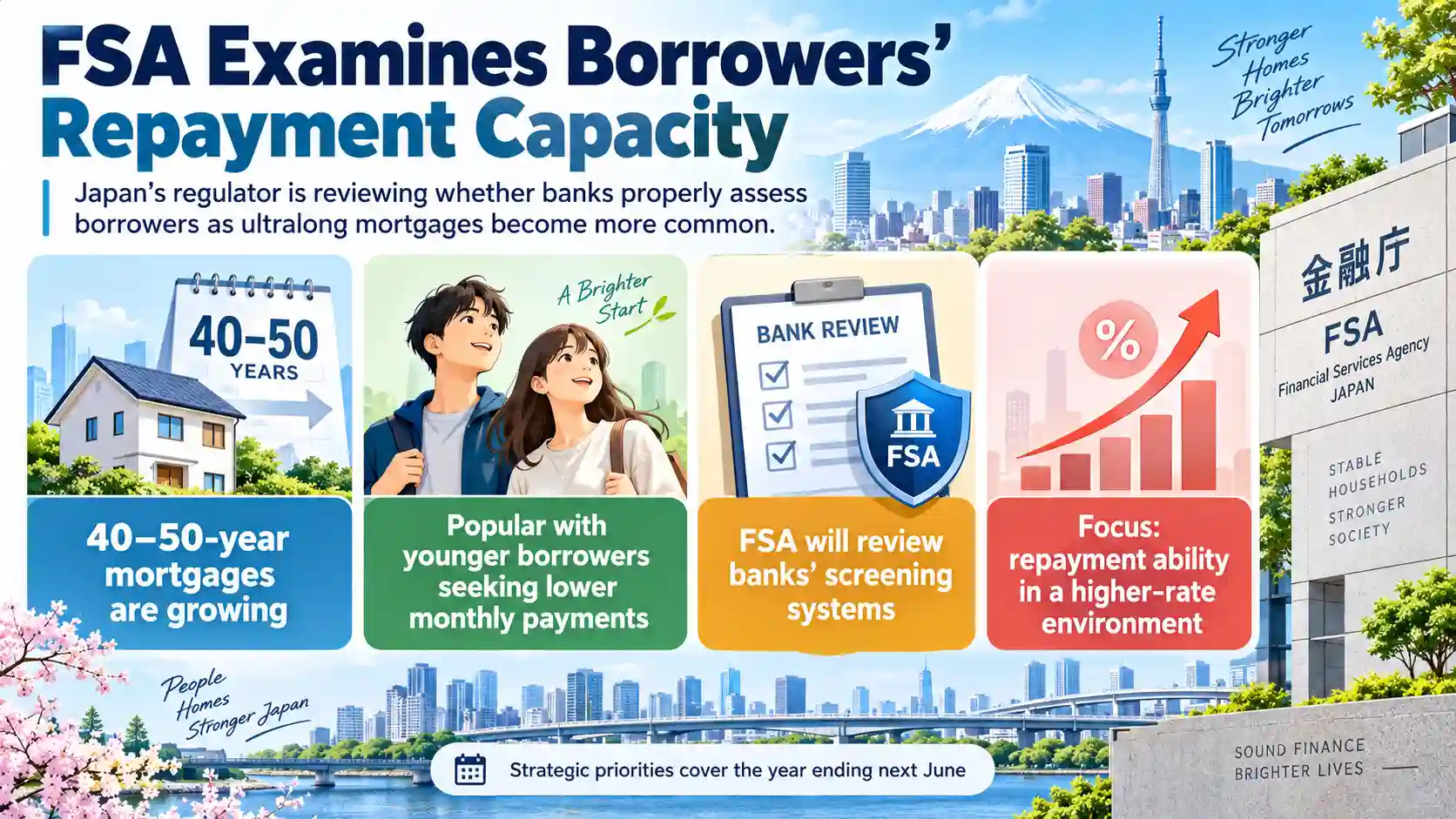
The popularity of 40- to 50-year mortgages is growing among borrowers, particularly young people seeking to reduce their monthly repayment burden.
However, the FSA plans to examine whether financial institutions’ screening systems adequately assess borrowers’ ability to repay their loans.
The regulator’s review comes as lenders and borrowers adjust to an environment of higher interest rates. The agency will assess the impact of rising rates on financial institutions’ deposit and loan operations, as well as their risk-management practices.
The strategic priorities cover the FSA’s action plans for the year ending next June.
Context is everything. Stay ahead of shifting trends with today’s market updates, and uncover emerging opportunities using the Serrari Group Market Index and Marketplace. Then, take control of your own financial future by exploring our Money & Life Reset Transformation Blueprint ™ to build stronger habits, create better systems, and design a path toward lasting wealth.
Overseas Funds and Data Centers Also on Watchlist
Real estate is not the only area under scrutiny. The FSA will also review banks’ risk management for loans extended to foreign funds and data centers.
The regulator plans to assess how financial institutions are responding to higher interest rates and whether their risk-management frameworks remain appropriate as lending and funding conditions change.
The FSA will also examine the effectiveness of governance and risk-management frameworks at major banking groups.
This review comes amid the global expansion of major Japanese banking groups and their growing use of generative artificial intelligence.
Focus on Governance and Corporate Culture
The FSA also highlighted its approach to irregularities at financial institutions.
Rather than attributing responsibility solely to individual employees, the regulator said it will analyze the root causes of irregularities by examining management attitudes and corporate culture.
This forms part of the agency’s broader strategic priorities for the year ahead, alongside monitoring credit risks, interest-rate impacts and financial institutions’ risk-management frameworks.
Outlook
Japan’s financial institutions are entering a changing interest-rate environment after years of deflation, creating new considerations for lenders and borrowers as they adjust to higher rates. Against this backdrop, the FSA’s increased scrutiny will focus on how banks manage real estate lending, ultralong mortgages, deposits and loans, as well as their exposures to overseas funds and data centers. The regulator will also assess how rising rates are affecting financial institutions’ operations and risk-management practices.
The regulator’s review of 40- to 50-year mortgages will focus on whether lenders’ screening systems adequately assess borrowers’ repayment capacity and whether longer repayment periods are appropriate for expected income trajectories. As these mortgages become more popular, particularly among younger borrowers seeking to reduce their monthly repayment burden, the FSA will continue examining whether financial institutions are appropriately managing the associated risks.
FAQs
1. Why is Japan’s FSA monitoring real estate lending?
The FSA is monitoring real estate lending to assess credit risks as banks and borrowers adjust to rising interest rates after years of deflation.
2. What is the FSA reviewing about ultralong mortgages?
The regulator will examine 40- to 50-year mortgages to determine whether lenders adequately assess borrowers’ repayment capacity and whether longer repayment periods are appropriate for expected income trajectories.
3. What other areas will the FSA monitor?
The FSA will examine lending to overseas funds and data centers, as well as the impact of rising interest rates on banks’ deposit and loan operations and their risk management.
4. Why is the FSA concerned about banks’ asset and liability management?
With interest rates rising and competition for deposits intensifying, the FSA wants to monitor how banks manage their assets, liabilities and funding costs in the changing interest-rate environment.
Sources: The Japan Times, nippon.com, JIJI PRESS
Your financial future isn’t something you wait for—it’s something you build.
The real question is: when do you begin?
Move beyond simply staying informed.
Navigate the markets with clarity—track trends through the Serrari Group Market Index, uncover opportunities in the Serrari Marketplace, and build practical knowledge with our Curated Wealth Builder Platform.
Stay connected to what truly matters.
Get daily insights on macro trends and financial movements across Kenya, Africa, and global markets—delivered through the Serrari Newsletter.
Growth opens doors.
Advance your career through professional programs including ACCA, HESI A2, ATI TEAS 7 , HESI EXIT , NCLEX – RN and NCLEX – PN, Financial Literacy!🌟—designed to move you forward with confidence.
See where money is flowing—clearly and in real time.
Track Money Market Funds, Treasury Bills, Treasury Bonds, Green Bonds, and Fixed Deposits, alongside global and African indexes, key economic indicators, and the evolving Crypto and stablecoin landscape—all within Serrari’s Market Index.