
















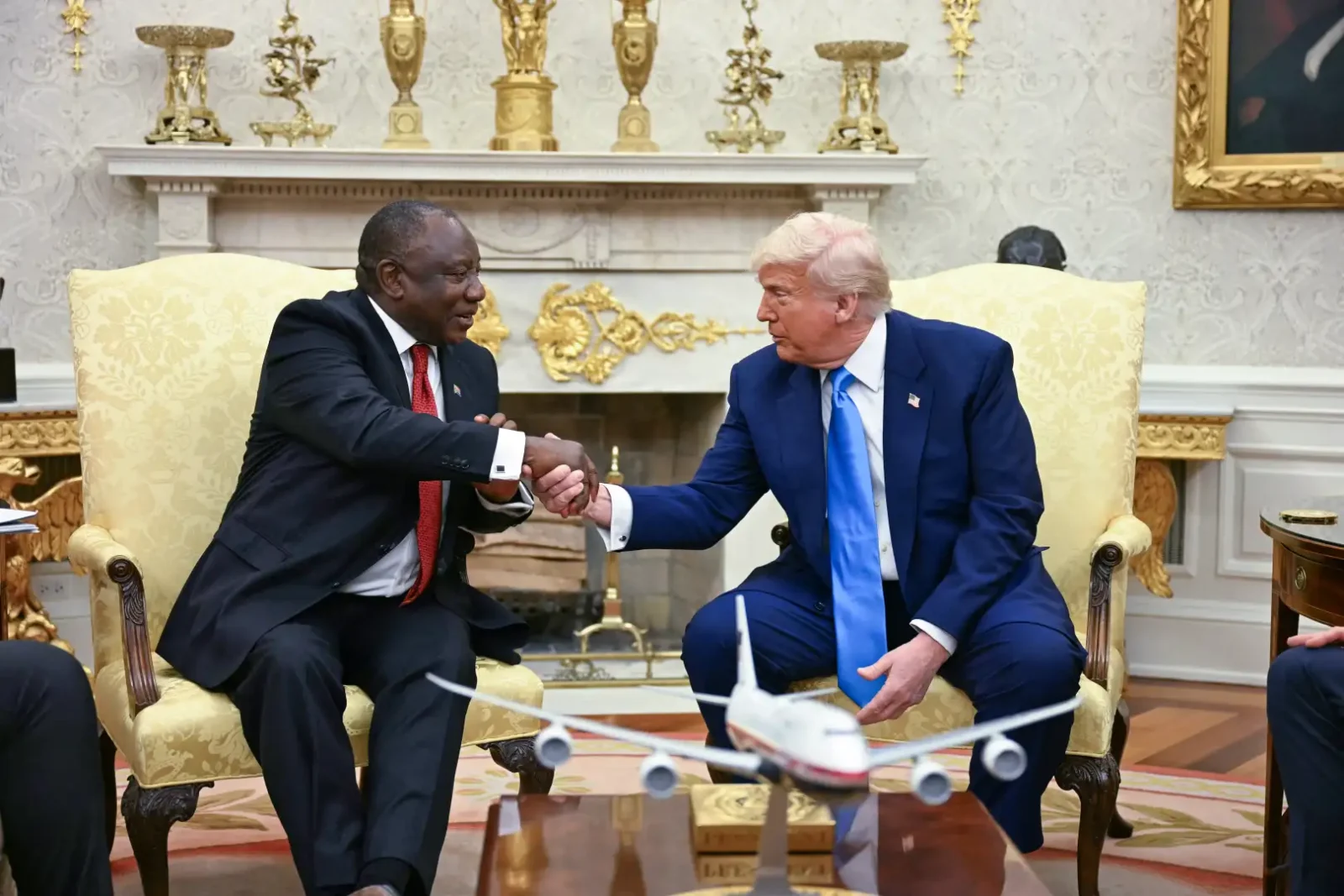
The United States and South Africa held preliminary discussions in Johannesburg on 7 May 2026 over potential resource deals spanning mining, energy, and infrastructure — the highest-level bilateral meeting between the two countries this year. Around 25 officials from both governments, joined by mining and banking executives, met at a forum convened by the Center for Strategic and International Studies (CSIS) to identify priority investment projects, including the Phalaborwa rare earths project in Limpopo Province. The talks represent Washington’s attempt to decouple critical mineral supply chains from China, which dominates global rare earth processing, while South Africa — a major producer of platinum, chromium, manganese, and vanadium — sees an opening for foreign investment and energy imports. The engagement comes after more than a year of severe diplomatic friction between the two nations, triggered by President Donald Trump’s allegations of persecution against white South Africans, the expulsion of South Africa’s ambassador from Washington, and the US boycotting the G20 summit held in South Africa.
Markets move fast; don’t get left behind. We’ve paired the Serrari Group Market Index with a curated Marketplace and a comprehensive Wealth Builder Platform to ensure you have the data—and the skills—to act on it.
Key Overview
- Meeting: Around 25 US and South African officials met in Johannesburg on 7 May 2026
- Convener: Center for Strategic and International Studies (CSIS), Washington-based think tank
- Focus areas: Critical minerals, energy investment, logistics infrastructure
- Priority project: Phalaborwa Rare Earths Project, backed by US$50 million from the US Development Finance Corporation
- Key minerals: Platinum-group metals, chromium, manganese, vanadium, rare earth elements
- China context: China holds 59% of rare earth mining, 91% of refining, and 94% of magnet manufacturing (IEA data)
- US initiatives: Project Vault — $12 billion strategic minerals reserve launched in February 2026
- Diplomatic backdrop: South Africa’s ambassador expelled from Washington in 2025; US boycotted the South Africa-hosted G20
- Status: Talks are at an early stage; no formal agreement has been announced
Minerals Bring Estranged Allies Back to the Table
Despite more than a year of deep diplomatic hostility, the United States and South Africa sat down together in Johannesburg this week for what attendees described as the most significant bilateral engagement of 2026 so far. Around 25 officials from both governments, accompanied by roughly 20 mining and banking executives, gathered on 7 May to discuss potential investments in mining, energy, and infrastructure — a tentative step toward commercial re-engagement between two countries that have been at loggerheads since President Donald Trump began his second term.
The forum, convened by the Washington-based Center for Strategic and International Studies, met for the first time in March in the United States and reconvened this week in South Africa. While talks remain at an early stage and no formal agreements have been reached, attendees pointed to a shared sense of urgency. One executive who attended told the Financial Times that the importance of building mineral supply chains free from Chinese control was central to discussions, adding that participants were firmly committed to the initiative.
The American delegation included officials from the Treasury, State, Commerce, Defense, and Energy departments, along with representatives from the US Export-Import Bank and the US International Development Finance Corporation (DFC). On the South African side, two deputy ministers and dozens of officials participated, alongside the new US Ambassador to Pretoria, Leo Brent Bozell III.
A Year of Diplomatic Fractures
The fact that the two countries are talking at all is notable given the depth of the rift that has defined their relationship since early 2025. Trump repeatedly made unfounded claims of “white genocide” in South Africa, and within weeks of taking office for his second term, signed an executive order cutting all foreign aid to the country, citing what the administration called “unjust racial discrimination” against white Afrikaners. The order also referenced South Africa’s Expropriation Act, which allows government seizure of land without compensation in certain circumstances.
The diplomatic deterioration escalated further when US Secretary of State Marco Rubio declared South Africa’s ambassador to Washington, Ebrahim Rasool, persona non grata — expelled for remarks critical of the Trump administration. Rasool, a veteran diplomat who had previously served during the Obama administration, was given only days to leave. South Africa has not replaced him, opting instead for what the Daily Maverick described as an “unorthodox approach” of engaging Washington without a permanent ambassadorial presence.
The tensions reached another flash point when Washington boycotted the G20 summit hosted by South Africa in November 2025, an extraordinary diplomatic snub to the host nation. The arrival of Bozell himself as the new US ambassador in early 2026 brought fresh friction. Within weeks of assuming his post, Bozell was summoned by South Africa’s foreign ministry after publicly dismissing a court ruling on the anti-apartheid chant “Kill the Boer,” calling it hate speech regardless of what South African courts determined. The formal diplomatic rebuke, known as a démarche, signalled Pretoria’s frustration with what it viewed as interference in its judicial system.
Context is everything. While you follow today’s updates, use the Serrari Group Market Index and Marketplace to spot emerging shifts. Need to sharpen your edge? Our Wealth Builder Platform turns these insights into a professional-grade strategy.
Why Minerals Are Overriding Politics
Yet beneath the political acrimony, a powerful economic logic has been pulling the two countries toward re-engagement. South Africa possesses one of the world’s most diversified mineral endowments, producing substantial quantities of platinum-group metals, chromium, manganese, and vanadium. It also hosts extensive smelting capacity — another area where China currently holds a commanding lead.
For Washington, the imperative is clear. China’s stranglehold on critical mineral supply chains — the International Energy Agency estimates that Beijing controls 59 per cent of global rare earth mining, 91 per cent of refining, and 94 per cent of magnet manufacturing — has become a national security concern. When China restricted exports of rare earth elements in early 2025, Western countries scrambled to build alternative mine-to-magnet supply chains. The Trump administration has responded with an unprecedented scale of action, including taking equity stakes in mining companies, signing bilateral minerals agreements with countries on every continent, and launching the US Strategic Critical Minerals Reserve, known as Project Vault.
Announced in February 2026 with backing of a $10 billion Export-Import Bank loan and nearly $2 billion in private capital, Project Vault represents the most aggressive US strategic stockpiling initiative in decades. The reserve is designed to store 60 critical minerals in secure facilities across the United States, shielding domestic manufacturers from supply disruptions.
Alongside Project Vault, the US State Department hosted a Critical Minerals Ministerial in February 2026, gathering officials from 55 countries. At the event, the US signed eleven new bilateral critical minerals frameworks and memoranda of understanding. Conspicuously absent from these formal agreements, however, was South Africa — a gap that this week’s Johannesburg meeting may be beginning to address.
The Phalaborwa Rare Earths Project
Among the most concrete investment prospects discussed at the forum was the Phalaborwa Rare Earths Project in South Africa’s north-eastern Limpopo Province. The project, developed by Rainbow Rare Earths, aims to extract rare earth elements from 35 million tons of phosphogypsum — industrial waste left over from decades of phosphate processing — rather than through conventional hard-rock mining.
The US Development Finance Corporation has committed US$50 million to the project through its investment partner TechMet, a firm focused on securing critical mineral supplies for the West. The DFC first pledged the investment in 2023 under the Biden administration, but the current Trump administration has continued to move the project forward, signalling that strategic mineral interests override the broader diplomatic tensions.
Rainbow Rare Earths CEO George Bennett told the Associated Press that the project aims to supply predominantly the US, with interest driven largely by defence applications. The company plans to produce separated neodymium and praseodymium oxide, along with heavy rare earth elements including dysprosium and terbium — materials essential for high-performance magnets used in wind turbines, electric vehicles, defence systems, and emerging technologies such as robotics.
Production is anticipated to begin in 2028, with construction of the processing factory expected to start in early 2027. The project is expected to operate for 16 years. Because the rare earths are being recovered from existing waste rather than mined from hard rock, operational costs are expected to be significantly lower than conventional rare earth mining, and Rainbow says the extraction process will use up to 90 per cent renewable energy.
Neha Mukherjee, a research manager at Benchmark Mineral Intelligence, described the Phalaborwa project as a fairly low-cost asset with modest capital requirements, but noted that its potential remains uncertain given the experimental nature of the above-ground extraction process. Crucially, she added, the global pipeline of rare earth projects outside China remains insufficient to meet growing demand.
South Africa’s Balancing Act
South Africa’s willingness to engage with the US on critical minerals reflects a pragmatic calculation, but it is not without internal tension. The country has long pursued what Pretoria describes as strategic autonomy in foreign policy — maintaining active relationships with China, Russia, and the West simultaneously, and resisting alignment with any single power bloc.
At the Mining Indaba conference in Cape Town in February 2026, South African Mining Minister Gwede Mantashe publicly criticised the Democratic Republic of Congo for signing a critical minerals deal with Washington, arguing that such bilateral arrangements with external powers threatened African sovereignty and risked intensifying a scramble for the continent’s resources. He urged African states to prioritise regional collaboration instead, warning that a failure to coordinate would result in a “race to the bottom.”
Mantashe’s position sits in tension with the commercial reality. South Africa’s mining sector — long a pillar of the national economy — needs foreign investment to modernise ageing infrastructure, expand downstream processing capacity, and address chronic logistics bottlenecks that have hampered industrial output for years. Potential US investment in South African logistics infrastructure was among the topics raised during the Johannesburg forum, reflecting long-standing concerns about the state of the country’s rail and port systems.
President Cyril Ramaphosa signalled a more conciliatory posture in April 2026, telling the American Chamber of Commerce annual meeting in Johannesburg that South Africa would continue developing a critical minerals framework to ensure it remains a strategic supplier of critical minerals to the US. He also pointed to the more than 600 American companies operating in South Africa, employing an estimated 250,000 people, as evidence of the enduring commercial partnership.
Secretary of State Rubio appeared to echo the warming tone, saying last week that the US remains open to constructive engagement with South Africa where interests align.
The Wider US Push Across Africa
The Johannesburg talks do not exist in isolation. They form part of a broader and rapidly accelerating US minerals engagement strategy across the African continent. At the Critical Minerals Ministerial in February, the US signed bilateral minerals frameworks with Guinea and Morocco, among others. The DFC-backed Orion Critical Mineral Consortium signed a memorandum of understanding with Glencore to potentially acquire assets in the DRC’s copper and cobalt sector. And Washington has continued financing the Lobito Corridor, a Biden-era initiative to build an 800-mile railway linking mineral-rich areas of Congo and Zambia to the Atlantic coast.
The US delegation at the February Mining Indaba in Cape Town was the largest American contingent in the conference’s history, including representatives from the US Trade and Development Agency, the State Department’s Bureau of African Affairs, the International Trade Administration, and the Department of Energy. The sheer scale of the presence underscored Washington’s growing strategic focus on African minerals, even as political relations with individual countries remained fraught.
Gracelin Baskaran, director of the critical minerals security programme at CSIS and convener of the Johannesburg forum, noted that South Africa is the dominant supplier to the US of platinum-group metals, as well as chromium and manganese. She described the mineral trade as a longstanding commercial partnership stretching back more than a century, one that has historically endured even during periods of geopolitical strain.
Outlook: Commerce Before Diplomacy
Several officials at the Johannesburg meeting cautioned that any formal resources deal remains far away. The talks are at an early stage, and the political sensitivities on both sides — Trump’s demands around land reform, affirmative action, and foreign policy alignment, versus South Africa’s insistence on sovereign decision-making — remain significant barriers to a comprehensive agreement.
Yet the trajectory is clear. The mutual economic logic of critical mineral cooperation is, for now, proving stronger than the diplomatic divisions. South Africa’s mineral wealth, its existing smelting infrastructure, and its need for energy imports and infrastructure investment create a natural opening for US capital. Washington’s urgent need to diversify mineral supply chains away from China creates the demand.
Whether this early commercial engagement can mature into the kind of formalised bilateral minerals framework that the US has already signed with Australia, the European Union, and dozens of other nations will depend on whether both sides can compartmentalise their economic interests from the political acrimony that continues to define the broader relationship. For the moment, at least, the minerals are doing the talking.
Sources: Financial Times, PBS News, OilPrice.com, Al Jazeera, Semafor, CSIS, US State Department, US EXIM, African Climate Wire, Daily Maverick, Bloomberg, CNBC, Rainbow Rare Earths, South African Presidency, Australian Department of Industry.
Your financial future isn’t something you wait for—it’s something you build.
The real question is: when do you begin?
Move beyond simply staying informed.
Navigate the markets with clarity—track trends through the Serrari Group Market Index, uncover opportunities in the Serrari Marketplace, and build practical knowledge with our Curated Wealth Builder Platform.
Stay connected to what truly matters.
Get daily insights on macro trends and financial movements across Kenya, Africa, and global markets—delivered through the Serrari Newsletter.
Growth opens doors.
Advance your career through professional programs including ACCA, HESI A2, ATI TEAS 7 , HESI EXIT , NCLEX – RN and NCLEX – PN, Financial Literacy!🌟—designed to move you forward with confidence.
See where money is flowing—clearly and in real time.
Track Money Market Funds, Treasury Bills, Treasury Bonds, Green Bonds, and Fixed Deposits, alongside global and African indexes, key economic indicators, and the evolving Crypto and stablecoin landscape—all within Serrari’s Market Index.