



Thailand’s electric vehicle board has agreed to increase excise taxes on fully imported electric vehicles to encourage investment in domestic automotive manufacturing. Fully imported vehicles will face the highest rate, while lower rates will apply to vehicles imported for testing, local assembly or production. Vehicles manufactured in Thailand using local content will receive the lowest tax rate. A final tax rate is expected by the end of September.
Key Overview
- Thailand plans to increase excise taxes on fully imported EVs above the current 10% rate.
- Lower rates will apply to vehicles imported for testing, local assembly or production.
- EVs manufactured in Thailand using domestic components will receive the lowest tax rate.
- Electric and hybrid vehicles accounted for 55% of new cars in the first seven months of 2026.
- EV ecosystem investment reached US$4.59 billion across 189 projects by August 2026.
- Thailand has produced about 170,000 EVs domestically and has potential annual capacity of 380,000 vehicles.
- The final excise tax rate is expected to be decided by the end of September.
Thailand Moves to Raise EV Import Taxes
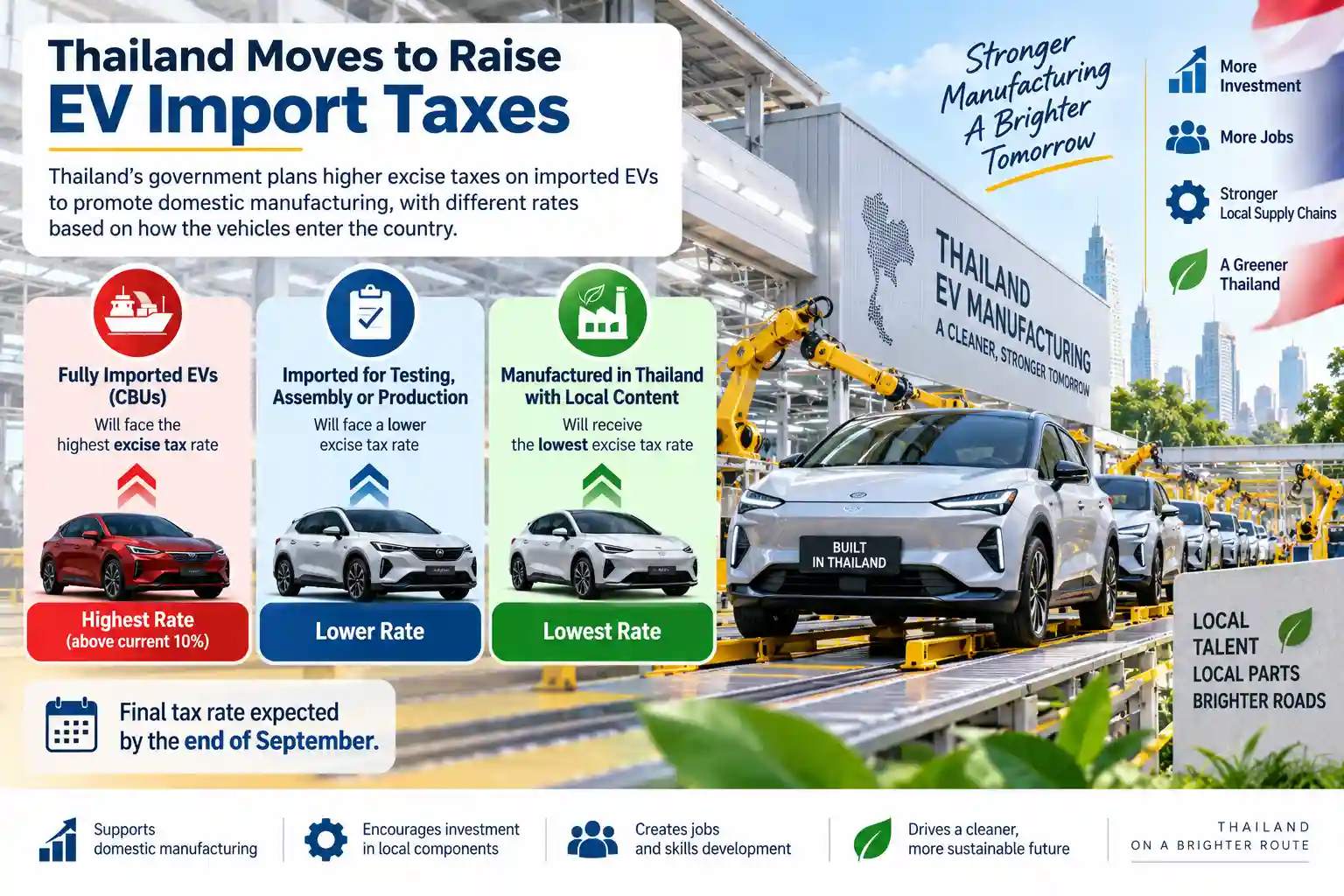
Thailand’s electric vehicle board has agreed to increase excise taxes on imported EVs as the government seeks to promote investment in domestic automotive manufacturing.
Finance official Pornchai Thiraveja said fully imported vehicles, known as completely built units (CBUs), would face the highest tax rate, above the current 10 per cent excise tax.
A lower tax rate would apply to vehicles imported for testing purposes and those brought into Thailand for local assembly or production.
Vehicles manufactured in Thailand using local content would be subject to the lowest tax rate.
The government will also provide automakers with a grace period to adapt to the new tax regime, although the duration has not yet been determined.
Finance Ministry Permanent Secretary Lavaron Sangsnit said a final tax rate would be decided by the end of the month.
Domestic Manufacturing Becomes a Priority
The proposed tax changes come as Thailand’s EV market continues to expand.
Electric and hybrid vehicles accounted for 55 per cent of new cars in the first seven months of 2026, according to the Board of Investment. This marked the first time combined registrations of EVs, hybrids and plug-in hybrids exceeded those of internal combustion engine vehicles.
The rapid shift in consumer demand is increasing pressure on Thailand to translate EV sales growth into domestic manufacturing, technology development and employment.
“The transition of Thailand’s automotive sector must convert rapid consumer demand into long-term capital formation, localised technology, and quality employment,” said Narit Therdsteerasukdi, head of the Board of Investment.
Cumulative BOI approvals in the electric vehicle ecosystem reached US$4.59 billion across 189 projects as of August 2026.
Thailand is already a major regional production and export hub for automakers including BYD and Toyota Motor.
Proposed EV Tax Rates Could Reach 39%
The Finance Ministry and Excise Department are reviewing possible changes to automotive excise taxes, including higher rates for EVs and range-extended electric vehicles (REEVs) that do not use domestically manufactured components.
Under a proposal from the private sector, the current 10% EV excise tax could rise to 31–39%.
The proposed increase is intended to protect vehicles manufactured in Thailand from competition from imported vehicles.
The treatment of hybrids and plug-in hybrids remains unclear under the proposed changes, with their current excise rates starting at 15%.
Vehicles using domestic components would retain their existing preferential excise rates to encourage production in Thailand. These include 2% for EVs and 5–6% for hybrids and plug-in hybrids.
Local Content Rules Could Also Change
The Excise Department is also considering additional criteria for determining local content in vehicles manufactured in Thailand.
The current system follows Customs Department rules based on a 40:60 ratio of Thai to non-Thai content.
Possible changes include increasing the Thai share to 50%, creating a 50:50 ratio, or tightening the details used to calculate local content.
The changes would further link preferential excise treatment to the use of locally manufactured components.
If EV excise taxes rise, vehicles ordered in advance would be exempt from the increase and retain their existing tax rates.
New orders would face the revised rates.
The source estimated that if the tax rate rose above 30%, the excise amount on a vehicle valued at 1 million baht could increase from 100,000 baht to approximately 300,000–400,000 baht.
Context is everything. Stay ahead of shifting trends with today’s market updates, and uncover emerging opportunities using the Serrari Group Market Index and Marketplace. Then, take control of your own financial future by exploring our Money & Life Reset Transformation Blueprint ™ to build stronger habits, create better systems, and design a path toward lasting wealth.
Thailand Seeks to Build EV Production Capacity
Thailand has already developed significant EV manufacturing capacity.
About 170,000 EVs have been produced domestically, while investment in electric vehicles and parts has reached approximately 140 billion baht.
The country now has potential EV production capacity of up to 380,000 vehicles a year, with the industry creating around 25,000 jobs.
The government is seeking to build on more than six decades of conventional automotive manufacturing.
Thailand has spent more than 60 years developing its internal combustion engine automotive industry into an important regional production and export base. However, the global shift toward electrification has changed the industry and created the need to adapt manufacturing capabilities.
EV Import Programmes Were Designed as a Transition
Pornchai said EV imports were necessary during the initial phase of Thailand’s transition to electric vehicles.
Imported EVs allowed consumers to become familiar with the technology while giving the domestic industry an opportunity to learn about electric vehicle manufacturing.
However, the government does not want Thailand to remain simply a market for imported vehicles without generating wider benefits for the domestic automotive industry.
The two programmes were therefore designed to combine initial imports and market development with new investment and production in Thailand.
The objective is to help Thailand build on its established internal combustion engine manufacturing expertise while developing capabilities in EV technology.
Outlook
Thailand’s proposed EV excise tax changes are designed to encourage automakers to move beyond importing finished vehicles and increase local assembly, production and the use of domestic components.
The final tax rate is expected by the end of September, while the duration of the transition period remains undecided.
With EVs and hybrids already accounting for 55% of new car registrations in the first seven months of 2026, Thailand is seeking to convert growing consumer demand into domestic investment, production capacity and employment.
The country’s existing EV investment of approximately 140 billion baht, potential annual production capacity of 380,000 vehicles and 25,000 jobs provide the foundation for the government’s push to strengthen domestic EV manufacturing.
FAQs
1. Why is Thailand increasing excise taxes on imported EVs?
Thailand aims to encourage investment in domestic automotive manufacturing and prevent the country from remaining primarily a market for imported electric vehicles.
2. What excise tax could fully imported EVs face?
Under a private-sector proposal, the current 10% rate could increase to between 31% and 39% for fully imported EVs that do not use domestically manufactured components.
3. What tax rate applies to EVs using domestic components?
EVs using domestic components currently benefit from a preferential 2% excise tax rate, while hybrids and plug-in hybrids have preferential rates of 5–6%.
4. How large is Thailand’s domestic EV industry?
Thailand has produced about 170,000 EVs domestically, with approximately 140 billion baht invested in EVs and parts. Potential annual production capacity has reached 380,000 vehicles, supporting around 25,000 jobs.
Sources: Channel News Asia, Nation Thailand, Paul Tan’s Automotive News
Your financial future isn’t something you wait for—it’s something you build.
The real question is: when do you begin?
Move beyond simply staying informed.
Navigate the markets with clarity—track trends through the Serrari Group Market Index, uncover opportunities in the Serrari Marketplace, and build practical knowledge with our Curated Wealth Builder Platform.
Stay connected to what truly matters.
Get daily insights on macro trends and financial movements across Kenya, Africa, and global markets—delivered through the Serrari Newsletter.
Growth opens doors.
Advance your career through professional programs including ACCA, HESI A2, ATI TEAS 7 , HESI EXIT , NCLEX – RN and NCLEX – PN, Financial Literacy!🌟—designed to move you forward with confidence.
See where money is flowing—clearly and in real time.
Track Money Market Funds, Treasury Bills, Treasury Bonds, Green Bonds, and Fixed Deposits, alongside global and African indexes, key economic indicators, and the evolving Crypto and stablecoin landscape—all within Serrari’s Market Index.

















Comments are closed.