Pakistan has sharply reduced climate-related development spending for FY2026-27 despite being among the world’s most climate-vulnerable countries. The government allocated only Rs 2.4 billion for climate projects, even as neighboring countries continue increasing investments in climate resilience, adaptation, and disaster preparedness.
Key Overview
- Pakistan allocates Rs 2.4 billion for climate projects in FY2026-27
- Climate spending has fallen by more than 60% over five years
- Pakistan remains among the world’s most climate-vulnerable countries
- Rising temperatures, floods, and glacier melt continue to threaten the country
- The Indus Basin supports nearly 90% of agricultural production
- The 2022 floods affected more than 33 million people
- Neighboring countries continue increasing climate investments
- Experts warn that climate risks are intensifying
Pakistan Cuts Climate Spending Despite Rising Climate Risks
Pakistan has significantly reduced climate-related development spending in its FY2026-27 federal budget despite growing evidence that the country remains among the world’s most vulnerable to climate change.
According to budget allocations under the Public Sector Development Programme (PSDP), the federal government has earmarked only Rs 2.4 billion (approximately US$8.6 million) for climate-related projects, representing a substantial decline from previous years.
The reduction comes at a time when neighboring countries are increasing investments in climate resilience, renewable energy, and adaptation programs.
Climate Funding Falls Sharply
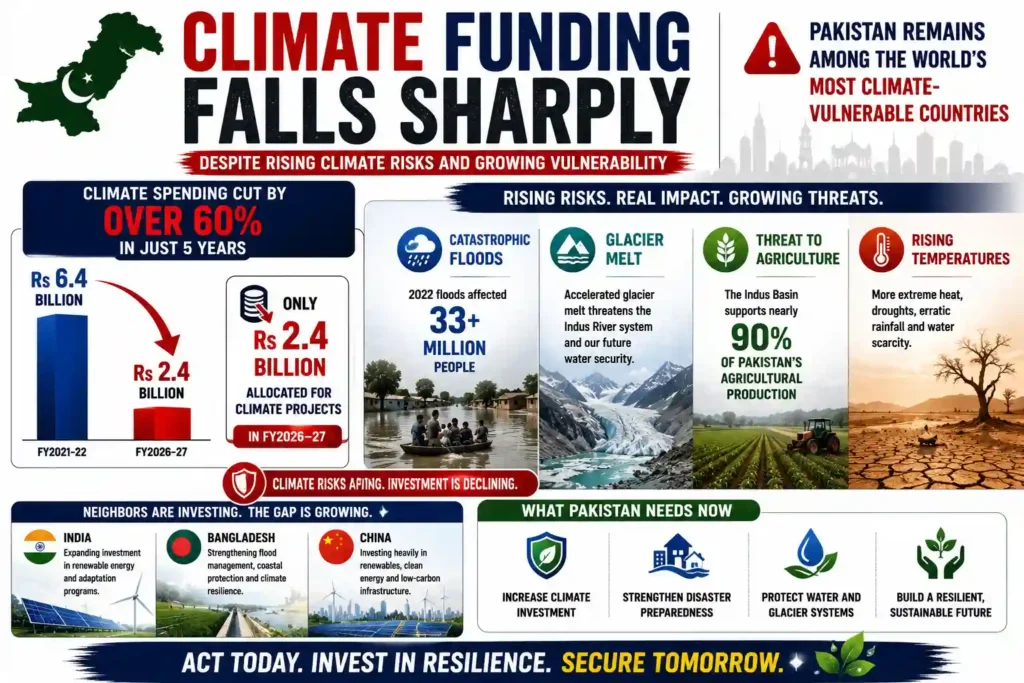
The latest allocation represents a decline of more than 60 percent compared with approximately Rs 6.4 billion allocated for climate-related projects five years ago.
The reduction has raised concerns among climate experts and researchers given Pakistan’s high exposure to extreme weather events and environmental risks.
Regional peers, including India, Bangladesh, and China, have continued to expand climate investments, creating an increasing gap in climate financing priorities across South Asia.
The decline also comes as international organizations continue to identify Pakistan as one of the countries most exposed to climate impacts.
One of the World’s Most Vulnerable Countries
Several international assessments consistently rank Pakistan among the countries most vulnerable to climate change.
The Climate Risk Index published by Germanwatch has repeatedly identified Pakistan among the nations most severely affected by climate-related disasters.
The World Bank’s Climate Change Knowledge Portal highlights several major climate risks facing the country, including:
- Rising temperatures
- Changing rainfall patterns
- Water scarcity
- Extreme heat events
- Flooding
- Droughts
- Glacier melt
According to the World Bank, temperatures in Pakistan are expected to rise significantly during this century, increasing health risks, reducing labor productivity, and placing additional stress on energy and water systems.
Growing Water and Glacier Risks
Pakistan faces mounting risks associated with glacier melt in the Hindu Kush-Karakoram-Himalayan region.
Accelerated melting threatens the long-term stability of the Indus River system, which serves as the country’s primary water source and supports agriculture, industry, and urban populations.
The United Nations Development Programme has warned that glacier retreat increases the risk of glacial lake outburst floods while also creating long-term concerns over water availability.
The Indus Basin remains critical to Pakistan’s economy, supporting nearly 90% of agriculture.
Any disruptions to water availability or river flows could therefore have significant economic and social consequences.
Context is everything. Stay ahead of shifting trends with today’s market updates, and uncover emerging opportunities using the Serrari Group Market Index and Marketplace. Then, take control of your own financial future by exploring our Money & Life Reset Transformation Blueprint ™ to build stronger habits, create better systems, and design a path toward lasting wealth.
Agriculture and Food Security Challenges
Climate change is already affecting Pakistan’s agricultural sector.
Researchers from the Pakistan Institute of Development Economics have highlighted the growing impacts of:
- Floods
- Droughts
- Erratic rainfall
- Rising temperatures
- Water shortages
These changes are affecting crop productivity, food security, and rural livelihoods across the country.
Since agriculture remains a major contributor to employment and economic activity, climate-related disruptions can have nationwide impacts on income, food prices, and economic stability.
Lessons From the 2022 Floods
Pakistan experienced one of its worst climate disasters in 2022, when catastrophic flooding affected more than 33 million people.
The floods caused widespread destruction of homes, infrastructure, agricultural land, and public services while resulting in billions of dollars in economic losses.
The disaster drew international attention to Pakistan’s vulnerability to climate change and prompted calls for increased adaptation and resilience investments.
Despite these experiences, the latest budget allocations indicate a reduction in climate-related development spending.
Regional Investment Trends
While Pakistan’s climate spending has declined, several neighboring countries continue expanding investments in resilience and adaptation.
India has increased investments in renewable energy and climate adaptation programs.
Bangladesh continues to strengthen flood management, coastal protection, and climate resilience initiatives.
China has also expanded investments in renewable energy, low-carbon infrastructure, and climate mitigation programs.
These trends highlight growing differences in climate investment priorities across the region.
Outlook
Pakistan’s reduced climate spending comes at a time when climate risks continue to intensify. Rising temperatures, glacier melt, water stress, and extreme weather events are expected to increase pressure on agriculture, infrastructure, energy systems, and public health.
With the country remaining highly exposed to climate impacts, experts argue that greater investment in adaptation, resilience, and disaster preparedness may become increasingly important to reduce future economic and social costs. As neighboring countries continue expanding climate investments, Pakistan faces growing pressure to strengthen its long-term climate response strategy.
FAQs
1. Why did Pakistan reduce its climate spending?
Pakistan allocated only Rs 2.4 billion for climate-related projects in FY2026-27, down by more than 60% compared to previous years. The government has not provided detailed reasons for the reduction, but the lower allocation comes despite increasing climate risks.
2. Why is Pakistan considered highly vulnerable to climate change?
Pakistan faces several climate threats, including floods, rising temperatures, glacier melting, droughts, and water shortages. The country is frequently ranked among the world’s most climate-vulnerable nations because extreme weather events have severe impacts on people, agriculture, and infrastructure.
3. How does climate change affect Pakistan’s agriculture and water supply?
Pakistan relies heavily on the Indus River system, which supports nearly 90% of the country’s agricultural production. Glacier melt, changing rainfall patterns, and water shortages can reduce crop yields, threaten food security, and affect millions of farmers and communities.
4. How are neighboring countries responding to climate change?
Countries such as India, Bangladesh, and China have increased investments in renewable energy, climate adaptation, disaster preparedness, and resilience projects. These investments aim to reduce climate risks and strengthen long-term economic and environmental sustainability.
Sources: Social News XYZ, tennews.in, Energy Magazines, The News Pakistan, NewKerala
Your financial future isn’t something you wait for—it’s something you build.
The real question is: when do you begin?
Move beyond simply staying informed.
Navigate the markets with clarity—track trends through the Serrari Group Market Index, uncover opportunities in the Serrari Marketplace, and build practical knowledge with our Curated Wealth Builder Platform.
Stay connected to what truly matters.
Get daily insights on macro trends and financial movements across Kenya, Africa, and global markets—delivered through the Serrari Newsletter.
Growth opens doors.
Advance your career through professional programs including ACCA, HESI A2, ATI TEAS 7 , HESI EXIT , NCLEX – RN and NCLEX – PN, Financial Literacy!🌟—designed to move you forward with confidence.
See where money is flowing—clearly and in real time.
Track Money Market Funds, Treasury Bills, Treasury Bonds, Green Bonds, and Fixed Deposits, alongside global and African indexes, key economic indicators, and the evolving Crypto and stablecoin landscape—all within Serrari’s Market Index.