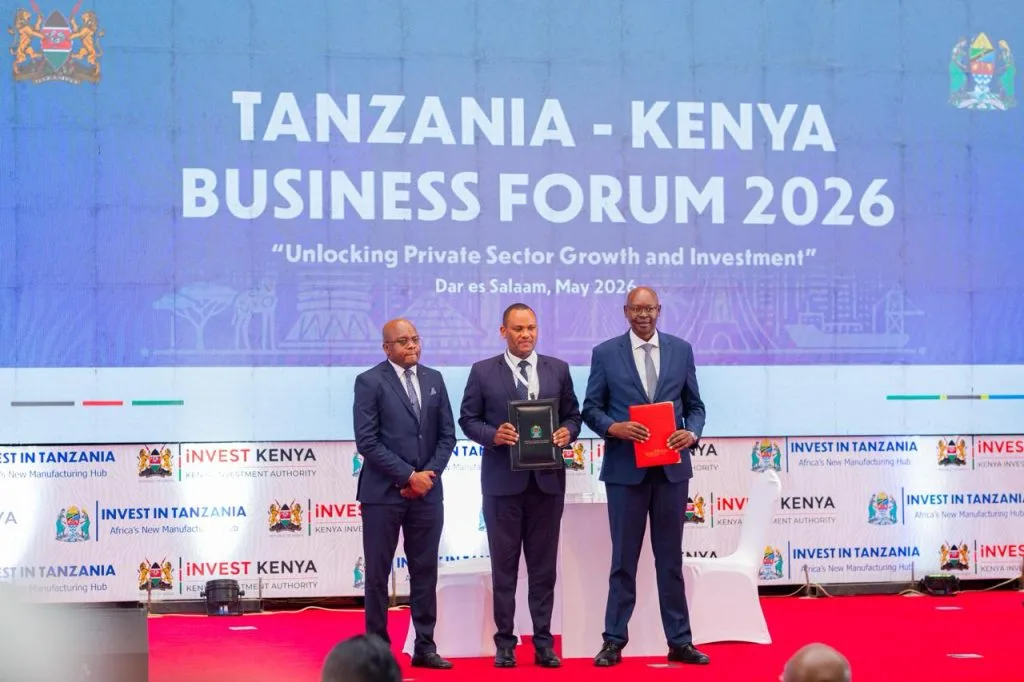
The Kenya National Chamber of Commerce and Industry (KNCCI), the Tanzania National Chamber of Commerce (TNCC), and the Zanzibar National Chamber of Commerce (ZNCC) signed a tripartite Memorandum of Understanding at the Kenya–Tanzania Business Forum 2026 in Dar es Salaam. The agreement, witnessed by Kenyan President William Ruto and Tanzanian President Samia Suluhu Hassan, creates a structured framework for trilateral trade promotion, joint business missions, SME development, and regional value chain integration. The MoU was signed alongside eight bilateral government agreements covering energy, railways, agriculture, and standards harmonisation, as both nations set a June 30 deadline to eliminate all remaining non-tariff barriers.
Markets move fast; don’t get left behind. We’ve paired the Serrari Group Market Index with a curated Marketplace and a comprehensive Wealth Builder Platform to ensure you have the data—and the skills—to act on it.
Key Takeaways
- Signatories: KNCCI, Tanzania National Chamber of Commerce (TNCC), and Zanzibar National Chamber of Commerce (ZNCC).
- Occasion: The Kenya–Tanzania Business Forum 2026 held at the Julius Nyerere International Conference Centre, Dar es Salaam, on May 4–5.
- Scope: Trilateral trade promotion, joint trade missions, market intelligence exchange, SME linkages, regional value chains, and capacity building.
- Governance: A Joint Coordination Committee will oversee implementation.
- Bilateral Trade: Kenya-Tanzania trade reached $860.3 million in 2025, accounting for nearly 40% of all intra-EAC commerce.
- NTB Deadline: Both governments have set June 30, 2026 to eliminate all remaining non-tariff barriers.
- Government MoUs: Eight bilateral agreements signed covering energy, railways, agriculture, standards, maritime cooperation, and more.
- Investment Target: A joint target of KSh195 billion ($1.5 billion) in new trade and cross-border investments.
The Private Sector’s Turn at the Table
When Presidents William Ruto and Samia Suluhu Hassan convened more than 300 business leaders at the Julius Nyerere International Conference Centre in Dar es Salaam on May 4, the centrepiece of their state-level agenda was clear: dismantle the obstacles that have kept East Africa’s two largest economies from realising the full potential of their trade relationship. The two-day forum produced eight intergovernmental Memoranda of Understanding spanning energy, railways, agriculture, and standards harmonisation. But alongside the government-to-government deals, it was a private-sector agreement that may prove equally consequential.
The tripartite MoU between KNCCI, TNCC, and ZNCC establishes a structured framework for enhanced trade, investment, and private sector collaboration across Kenya, Mainland Tanzania, and Zanzibar. Its core objective is to deepen economic integration by building stronger commercial linkages between businesses in the three markets — moving beyond the political declarations that have characterised past East African summits and into the operational architecture needed to make those declarations stick.
“We fully support the establishment of a Tanzania–Kenya joint business council as the central platform for structured collaboration. Through sector-specific working groups we will ensure continuous engagement and translate private sector priorities into investment partnerships,” said President Ruto.
What the MoU Covers
The agreement spans several dimensions of cross-border commerce. At its core are provisions for the promotion of trilateral trade and investment, facilitation of joint trade missions and business forums, and the exchange of market intelligence and policy information. The three chambers also committed to supporting joint ventures, strengthening SME linkages, and developing regional value chains, with particular emphasis on sectors with high cross-border potential.
Capacity building forms a significant pillar of the agreement. The MoU provides for training programmes, institutional strengthening initiatives, and coordinated business delegations aimed at unlocking new market opportunities for member businesses. A Joint Coordination Committee will be established to oversee implementation, monitor progress, and ensure that agreed initiatives translate into measurable outcomes.
The inclusion of Zanzibar as a distinct signatory is noteworthy. While Zanzibar is constitutionally part of Tanzania, it maintains its own chamber of commerce and has historically operated as a semi-autonomous economic zone with its own investment promotion framework. Treating it as a separate party in the MoU acknowledges Zanzibar’s distinct business environment and its growing role as a gateway for trade and tourism in the Indian Ocean region.
The Bilateral Context: $860 Million in Trade and an Ambitious Deadline
The chamber-level MoU lands in the middle of the most significant reset of Kenya-Tanzania economic relations in years. According to data cited by President Ruto at the forum, bilateral trade between Kenya and Tanzania reached $860.3 million in 2025, making the pair the strongest trading partnership within the eight-member East African Community. The two countries together account for roughly 40% of all intra-EAC trade.
Yet the number could be substantially higher. Bilateral trade actually fell from $950 million in 2024 to $860.3 million in 2025 — a decline attributed largely to non-tariff barriers that have frustrated cross-border commerce for years. President Ruto was direct about the cause, noting that the two countries should have already crossed the $1 billion mark.
“We lost a bit of trade, close to US$100 million between 2024 and 2025, because of non-tariff barriers,” he said.
The barriers are well documented. Traders moving goods between Nairobi and Dar es Salaam have contended with a persistent catalogue of frictions: duplicate product testing by the Kenya Bureau of Standards (KEBS) and Tanzania Bureau of Standards (TBS), delays at weighbridges, roadblocks, inconsistent regulatory standards, excessive administrative fees, and ad hoc levies that add unpredictable costs to shipments. Dairy, maize, eggs, steel, and confectionery have been among the most affected goods, with trucks frequently detained at border points.
Both presidents set a June 30, 2026, deadline to eliminate all remaining non-tariff barriers — a timeline aligned with a directive from the 25th EAC Summit. A joint technical mechanism will track progress and prevent new barriers from emerging. One of the eight government MoUs directly addresses this by creating a joint technical committee to harmonise testing and certification between KEBS and Shirika la Viwango Tanzania. In practical terms, this means a product cleared in Dar es Salaam should no longer face repeat inspection at the Namanga or Holili border crossings.
TNCC President Vincent Bruno Minja was blunt about the status quo at the forum. He criticised regulatory inefficiencies including double testing of goods and called for the free movement of investors, traders, and goods across the region.
Context is everything. While you follow today’s updates, use the Serrari Group Market Index and Marketplace to spot emerging shifts. Need to sharpen your edge? Our Wealth Builder Platform turns these insights into a professional-grade strategy.
Eight Government MoUs: From Railways to Gas Pipelines
The tripartite chamber MoU was signed alongside a package of eight bilateral agreements that collectively represent the broadest expansion of Kenya-Tanzania cooperation in recent years. The agreements cover energy, legal cooperation, agriculture, railway development, public service capacity building, maritime cooperation, certification standards for seafarers, and harmonisation of standards.
Two stand out for their potential to reshape the economic geography of East Africa.
The first is a railway MoU committing both countries to revive the Voi-Mwatate-Taveta line, linking Kenya’s Standard Gauge Railway to northern Tanzania and significantly cutting freight time to Moshi and Arusha. President Ruto confirmed that construction on the 127-kilometre metre-gauge line commenced in April 2026, with completion expected by April 2027. Both leaders also agreed to jointly develop an SGR line running from Tanga through Kilimanjaro to Taveta, with a planned extension to Singida — a corridor that could eventually connect Mombasa to Burundi through a continuous rail route.
The second is an energy MoU covering enhanced cross-border electricity trade and a feasibility study for a natural gas pipeline from Dar es Salaam to Mombasa. The electricity agreement would allow the two countries to share surplus power during peak demand, improving grid stability on both sides.
Additionally, over 20 commercial agreements valued at approximately $500 million were finalised between private sector entities at the forum, spanning tourism, agriculture, and manufacturing.
What It Means for SMEs and the Wider Business Community
For the thousands of small and medium enterprises that constitute the backbone of both economies, the chamber-level MoU offers a potentially meaningful shift. Cross-border trade in East Africa has long been dominated by a small number of large firms with the resources to navigate complex regulatory environments, maintain relationships with customs officials, and absorb the costs of delays and compliance. Smaller businesses, particularly those operating near border areas or in sectors like agriculture, light manufacturing, and services, have often been priced out.
The MoU’s provisions for SME linkages, coordinated business delegations, and joint trade missions aim to lower these barriers to entry. By pooling market intelligence across three chambers and creating structured platforms for matchmaking, the agreement can help smaller firms identify partners, understand regulatory requirements, and access markets they might not reach on their own.
This is consistent with the broader policy direction across the EAC. The bloc has been developing an e-commerce Buyer-Seller Platform designed to bring visibility to products made in the region and connect manufacturers, SMEs, and wholesalers with buyers across borders. The platform, currently under development, represents the digital complement to the kind of physical networking and trade mission infrastructure the KNCCI-TNCC-ZNCC MoU aims to strengthen.
At the continental level, the African Continental Free Trade Area (AfCFTA) has emphasised the critical role of MSMEs, which account for an estimated 80% of employment across Africa. Deliberate interventions — including simplified trade regimes, digital tools, and groupage models that consolidate smaller shipments for export — have been identified as essential for ensuring smaller firms benefit from the integrated continental market.
The KNCCI-TNCC-ZNCC agreement positions the three chambers to serve as delivery vehicles for these broader integration objectives at the practical, enterprise level.
The Bigger Picture: A 120-Million-Person Market
Tanzania’s Minister of State for Planning and Investment, Professor Kitila Mkumbo, placed the partnership in a broader economic context at the forum. He noted that Kenya and Tanzania represent a combined market of 120 million people and a GDP between $200 billion and $230 billion. He highlighted that Tanzania has 44 million acres of arable land, of which only 33% is currently under cultivation, and argued for leveraging comparative advantages — positioning Tanzania as a production hub and Kenya as a leader in agro-processing, fintech, and renewable energy.
Both leaders framed their relationship as complementary rather than competitive. President Samia emphasised that Tanzania’s strength in agriculture complements Kenya’s strength in manufacturing, and that the private sector is expected to drive 70% of the implementation of Tanzania’s national development vision. President Ruto called for the harmonisation of telecommunications, suggesting that calls between the two countries should be treated as local rather than international to reflect the depth of integration.
Kenyan investments in Tanzania already exceed $1.7 billion across financial services, manufacturing, telecommunications, and retail. Foreign direct investment from Kenya into Tanzania between 2020 and 2024 totalled $297 million across 109 projects, spanning banking, manufacturing, and telecommunications — making Kenya one of Tanzania’s top intra-EAC investors.
The leaders also set a joint target of KSh195 billion ($1.5 billion) in new trade and cross-border investment, including KSh130 billion in trade and KSh65 billion in direct investment. Achieving this will require the very kind of structured private-sector engagement that the tripartite MoU is designed to facilitate.
The EAC Context: Intra-Regional Trade Still Punching Below Its Weight
The Kenya-Tanzania push comes against a backdrop of renewed momentum — and persistent frustration — across the broader East African Community. EAC data cited by President Ruto showed that total regional trade grew 25% in 2025 to $156.6 billion, with intra-EAC trade growing even faster at 28% to reach $19.3 billion. Yet intra-regional trade still accounts for only about 15% of the bloc’s total commerce — a figure that underscores how much of East African trade continues to flow to external markets in Europe, Asia, and the Middle East.
The EAC has set an ambitious target of 40% intra-bloc trade by 2030, a goal that appears remote without decisive action on standards harmonisation, border efficiency, and administrative friction. The June 30, 2026, deadline for eliminating non-tariff barriers between Kenya and Tanzania — if met — could provide a template for the wider community.
The institutional framework for deeper integration exists. The EAC Customs Union and Common Market protocols have reduced formal tariff barriers, while One Stop Border Posts have improved customs processing at several crossings. But the gap between policy and practice remains wide. At the 42nd meeting of the EAC Sectoral Council of Ministers on Trade in June 2023, partner states reported resolving 10 non-tariff barriers while four new ones simultaneously emerged — illustrating how regulatory frictions can re-form even when political will to clear them exists.
The chamber-level MoU adds a new layer of accountability. By creating a Joint Coordination Committee with a mandate to translate commitments into outcomes, KNCCI, TNCC, and ZNCC are effectively establishing a parallel monitoring mechanism driven by the private sector — the constituency most directly affected by implementation failures.
From Declarations to Delivery
East African economic summits have a long history of producing ambitious communiqués that outpace follow-through. The Kenya-Tanzania Business Forum 2026 was notable for the specificity of its commitments: a binding deadline for NTB elimination, named railway projects with construction timelines, and a structured chamber-level framework with a dedicated coordination body.
Whether the tripartite MoU delivers depends on several factors: the political will to sustain momentum beyond the summit, the capacity of the three chambers to coordinate across jurisdictions, and the willingness of member governments to act on recommendations from their private sectors. The Joint Coordination Committee’s effectiveness will be tested in its first year as it attempts to move from framework agreements to tangible programmes that benefit businesses on the ground.
For the business communities of Kenya, Tanzania, and Zanzibar, the MoU represents an institutional bet — that structured collaboration between chambers of commerce can accelerate the kind of cross-border integration that governments alone have struggled to deliver. If it works, it could serve as a model for private-sector-led economic cooperation across the broader EAC and the continent.
Your financial future isn’t something you wait for—it’s something you build.
The real question is: when do you begin?
Move beyond simply staying informed.
Navigate the markets with clarity—track trends through the Serrari Group Market Index, uncover opportunities in the Serrari Marketplace, and build practical knowledge with our Curated Wealth Builder Platform.
Stay connected to what truly matters.
Get daily insights on macro trends and financial movements across Kenya, Africa, and global markets—delivered through the Serrari Newsletter.
Growth opens doors.
Advance your career through professional programs including ACCA, HESI A2, ATI TEAS 7 , HESI EXIT , NCLEX – RN and NCLEX – PN, Financial Literacy!🌟—designed to move you forward with confidence.
See where money is flowing—clearly and in real time.
Track Money Market Funds, Treasury Bills, Treasury Bonds, Green Bonds, and Fixed Deposits, alongside global and African indexes, key economic indicators, and the evolving Crypto and stablecoin landscape—all within Serrari’s Market Index.