
18 November 2026
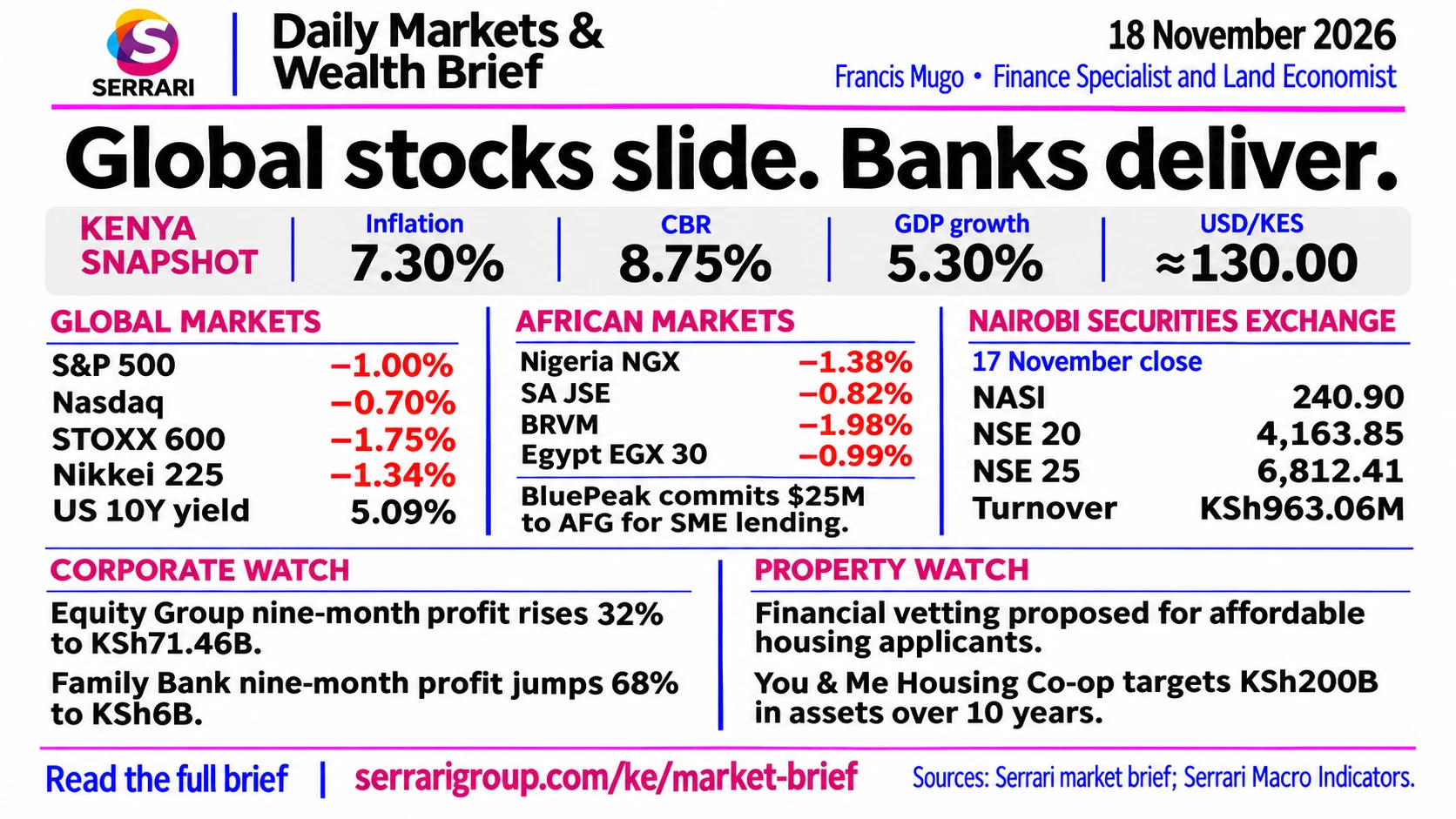
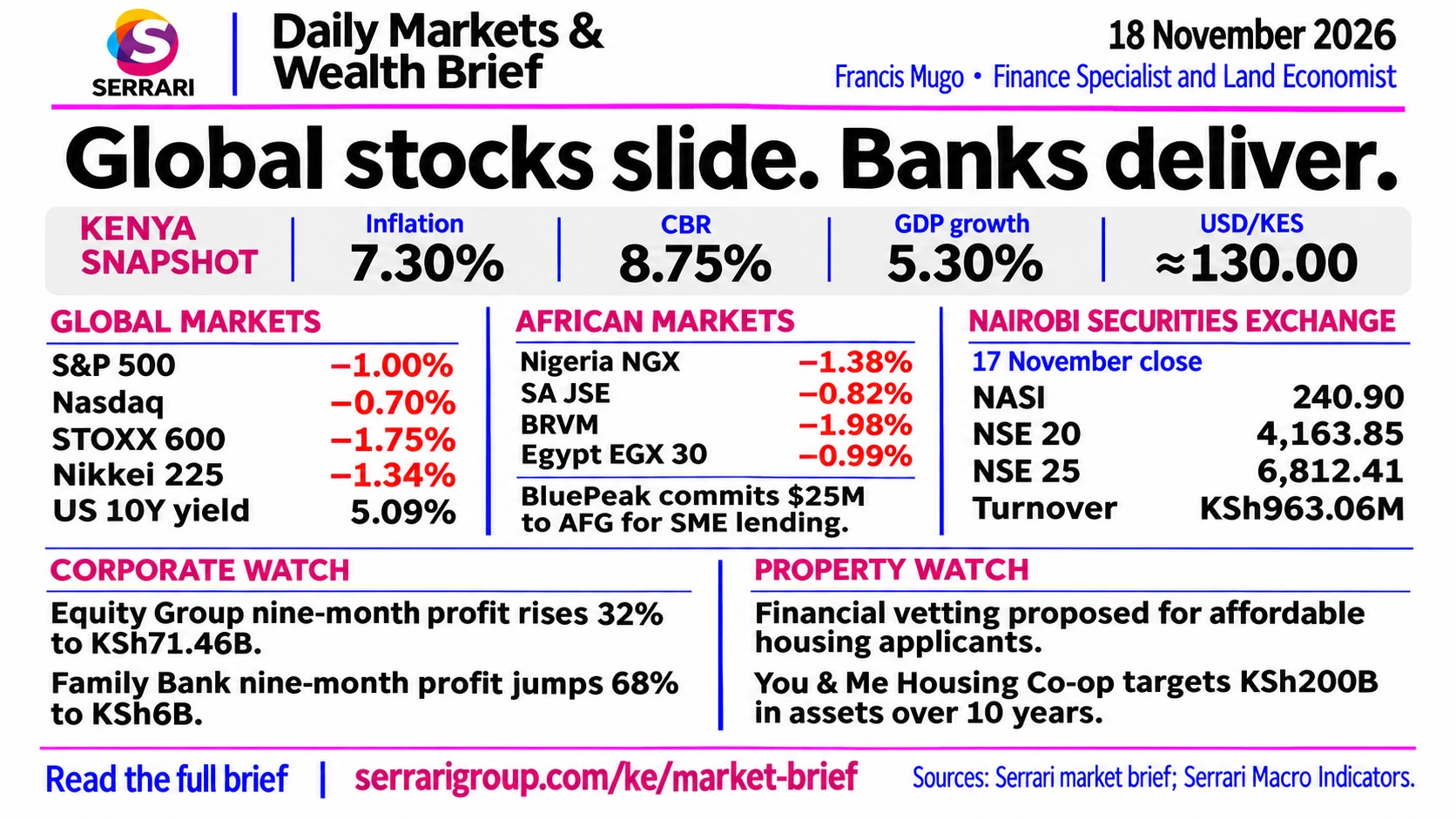
Global stocks slid on 17 November as an AI and chip sell-off sent the S&P 500 down 1.0% and the STOXX 600 down 1.75%, its sharpest drop in eight months. In Nairobi, Equity Group posted a record KSh 71.46 billion nine-month profit and Family Bank a 68% jump to KSh 6 billion.
Global Markets
Figures as at · Market data for Tuesday 17 November 2026, as reported in this brief
International markets faced severe tech and semiconductor pressure from a continuing AI sell-off, shifting corporate leadership and broader macroeconomic jitters.
- United States: Stock indexes fell across the board, dragged by volatility in AI stocks and heavy losses in the financial sector.
- Europe: European markets suffered their sharpest single-day drop in eight months as a broad technology sell-off dragged major benchmarks into the red.
- Asia: Asian equities broadly declined on a global tech sell-off after tighter US AI chip export restrictions and leadership turmoil at Nvidia, as well as sluggish Chinese data and hawkish central bank signals.
- Africa: African stock markets largely retreated on a surging dollar, global tech jitters and heavy local sell-offs in major bellwethers, as central banks signalled a prolonged period of tight policy and several major corporate and private equity deals closed.
Global forex: the dollar near 19-month highs
- Overview: Foreign exchange was dominated by dollar consolidation near 19-month highs as traders balanced hawkish Fed expectations against retreating Treasury yields and technical support levels; safe-haven demand amid equity volatility kept the greenback supported.
- Dollar Index (DXY): Hovered near fresh 2026 highs around 103.50, supported by a roughly 95% market probability of a 25-basis-point Fed hike in December, though momentum slowed as two-year yields pulled back slightly.
- EUR/USD: The euro briefly dipped below 1.1000 — the ECB set its reference rate at 1.0989 — before rebounding above 1.1000 as sellers failed to sustain the breakdown.
- USD/JPY: Repeatedly tested 160.00 before slipping toward 159.51; verbal intervention warnings from Tokyo and risk-off sentiment kept it capped below 160.
- GBP/USD: Sterling tested pivotal yearly support near 1.3200 as UK data showed an unexpected drop in unemployment alongside moderating wage growth, ahead of inflation figures.
- Commodity currencies: The Canadian, Australian and New Zealand dollars weakened in early trading. USD/CAD stayed near 19-month highs around 1.4200 after Canadian inflation of 3.1% year on year, while AUD/USD showed intraday indecision.
Forex drivers
- Fed rate pricing: Hotter-than-expected US inflation reinforced expectations of further Fed tightening next month, locking in strong support for the dollar.
- Risk aversion: Equity declines across Asia, Europe and the US, driven by tech and AI jitters ahead of Nvidia’s results, fuelled safe-haven flows into the dollar and capped yen losses.
- Asian economic and energy pressures: Contraction in Japan’s annualised GDP and sluggish industrial production in Japan and China highlighted continuing energy cost pressure on regional currencies.
United States
Figures as at · Market data for 17 November 2026, as reported in this brief
All four benchmark indexes finished in negative territory, extending their weekly declines.
- AI and tech volatility: Nvidia remained the focal point, sliding in regular trading as investors questioned the payoff of massive AI investment, then rebounding 4.8% in extended trading after better-than-expected sales forecasts in its first earnings release since Jensen Huang’s departure.
- Sector pressure: Financial stocks weighed heavily, contributing significantly to the Dow’s 848-point drop. Salesforce plunged 9% amid broader enterprise software valuation resets.
- Treasury rally: Investors rotated into safer assets, pushing bond prices higher; the 10-year Treasury yield eased to 5.09%.
- Commodities and currencies: Crude rose during Tuesday’s session, while the dollar held near a 19-month high on data supporting the case for higher rates.
- Retail earnings: According to LSEG Lipper Alpha, 78% of companies in the US Retail/Restaurant Index have reported Q3 2026 earnings, with 69% beating profit estimates and blended earnings growth tracking at 8.1%.
- Volatility Index (VIX): Rose for the fourth straight day, jumping up to 21% to reach 27.73.
US benchmark indexes, 17 November 2026
| Index | Close | Daily change | Weekly change | Year to date |
|---|---|---|---|---|
| S&P 500 | 7,340.53 | -76.06 (-1.0%) | -2.9% | +7.2% |
| Dow Jones | 50,759.42 | -848.75 (-1.6%) | -3.0% | +5.6% |
| Nasdaq Composite | 24,328.38 | -181.37 (-0.7%) | -3.2% | +4.7% |
| Russell 2000 | 2,701.87 | -41.07 (-1.5%) | -3.2% | +8.9% |
Europe
Figures as at · Market data for 17 November 2026, as reported in this brief
All major European bourses ended the session significantly lower.
European indices, 17 November 2026
| Index | Region | Closing level | Daily change |
|---|---|---|---|
| STOXX Europe 600 | Pan-European | 650.72 | -1.75% (-1.8%) |
| DAX | Germany | 26,045.37 | -2.1% (-1.97%) |
| FTSE 100 | United Kingdom | 10,689.87 | -1.8% |
| CAC 40 | France | 8,216.78 | -1.6% (-1.62%) |
| AEX | Netherlands | — | -2.14% |
Outlook and macro pressures
- European economy: The European Union slightly lifted its growth outlook despite persistent headwinds; the Commission’s Autumn 2026 Economic Forecast projects steady EU real GDP growth of 1.4% for 2026 alongside persistent inflation pressure.
- Inflation and energy: Euro zone inflation hovered around 4% in October. Energy flows through the Strait of Hormuz remained severely disrupted, pushing up freight and insurance costs and tightening gas markets and refining.
- Central banks: Markets remained confident in the ECB’s price stability approach after previous rate hikes, while the Swiss National Bank previously held its policy rate at 0.00%, with Swiss inflation projected to average 0.7% in 2026.
Key market drivers
- US AI chip curbs and Nvidia earnings: Sentiment soured after the US Commerce Department tightened export restrictions to block Chinese access to advanced AI chips via third-country data centres in Southeast Asia; investors also pared tech exposure ahead of Nvidia’s results.
- Tech sell-off: European technology stocks tumbled 3.9%. ASML shed 5.3% and SAP dropped 5.6% after the resignation of Chief Customer Officer Thomas Saueressig.
- German sentiment: The ZEW economic expectations index rose more than expected, to 35.6 in November from 28.1 in September.
- Energy and currencies: Brent rose 0.8% to $93.13 a barrel on Middle East supply disruption, offering rare support to energy stocks, while a surging dollar pushed the euro down to $1.0992.
Asia
Figures as at · Market data for 17 November 2026, as reported in this brief
The outlook was defined by a sharp divergence between resilient AI hardware exports and acute geopolitical, monetary and domestic demand pressures. Most benchmarks closed in the red, tracking Wall Street, with India a rare gainer.
- US AI chip curbs: Washington tightened remote cloud access and licensing rules for advanced chips across ASEAN nations, sparking a tech sell-off.
- Nvidia: Caution lingered ahead of earnings after Jensen Huang’s resignation and a newly formed security oversight board.
- China’s slowdown: October retail sales rose just 0.4% year on year while fixed-asset investment contracted 8.1%, alongside central bank liquidity draining.
- Central banks and currencies: The dollar topped 103.50 on firm Fed expectations, RBA minutes pointed to a divided board, and the NZD hit a six-year low.
- Diplomatic summits: Markets watched trade and policy talks at the ASEAN summit in Manila and the APEC CEO Summit in Shenzhen.
Asia-Pacific indices, 17 November 2026
| Market / index | Closing level | Daily change | Key drivers |
|---|---|---|---|
| South Korea (Kospi) | 4,968.48 | -2.6% | First close below 5,000 since February, led by Samsung (-3.1%) and SK Hynix (-1.8%) |
| Taiwan (Taiex) | — | -2.3% | Tech sell-off prompted exchange intervention pledges |
| Australia (S&P/ASX 200) | 8,883.20 | -1.8% | Pulled down by miners BHP and Rio Tinto |
| Thailand (SET Index) | 1,474.68 | -1.66% | Hit by new US semiconductor licensing rules for ASEAN data centres |
| Japan (Nikkei 225) | 58,860.43 | -1.34% | SoftBank (-3.9%) and Advantest (-4.4%) paced declines; TOPIX dropped 1.57% |
| Hong Kong (Hang Seng) | 23,539.97 | -0.9% | Slumped after overnight drops in US-listed Chinese stocks |
| China (Shanghai Composite) | 3,580.70 | -0.6% | Hindered by soft domestic data and PBoC liquidity withdrawal |
| India (Sensex) | — | +0.4% | Bucked the regional trend to finish slightly higher |
Commodities
Figures as at · Prices for 17 November 2026, as reported in this brief
Commodities traded mixed in choppy sessions as renewed geopolitical tension in the Middle East and the Black Sea offset a strong dollar and Fed hike expectations. Crude and wheat rebounded from Monday’s losses, while gold, industrial metals and livestock moved lower.
Commodity settlements, 17 November 2026
| Commodity | Settlement / level | Daily change |
|---|---|---|
| WTI crude (Dec) | $86.01 / bbl | +$0.29 (~+0.34%) |
| Brent crude | ~$92.54 – $93.00 / bbl | Edged up |
| Natural gas (front month) | ~$3.208 / MMBtu | +2.79% |
| Gold (Dec COMEX) | $3,851.90 / oz | -$12.00 |
| Silver | $47.29 / oz | +1.07% |
| Copper (LME 3-month) | $13,201.50 / t | -0.4% |
| Chicago wheat (Dec) | $5.95¼ / bu | +8¼¢ |
| Kansas City wheat | $6.33 / bu | +14¢ |
| Corn (Dec) | $4.46¾ / bu | -2¢ |
| Soybeans (Jan) | $12.25½ / bu | -3½¢ |
| Live cattle (Dec) | $218.77 / cwt | -$1.55 |
| Lean hogs (Dec) | $53.10 / cwt | -$2.25 |
Energy
- Crude and gas: December WTI rose $0.29 (roughly 0.34%) to settle at $86.01 a barrel, Brent edged up to settle near $92.54 to $93.00, and front-month natural gas gained 2.79% to about $3.208 per MMBtu.
- Drivers: Rigzone reported fresh vessel attacks near the Strait of Hormuz and Iranian strikes targeting Bahrain, overshadowing surging October Saudi output and IEA surplus projections.
Precious and industrial metals
- Gold and silver: With the dollar near 20-month highs, December COMEX gold dipped $12.00 to $3,851.90 an ounce after falling below $3,800 intraday for the first time since September 2025. Silver recovered 1.07% to $47.29.
- Copper: LME three-month copper fell 0.4% to $13,201.50 a tonne, its lowest since 1 July; MINING.COM said the AI equity sell-off weighed on the data-centre demand outlook as traders priced a near-certain December Fed hike.
Agriculture and livestock
- Grains: December Chicago wheat jumped 8¼ cents to $5.95¼ a bushel and Kansas City wheat surged 14 cents to $6.33. December corn slipped 2 cents to $4.46¾ and January soybeans fell 3½ cents to $12.25½.
- Livestock: December live cattle dropped $1.55 to $218.77 per cwt and December lean hogs fell $2.25 to $53.10.
- Drivers: Successful Farming noted that Ukrainian strikes on a bridge linking southern Russia and Crimea sparked short-covering in wheat ahead of President Trump’s APEC meeting with President Xi Jinping.
Africa
Figures as at · Market data for 17 November 2026, as reported in this brief
Equities and regional exchanges
- Nigeria (NGX): The All-Share Index fell 1.38% to 249,318.65, wiping roughly ₦2.27 trillion off market capitalisation, driven by a near-10% drop in Dangote Cement (down 9.99% to ₦1,323) and a 4.16% decline in NGX Group.
- South Africa (JSE): The FTSE/JSE All Share declined 0.82% to 110,616 (Top 40 -0.85%) as losses in resources and tech — Sasol, BHP, Anglo American and Prosus — outweighed gains in FirstRand and Standard Bank. Telkom reported a 10.8% rise in profit and a nearly 38% jump in free cash flow amid early-stage takeover talks with MTN.
- West Africa (BRVM): Broad selling pushed the BRVM Composite down 1.98% to 502.68, with Bank of Africa Niger (-7.42%), Africa Global Logistics Côte d’Ivoire (-7.19%) and Orange Côte d’Ivoire (-2.59%) the key drags.
- North Africa: Egypt’s EGX30 dropped 0.99% to 51,681.62, weighed by a 19.67% plunge in Creast Mark Contracting. Morocco’s MASI closed nearly flat (-0.03% at 17,234.80), supported by a 10.75% rally in newly listed Jet Energy.
- Outperformers: Zimbabwe’s Victoria Falls exchange posted the steepest drop among major tracked indices, while modest gains were recorded in Tunisia, Mauritius, Botswana (+0.09%) and Tanzania (+0.08%).
Currencies and commodities
- Stronger dollar: Top African currencies faced significant headwinds as the dollar climbed to a 19-month high on expectations the Fed may extend its hiking cycle.
- Rand: Weakened toward R17/$, trading around 16.93–16.98, amid municipal coalition concerns and falling precious metal prices.
- Shilling and naira: The Kenyan shilling held relatively steady near 130.00 per dollar; the naira was mixed, rebounding at the official close despite intraday volatility.
- Commodities: Gold sank to a one-year low around $3,857/oz and platinum slipped to $1,449/oz, pressuring mining-heavy markets, while Brent traded near $92.56.
Monetary policy and debt markets
- Rates to stay high: According to Bloomberg, 11 of the 13 African central banks meeting before year-end (including South Africa, Ghana, Nigeria and Egypt) are expected to hold rates to defend currencies against Fed risk.
- Policy outliers: Angola’s central bank cut its key rate by 75 bps to 14% on Tuesday, its fourth consecutive cut, as inflation cooled. Kenya, conversely, is projected to hike as inflation nears its 7.5% upper target.
- Debt issuance: Nigeria’s Debt Management Office raised ₦1.4 trillion at its latest bond auction, and Citigroup projected African sovereign and corporate dollar-bond issuance in 2027 will surpass 2026’s record pace.
Corporate deals and macro developments
- Energy and M&A: A.P. Moller Capital completed its acquisition of Mainstream Renewable Power South Africa, gaining an 11.9 GW solar, wind and storage pipeline. Tony Elumelu increased his stake in Seplat Energy to 22.05%.
- Private equity and fintech: BluePeak Private Capital committed $25 million to Abidjan-based AFG Holding to expand SME lending across seven African countries. Strive Masiyiwa’s Cassava Technologies is in talks with US and Middle Eastern investors to fund GPU data-centre expansion.
- Trade and climate: Kenya, Nigeria, Ghana, Rwanda, South Africa and Egypt prepared to sign an AfCFTA-linked deal easing market entry for Nigerian tech firms; at COP31, three African nations agreed to explore coordinated carbon charges on international shipping.
Nairobi Securities Exchange
Figures as at · Nairobi Securities Exchange session data for 17 November 2026, as reported in this brief
NSE benchmark and sector indexes, 17 November 2026
| Index | Close | Point change | % change |
|---|---|---|---|
| NSE All Share Index (NASI) | 240.90 | -0.66 | -0.27% |
| NSE 10 Share Index | 2,665.95 | -6.06 | -0.23% |
| NSE 20 Share Index | 4,163.85 | -18.30 | -0.44% |
| NSE 25 Share Index | 6,812.41 | -16.78 | -0.25% |
| NSE Banking Sector Index | 283.96 | -0.70 | -0.25% |
| NSE Bonds Index | 1,169.61 | +0.23 | +0.02% |
Market highlights
- Extended trading hours: The NSE received Capital Markets Authority approval to extend daily trading across equities, fixed income and derivatives by one hour. From 4 January 2027 the market closes at 4:00 PM instead of 3:00 PM, its first major change in trading hours in nearly 19 years.
- Crypto regulation enforcement: After the one-year compliance window under the Virtual Asset Service Providers Act, the CBK and CMA issued a joint notice requiring all virtual asset providers to apply for licences or face fines of up to KSh 25 million.
Market activity and statistics
- Market capitalisation: KSh 4,072.88 billion.
- Volume and turnover: 60,268,897 shares traded for equity turnover of KSh 963,056,523.10 across 12,842 deals.
- Derivatives: Turnover of KSh 2,035,000.00 (2 contracts).
- Active counters: Safaricom led volume, followed by active trading in Absa Bank Kenya, Co-operative Bank, Equity Group and KCB Group.
Kenya Corporate News
Figures as at · As reported in this brief
Bank earnings
- Equity Group: Posted a record KSh 71.46 billion profit for the first nine months (+32%), with regional subsidiaries including the DRC accounting for nearly half of combined banking profits.
- Family Bank: Reported a 68% jump in nine-month profit to KSh 6 billion on stronger income, with assets reaching KSh 247 billion.
Corporate and business news
- Company strike-off notice: The Registrar of Companies listed 1,851 companies facing dissolution across four Kenya Gazette notices dated 13 November 2026; they have until mid-February 2027 to show cause via 254.ke.
- Digital marine cargo insurance: Importers and clearing agents urged suspension of full enforcement of mandatory digital marine cargo insurance; the Shippers Council of Eastern Africa submitted 20 operational and cost concerns to the IRA after KRA blocked consignments missing valid digital certificates.
- KPC share sale and SGR: Treasury CS John Mbadi addressed the extension of the Kenya Pipeline Company share sale deadline and discussions on the Standard Gauge Railway from Mombasa through Nairobi to Naivasha.
- Global minimum tax deadline: Multinationals faced a 17 November 2026 deadline to notify potential liability under Kenya’s 15% global minimum tax, which targets groups with annual consolidated revenue of at least KSh 110 billion (€750 million).
- Renewable energy expansion: EPRA announced plans to triple renewable capacity and double energy efficiency under Kenya’s climate and power demand strategy, presented at COP31 in Antalya, Türkiye.
County and public finance
- County pending bills: The Parliamentary Budget Office put county governments’ pending bills at KSh 172.5 billion as of June 2026; Nairobi City County holds the largest share at KSh 49.1 billion (and historically leads with KSh 86.9 billion owed overall).
- Treasury disbursements: Nairobi City County was the top recipient of Treasury allocations, receiving over KSh 123.1 billion across six financial years (2020/2021 to 2025/2026).
- Budget and debt: Kenya’s Sh 5.3 trillion budget continues to navigate heavy public debt, which peaked around Sh 13.1 trillion, with interest consuming roughly Sh 1.07 trillion in 2025/26.
Leadership appointments
- TSC: The Teachers Service Commission appointed Cheptumo Ayabei as Secretary and Chief Executive Officer.
- KNCHR: Dr. Mary Kimari was appointed Chief Executive of the Kenya National Commission on Human Rights.
Real Estate
Figures as at · As reported in this brief
Key developments include proposed vetting rules for affordable housing, a KSh 200 billion cooperative expansion target and a sharp shift in Nairobi land versus residential returns.
Policy and government initiatives
- Affordable housing financial vetting: The Parliamentary Budget Office proposed pre-allocation financial assessments for Boma Yangu applicants, reported by People Daily Digital, evaluating income, savings habits and existing debt to match buyers with units they can afford and prioritise cash or mortgage purchases.
- Infrastructure and housing spending: President William Ruto’s administration accelerated spending to KSh 218 billion over three months on roads and housing ahead of the 2027 elections, as reported by Business Daily Africa, including KSh 15 billion in new rural road contracts.
- Nairobi land reference overhaul: Lands CS Alice Wahome gazetted the conversion of Nairobi parcel numbers into new registration references effective 12 February 2027, according to People Daily Digital, affecting Westlands, Lavington, Karen, Lang’ata, Eastleigh, South C and the CBD.
- Unlicensed construction: Analysts on KTN News Kenya on 17 November highlighted regulatory gaps, warning that some developers still break ground without statutory approvals.
Financing and pricing
- You & Me Housing Co-operative: On 17 November the society announced, via Capital FM, a 10-year goal to grow its assets to KSh 200 billion, expanding from 7,500 to 500,000 members within five years to finance homes, rental units and schools alongside the National Housing Corporation.
- Q4 national asking benchmarks: Kenya Property Centre’s Q4 report puts the national median asking price at KSh 15.9 million for sales and KSh 132,200 a month for rentals. Kilimani apartments posted the highest gross rental yield at 11.1%, and average selling times stretched to 547 days.
Kenya Snapshot
Every figure below carries the date it describes and who published it. Where this brief did not restate a value, the figure Serrari already publishes is carried over with its own effective date — it is never re-dated to today. Most recent figure in this snapshot: .
Macro
Inflation
7.3%
Year-on-year headline CPI.
As at
KNBS CPI, Oct 2026 — carried over from Serrari's published macro dataGDP growth
5.3%
Real GDP, year-on-year. Not restated in this brief.
As at
KNBS quarterly GDP (owner, 2026-09-14), Q1 2026 — carried over from Serrari's published macro data
Foreign exchange
USD / KES
130.00
Held relatively steady near 130.00
As at
As reported in this brief (artwork ≈130.00)
Equities
NSE All-Share (NASI)
240.90
-0.27%
As at
Nairobi Securities Exchange, as reported in this briefNSE 20-Share
4,163.85
-0.44%
As at
Nairobi Securities Exchange, as reported in this briefNSE 25-Share
6,812.41
-0.25%
As at
Nairobi Securities Exchange, as reported in this briefNSE 10
2,665.95
-0.23%
As at
Nairobi Securities Exchange, as reported in this briefNSE Banking Index
283.96
-0.25%
As at
Nairobi Securities Exchange, as reported in this brief
Rates
Central Bank Rate
8.75%
As at
Central Bank of Kenya — Monetary Policy Committee, as published on this brief’s artwork
At a glance
- 1An AI and semiconductor sell-off hit every region: the Dow fell 848.75 points (-1.6%), the STOXX 600 had its sharpest one-day drop in eight months (-1.75%) and Korea’s Kospi closed below 5,000 for the first time since February — though Nvidia rebounded 4.8% after hours on better-than-expected guidance.
- 2Kenyan banks delivered: Equity Group posted a record KSh 71.46 billion nine-month profit (+32%) and Family Bank a 68% jump to KSh 6 billion, even as NASI slipped 0.27% to 240.90 on KSh 963.06 million turnover.
- 3The CMA approved a one-hour extension of NSE trading across equities, fixed income and derivatives: from 4 January 2027 the market closes at 4:00 PM, its first major change in trading hours in nearly 19 years.
Sources
- Serrari Group desk compilation, 18 November 2026; Markets Snapshot – 17 November 2026
- Central Bank of Kenya — indicative exchange rates
- Nairobi Securities Exchange — daily market statistics
- Serrari published Africa macro data