
2 October 2026
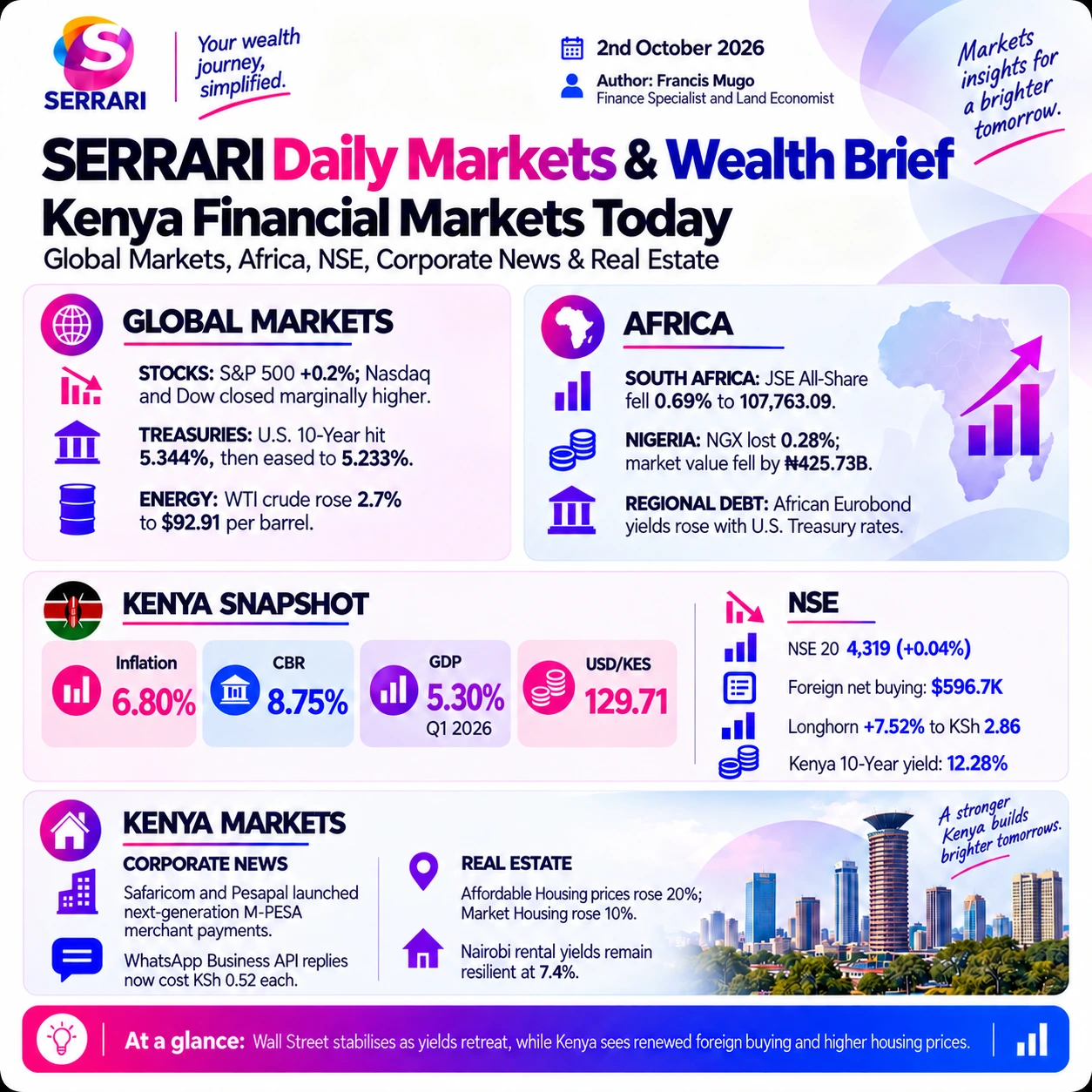
The US 10-year hit a 24-year high of 5.344% before dip-buyers forced it back to 5.233%, snapping Wall Street’s three-day slide while Europe fell to three-month lows. Foreign investors turned net buyers on the NSE for the first time since mid-September.

Global Markets
Figures as at · Closing levels for Thursday 1 October 2026, as reported in this brief
Wall Street staged a late-afternoon recovery to snap a three-day losing streak while European indices collapsed to three-month lows. The session was dictated by the fixed-income market, where a historic rout briefly pushed borrowing costs to extremes before dip-buyers stepped in.
Major global indices
| Index | Close | Change |
|---|---|---|
| S&P 500 | 7,666.45 | +0.2% — information technology led at +0.8% on semiconductor tailwinds |
| Nasdaq Composite | 26,871.60 | Up fractionally (under 0.1%) |
| Dow Jones Industrial Average | 50,926.56 | +20.51 (under 0.1%), lagging on defensive sector drag |
| FTSE 100 (UK) | — | -1.7% |
| CAC 40 (France) | — | -1.6% |
| DAX (Germany) | — | -1.0% |
What moved it
- The yield round trip: The US 10-year skyrocketed to a 24-year high of 5.344% in early trading, sparking equity panic, before cooling to 5.233% and triggering the late-afternoon rebound.
- Corporate catalysts: Micron Technology surged over 3% and Accenture jumped after both issued stronger-than-expected revenue guidance, evidence that structural AI infrastructure demand is holding.
- Policy recalibration: Federal Reserve Vice Chair Philip Jefferson said officials have time to evaluate further hikes. Fed funds futures cut the odds of an October hike to 26%, down from 37.6% a day earlier.
- Asia: Mostly higher on thinned holiday volume. Japan’s Nikkei 225 surged over 3% to 38,956 before Friday’s pullback, and Hong Kong’s Hang Seng added 0.3%.
Global forex
- Dollar index: Jumped to a daily high of 102.21 and closed at 102.04 — a 17-month high against the euro — on resilient output tracking near 4% for Q3, sticky inflation indicators and rising yields.
- EUR/USD: Dipped below $1.1250 to a low of 1.1221, pressured by dollar strength and growing concern over France’s widening fiscal deficits.
- USD/JPY: Hit a daily high of 158.45 before settling near 158.18. Tokyo core inflation posted its sharpest 10-month increase, but Fed–BoJ yield differentials continued to pummel the yen.
- GBP/USD: Shed roughly 0.56% to 1.3192 from a daily open of 1.3264, as a Ukrainian strike on a Russian oil hub and escalated rhetoric on Iran drove capital out of sterling.
- Pre-payrolls positioning: With headline PCE at 3.42% year on year, traders held a defensive pro-dollar stance ahead of Friday’s Non-Farm Payrolls.
Global Yields
Figures as at · Closing yields for 1 October 2026, as reported in this brief
Sovereign bond markets saw intense intraday volatility. An aggressive morning selloff driven by fiscal deficits and sticky inflation pushed borrowing costs to multi-decade peaks before an afternoon wave of bargain hunting reversed the move.
Sovereign movements
- United States: The 10-year hit a 24-year high of 5.34% early, then heavy dip-buying and short-covering stabilised it near 5.233%–5.26%. The 2-year led the late-day rally as rate-hike anxieties cooled.
- United Kingdom: The 30-year gilt crossed 6.00% for the first time since 1998, and the 10-year hovered near 5.40%. Long-duration debt bore the brunt of local fiscal anxiety.
- Europe: France’s 10-year closed in on 5.00%, peaking at 4.92% — its highest since 2002 — as markets reacted to the government’s budget presentation.
- Japan: JGB yields tracked upward with global peers, anchored near multi-decade highs.
What is driving it
- Higher for longer: Upgraded GDP forecasts and expanding factory data across Asia and Europe have convinced traders that economies can sustain restrictive rates. Swaps are pricing up to three further Fed hikes by mid-2027.
- The sticky inflation loop: US ISM Manufacturing PMI printed at 54.5 with an aggressive jump in producer input costs. With crude over $101 a barrel on US–Iran friction, fixed income is baking in a structurally higher inflation premium.
- Fiscal deficit anxiety: Institutional consensus points to a lack of faith in Western governments’ ability to rein in public debt, demanding higher term premiums on long-dated paper.
- Labour tightness: US initial jobless claims fell unexpectedly to 197,000, keeping junk bond credit default swaps at their highest since April ahead of Friday’s payrolls.
Commodities
Figures as at · Settlement prices for 1 October 2026, as reported in this brief
Energy: refinery squeezes propel prices
- Crude: Futures gained over 2.7%, settling at $92.91 a barrel for WTI. Middle Eastern shipping volumes normalised toward pre-war baselines, but fear shifted to refined fuel scarcity.
- The refined squeeze: PetroChina abruptly suspended October gasoline and jet fuel exports to prioritise domestic stockpiles ahead of Golden Week. With tight global distillate inventories, diesel markets remain at record highs.
- Gas and LNG: Focus turned to the OPEC+ policy meeting on Sunday. Australia projected a 5% rise in annual resource and energy export revenues through mid-2027.
Metals: resilient under bond drag
- Gold: Hovered near $4,175–$4,177 an ounce. Tracking toward a second consecutive weekly decline on dollar strength, but central bank diversification and Chinese physical import demand have set a resilient floor.
- Copper: Dipped 0.61% to $6.52 a pound. Rising raw input costs in global manufacturing PMIs are capping upside despite AI and semiconductor infrastructure spending.
Africa
Figures as at · Closing levels for 1 October 2026, as reported in this brief
African markets faced intense pressure as a violent selloff in global fixed income and a dominant dollar pulled capital out of emerging economies.
Equities
- South Africa: The FTSE/JSE All-Share dropped 0.69% to 107,763.09. After a R1.61 trillion ($97 billion) rout in September driven by a collapse in precious metals miners, the index hit its most technically oversold level in 17 months.
- Nigeria: The NGX All-Share shed 0.28% to 251,211.67 on the first day of the new quarter, reducing market capitalisation by ₦425.73 billion.
- Kenya: The NSE 20 and NASI stayed under structural constraint as international equity funds adjusted exposures to surging core G7 risk-free rates.
Bonds and currencies
- South African bonds: The benchmark 2035 government bond yield rose 3 basis points to 8.85%.
- Eurobonds: Kenyan, Ghanaian and Nigerian dollar-denominated debt saw yields tick upward as the US 10-year peaked at 5.34%, raising the borrowing premium for frontier issuers.
- South African rand: Slipped 0.8% to R16.5750 per dollar. A surprise expansion in the Absa Manufacturing PMI and a 12.7% acceleration in vehicle sales failed to shield it from the dollar index peak of 102.21.
- Nigerian naira: Highly volatile in both official and parallel markets as liquidity issues met an escalating import bill driven by refined fuel dependency.
Commodities for the region
- Crude: Supportive for Nigeria and Angola, with WTI up 2.7% at $92.87 and Brent near $99.50 on heightened Middle East troop deployments.
- Precious metals: Gold’s recovery toward $4,175 gave temporary support, but prolonged weakness in platinum and palladium continued to squeeze South African miners’ margins.
Nairobi Securities Exchange
Figures as at · Nairobi Securities Exchange session data for 1 October 2026, as reported in this brief
Kenyan markets showed contrasting dynamics on Thursday: a strong rotation by foreign investors stabilised equities while the shilling faced mild depreciation.
Equities
- NSE 20 Share Index: Edged 0.04% higher to close at 4,319 points, a marginal gain reflecting stabilising sentiment after a month-long correction.
- Foreign investor rebound: After notable outflows in mid-September, foreign investors swung back to net buying, injecting roughly $596,700.
- Where the money went: Equity Group Holdings led the buying, capturing 23.2% of total market turnover. Heavy large-cap volumes also targeted KCB Group and I&M Holdings.
- Individual movers: Longhorn Publishers climbed 7.52% to KSh 2.86, while East African Breweries slipped 1.03% to KSh 287.00.
Bonds
- Kenya 10-year: The benchmark yield eased 12 basis points to 12.28%.
- Curve shape: The domestic market kept normal convexity with a 320 basis point spread between long and short-term debt. Local yields stayed insulated from the same session’s 24-year peak selloff in US Treasuries.
Kenya Forex
Figures as at · Central Bank of Kenya indicative mid-market rates, 1 October 2026
Rates
- USD/KES: Mild depreciation, with the CBK issuing an official mid-market indicative rate of 129.71.
- Alternative crosses: The CBK marked the British pound at 172.28 and the euro at 147.30.
- Retail spread: End-of-month import matching pushed commercial bank retail quotes wider, ranging between 125.00 buy and 133.50 sell.
Commodities and fuel
- Agricultural exports: Weekly inflows from tea and coffee auctions remained steady, balancing elevated import bills driven by global energy prices.
- Fuel costs: Local retail fuel expectations stay under pressure with Brent toward $99.50. PetroChina’s October export freeze on gasoline and jet fuel is projected to trigger refined distillate pricing friction across East African ports in coming weeks.
Kenya Corporate News
Figures as at · As reported in this brief
Safaricom and Pesapal launch next-generation M-PESA
- The collaboration: Safaricom and Pesapal announced a rollout of next-generation physical merchant payment architecture.
- What is new: The upgrade integrates Dynamic Scan-to-Pay, Tap-to-Pay and AI-assisted payments directly across Pesapal’s point-of-sale terminal network.
- Parliamentary probe: Separately, Parliament’s Public Petitions Committee opened an inquiry into the legal fate of unutilised M-Pesa funds attached to SIM cards deactivated after six months of dormancy.
Meta activates WhatsApp Business charges
- New fees: From 1 October 2026, Meta charges a flat KSh 0.52 ($0.0040) per delivered customer-service reply via the WhatsApp Business Platform API.
- Exemptions: Users typing in the ordinary WhatsApp Business app stay uncharged. The fee applies to banks, automated bots and enterprise CRM software, with 1,000 free replies monthly per business line.
Policy and energy
- Currency crackdown: A new CBK Amendment Bill sponsored by Rongai MP Paul Abuor proposes a KSh 1 million fine to curb foreign currency hoarding.
- EPRA shake-up: Dr Edward Kinyua took charge as Director General at the Energy and Petroleum Regulatory Authority, alongside leadership changes at KETRACO and the Geothermal Development Company.
Real Estate
Figures as at · As reported in this brief
The market was dominated by a policy shift from the State Department for Housing, alongside structural rebalancing between premium residential nodes and middle-income satellite developments.
Steep price hikes for public housing
- The directive: Issued 1 October 2026: an immediate 20% price increase for Affordable Housing units and 10% for Market Housing typologies.
- The cost impact: New applicants on the Boma Yangu platform face bumps of up to KSh 600,000 per unit. The state cited shifting project economics, input inflation and structural cost changes.
The Nairobi apartment correction
- A bifurcated market: Standalone houses in Karen, Lavington and Spring Valley keep appreciating on limited land and diaspora demand.
- The repricing dividend: High-end apartments in Nairobi Upper and Middle are correcting 7% to 11% on developer oversupply. Analysts read the softening as an affordability dividend bringing urban multi-family units closer to what end-users can finance.
- Yields hold: Average Nairobi rental yields remain at 7.4%, the highest baseline since 2007, with Kilimani and Westlands at 7% to 9% gross for premium units.
Commercial and retail
- Decentralised retail: Developers are moving from regional malls to community-centric neighbourhood centres. Budget chains and hypermarkets such as Carrefour are leasing aggressively in Ruai and Ruiru.
- Premium offices: Slow new completions in early 2026 pushed premium office absorption to 77.7%, concentrated in ESG-compliant developments in Westlands.
Kenya Snapshot
Every figure below carries the date it describes and who published it. Where this brief did not restate a value, the figure Serrari already publishes is carried over with its own effective date — it is never re-dated to today. Most recent figure in this snapshot: .
Macro
Inflation
6.8%
Year-on-year headline CPI.
As at
KNBS CPI, Sep 2026 — carried over from Serrari's published macro dataGDP growth
5.3%
Real GDP, year-on-year. Not restated in this brief.
As at
KNBS quarterly GDP (owner, 2026-09-14), Q1 2026 — carried over from Serrari's published macro data
Foreign exchange
USD / KES
129.71
Retail bank quotes ranged 125.00 buy to 133.50 sell.
As at
Central Bank of Kenya official mid-market indicative rateGBP / KES
172.28
As at
Central Bank of Kenya indicative rateEUR / KES
147.30
As at
Central Bank of Kenya indicative rate
Equities
NSE 20-Share
4,319
+0.04%
As at
Nairobi Securities Exchange, as reported in this briefForeign net buying
$596,700
First net inflow since the mid-September outflows
As at
Nairobi Securities Exchange, as reported in this brief
Rates
Central Bank Rate
8.75%
Held.
As at
Central Bank of Kenya — Monetary Policy Committee, as published on this brief’s artworkKenya 10-year bond
12.28%
Eased 12 basis points; a 320bp spread between long and short-term debt.
As at
Secondary market, as reported in this brief
At a glance
- 1The 10-year spiked to a 24-year high of 5.344% and then reversed to 5.233% in one session. That round trip, not the level, is what snapped Wall Street’s three-day losing streak.
- 2The UK 30-year gilt crossed 6.00% for the first time since 1998 and France’s 10-year touched 4.92%, its highest since 2002 — Europe, not the US, took the worst of the rout.
- 3Foreign investors swung back to net buying on the NSE, injecting about $596,700 after mid-September outflows, with Equity Group alone taking 23.2% of turnover.
Sources
- Serrari Group desk compilation, 2 October 2026
- Central Bank of Kenya — indicative exchange rates
- Nairobi Securities Exchange — daily market statistics
- Serrari published Africa macro data