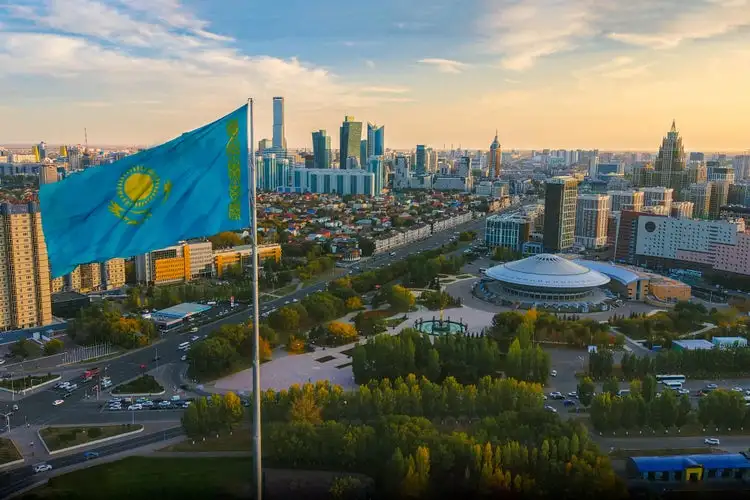
Kazakhstan is intensifying its push to attract long-term foreign investment across energy, infrastructure, digital transformation and industrial production. Prime Minister Olzhas Bektenov used the sidelines of the 38th plenary session of the Foreign Investors’ Council to meet executives from major global energy companies and financial institutions, reinforcing Astana’s focus on a new investment cycle.
The meetings brought together senior representatives from Eni, Baker Hughes, Chevron, Shell, ExxonMobil, Marubeni, the World Bank, the European Bank for Reconstruction and Development and the Islamic Development Bank. The discussions centered on oil and gas development, energy transition projects, transport corridors, industrial localization, artificial intelligence and Islamic finance.
Key Overview
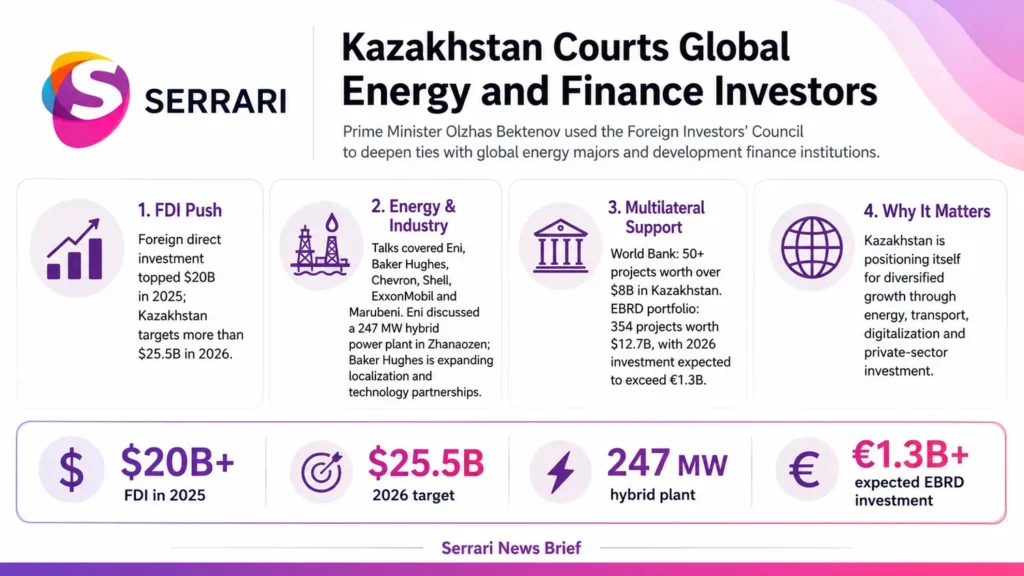
Kazakhstan says foreign direct investment exceeded $20 billion in 2025, while the government is targeting more than $25.5 billion in 2026. That ambition is tied to efforts to diversify the economy beyond extractives, deepen local manufacturing and expand private-sector-led growth.
A major theme was energy modernization. Eni discussed a 247-megawatt hybrid power plant in Zhanaozen, while Baker Hughes highlighted deeper localization in Kazakhstan’s oil and gas supply chain. Chevron, Shell and ExxonMobil also reviewed continued work around major fields including Tengiz, Karachaganak and Kashagan.
Energy Majors Back Kazakhstan’s Investment Cycle
Bektenov’s talks with Eni focused on expanding Kazakhstan’s energy infrastructure and supporting lower-carbon technologies. The planned hybrid power plant in Zhanaozen is expected to strengthen the country’s power system while supporting industrial needs in the oil-producing Mangystau region.
Baker Hughes, meanwhile, discussed localization and advanced technologies for the oil and gas sector. The company has already localized production of 174 types of spare parts, while nearly 100 additional products are being developed with Kazakh suppliers. Around 95% of its service operations in Kazakhstan are now performed by local specialists, according to the government.
That localization agenda matters because Kazakhstan is trying to retain more value from its resource sector. Rather than relying only on extraction, the government wants more domestic manufacturing, engineering, digital monitoring and workforce development around large energy projects.
Context is everything. Stay ahead of shifting trends with today’s market updates, and uncover emerging opportunities using the Serrari Group Market Index and Marketplace. Then, take control of your own financial future by exploring our Money & Life Reset Transformation Blueprint ™ to build stronger habits, create better systems, and design a path toward lasting wealth.
Chevron, Shell and ExxonMobil Remain Central Players
Chevron and Shell remain deeply tied to Kazakhstan’s largest hydrocarbon assets. Bektenov and Chevron Upstream President Clay Neff discussed the continued development of the Tengiz and Karachaganak projects, including stable operations at new production facilities and future exploration cooperation.
Shell’s President of Exploration and Production Peter Costello reviewed ongoing work at Karachaganak and in the North Caspian, as well as further geological exploration opportunities. The talks come after a period of legal and commercial tension in the sector, including reports that Shell had paused new Kazakhstan investments earlier in 2026 due to cost-dispute proceedings involving major oil projects.
ExxonMobil also reaffirmed its long-term commitment through participation in Tengiz, Kashagan and the Caspian Pipeline Consortium. For Kazakhstan, keeping these operators engaged is important because the country’s export earnings, fiscal revenue and industrial strategy remain closely linked to large upstream projects.
World Bank and EBRD Focus on Diversification
Beyond energy, Kazakhstan is leaning on multilateral lenders to support a broader economic transition. Bektenov met World Bank Vice President for Europe and Central Asia Antonella Bassani to discuss the 2026–2031 Country Partnership Framework, which prioritizes connectivity, resilience, jobs and private-sector-led growth.
The World Bank says the framework is designed to help Kazakhstan move toward a more diversified, competitive and resilient economy. It also emphasizes infrastructure services, better natural-resource management and a stronger environment for private-sector innovation.
Kazakhstan’s cooperation with the World Bank is already extensive. According to the government, the institution has supported more than 50 projects worth over $8 billion across transport, education, digitalization, environmental protection and green technologies. Bassani also pointed to Kazakhstan’s role in developing the Trans-Caspian International Transport Route, a corridor that is becoming more important for Eurasian trade.
The EBRD is also scaling up. Its Kazakhstan investment footprint has reached 354 projects worth about $12.7 billion, while the bank expects its 2026 investment to exceed €1.3 billion, a potential record level. The lender has also signed a new five-year cooperation agreement with Kazakhstan covering sustainable infrastructure, private-sector support, digitalization and green growth.
Islamic Finance and Industrial Cooperation Expand
Kazakhstan is also broadening its financial partnerships. Deputy Prime Minister Serik Zhumangarin met Islamic Development Bank President Muhammad Al Jasser to discuss deeper strategic cooperation, including a proposal to open an additional IsDB office in Astana.
The two sides exchanged signed copies of a forward-leasing agreement aimed at supporting infrastructure development in Kazakhstan’s special economic and industrial zones. The move signals Astana’s interest in expanding Islamic finance as part of its broader investment toolkit.
Marubeni also discussed opportunities to deepen Kazakh-Japanese cooperation in energy and industrial production. Combined with talks involving Western energy majors and multilateral lenders, the meetings show Kazakhstan positioning itself as both a resource hub and a regional infrastructure platform.
For investors, the key message is clear: Kazakhstan wants capital, technology and long-term partnerships. For the government, the challenge is to translate high-level agreements into bankable projects, stronger local supply chains and a more diversified economy.
Sources used: The Astana Times / Prime Minister of Kazakhstan / World Bank / EBRD / Qazinform / Reuters
Your financial future isn’t something you wait for—it’s something you build.
The real question is: when do you begin?
Move beyond simply staying informed.
Navigate the markets with clarity—track trends through the Serrari Group Market Index, uncover opportunities in the Serrari Marketplace, and build practical knowledge with our Curated Wealth Builder Platform.
Stay connected to what truly matters.
Get daily insights on macro trends and financial movements across Kenya, Africa, and global markets—delivered through the Serrari Newsletter.
Growth opens doors.
Advance your career through professional programs including ACCA, HESI A2, ATI TEAS 7 , HESI EXIT , NCLEX – RN and NCLEX – PN, Financial Literacy!🌟—designed to move you forward with confidence.
See where money is flowing—clearly and in real time.
Track Money Market Funds, Treasury Bills, Treasury Bonds, Green Bonds, and Fixed Deposits, alongside global and African indexes, key economic indicators, and the evolving Crypto and stablecoin landscape—all within Serrari’s Market Index.