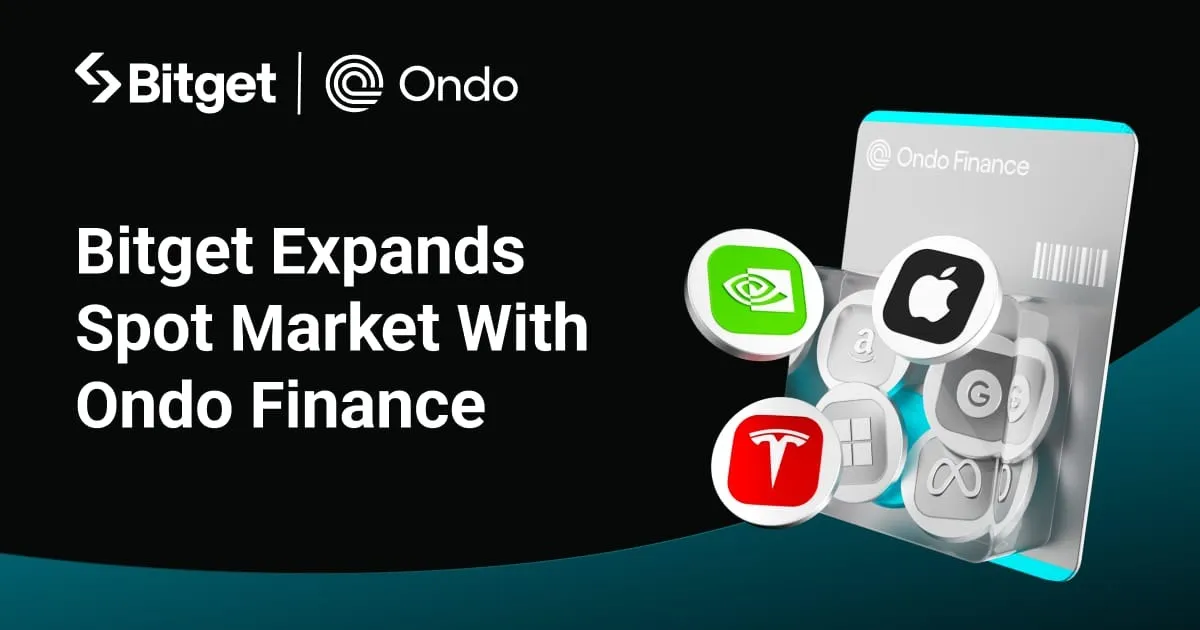
Global cryptocurrency platform Bitget has expanded its trading ecosystem to include tokenised US stocks, ETFs, and precious metals for Kenyan investors, implemented through a partnership with Ondo Finance. Users can now trade assets including Tesla, NVIDIA, Apple, Alphabet, Microsoft, Amazon, and Meta — alongside index ETFs such as SPY, QQQ, and IWM — within a single USDT-based account, funded through M-Pesa-powered peer-to-peer transactions. Ondo Finance, which reports capturing up to 89% of the global tokenised stock trading market, has introduced more than 198 tokenised assets since September 2025. The integration eliminates the need for multiple platforms or conventional cross-border brokerage accounts, positioning Bitget as a gateway for Kenya’s growing retail investor base to access global capital markets through familiar, mobile-first infrastructure.
Key Overview
- Platform: Bitget (global cryptocurrency exchange)
- Infrastructure Partner: Ondo Finance
- Market: Kenya (primary focus)
- Assets Available: Tesla, NVIDIA, Apple, Alphabet, Microsoft, Amazon, Meta + SPY, QQQ, IWM ETFs + precious metals
- Account Currency: USDT (single unified account)
- Funding Method: M-Pesa-powered peer-to-peer transactions
- Ondo Tokenised Assets Introduced: 100+ since September 2025, then additional 98 US stocks and ETFs
- Ondo Global Market Share: Up to 89% of tokenised stock trading market
- Bitget Platform Market Share (December): Rose from ~73% to ~89% within the month
- Strategic Significance: First integrated crypto-traditional asset platform accessible via M-Pesa in Kenya
The Wall Street Access Gap, Now Closed for Kenyan Investors
For the overwhelming majority of Kenya’s retail investors, owning a share of Apple, tracking the S&P 500 through an index ETF, or gaining exposure to gold as an inflation hedge has historically required navigating a system designed with someone else in mind. International brokerage accounts demand foreign bank references, minimum deposit thresholds calibrated to Western income levels, compliance documentation that assumes existing banking relationships, and foreign exchange mechanisms that charge premiums that erode returns before the first trade is placed.
The result has been a structurally enforced exclusion: Kenyan retail investors, many of whom are digitally sophisticated, financially ambitious, and acutely aware of global market opportunities, have watched the world’s most wealth-generating companies — NVIDIA’s extraordinary AI-driven appreciation, Apple’s sustained compounding, Amazon’s commercial dominance — from a distance. The assets existed. The knowledge existed. The desire to participate existed. The access infrastructure did not.
Bitget’s expansion into tokenised US stocks, ETFs, and precious metals — implemented through a partnership with Ondo Finance and funded through M-Pesa’s peer-to-peer payment network — is the most direct attempt yet to close that gap for Kenyan investors specifically. Its significance extends well beyond a product feature announcement. It represents a convergence of blockchain technology, mobile money infrastructure, and tokenised finance that could permanently alter how African retail investors engage with global capital markets.
Markets move fast; don’t get left behind. We’ve paired the Serrari Group Market Index with a curated Marketplace and a comprehensive Wealth Builder Course to ensure you have the data—and the skills—to act on it.
Historical Context: The Long Road to African Retail Market Access
Understanding why Bitget’s Kenyan expansion matters requires tracing the history of African retail investors’ relationship with global financial markets — a history defined largely by exclusion, workarounds, and the persistent gap between aspiration and access.
For most of the post-independence period, African retail investors operated within the boundaries of domestic capital markets — stock exchanges in Nairobi, Lagos, Accra, Johannesburg, and a handful of other cities that listed primarily local companies with limited international diversification. The Nairobi Securities Exchange, established in 1954, has provided a functioning domestic equity market for Kenyan investors, but its listed companies represent a narrow slice of the global economy. An investor wanting exposure to the technology sector — which has driven the majority of global equity returns over the past two decades — has found limited options on the NSE’s listings.
The liberalisation of global capital markets in the 1990s created theoretical access to international investments for African investors but not practical access. Most international brokerages either did not accept clients from African jurisdictions or imposed documentation, minimum deposit, and compliance requirements that effectively excluded all but the wealthiest individuals. The foreign exchange mechanisms required to fund international brokerage accounts — converting Kenyan shillings to US dollars through commercial bank channels — added costs and delays that compounded the access barriers.
The rise of mobile money in Kenya, anchored by M-Pesa’s extraordinary penetration and reliability, created the financial infrastructure that serves as the foundation for Bitget’s current integration. M-Pesa’s ability to move money instantly, affordably, and without the friction of formal banking channels has made it the backbone of Kenya’s financial ecosystem. Its integration into peer-to-peer cryptocurrency transactions — allowing Kenyans to acquire USDT through M-Pesa transactions with other users — created a pathway from local mobile money to global digital asset markets that did not exist through any conventional financial channel.
The cryptocurrency market, for all its volatility and controversy, served a specific and underappreciated function for Kenyan retail investors in its early years: it was the first genuinely accessible global market. Anyone with a smartphone, an M-Pesa account, and the willingness to navigate the onboarding process of a crypto exchange could, for the first time, participate in a global asset market on essentially equal terms with a retail investor in London or New York. The asset being traded was Bitcoin or Ethereum rather than Apple or Amazon — but the infrastructure of access was being built.
Tokenised stocks — blockchain-based representations of traditional equity assets — are the next logical evolution of that infrastructure. They apply the accessibility architecture that crypto exchanges built for digital assets to the traditional equity instruments that retail investors globally recognise, understand, and aspire to own.
The Ondo Finance Partnership: What Tokenisation Actually Means
The technical foundation of Bitget’s expansion rests on its partnership with Ondo Finance, and understanding what Ondo does — and why its market position matters — is essential for assessing the product’s credibility and durability.
Tokenization, in the context of traditional financial assets, involves creating a digital token on a blockchain that represents ownership of — or economic exposure to — an underlying traditional asset. A tokenised Apple share is a blockchain-based instrument whose value tracks the price of Apple’s NASDAQ-listed equity, allowing it to be traded on crypto infrastructure with the settlement speed, divisibility, and accessibility that blockchain rails provide, while maintaining the economic exposure of the underlying stock.
The technical and legal architecture of tokenisation is more complex than this description suggests. The issuer must maintain the underlying assets as backing for the tokens, manage the relationship between token supply and underlying asset prices, navigate securities regulations across multiple jurisdictions, and ensure that token holders’ economic rights are protected through legal structures that vary by market. These requirements have historically limited tokenised stock products to sophisticated investors in regulated environments.
Ondo Finance has built its business around making tokenised traditional assets accessible at scale, and its reported market share statistics — capturing up to 89% of the global tokenised stock trading market — suggest it has achieved a dominant position in what remains an early-stage but rapidly growing sector. The introduction of more than 100 tokenised assets since September 2025, followed by an additional 98 US stocks and ETFs, indicates a product development pace that is outrunning competitors and building a catalogue depth that makes the platform genuinely useful for investors seeking diversification across the US equity market rather than exposure to a small number of flagship names.
Bitget’s platform-level data reinforces the market share picture. Ondo tokenised stock trading on Bitget captured approximately 73% of market share in early December before rising to roughly 89% later in the same month — a rapid increase within a single month that reflects the combination of new asset additions, platform promotional activity, and genuine underlying demand from retail investors seeking blockchain-based access to US equity markets.
The single USDT-based account structure through which all trading occurs is an important design decision that reduces friction for users who would otherwise need to manage separate accounts for crypto assets and traditional asset exposure. By denominating all positions in USDT — the world’s largest stablecoin by market cap — the platform eliminates the currency conversion step between crypto and traditional asset trading, allowing users to move capital between Bitcoin, Tesla, SPY, and gold within a single account balance.
Why Kenya Specifically: The Market Context
The Kenya-specific focus of Bitget’s rollout announcement reflects a deliberate assessment of market opportunity that is grounded in specific characteristics of Kenya’s retail investor landscape.
Kenya’s digital financial infrastructure is, by African standards, extraordinarily developed. M-Pesa’s penetration — reaching over 30 million active users and handling transaction values equivalent to a substantial share of Kenya’s GDP — means that the payment rails required to fund a USDT account through peer-to-peer transactions are already embedded in the daily financial behaviour of millions of Kenyans. The friction of acquiring the USDT that serves as the gateway currency for tokenised asset trading is lower in Kenya than in virtually any other African market, because the P2P M-Pesa marketplace for USDT acquisition is liquid, trusted, and familiar to a large and growing population of crypto-curious Kenyans.
Kenya’s retail investor base has been growing rapidly across multiple channels. The Nairobi Securities Exchange has seen increased retail participation through mobile-accessible brokerage platforms. The success of Mansa X, Ziidi, and other locally relevant investment products has demonstrated that Kenyan retail investors will engage with formal investment vehicles when access friction is low enough and returns are competitive. The popularity of cryptocurrency — Kenya consistently ranks among the top African markets for crypto adoption in global surveys — indicates both comfort with digital assets and a willingness to engage with investment instruments that exist outside conventional banking infrastructure.
The appetite for US technology stock exposure specifically is a reasonable inference from Kenya’s demographic and economic profile. Kenya’s technology sector is one of the most dynamic in Africa, with a large and growing cohort of technology workers, entrepreneurs, and digital economy participants who are acutely aware of the companies — NVIDIA, Apple, Microsoft, Alphabet, Meta — whose products and platforms shape their professional and personal lives daily. The aspiration to own shares in those companies, and to participate in the wealth creation they represent, is genuine and widespread among this demographic. Bitget’s tokenised stock offering converts that aspiration into a practical possibility for the first time at scale.
The Asset Universe: What Is Now Accessible
The specific assets made available through the Bitget-Ondo integration reflect a deliberate curation of what global retail investor demand looks like in 2026.
The individual stock selections — Tesla, NVIDIA, Apple, Alphabet, Microsoft, Amazon, and Meta — are not arbitrary. They represent the companies that have dominated global equity returns, global financial media coverage, and retail investor awareness for the past decade. Each is a household name in Kenya’s technology-aware professional community. Each has a narrative that retail investors can engage with — NVIDIA’s AI infrastructure dominance, Apple’s ecosystem, Tesla’s electric vehicle disruption — rather than requiring the deep financial analysis that less recognised companies would demand. For a first-generation retail investor entering global equity markets for the first time, these are the assets that provide the combination of name recognition, liquidity, and narrative accessibility that supports confident investment decisions.
The index ETFs — SPY tracking the S&P 500, QQQ tracking the Nasdaq-100, and IWM tracking the Russell 2000 small-cap index — add a diversification dimension that individual stock selection cannot provide. For investors who want US equity market exposure without the concentration risk of individual company positions, a tokenised SPY or QQQ position provides broad market exposure at a fraction of the analysis burden. The inclusion of both large-cap growth (QQQ) and broader market (SPY) and small-cap (IWM) options allows investors to express differentiated views about US market dynamics rather than defaulting to a single exposure.
Precious metals — gold specifically, as the most universally recognised store of value commodity — extend the platform’s utility into inflation protection and portfolio diversification that has historically been difficult for Kenyan retail investors to access in a frictionless format. Gold’s cultural and financial significance as a wealth preservation asset resonates across economic contexts, and tokenised gold provides the liquidity and divisibility that physical gold ownership cannot easily provide at retail scale.
Context is everything. While you follow today’s updates, use the Serrari Group Market Index and Marketplace to spot emerging shifts. Need to sharpen your edge? Our Wealth Builder Course turns these insights into a professional-grade strategy.
Why This Matters: The Democratisation of Global Capital Markets
Bitget’s Kenyan expansion carries implications that transcend a single platform’s product announcement.
It establishes a replicable model for emerging market retail investor access to global assets. The combination of a global crypto exchange, a tokenisation infrastructure provider, a mobile money payment rail, and a stablecoin intermediary creates a four-component architecture that could be deployed in any market where crypto exchange access, mobile money infrastructure, and retail investor demand for global asset exposure coexist. Kenya is the current focus — but the model is inherently portable to Ghana, Nigeria, Tanzania, Uganda, and beyond.
It challenges the incumbent brokerage and wealth management industry’s access monopoly. Traditional international brokerages that have historically been the only channel through which African retail investors could access US stocks face a new competitive reality: a platform that requires no foreign bank account, no minimum deposit calibrated to Western income levels, no compliance documentation designed for developed market investors, and no foreign exchange mechanism beyond a peer-to-peer M-Pesa transaction. The simplicity advantage is structural rather than merely operational, and incumbents have limited ability to match it without fundamentally redesigning their access architecture.
It creates a new dimension of financial inclusion that goes beyond payments. Kenya’s financial inclusion story has been primarily a payments story — M-Pesa enabling transactions, transfers, and basic savings for populations previously excluded from formal finance. Tokenised stock access extends financial inclusion into wealth creation — the dimension of financial services that has the most significant long-term impact on household economic outcomes. An investor who begins building a position in a US technology index fund at 25 and holds it for 30 years participates in wealth compounding that transforms lifetime financial outcomes in ways that access to payment services alone cannot.
Risks to Consider
Regulatory uncertainty is the most immediate risk for tokenised stock products in Kenya. The Capital Markets Authority has not yet established a comprehensive framework for tokenised traditional financial assets, and the regulatory treatment of these instruments — as securities, as crypto assets, or as a hybrid category requiring its own framework — remains unsettled. A regulatory intervention that reclassified tokenised stocks as unregistered securities offerings could restrict or suspend access without warning.
Counterparty and custody risk in tokenised asset structures requires careful investor understanding. Holding a tokenised stock through Bitget involves trust in multiple counterparties — Bitget as the platform operator, Ondo Finance as the tokenisation provider, and the custody arrangements underlying the tokenised positions. The failure of any counterparty in this chain could affect token holders’ ability to access their positions or receive the underlying economic value they represent.
Foreign exchange and USDT basis risk adds a layer of complexity that conventional brokerage accounts denominated in local currency do not carry. An investor who acquires USDT through a P2P M-Pesa transaction and then holds tokenised US stocks is exposed to both the underlying asset price movement and the USDT-to-Kenyan shilling exchange rate. In periods of shilling depreciation, this exposure works in the investor’s favour; in periods of shilling appreciation, it creates additional return headwind beyond the asset’s own performance.
Market concentration risk in Ondo’s 89% market share position creates platform dependency for investors who build significant positions through this single infrastructure provider. High market concentration in early-stage infrastructure categories frequently gives way to competition as the market matures, but the transition period can create uncertainty for users whose assets are held on a dominant-but-not-yet-tested-at-scale platform.
Challenges Ahead
Investor education is a critical prerequisite for this product category’s responsible growth. Tokenised stocks share the name recognition of familiar companies but introduce structural and regulatory complexity that requires investor understanding to avoid misaligned expectations. A retail investor who treats a tokenised Tesla position identically to a conventional equity holding — without understanding the counterparty structure, the custody arrangements, and the regulatory ambiguity — is taking risks that the platform’s interface may not adequately communicate.
M-Pesa P2P USDT acquisition operates in a regulatory grey area that could be affected by future Central Bank of Kenya guidance on crypto-related payment transactions. The convenience of the M-Pesa funding mechanism is also its vulnerability: it depends on regulatory tolerance for P2P crypto transactions that is not guaranteed to persist as the market scales.
Platform reliability and security at the scale that significant retail adoption would require demands infrastructure investment and security architecture that the platform’s current scale may not yet have fully stress-tested. Crypto exchange security incidents — hacks, liquidity crises, and operational failures — have affected multiple major platforms over the past decade, and Kenyan retail investors entering global markets for the first time through this channel may not have the risk awareness to manage those scenarios.
Looking Ahead: The Next Chapter of African Financial Access
Bitget’s tokenised stock expansion in Kenya is most accurately understood as an early proof of concept for a model that, if it succeeds commercially and navigates its regulatory environment constructively, has the potential to transform retail investment access across Africa over the coming decade.
The convergence of forces enabling this moment — blockchain-based tokenisation infrastructure mature enough for institutional partnership, mobile money networks penetrated deeply enough to serve as universal payment rails, retail investor awareness of global markets sophisticated enough to generate genuine demand, and regulatory environments open enough to permit early-stage experimentation — is not unique to Kenya. It describes, with varying degrees of development, the conditions in multiple African markets simultaneously.
The investors who benefit most from this expansion will be those who approach it with a clear understanding of both the genuine opportunity it represents — affordable, accessible, mobile-first exposure to the world’s most dynamic equity markets — and the specific risks that its novel structure introduces. Used thoughtfully, tokenised stock access through M-Pesa-funded USDT accounts represents a genuine democratisation of global capital market participation. Used without adequate understanding, it introduces complexity that can obscure the risks embedded in a multi-counterparty, cross-jurisdictional, blockchain-based investment structure.
The access gap is closing. The responsibility for navigating it wisely rests with investors, platforms, and regulators in equal measure.
Your financial future isn’t something you wait for, it’s something you build.
The real question is: when do you begin?
Move beyond simply staying informed.
Navigate the markets with clarity—track trends through the Serrari Group Market Index, uncover opportunities in the Serrari Marketplace, and build practical knowledge with our Curated Wealth Builder Course.
Stay connected to what truly matters.
Get daily insights on macro trends and financial movements across Kenya, Africa, and global markets—delivered through the Serrari Newsletter.
Growth opens doors.
Advance your career through professional programs including ACCA, HESI A2, ATI TEAS 7 , HESI EXIT , NCLEX – RN and NCLEX – PN, Financial Literacy!🌟—designed to move you forward with confidence.
See where money is flowing—clearly and in real time.
Track Money Market Funds, Treasury Bills, Treasury Bonds, Green Bonds, and Fixed Deposits, alongside global and African indexes, key economic indicators, and the evolving Crypto and stablecoin landscape—all within Serrari’s Market Index.