Germany has provided South Africa with a €200 million concessional climate loan to support grid upgrades and renewable energy expansion.
An additional €270 million will fund green hydrogen and battery value chains, strengthening long-term industrial decarbonisation.
The deal reflects a broader shift toward European partnerships amid geopolitical tensions with the United States.
Key Overview
- €200M concessional climate loan secured
- Targets grid modernisation + renewable expansion
- Additional €270M for hydrogen and batteries
- Germany commitments now at €2.68B total
- Supports energy security and decarbonisation
- Comes amid U.S.–South Africa diplomatic tensions
- Part of $12.4B Just Energy Transition Partnership
Germany Strengthens Climate Finance Support for South Africa
Germany has agreed to provide South Africa with a €200 million concessional climate loan, marking a significant step in strengthening bilateral cooperation on energy transition and climate finance.
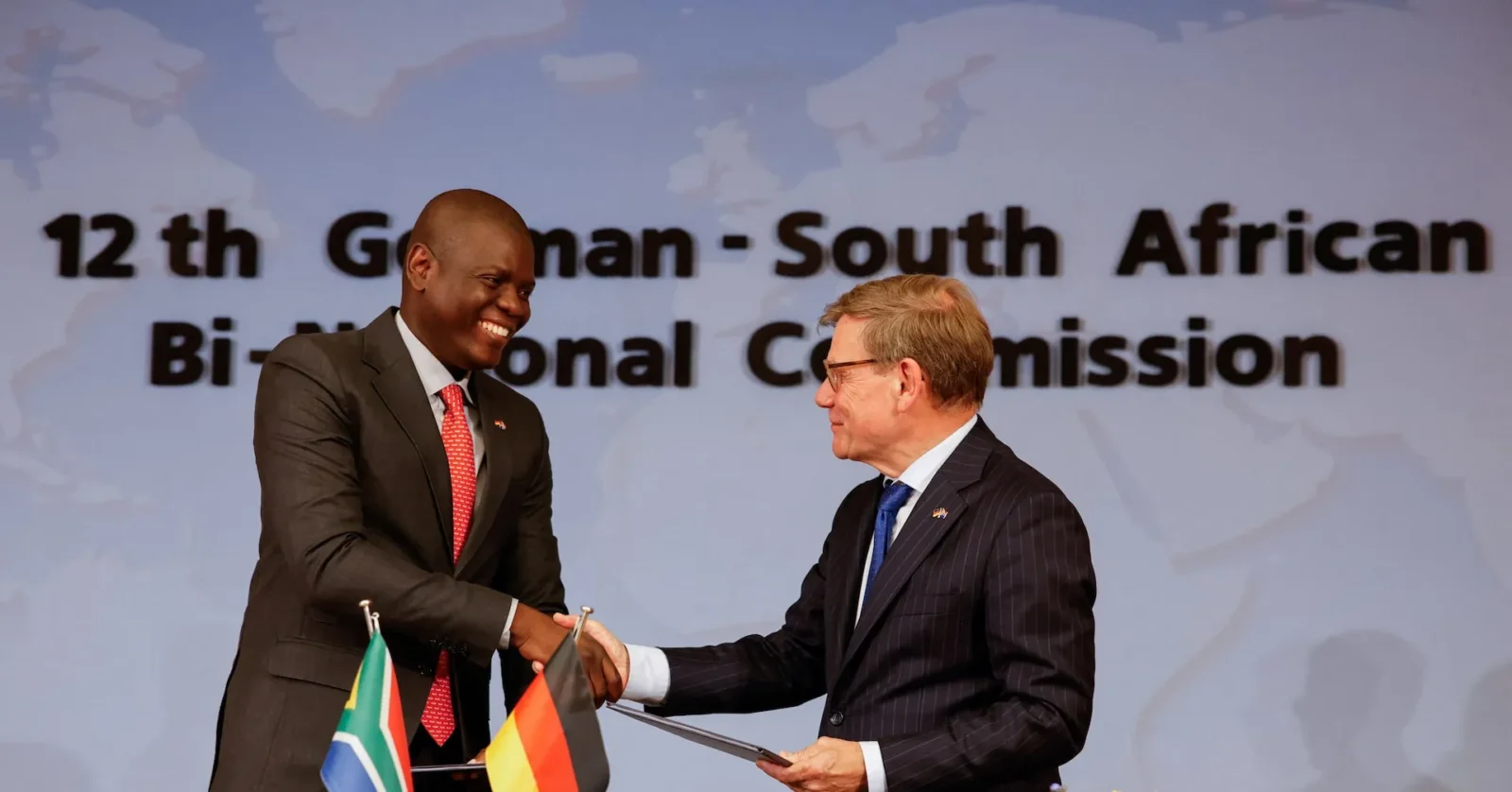
The agreement was secured during a high-level diplomatic visit to Berlin by Ronald Lamola, reflecting a deepening relationship between the two countries at a time when global alliances are increasingly being reshaped by geopolitical and economic shifts.
This development highlights how climate finance is becoming a central pillar of international diplomacy and economic cooperation.
The deal underscores the growing role of concessional finance in supporting large-scale energy transitions, particularly in emerging markets where access to affordable capital remains a major constraint.
Unlike traditional commercial loans, concessional financing provides capital at below-market interest rates, often supported by government guarantees or development finance institutions. This reduces borrowing costs while enabling governments to invest in long-term infrastructure projects that may not deliver immediate financial returns but are critical for sustainability and economic resilience.
Lower financing costs create fiscal space for countries to accelerate energy transition without placing excessive strain on public finances.
As a result, concessional finance is emerging as a powerful tool for bridging the gap between immediate energy security needs and long-term climate objectives, allowing countries like South Africa to pursue both priorities simultaneously.
Markets move fast; don’t get left behind. We’ve paired the Serrari Group Market Index with a curated Marketplace and a comprehensive Wealth Builder Platform to ensure you have the data—and the skills—to act on it.
€200M Loan Targets Grid and Renewable Expansion
The €200 million facility will be directed toward modernising South Africa’s electricity grid and accelerating renewable energy deployment, two critical priorities for a country facing persistent and structural energy challenges.
South Africa’s energy system has long been constrained by aging infrastructure, frequent supply shortages, and a heavy reliance on coal-fired generation, which continues to dominate the country’s energy mix.
These challenges have not only affected energy reliability but also constrained economic growth and industrial productivity.
Upgrading the national grid is therefore essential. A modernized grid enables the efficient transmission and distribution of electricity, while also allowing for the integration of intermittent renewable energy sources such as solar and wind at scale.
Grid infrastructure is the backbone of any successful energy transition.
At the same time, expanding renewable energy capacity will help reduce greenhouse gas emissions, lower dependence on fossil fuels, and diversify the country’s energy mix. This diversification enhances resilience by reducing exposure to fuel price volatility and supply disruptions.
Renewable expansion supports both environmental sustainability and long-term energy security.
The combination of grid investment and renewable deployment reflects a holistic and systems-based approach to energy transition—one that recognizes the need to upgrade both generation capacity and supporting infrastructure simultaneously.
Expanding Into Hydrogen and Battery Value Chains
Beyond the core loan facility, Germany and the European Union have committed an additional €270 million to support the development of green hydrogen and battery value chains in South Africa.
These sectors are increasingly viewed as critical components of long-term industrial decarbonisation and global competitiveness, particularly as countries transition toward low-carbon economies.
The energy transition is expanding beyond electricity generation into industrial and technological ecosystems.
Green hydrogen, produced using renewable energy, has the potential to become a major export industry for South Africa. It can be used in sectors that are difficult to electrify, such as heavy industry, shipping, and aviation, making it a key element of global decarbonisation strategies.
At the same time, battery value chains play a crucial role in enabling energy storage, supporting electric mobility, and stabilizing power systems with high levels of renewable penetration.
Energy storage is becoming a critical enabler of renewable energy scalability and reliability.
By investing in these areas, South Africa is positioning itself not just as a consumer of clean energy, but as an active participant in global supply chains linked to the energy transition.
This shift represents a move up the value chain—from exporting raw materials to developing domestic capabilities in processing, manufacturing, and technology deployment.
Moving up the value chain enhances economic resilience, creates jobs, and strengthens long-term competitiveness in the global green economy.
Geopolitical Tensions Reshape Climate Partnerships
The agreement comes at a time of heightened geopolitical tension, particularly between South Africa and the United States, underscoring how global politics are increasingly influencing climate finance and international energy cooperation.
Following the return of Donald Trump to office, the U.S. withdrew its $1 billion pledge to the Just Energy Transition Partnership (JETP) and excluded South Africa from key G20 engagements.
This marked a significant shift in diplomatic and financial support, creating both funding gaps and uncertainty around multilateral cooperation.
The withdrawal not only reduced available climate financing but also signaled a broader cooling of bilateral relations, affecting South Africa’s position within global economic and policy discussions.
Climate finance is increasingly becoming intertwined with geopolitical alignment and foreign policy priorities.
In response, South Africa has moved to strengthen ties with alternative partners, particularly in Europe, where there remains strong political and financial support for climate transition initiatives.
Germany’s continued backing has helped offset some of this disruption, reinforcing its role as a key strategic ally in South Africa’s energy transition.
The partnership reflects a broader realignment, where countries are diversifying alliances to secure both funding and long-term cooperation.
Ultimately, the deal signals a shift toward European-led climate partnerships, highlighting how changing global dynamics are reshaping the flow of capital, influence, and collaboration in the energy transition.
Context is everything. While you follow today’s updates, use the Serrari Group Market Index and Marketplace to spot emerging shifts. Need to sharpen your edge? Our Wealth Builder Platform turns these insights into a professional-grade strategy.
Strengthening the Just Energy Transition Partnership
Despite the withdrawal of U.S. funding, the Just Energy Transition Partnership (JETP) has demonstrated notable resilience, expanding to approximately $12.4 billion with new contributors stepping in to bridge the financing gap.
Countries such as Denmark and the Netherlands have joined the initiative, reinforcing the importance of collective international action in supporting large-scale energy transitions.
The ability of the JETP to attract new partners highlights the strength and adaptability of multilateral climate finance frameworks.
Germany remains a leading contributor within this structure, with total commitments now reaching €2.68 billion, underscoring its long-term commitment to supporting South Africa’s transition toward a more sustainable energy system.
Consistent financial support from key partners is critical for maintaining momentum in large-scale transition programs.
This continued expansion demonstrates that, even amid geopolitical uncertainty, global climate finance mechanisms can evolve and adapt to changing circumstances.
It also reinforces the idea that climate action is increasingly being driven by coalitions of willing partners, rather than reliance on a single dominant contributor.
Multilateral cooperation is proving essential in sustaining progress toward global climate goals.
Overall, the resilience of the JETP highlights a broader trend:
Climate finance is becoming more diversified, collaborative, and resilient—capable of adapting to geopolitical shifts while continuing to support long-term energy transition efforts.
What This Means for Energy and Investment
The agreement between Germany and South Africa highlights several structural trends that are reshaping global energy systems, investment flows, and development strategies—particularly across emerging markets.
First, concessional finance is becoming a critical enabler of energy transition, especially in economies where access to affordable capital remains a key constraint. By offering funding at below-market rates, concessional loans reduce the financial burden associated with large-scale infrastructure projects, making it easier for governments to invest in renewable energy, grid upgrades, and supporting technologies.
Affordable capital is emerging as one of the most important drivers of energy transition in developing economies.
Second, climate finance is becoming increasingly intertwined with geopolitics, influencing how countries form partnerships, secure funding, and position themselves within the global energy landscape.
As traditional alliances shift, countries are actively seeking new partners that can provide both financial resources and strategic cooperation.
Third, investment is shifting toward integrated energy systems, rather than isolated projects. This includes not only power generation, but also storage solutions, grid infrastructure, and industrial value chains such as hydrogen and battery production.
The future of energy lies in interconnected systems that combine generation, storage, and industrial capabilities.
This broader approach reflects a growing recognition that sustainable development requires entire ecosystems—not just individual assets.
Energy transition is evolving from a sectoral shift into a comprehensive economic transformation.
Outlook: A Strategic Shift in Energy Partnerships
Looking ahead, the €200 million loan signals a broader transformation in how South Africa approaches its energy transition, economic development, and international partnerships.
In the short term, the immediate focus will be on implementing grid upgrades and accelerating renewable energy deployment, both of which are essential for improving energy reliability and addressing persistent supply constraints.
Effective execution will be critical in translating financial commitments into tangible improvements in energy access and system stability.
Over the medium term, investments in green hydrogen and battery value chains could unlock entirely new industries, creating opportunities for industrial growth, job creation, and export revenue.
These sectors have the potential to position South Africa as a competitive player in emerging global markets linked to clean energy technologies.
Industrial diversification will be a key outcome of sustained investment in energy transition sectors.
In the long term, South Africa has the potential to evolve into a regional energy and industrial hub, supported by a diversified energy mix, modern infrastructure, and strengthened supply chains.
By combining renewable energy capacity with industrial capabilities, the country can enhance both its economic resilience and its role within regional and global markets.
The transition from energy importer to regional energy player represents a fundamental shift in economic positioning.
At the same time, the growing reliance on European-backed climate finance signals a broader realignment in international partnerships.
The shift toward European cooperation may redefine South Africa’s role in the global energy transition, influencing both its funding sources and strategic alliances.
Ultimately, the agreement reflects a deeper transformation:
Energy transition is becoming a catalyst for economic restructuring, geopolitical realignment, and long-term sustainable growth.
Your financial future isn’t something you wait for—it’s something you build.
The real question is: when do you begin?
Move beyond simply staying informed.
Navigate the markets with clarity—track trends through the Serrari Group Market Index, uncover opportunities in the Serrari Marketplace, and build practical knowledge with our Curated Wealth Builder Platform.
Stay connected to what truly matters.
Get daily insights on macro trends and financial movements across Kenya, Africa, and global markets—delivered through the Serrari Newsletter.
Growth opens doors.
Advance your career through professional programs including ACCA, HESI A2, ATI TEAS 7 , HESI EXIT , NCLEX – RN and NCLEX – PN, Financial Literacy!🌟—designed to move you forward with confidence.
See where money is flowing—clearly and in real time.
Track Money Market Funds, Treasury Bills, Treasury Bonds, Green Bonds, and Fixed Deposits, alongside global and African indexes, key economic indicators, and the evolving Crypto and stablecoin landscape—all within Serrari’s Market Index.