Pressure in global government bond markets is increasingly exposing France’s domestic vulnerabilities, with French OATs underperforming German Bunds as investors demand a larger premium to hold the country’s debt.
The renewed weakness reflects more than the broader global rise in yields. France is dealing with slower economic growth, a persistent budget deficit, rising debt-servicing costs and uncertainty surrounding the 2027 presidential election. Together, those factors are pushing France-specific risk back toward the centre of European bond-market attention.
Key Overview
- French OATs have come under greater pressure relative to German Bunds as investors demand a higher risk premium.
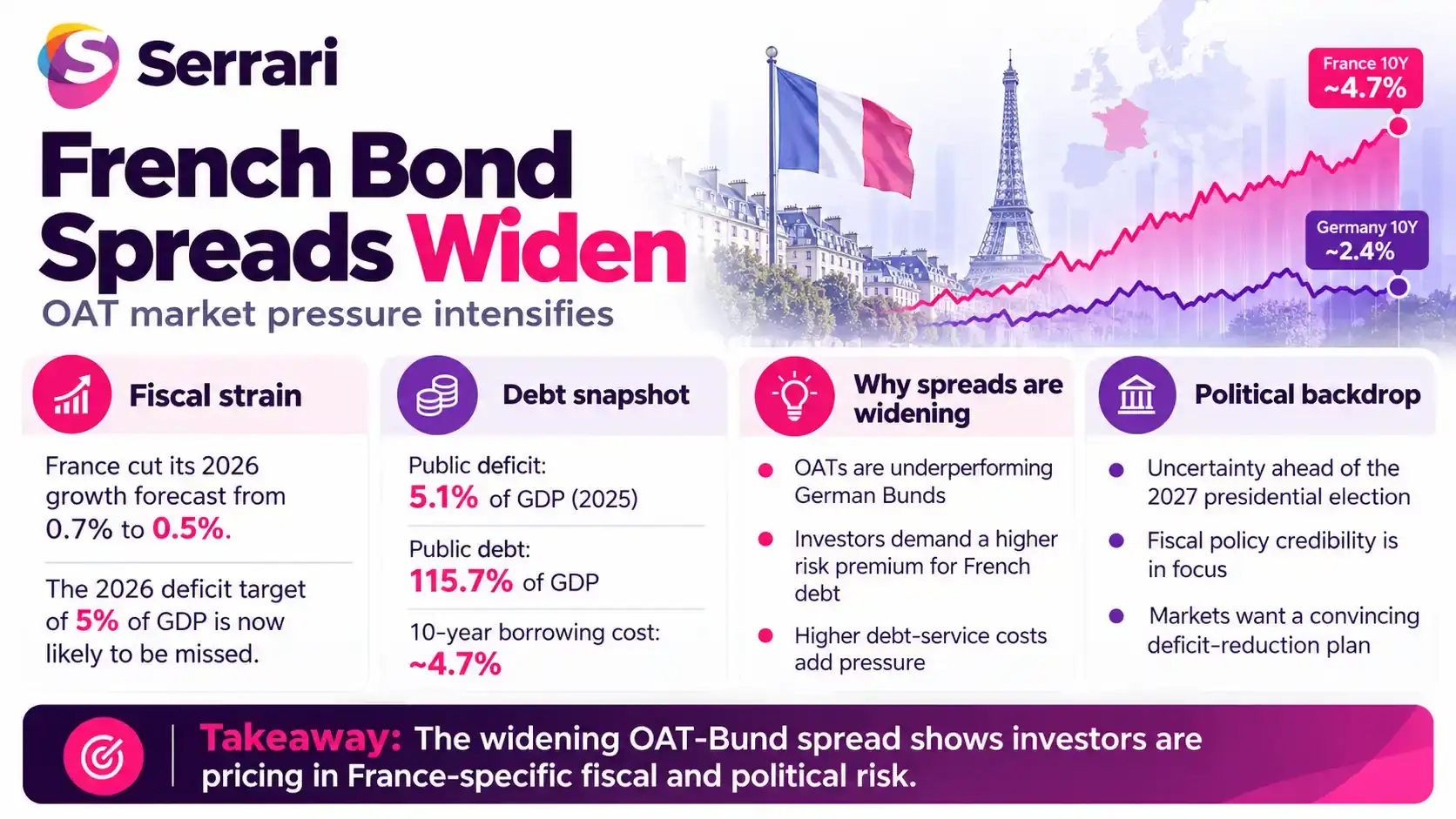
- France has lowered its 2026 economic growth forecast from 0.7% to 0.5%.
- The government has acknowledged that it is likely to miss its target of reducing the 2026 budget deficit to 5% of GDP.
- France’s public deficit stood at 5.1% of GDP in 2025, while public debt reached 115.7% of GDP.
- France’s 10-year borrowing cost recently climbed to around 4.7%, its highest level since the 2008 financial crisis.
- Political uncertainty ahead of the 2027 presidential election is becoming an increasingly important consideration for bond investors.
French Fiscal Pressure Is Repricing OAT Risk
France’s bond-market weakness is increasingly being viewed as a country-specific problem rather than simply another consequence of rising global yields.
The government recently reduced its 2026 growth forecast from 0.7% to 0.5%, citing weaker economic conditions, political instability, higher energy costs and increased borrowing costs.
That weaker outlook has made the government’s fiscal targets harder to achieve. France had aimed to reduce its budget deficit to 5% of GDP in 2026, but officials now acknowledge that the target is likely to be missed.
The longer-term fiscal backdrop is already challenging. An official assessment of France’s deteriorating public finances shows that the public deficit stood at 5.1% of GDP in 2025, while government debt reached 115.7% of GDP.
That combination leaves France more exposed when borrowing costs rise. Higher yields increase the amount the government must allocate to debt service, reducing the fiscal room available for other spending and making deficit reduction more difficult.
Debt-servicing costs have already risen sharply, with interest expenditure projected at around €65 billion and now ranking among the government’s largest spending commitments.
Context is everything. Stay ahead of shifting trends with today’s market updates, and uncover emerging opportunities using the Serrari Group Market Index and Marketplace. Then, take control of your own financial future by exploring our Money & Life Reset Transformation Blueprint ™ to build stronger habits, create better systems, and design a path toward lasting wealth.
OAT-Bund Spread Reflects France-Specific Concerns
The clearest indication of investor concern is the widening gap between French and German government bond yields.
German Bunds are widely treated as the Eurozone’s benchmark safe asset, which means the difference between French OAT and German Bund yields acts as an important measure of the additional compensation investors require for holding French sovereign debt.
France’s 10-year borrowing costs recently climbed to around 4.7%, a level not seen since the global financial crisis.
The pressure is also visible further along the curve. Official French bond-market data show yields on longer-maturity French government securities continuing to rise through late September, underlining how concerns are spreading beyond shorter-term policy expectations.
Earlier in 2026, France’s risk premium had remained comparatively contained despite higher sovereign yields. By June, the 10-year OAT-Bund spread had risen only modestly even as broader bond yields climbed. However, officials warned at the time that failure to improve the fiscal position could weaken investor confidence and increase refinancing risks.
That warning is now becoming more relevant as both yields and spreads move higher.
Political Risk Is Becoming Part of the Bond Trade
France’s political outlook is adding another layer of uncertainty.
The 2027 presidential election is approaching at a time when the current government is struggling to implement meaningful fiscal consolidation without broader parliamentary support.
Recent polling indicates that Marine Le Pen and Jean-Luc Mélenchon are among the strongest contenders in scenarios for the 2027 presidential election.
For bond investors, the central issue is not simply which candidate leads the polls. The larger concern is how future governments may approach spending, taxation, debt reduction and France’s fiscal commitments within the European Union.
Markets tend to demand a higher risk premium when there is greater uncertainty over future fiscal policy, particularly when a country’s debt levels are already elevated.
France Cannot Rely on the ECB Alone
Another important constraint is that France cannot simply assume the European Central Bank will absorb the market pressure.
France’s central bank governor has warned that the country cannot depend on ECB intervention to resolve its fiscal difficulties. Any use of extraordinary European support mechanisms would generally depend on the country demonstrating credible steps toward restoring fiscal stability.
That places greater responsibility on the French government to present a convincing deficit-reduction strategy.
The implication for investors is clear: unless France can stabilise its public finances and reduce uncertainty around future fiscal policy, pressure on OATs could persist even if global bond markets eventually calm.
The widening OAT-Bund spread therefore represents more than a technical bond-market move. It is increasingly becoming a market measure of confidence in France’s ability to manage high debt, weak growth and political uncertainty at the same time.
Sources: Reuters / Financial Times / Banque de France / Direction générale du Trésor
Your financial future isn’t something you wait for—it’s something you build.
The real question is: when do you begin?
Move beyond simply staying informed.
Navigate the markets with clarity—track trends through the Serrari Group Market Index, uncover opportunities in the Serrari Marketplace, and build practical knowledge with our Curated Wealth Builder Platform.
Stay connected to what truly matters.
Get daily insights on macro trends and financial movements across Kenya, Africa, and global markets—delivered through the Serrari Newsletter.
Growth opens doors.
Advance your career through professional programs including ACCA, HESI A2, ATI TEAS 7 , HESI EXIT , NCLEX – RN and NCLEX – PN, Financial Literacy!🌟—designed to move you forward with confidence.
See where money is flowing—clearly and in real time.
Track Money Market Funds, Treasury Bills, Treasury Bonds, Green Bonds, and Fixed Deposits, alongside global and African indexes, key economic indicators, and the evolving Crypto and stablecoin landscape—all within Serrari’s Market Index.