
Ethiopia is exploring carbon market opportunities as part of its efforts to strengthen sustainable agriculture, climate resilience, and rural transformation. During a high-level scientific and policy dialogue in Addis Ababa, government officials, researchers, and development partners examined how the country can responsibly participate in emerging global carbon markets while ensuring strong governance, protecting community interests, and supporting long-term sustainable development.
Key Overview
- Ethiopia convened a high-level dialogue on carbon markets and sustainable agriculture.
- The seminar explored governance, climate finance, and carbon market opportunities.
- Officials highlighted carbon markets as a tool to support agricultural transformation.
- The Green Legacy Initiative was identified as a foundation for nature-based climate solutions.
- Participants called for stronger research, policy coordination, and institutional capacity.
High-Level Dialogue Focuses on Carbon Finance Opportunities
Ethiopia has stepped up efforts to explore carbon market opportunities as part of its broader strategy to strengthen sustainable agriculture, climate resilience, and rural transformation.
The Ministry of Agriculture, in collaboration with the Agricultural Transformation Institute (ATI) and the Ethiopian Academy of Sciences (EAS) Agriculture Working Group, convened a high-level scientific and policy dialogue in Addis Ababa to examine how Ethiopia can strategically engage in emerging global carbon markets.
Held under the theme “Carbon Markets in Ethiopia: Opportunities, Governance, and Implications for Sustainable Agricultural Development,” the seminar brought together senior government officials, researchers, academics, development partners, private sector representatives, and practitioners to discuss the role of carbon finance in supporting sustainable development while safeguarding national interests and community benefits.
Carbon Markets Seen as a New Source of Climate Finance
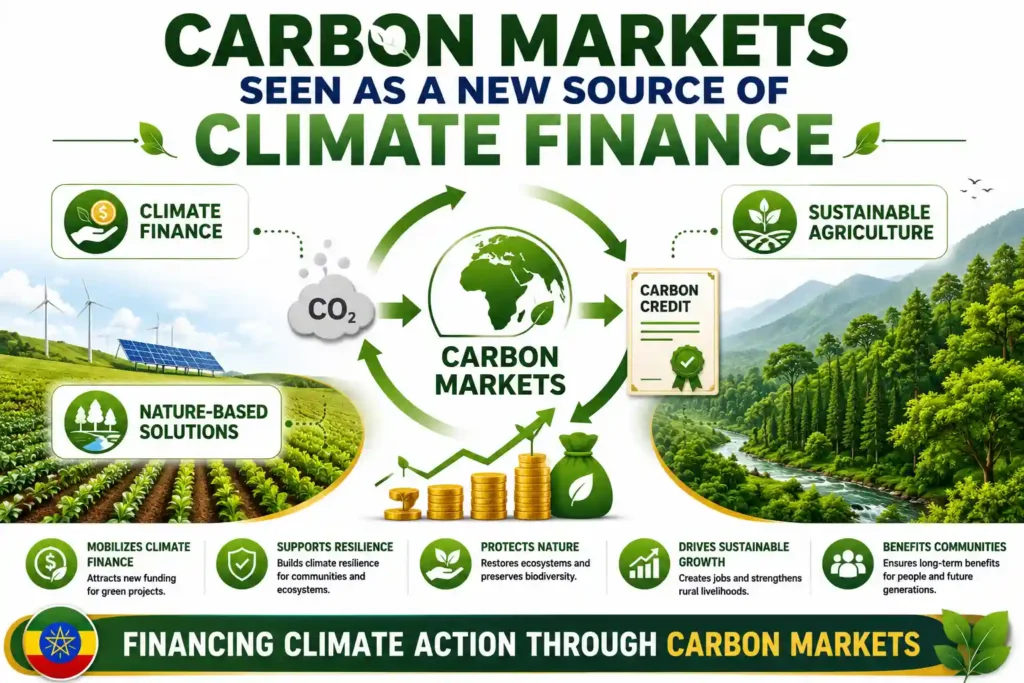
The seminar comes as Ethiopia seeks innovative financing mechanisms to address the growing impacts of climate change on agriculture, natural resources, and rural livelihoods.
Opening the event, State Minister for Environment, Climate Change and Demography at the Ministry of Planning and Development, Seyoum Mekonnen, said climate change remains one of the development challenges affecting Ethiopia’s agricultural productivity, natural resource base, and rural livelihoods.
He stressed the importance of integrating climate action into Ethiopia’s broader development agenda, noting that the country’s diverse landscapes and agricultural systems present significant opportunities for climate mitigation and adaptation through sustainable land management, ecosystem restoration, agroforestry, and climate-smart agriculture.
Officials said well-governed carbon markets could mobilize additional climate finance while supporting long-term environmental sustainability and rural economic development.
Supporting Agricultural Transformation
State Minister for Natural Resources Development at the Ministry of Agriculture, Prof. Eyasu Elias, said carbon markets could become an innovative financing mechanism for Ethiopia’s agricultural transformation.
According to him, carbon finance can help promote sustainable farming practices, improve soil health, restore degraded landscapes, strengthen climate resilience, and create additional income opportunities for farming communities.
He added that Ethiopia’s Green Legacy Initiative (GLI) has evolved beyond a tree-planting campaign into a nationwide programme supporting landscape restoration, biodiversity conservation, climate resilience, ecosystem rehabilitation, and food security.
Prof. Eyasu said the initiative provides a strong foundation for expanding nature-based climate solutions while enabling Ethiopia to participate responsibly in international carbon markets.
He also noted that Ethiopia has already established much of the groundwork required to engage in global carbon trading and that the next priority is transforming these achievements into scientifically verified climate assets capable of generating long-term benefits for local communities.
Governance and Research Remain Key Priorities
The seminar featured technical presentations examining Ethiopia’s experience with forestry carbon markets as well as discussions on the country’s legal, policy, and institutional frameworks governing carbon market development.
Participants explored issues including carbon accounting, governance, market preparedness, research priorities, and strategies for maximising the contribution of carbon markets to sustainable development.
The discussions emphasized the importance of maintaining transparency, strong governance, environmental integrity, and effective institutional coordination as Ethiopia develops its carbon market framework.
Context is everything. Stay ahead of shifting trends with today’s market updates, and uncover emerging opportunities using the Serrari Group Market Index and Marketplace. Then, take control of your own financial future by exploring our Money & Life Reset Transformation Blueprint ™ to build stronger habits, create better systems, and design a path toward lasting wealth.
Evidence-Based Policy Development
ATI Chief Executive Officer Dr. Mandefro Nigussie highlighted the importance of evidence-based dialogue and stronger collaboration among government institutions, research organisations, development partners, and the private sector.
He said coordinated efforts would be essential for advancing Ethiopia’s climate resilience and agricultural transformation agenda while ensuring that carbon markets deliver meaningful environmental and economic benefits.
Similarly, participants noted that stronger scientific research and knowledge sharing will play an important role in helping Ethiopia design effective carbon market policies and attract climate finance.
Participants Call for Stronger Institutional Capacity
Closing the seminar, Ethiopian Academy of Sciences President Prof. Belay Kassa underscored the critical role of science, research and innovation in guiding Ethiopia’s participation in emerging climate finance mechanisms.
Participants concluded the event by reaffirming their commitment to strengthening research, improving policy coordination, enhancing institutional capacity, and promoting knowledge sharing to ensure carbon markets effectively support sustainable agricultural development, climate resilience, and inclusive rural transformation.
The organisers noted that the Agriculture Science Seminar Series will continue serving as a platform for evidence-based dialogue on agricultural development and climate policy through collaboration between the Ministry of Agriculture, ATI, and the Ethiopian Academy of Sciences.
Outlook
Ethiopia’s growing interest in carbon markets reflects the country’s broader efforts to mobilize innovative climate finance while strengthening sustainable agriculture and rural development. As global demand for high-quality carbon credits continues to expand, well-designed governance frameworks, scientific research, and institutional coordination will be critical to ensuring carbon markets deliver long-term environmental, economic, and social benefits. By building on initiatives such as the Green Legacy Initiative and strengthening collaboration among government, researchers, and development partners, Ethiopia is positioning itself to leverage carbon finance as a tool for climate resilience, agricultural transformation, and sustainable economic growth.
FAQs
1. Why is Ethiopia exploring carbon markets?
Ethiopia is exploring carbon markets to attract climate finance, strengthen sustainable agriculture, improve climate resilience, and support rural transformation.
2. What was discussed during the seminar?
Participants discussed carbon market opportunities, governance, carbon accounting, policy frameworks, research priorities, and strategies to maximize sustainable development benefits.
3. How do carbon markets support agriculture?
Carbon markets can finance sustainable farming practices, ecosystem restoration, climate-smart agriculture, improved soil health, and additional income opportunities for farming communities.
4. What role does the Green Legacy Initiative play?
The Green Legacy Initiative provides a strong foundation for nature-based climate solutions by supporting landscape restoration, biodiversity conservation, climate resilience, and Ethiopia’s future participation in international carbon markets.
Sources: Farmers Review Africa, Fana Media Corporation S.C, ENA English
Your financial future isn’t something you wait for—it’s something you build.
The real question is: when do you begin?
Move beyond simply staying informed.
Navigate the markets with clarity—track trends through the Serrari Group Market Index, uncover opportunities in the Serrari Marketplace, and build practical knowledge with our Curated Wealth Builder Platform.
Stay connected to what truly matters.
Get daily insights on macro trends and financial movements across Kenya, Africa, and global markets—delivered through the Serrari Newsletter.
Growth opens doors.
Advance your career through professional programs including ACCA, HESI A2, ATI TEAS 7 , HESI EXIT , NCLEX – RN and NCLEX – PN, Financial Literacy!🌟—designed to move you forward with confidence.
See where money is flowing—clearly and in real time.
Track Money Market Funds, Treasury Bills, Treasury Bonds, Green Bonds, and Fixed Deposits, alongside global and African indexes, key economic indicators, and the evolving Crypto and stablecoin landscape—all within Serrari’s Market Index.