
















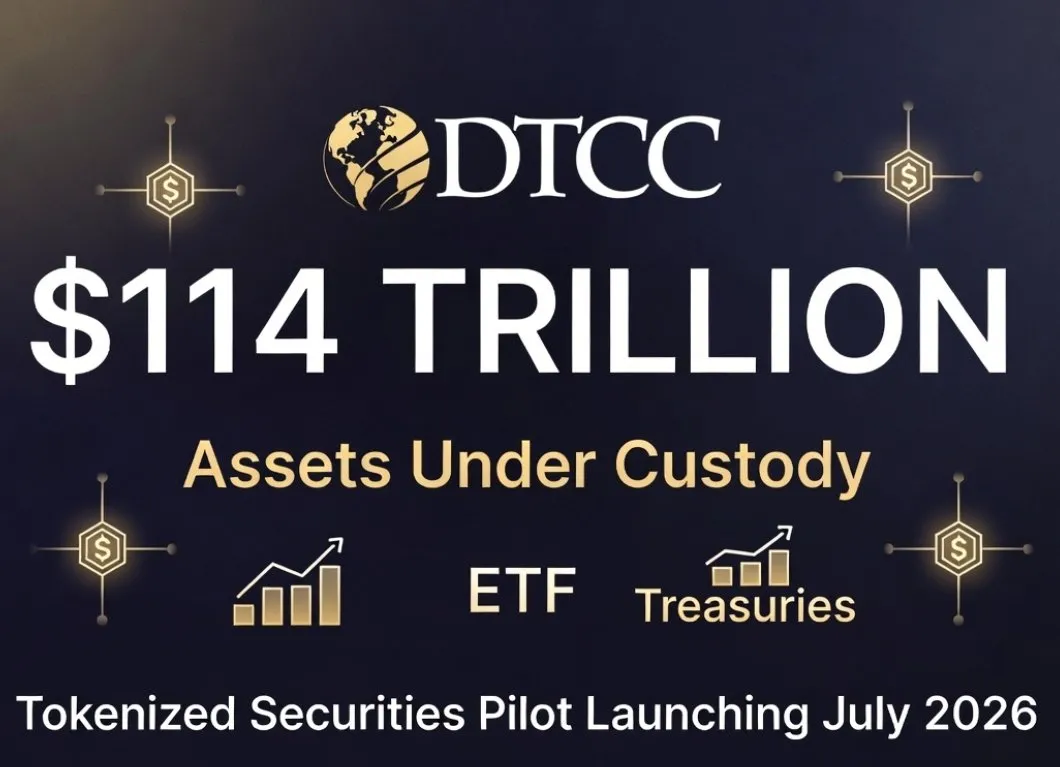
The global financial system is approaching what could become one of the most significant transitions in modern market infrastructure: the tokenization of traditional securities at institutional scale. The Depository Trust & Clearing Corporation (DTCC), through its subsidiary the Depository Trust Company (DTC), is preparing to launch the first phase of a tokenization service that could eventually connect blockchain infrastructure to more than $114 trillion in custodial assets.
Backed by regulatory approval from the U.S. Securities and Exchange Commission and developed alongside more than 50 institutions from traditional finance and decentralized finance, the initiative represents a major shift in how securities may be settled, transferred, and managed in the future.
The launch comes as the tokenized real-world asset market continues to expand rapidly, growing from a niche blockchain category into one of the fastest-growing segments of digital finance. While the market currently stands at around $25 billion, the potential integration of even a small portion of DTC’s custodial base could transform the scale of tokenized finance globally.
Key Overview
The DTCC plans to launch the first limited phase of its tokenization service in July 2026, with full deployment expected in October. The initiative follows SEC approval granted in December 2025 under a three-year pilot program allowing tokenized processing for highly liquid assets including Russell 1000 components, ETFs tracking major indices, and U.S. Treasuries.
The DTC currently provides custody for more than $114 trillion in assets across the United States and over 131 countries and territories. By comparison, the tokenized real-world asset market is valued at approximately $25 billion, highlighting the enormous scale gap and long-term opportunity for blockchain-based financial infrastructure.
Markets move fast; don’t get left behind. We’ve paired the Serrari Group Market Index with a curated Marketplace and a comprehensive Wealth Builder Platform to ensure you have the data—and the skills—to act on it.
DTCC Brings Tokenization Into the Core of Global Finance
The involvement of the Depository Trust & Clearing Corporation fundamentally changes the narrative around tokenization.
For years, blockchain-based finance was largely associated with crypto-native startups, decentralized exchanges, and speculative digital assets. Institutional participation existed, but most projects remained limited in scale or confined to pilot programs.
The DTCC’s entry represents something different entirely. The organization operates at the center of global capital markets infrastructure. Its systems underpin the clearing, settlement, and custody of enormous volumes of financial assets every day.
Its subsidiary, the DTC, provides book-entry custody for more than $114 trillion in assets. These include municipal bonds, corporate bonds, equities, money market instruments, and securities tied to markets in over 131 countries and territories.
This means the discussion around tokenization is no longer hypothetical. It is now connected directly to the infrastructure supporting the global financial system itself.
Understanding the Importance of DTC Custody Infrastructure
The Depository Trust Company plays a central role in how modern financial markets function. Rather than investors physically holding paper certificates representing ownership, the DTC maintains electronic records of securities ownership through centralized book-entry systems.
This infrastructure enables efficient settlement and custody across trillions of dollars in daily market activity.
Because of its systemic importance, any technological shift involving the DTC has implications far beyond individual firms or blockchain projects. It potentially affects the mechanics of settlement, liquidity, collateral management, and asset transfer across the entire financial ecosystem.
The scale involved is staggering. The tokenized real-world asset market currently stands at roughly $25 billion. Against a custodial base exceeding $114 trillion, this market remains tiny by comparison.
Yet this gap is exactly what makes the DTCC initiative so important.
SEC Approval Removes a Critical Roadblock
Regulatory uncertainty has long been one of the biggest barriers preventing institutional adoption of tokenized securities.
That changed significantly in December 2025 when the SEC granted the DTCC a three-year pilot authorization allowing tokenized processing for a defined group of highly liquid assets.
These include components of the Russell 1000 Index, exchange-traded funds tied to major U.S. indices, and various Treasury securities including bills, bonds, and notes.
The significance of this approval extends beyond the assets themselves. The SEC’s authorization effectively creates a framework in which tokenized securities can receive the same protections, ownership rights, and legal recognition as traditionally custodian assets.
This addresses one of the biggest institutional concerns surrounding blockchain finance: legal certainty.
For large financial institutions, operational efficiency alone is not enough. Regulatory clarity and enforceable ownership rights are essential.
Why the July 2026 Launch Matters
The first production phase of the tokenization service is expected to begin in July 2026, with broader rollout planned for October.
This timeline is important because it marks the transition from experimentation into live operational infrastructure.
Many blockchain projects in traditional finance have remained stuck in testing phases for years. Institutions often experimented internally without deploying systems into active market environments.
The DTCC’s phased rollout changes that dynamic. Production trading activity introduces real-world settlement workflows, operational testing, and institutional coordination at scale.
The launch is also strategically structured. By focusing first on highly liquid assets, the DTCC reduces complexity while maximizing market relevance.
Liquid securities tend to have standardized structures, active trading volumes, and established pricing mechanisms, making them ideal candidates for tokenization pilots.
The Collaboration Between Traditional Finance and DeFi
One of the most notable aspects of the initiative is the composition of the DTCC Industry Working Group.
The group includes more than 50 custodians, asset managers, broker-dealers, and infrastructure providers spanning both traditional finance and decentralized finance ecosystems.
This collaboration reflects a broader convergence occurring within financial markets.
Traditional institutions bring scale, regulation, and operational expertise. DeFi participants contribute blockchain-native innovation and decentralized infrastructure design.
Historically, these sectors often viewed each other as competitors. Increasingly, however, institutions are recognizing that blockchain technology may enhance rather than replace traditional systems.
The working group’s focus on standards alignment and workflow preparation highlights how important interoperability will be for future adoption.
Real-World Assets Become One of Crypto’s Fastest-Growing Segments
The tokenized real-world asset market has expanded significantly since 2022.
According to DefiLlama, the sector was valued at around $25 billion as of May 2026, with particularly strong acceleration during 2024 and 2025.
This growth reflects increasing institutional interest in bringing traditional financial products onto blockchain rails.
Within the market, bonds account for the largest share at more than $15 billion. Precious metals represent roughly $5.6 billion, while private credit stands at $2.6 billion.
Public equities remain relatively small at approximately $838 million, with additional value spread across digital assets and other tokenized categories.
The dominance of bonds is not surprising. Fixed-income products are generally easier to standardize and integrate into settlement systems than more complex equity structures.
Context is everything. While you follow today’s updates, use the Serrari Group Market Index and Marketplace to spot emerging shifts. Need to sharpen your edge? Our Wealth Builder Platform turns these insights into a professional-grade strategy.
The Liquidity Opportunity Is Far Larger Than the Market Today
The most important point about tokenization may not be the current size of the RWA market, but the scale of capital that could eventually move through tokenized infrastructure.
The DTC’s $114 trillion custodial base represents one of the largest concentrations of financial assets in the world.
Even if only a fraction of these assets transition into tokenized settlement systems, the impact on market liquidity and infrastructure could be enormous.
This is why many analysts view tokenization as an infrastructure transformation rather than simply another crypto trend.
The opportunity is not defined by today’s $25 billion market. It is defined by the possibility of integrating blockchain technology into existing capital markets.
Settlement Speed Could Become a Major Advantage
One of the strongest arguments for tokenization involves settlement efficiency.
Traditional securities markets often operate on settlement cycles that can take multiple business days. Blockchain-based systems could potentially support much faster settlement, including near-instant or continuous settlement models.
This could reduce counterparty risk, lower operational costs, and improve capital efficiency.
Faster settlement may also improve liquidity by reducing the amount of collateral and capital tied up during transaction processing.
In addition, blockchain systems can theoretically operate around the clock, introducing the possibility of 24/7 market connectivity.
Stablecoins Still Seen as the Immediate Winner
Despite the excitement around tokenized securities, some analysts remain cautious about near-term practical benefits.
David Easthope, senior analyst and head of fintech research at Coalition Greenwich, argued that stablecoins currently offer a more immediate value proposition than tokenized securities.
According to Easthope, CFOs and corporate treasurers may not see material benefits from tokenized securities for some time because the technology remains relatively early in its adoption cycle.
This distinction is important.
Stablecoins already support payments, transfers, and liquidity management at scale. Their use cases are immediate and operationally straightforward.
Tokenized securities, by contrast, require integration with legal, custodial, and settlement systems that are deeply embedded within global finance.
DTCC Expands Blockchain Presence Through Canton Network
In a related development, the DTCC became a Super Validator on the Canton Network after the implementation of Canton Improvement Proposal CIP-0083.
Validator roles are important because they help secure and govern blockchain networks.
This move signals that the DTCC is not merely observing blockchain infrastructure from the sidelines. It is actively participating in governance and operational frameworks within institutional blockchain ecosystems.
That level of involvement suggests the organization sees blockchain as strategically important to the future of financial market infrastructure.
Why This Could Reshape Global Capital Markets
The DTCC’s tokenization initiative has implications extending far beyond crypto markets.
If successful, it could encourage broader institutional adoption of blockchain settlement systems across equities, bonds, money markets, and other financial products.
It may also accelerate regulatory frameworks globally as policymakers observe operational models emerging in U.S. markets.
Importantly, the initiative reinforces a growing reality within digital finance: the next major phase of blockchain adoption may be driven less by speculative crypto trading and more by institutional infrastructure modernization.
Final Takeaway
The DTCC’s planned rollout of tokenized securities infrastructure represents one of the most consequential institutional blockchain developments to date.
Backed by SEC approval, integrated with a custodial network exceeding $114 trillion, and supported by major financial institutions, the initiative moves tokenization from experimental finance into the operational core of global capital markets.
While the current tokenized real-world asset market remains relatively small at around $25 billion, the scale of traditional assets connected to DTC infrastructure highlights the magnitude of the long-term opportunity.
Questions remain around adoption speed, operational benefits, and market integration. However, the July 2026 launch signals that tokenization is no longer just a future possibility—it is becoming part of the evolving architecture of modern finance.
Your financial future isn’t something you wait for, it’s something you build.
The real question is: when do you begin?
Move beyond simply staying informed.
Navigate the markets with clarity—track trends through the Serrari Group Market Index, uncover opportunities in the Serrari Marketplace, and build practical knowledge with our Curated Wealth Builder Platform.
Stay connected to what truly matters.
Get daily insights on macro trends and financial movements across Kenya, Africa, and global markets—delivered through the Serrari Newsletter.
Growth opens doors.
Advance your career through professional programs includingACCA,HESI A2,ATI TEAS 7,HESI EXIT ,NCLEX – RNandNCLEX – PN,Financial Literacy!🌟—designed to move you forward with confidence.
See where money is flowing—clearly and in real time.
Track Money Market Funds, Treasury Bills, Treasury Bonds, Green Bonds, and Fixed Deposits, alongside global and African indexes, key economic indicators, and the evolving Crypto and stablecoin landscape—all withinSerrari’s Market Index.