
Kenya’s Finance Bill 2026 proposes a series of new taxes and regulatory requirements targeting cryptocurrency companies, digital payment providers, and financial technology firms. The measures include a 10% excise duty on Virtual Asset Service Providers (VASPs), substantial licensing fees, and mandatory reporting requirements. While the government aims to strengthen regulation and boost tax revenues, industry participants warn the proposals could increase operating costs and reduce Kenya’s competitiveness as a regional digital finance hub.
Key Overview
- Kenya proposes a 10% excise duty on crypto service providers.
- The proposed tax is double the 5% rate applied to betting firms.
- Crypto companies would pay a KSh 150 million licensing fee.
- Annual renewal fees would be set at KSh 2 million.
- VASPs would be required to submit user and transaction data to KRA.
- Additional taxes target digital payments and fintech services.
- Industry participants warn of potential capital and talent flight.
- Protests have resumed over concerns about rising taxation.
Kenya Targets Crypto Sector with New Tax Measures

Kenya’s government has unveiled a series of tax and regulatory proposals that could significantly reshape the country’s cryptocurrency and digital finance landscape.
Under the Finance Bill 2026, Virtual Asset Service Providers (VASPs), including cryptocurrency exchanges and trading platforms, would face a new 10% excise duty on fees charged for crypto-related services. The proposal forms part of a broader effort by authorities to increase tax revenues from rapidly growing digital sectors.
The proposed tax rate has attracted attention because it is twice the 5% excise duty currently imposed on Kenya’s betting industry. Industry observers argue that the move signals a tougher regulatory approach toward digital assets as the government seeks greater oversight of the sector.
Kenya has emerged as one of Africa’s leading digital economies, with growing adoption of cryptocurrencies, mobile payments, and fintech solutions. The proposed measures therefore have implications not only for crypto businesses but also for the country’s broader technology ecosystem.
Licensing Costs Could Raise Barriers to Entry
Beyond the new excise duty, the proposed legislation introduces significant licensing requirements for crypto businesses seeking to operate in Kenya.
The Virtual Asset Service Providers framework would require firms to pay a one-time licensing fee of KSh 150 million (approximately $1.1 million) before commencing operations. In addition, licensed operators would be required to pay an annual renewal fee of KSh 2 million.
Supporters of the proposal argue that licensing requirements could improve consumer protection by ensuring only well-capitalized and compliant firms enter the market.
However, critics contend that the high costs could create barriers for startups and emerging fintech companies, potentially reducing competition and innovation within Kenya’s digital asset sector.
Smaller firms may struggle to meet the financial requirements, leaving the market dominated by a limited number of large players capable of absorbing the costs.
Mandatory Reporting Requirements Increase Oversight
The Finance Bill also seeks to strengthen regulatory oversight through enhanced reporting obligations.
Under the proposed framework, crypto exchanges and other VASPs would be required to submit annual reports to the Kenya Revenue Authority (KRA) containing information about users and transaction activities.
The reporting requirements are designed to improve tax compliance, increase transparency, and help authorities monitor financial activity within the digital asset ecosystem.
Governments around the world have increasingly introduced similar reporting standards as cryptocurrency adoption continues to expand. Regulators argue that such measures are necessary to combat tax evasion, money laundering, and other illicit financial activities.
Nevertheless, privacy advocates and some industry participants have raised concerns about the collection and storage of sensitive user information.
Additional Taxes Target Digital Payments
The Finance Bill’s impact extends beyond cryptocurrency businesses.
Several new tax proposals target digital payment systems and financial technology services, potentially affecting a broad range of consumers and businesses.
Among the proposed measures is a 5% withholding tax on local card transactions and a 20% withholding tax on non-resident card transactions. Certain digital payment services offered by fintech firms would also become subject to a 16% Value Added Tax (VAT).
Additionally, payment gateway services may be classified as royalties under the new framework. If adopted, payments made to foreign payment service providers could become subject to a 20% withholding tax.
The proposals reflect the government’s growing focus on taxing digital economic activity as more transactions move online.
Dividend Tax Changes and Lending Provisions
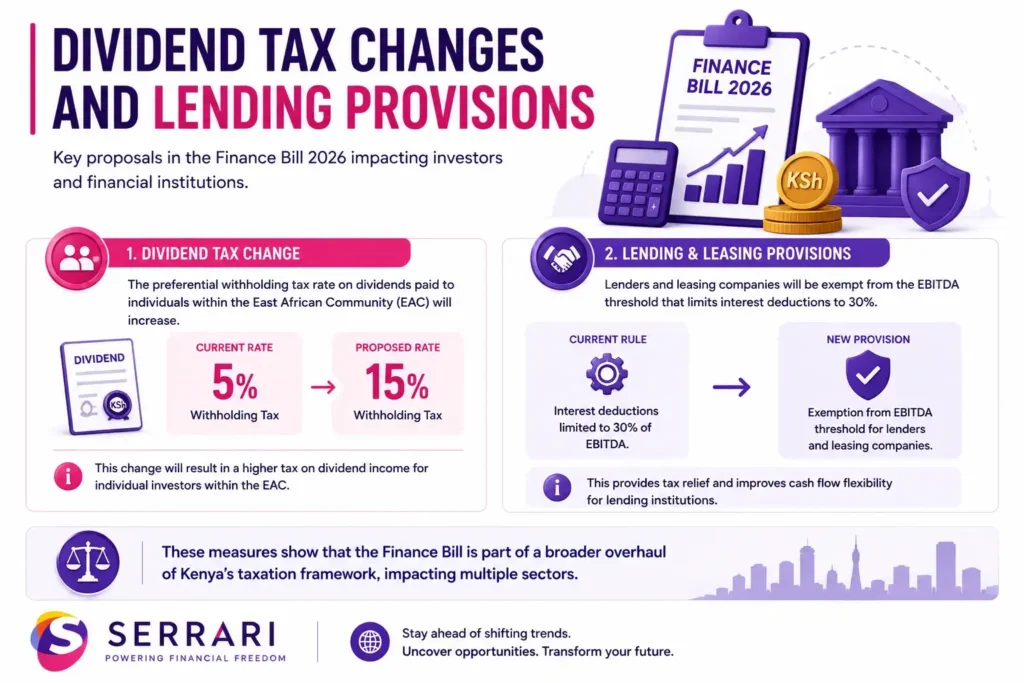
The Finance Bill also includes changes affecting investors and financial institutions.
A preferential 5% withholding tax rate currently applied to dividends paid to individuals within the East African Community would be replaced with a higher 15% withholding tax.
Meanwhile, lenders and leasing companies would receive relief through an exemption from the Earnings Before Interest, Taxes, Depreciation, and Amortization (EBITDA) threshold that limits interest deductions to 30%.
These measures indicate that the Finance Bill is not solely focused on digital assets but forms part of a broader overhaul of Kenya’s taxation framework.
Industry Concerns Over Competitiveness
Industry participants have expressed concerns that the proposed measures could undermine Kenya’s position as one of Africa’s leading digital innovation hubs.
Kenya has built a strong reputation for financial technology adoption, driven largely by mobile money platforms, digital banking services, and increasing cryptocurrency usage.
Critics argue that imposing a 10% excise duty alongside substantial licensing fees could increase operational costs significantly. Companies may choose to pass those costs on to consumers through higher transaction fees, potentially reducing adoption and market activity.
Others warn that some crypto firms could consider relocating operations to jurisdictions with more favorable regulatory environments and lower tax burdens.
Such a shift could reduce investment, innovation, and job creation within Kenya’s growing digital economy.
Public Protests Add Pressure
The tax proposals have emerged amid renewed public demonstrations in several parts of the country, including Nairobi.
Many protesters, particularly younger Kenyans, have voiced concerns about the rising tax burden affecting digital services, mobile transactions, financial services, and cryptocurrencies.
The demonstrations reflect broader debates over taxation, economic growth, and the balance between government revenue collection and support for innovation.
As lawmakers review the Finance Bill, public sentiment and industry feedback are expected to play a significant role in shaping the final legislation.
Why This Matters
The Finance Bill 2026 represents one of the most significant regulatory and taxation changes proposed for Kenya’s digital economy in recent years.
For cryptocurrency firms, the combination of a 10% excise duty, KSh 150 million licensing fee, annual renewal costs, and mandatory reporting requirements could substantially increase the cost of doing business. These measures may influence investment decisions and determine whether Kenya remains an attractive destination for digital asset companies.
For consumers, higher compliance and operational costs could ultimately translate into increased transaction fees and reduced access to digital financial services.
More broadly, the proposals highlight the challenge governments face in balancing tax collection, investor protection, and innovation. As Kenya continues to position itself as a regional technology and fintech leader, the outcome of the Finance Bill could shape the future of the country’s crypto and digital finance ecosystem for years to come.
Sources: Weex, Binance Square, Bidget, Kucoin
Your financial future isn’t something you wait for—it’s something you build.
The real question is: when do you begin?
Move beyond simply staying informed.
Navigate the markets with clarity—track trends through the Serrari Group Market Index, uncover opportunities in the Serrari Marketplace, and build practical knowledge with our Curated Wealth Builder Platform.
Stay connected to what truly matters.
Get daily insights on macro trends and financial movements across Kenya, Africa, and global markets—delivered through the Serrari Newsletter.
Growth opens doors.
Advance your career through professional programs including ACCA, HESI A2, ATI TEAS 7 , HESI EXIT , NCLEX – RN and NCLEX – PN, Financial Literacy!🌟—designed to move you forward with confidence.
See where money is flowing—clearly and in real time.
Track Money Market Funds, Treasury Bills, Treasury Bonds, Green Bonds, and Fixed Deposits, alongside global and African indexes, key economic indicators, and the evolving Crypto and stablecoin landscape—all within Serrari’s Market Index.