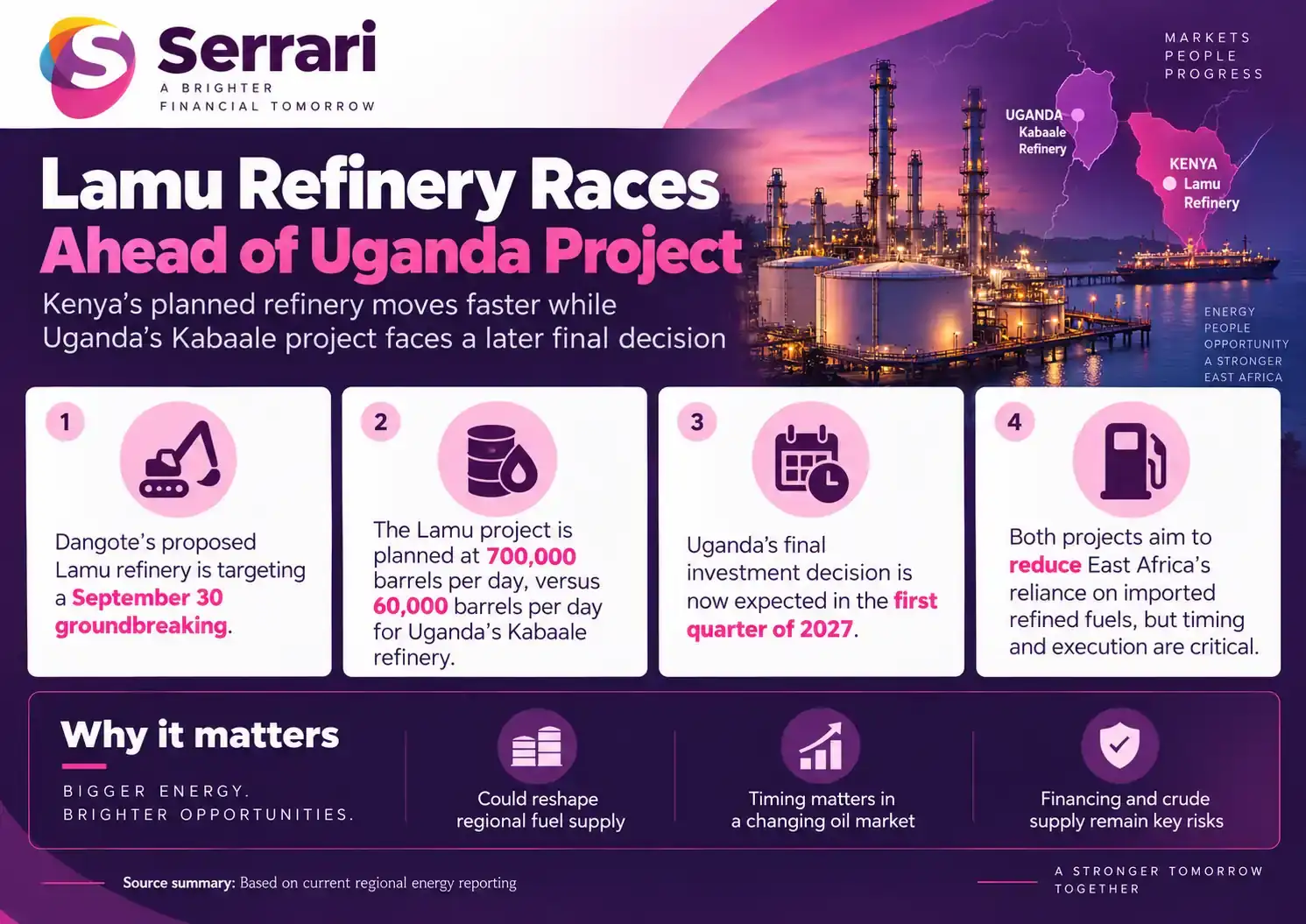
Dangote Group’s planned 700,000-barrel-per-day refinery in Lamu is moving toward a September 30 groundbreaking, potentially giving Kenya a major head start over Uganda’s long-delayed 60,000-barrel-per-day Kabaale refinery.
The Kenyan project, now estimated at roughly $15–16 billion, is designed to supply Kenya and neighbouring East African markets while reducing dependence on imported refined petroleum products. Uganda’s refinery remains in pre-construction development, with its final investment decision now expected in the first quarter of 2027.
The timing matters because both projects are entering an energy market increasingly shaped by electric vehicles, changing oil demand and pressure for lower-carbon transport.
Key Overview
- Dangote plans to break ground on the Lamu refinery on September 30, 2026.
- The proposed plant would process about 700,000 barrels of crude oil per day.
- Current estimates put the Kenyan project at roughly $15–16 billion.
- Uganda’s Kabaale refinery is designed for 60,000 barrels per day and is estimated at about $4 billion.
- Uganda’s final investment decision has shifted to the first quarter of 2027.
- Both projects could reduce East Africa’s dependence on imported refined fuels, but financing, crude supply and execution remain major risks.
Lamu Moves Toward Construction
Dangote has set September 30, 2026, for the groundbreaking of the Lamu facility, which would become East Africa’s largest refinery if completed as planned.
The proposed plant would have capacity of about 700,000 barrels per day, while current estimates place the project cost at roughly $15–16 billion and commissioning around 2030.
Dangote intends to use a combination of internal cash, bonds and equity financing to fund the development. Preparatory work including site selection, soil testing and engineering has already begun as the company works toward construction.
The refinery is planned for the LAPSSET special economic zone in Lamu. Its coastal location would provide access to seaborne crude supplies and export routes while placing it within reach of markets across Kenya, Ethiopia, South Sudan, Somalia and the wider East African region.
Uganda’s Kabaale Project Faces Another Delay
Uganda’s Kabaale refinery has followed a much slower path.
The project is designed to process 60,000 barrels per day and is estimated to require roughly $4 billion. UAE-based Alpha MBM Investments holds a 60% stake in the planned refinery, while Uganda National Oil Company holds the remaining 40%.
Uganda’s final investment decision is now expected in the first quarter of 2027, subject to completion of Front-End Engineering Design studies, early works, commercial agreements and regulatory approvals.
That schedule puts Kabaale behind Lamu before construction has even started.
Uganda is nevertheless progressing with the wider infrastructure needed to commercialise its crude resources. By the end of August, the East African Crude Oil Pipeline had reached 92.7% overall completion, moving the country closer to exporting oil through Tanzania.
Context is everything. Stay ahead of shifting trends with today’s market updates, and uncover emerging opportunities using the Serrari Group Market Index and Marketplace. Then, take control of your own financial future by exploring our Money & Life Reset Transformation Blueprint ™ to build stronger habits, create better systems, and design a path toward lasting wealth.
Different Refineries, Different Strategic Advantages
The two refineries would not necessarily serve identical markets.
Lamu is being positioned as a large regional processing and export hub. Its coastal location gives it easier access to internationally traded crude and maritime routes, while its scale could allow it to serve several East African economies.
Kabaale has a different advantage: proximity to Uganda’s own crude reserves. Refining Ugandan oil domestically could lower exposure to imported fuel costs and the expense of moving finished petroleum products inland from the coast.
Uganda currently relies heavily on imported petroleum products, while Kenya also depends on imported finished fuel after ending refining operations at its former Mombasa facility. Official petroleum information shows that Kenya imports essentially all of its petroleum requirements, creating a substantial potential domestic market for Lamu.
Crude Supply Could Be Lamu’s Biggest Challenge
Scale alone does not guarantee commercial success.
Unlike Uganda, Kenya currently lacks commercial crude production capable of feeding a 700,000-barrel-per-day refinery. Potential regional sources include Uganda and South Sudan, but infrastructure constraints mean the facility may initially have to depend heavily on seaborne imports.
That leaves Lamu exposed to international crude prices, freight costs and supply disruptions. The project will also require major supporting infrastructure, including storage and logistics capacity around the LAPSSET zone.
Uganda’s Kabaale refinery, by comparison, would have easier access to domestic feedstock once the country’s oil fields reach full commercial production.
For Lamu, securing dependable crude supplies and completing the surrounding infrastructure may therefore be as important as financing and constructing the refinery itself.
The Race Comes as Oil Demand Is Changing
Both projects are being developed against a rapidly shifting global energy backdrop.
Electric vehicles are already cutting petrol and diesel consumption in major markets. In China alone, EVs were estimated to have displaced about 36 million tonnes of oil during the first half of 2026.
That does not mean East African fuel demand will disappear quickly. Population growth, expanding vehicle ownership, aviation, freight transport and industrial development could continue supporting regional petroleum consumption for years.
But delays increasingly matter. Refineries require huge upfront investment and long operating lives to generate returns, meaning investors must consider not only today’s demand but how transport and energy use could evolve through the 2030s.
For Kenya and Uganda, the contest is therefore about more than which refinery starts first. The decisive issue will be whether each project can secure financing, feedstock, infrastructure and regional demand quickly enough to remain commercially competitive in a changing global energy market.
Sources: Nation Media Group / Reuters / East African Crude Oil Pipeline / Uganda Investment Authority / Ministry of Energy and Mineral Development Uganda / Kenya Ministry of Energy and Petroleum / Carbon Brief
Your financial future isn’t something you wait for—it’s something you build.
The real question is: when do you begin?
Move beyond simply staying informed.
Navigate the markets with clarity—track trends through the Serrari Group Market Index, uncover opportunities in the Serrari Marketplace, and build practical knowledge with our Curated Wealth Builder Platform.
Stay connected to what truly matters.
Get daily insights on macro trends and financial movements across Kenya, Africa, and global markets—delivered through the Serrari Newsletter.
Growth opens doors.
Advance your career through professional programs including ACCA, HESI A2, ATI TEAS 7 , HESI EXIT , NCLEX – RN and NCLEX – PN, Financial Literacy!🌟—designed to move you forward with confidence.
See where money is flowing—clearly and in real time.
Track Money Market Funds, Treasury Bills, Treasury Bonds, Green Bonds, and Fixed Deposits, alongside global and African indexes, key economic indicators, and the evolving Crypto and stablecoin landscape—all within Serrari’s Market Index.