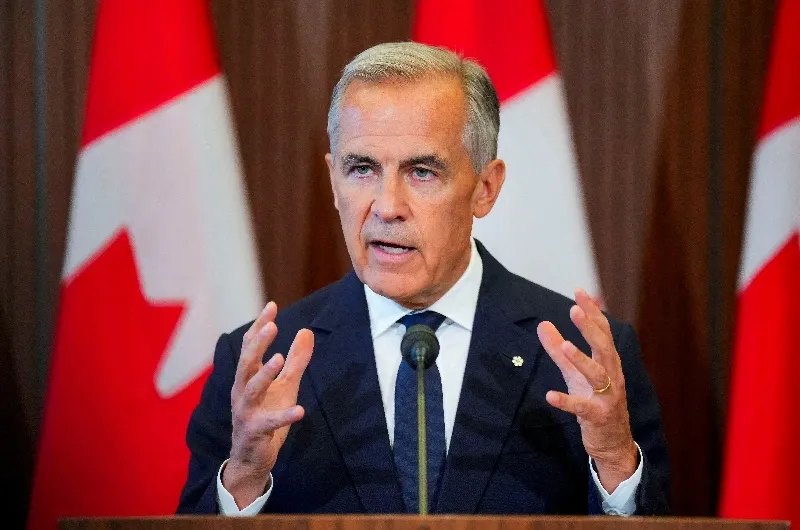
Canadian Prime Minister Mark Carney is making a major push to attract global capital as the country seeks to reduce its economic dependence on the United States and build new engines of growth.
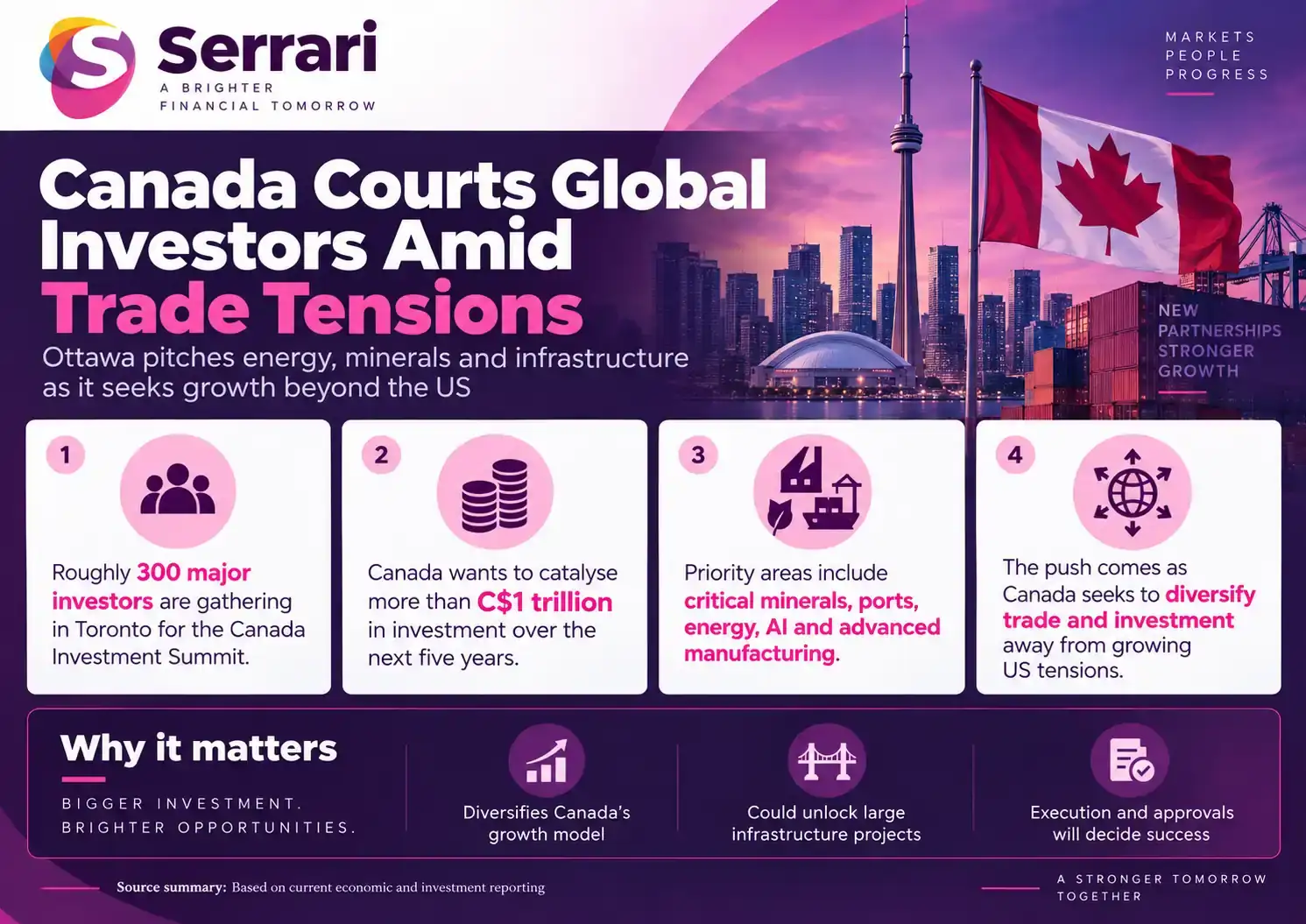
Hundreds of major investors, asset managers and executives have gathered in Toronto for the Canada Investment Summit on September 14 and 15, with participating institutions collectively overseeing more than $120 trillion in global assets. The meeting comes as an escalating trade dispute with Washington has increased pressure on Canada to diversify its markets, strengthen domestic infrastructure and accelerate large investment projects.
Key Overview
- Canada wants to catalyse more than C$1 trillion in total investment over the next five years.
- About C$280 billion in government capital investment and incentives is expected to help mobilise private and institutional funding.
- Energy, critical minerals, ports, artificial intelligence and advanced manufacturing are major investment priorities.
- Canada is increasingly seeking markets beyond the US as bilateral trade tensions deepen.
- Faster project approvals and improved regulatory certainty will be critical to converting investor interest into completed projects.
Carney Targets a C$1 Trillion Investment Wave
The Toronto summit forms part of a broader strategy to catalyse more than C$1 trillion in investment across Canada over the next five years.
Government capital investments and incentives supporting third parties are expected to total roughly C$280 billion over that period, with Ottawa hoping the public commitments will unlock significantly larger amounts of private and institutional capital.
The potential investment pipeline spans critical minerals, mining, energy infrastructure, ports, transport networks, artificial intelligence, advanced manufacturing and other strategically important industries.
Carney’s central argument is that Canada offers more than access to the US economy. It combines substantial natural resources, a highly skilled workforce, political stability and broad access to international markets.
Canadian companies currently benefit from free trade agreements covering 51 countries, giving them preferential access to markets representing around 1.5 billion consumers.
US Trade Conflict Accelerates Diversification
For decades, close access to the United States was one of Canada’s greatest investment advantages. That relationship remains economically crucial, with roughly 70% to 75% of Canadian goods exports having historically gone south of the border.
But the renewed trade conflict has exposed the risks of relying so heavily on one market.
Following the collapse of negotiations in August, Washington imposed 50% tariffs on around US$20 billion of Canadian imports, while Canada responded with retaliatory tariffs on a comparable value of American goods.
Ottawa’s countermeasures cover hundreds of US products with tariffs ranging from 15% to 50%, illustrating how rapidly the relationship between two historically integrated economies has deteriorated.
The dispute is giving greater urgency to Canada’s attempts to deepen commercial relationships with Europe, Asia and the Middle East while building infrastructure capable of moving Canadian resources to alternative markets.
Ports, pipelines, rail networks and other export infrastructure therefore play a central role in the investment strategy.
Context is everything. Stay ahead of shifting trends with today’s market updates, and uncover emerging opportunities using the Serrari Group Market Index and Marketplace. Then, take control of your own financial future by exploring our Money & Life Reset Transformation Blueprint ™ to build stronger habits, create better systems, and design a path toward lasting wealth.
Energy and Critical Minerals Lead the Opportunity
Much of Canada’s investment proposition is concentrated in sectors tied to its physical resources and productive capacity.
Mining and critical minerals are particularly important as governments and companies compete for secure supplies of materials used in batteries, defence equipment, semiconductors and clean technologies. Energy generation, electricity infrastructure and export projects are also prominent.
The investment drive extends beyond traditional resources. Artificial intelligence infrastructure, data centres, advanced manufacturing and transportation projects are being positioned as opportunities capable of improving productivity and diversifying the economy.
Major Canadian financial institutions are also mobilising capital around these themes, adding domestic financing capacity to Ottawa’s effort to bring foreign investment into large-scale projects.
Canada Must Prove It Can Build Faster
Attracting investors to Toronto is only the first step. Canada’s longer-running challenge has been moving projects from announcement through permitting, financing and construction.
Ottawa established the Major Projects Office to create a more coordinated pathway for strategically important developments and is pursuing a “one project, one review” system designed to reduce duplication between federal and provincial approval processes.
The government is also seeking to shorten federal review and decision-making timelines while maintaining environmental protections and consultation requirements.
For very large investments, authorities have introduced another incentive: requests for advance tax rulings involving projects worth at least C$1 billion can now receive expedited treatment, giving investors greater certainty about tax consequences before committing capital.
Investment Commitments Will Determine Success
The summit gives Canada an unusual opportunity to place hundreds of major global investors directly in front of government officials, corporate leaders and projects seeking financing.
However, attendance alone will not determine whether the strategy succeeds.
The more important measures will be how much capital investors ultimately commit, how quickly projects secure approvals, whether financing reaches construction and how effectively new infrastructure reduces Canada’s dependence on the US market.
Carney is effectively asking investors to view the current trade disruption not simply as a risk, but as the beginning of a major restructuring of the Canadian economy.
If Ottawa can translate its project pipeline, regulatory reforms and public investment into commercially viable developments, the US trade conflict could accelerate a broader shift toward a more diversified Canadian economy. If projects continue to face long delays, however, the scale of investor interest in Toronto may prove easier to generate than the investment itself.
Sources: Al Jazeera / Government of Canada / Reuters / Associated Press
Your financial future isn’t something you wait for—it’s something you build.
The real question is: when do you begin?
Move beyond simply staying informed.
Navigate the markets with clarity—track trends through the Serrari Group Market Index, uncover opportunities in the Serrari Marketplace, and build practical knowledge with our Curated Wealth Builder Platform.
Stay connected to what truly matters.
Get daily insights on macro trends and financial movements across Kenya, Africa, and global markets—delivered through the Serrari Newsletter.
Growth opens doors.
Advance your career through professional programs including ACCA, HESI A2, ATI TEAS 7 , HESI EXIT , NCLEX – RN and NCLEX – PN, Financial Literacy!🌟—designed to move you forward with confidence.
See where money is flowing—clearly and in real time.
Track Money Market Funds, Treasury Bills, Treasury Bonds, Green Bonds, and Fixed Deposits, alongside global and African indexes, key economic indicators, and the evolving Crypto and stablecoin landscape—all within Serrari’s Market Index.